Redis Cluster Infrastructure
We take full ownership of your Redis environment, from cluster sharding to persistence strategies, to ensure your caching layer remains fast and resilient under heavy production load.
Prevent data loss and downtime.











A Redis instance that works for a small app behaves differently when it holds terabytes of data. Most performance bottlenecks occur when Redis is treated as a simple key-value store without considering sharding, automatic failover, or disk persistence. These issues lead to cache crashes and data loss exactly when you need speed the most.
We build Redis infrastructure for extreme scale using three core principles. First, we implement Redis Cluster to shard data across multiple nodes, allowing your cache to grow to terabytes. Next, we use Redis Sentinel to provide high availability with automatic failover, ensuring the system stays online even if a server fails. Finally, we tune AOF and RDB persistence to balance high-speed performance with data safety, ensuring your information survives a restart without slowing down your application.
Client Results and Success

400M+ global payments processed annually
The system provides the scalability required to handle millions of transactions while maintaining data integrity and administrative control.
- Active Users in the UK, Canada, Europe, and Australia
- 120k+
- Global Payments Processed Annually
- 400M+
- Downloads Across iOS and Android
- 350k+

3x faster AI feature iteration
The modular backend architecture allowed the team to deploy new AI capabilities and personalized features significantly faster than industry benchmarks.
- Reduction in meal decision time
- 40%
- Increase in daily active usage during pilot
- 2x
- Faster iteration on new AI-driven features
- 3x
$57,000+ Annual Savings
The project achieved a 60% reduction in monthly cloud costs (from $8,100 to $3,300) without any loss in transaction speed or system security.
- Reduction in monthly cloud costs
- 60%
- Saved per month
- $4800
- Annual savings
- $57,000+
50% reduction in manual validation cycles
The integration of automated benchmarking frameworks and AI-driven process automation also resulted in 30% faster internal testing workflows.
- faster internal testing
- 30%
- reduction in manual validation
- 50%
Our Redis Cluster Infrastructure Capabilities
We scale your memory capacity horizontally. Using the Gossip Protocol and smart client routing, we distribute data across nodes so your application can handle massive traffic spikes without hitting a single-node memory ceiling.
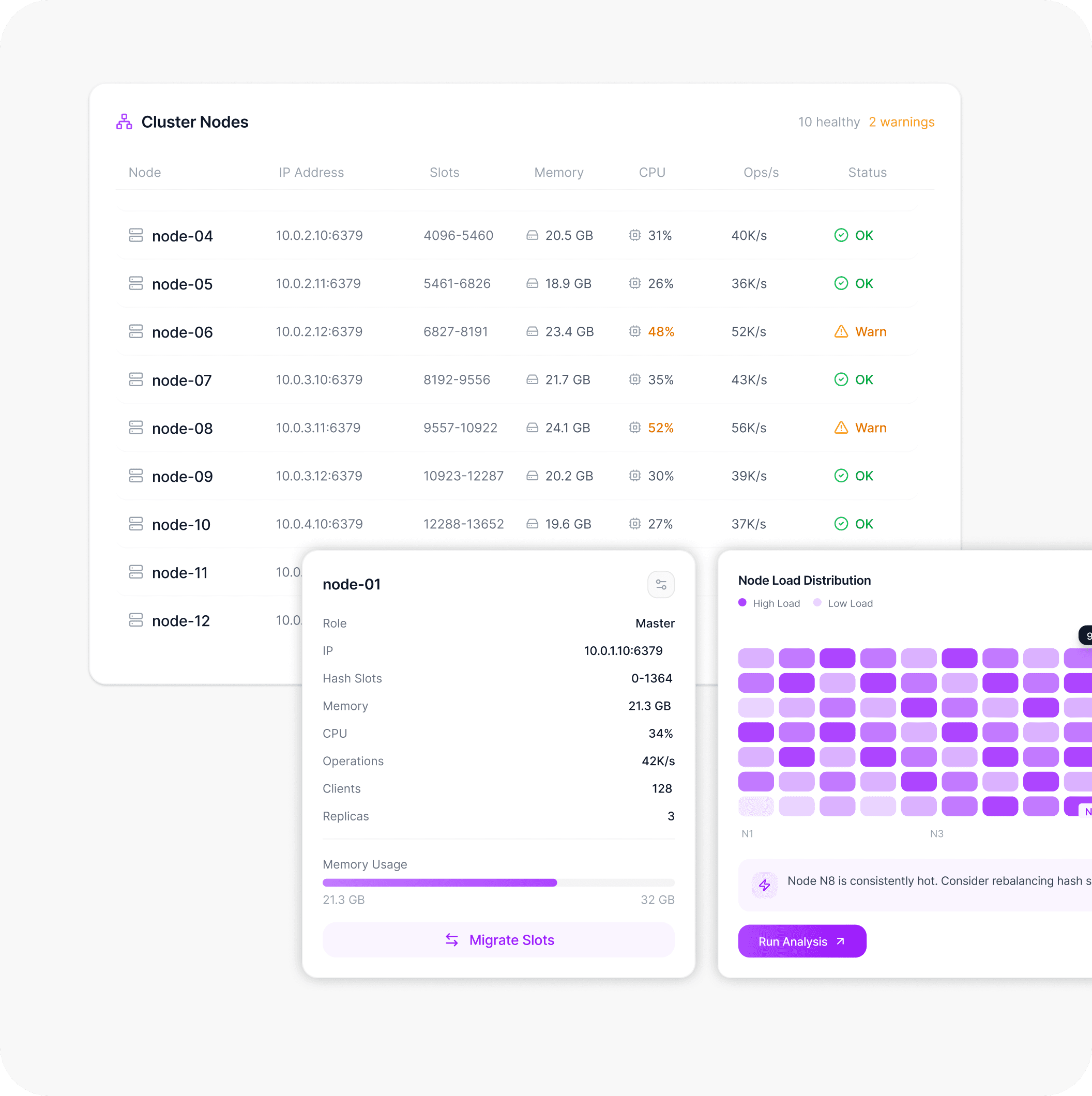
We deploy Redis Sentinel to monitor your nodes 24/7. If a master node fails, Sentinel automatically promotes a replica to take its place, ensuring your application never loses its connection to the cache.
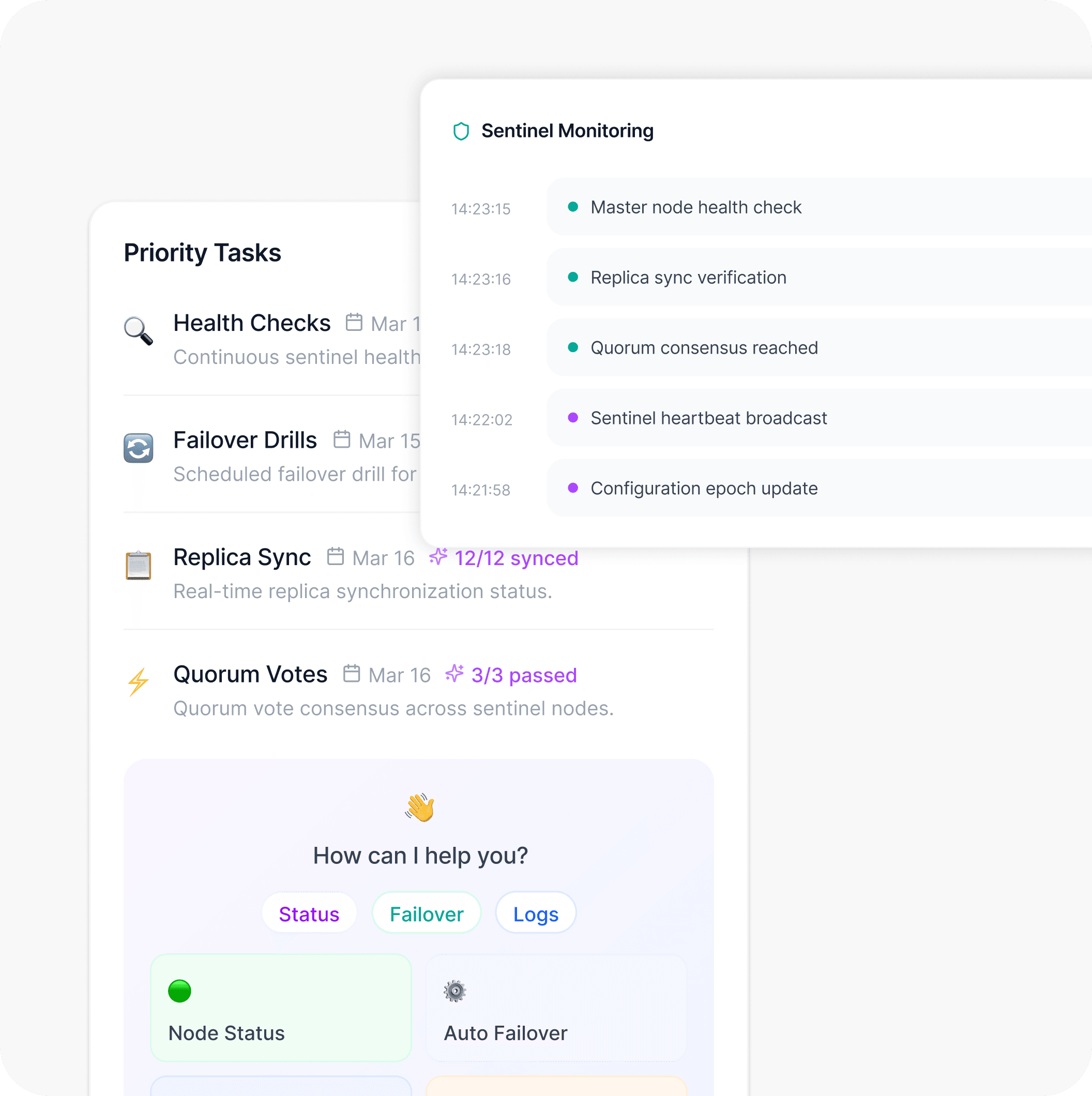
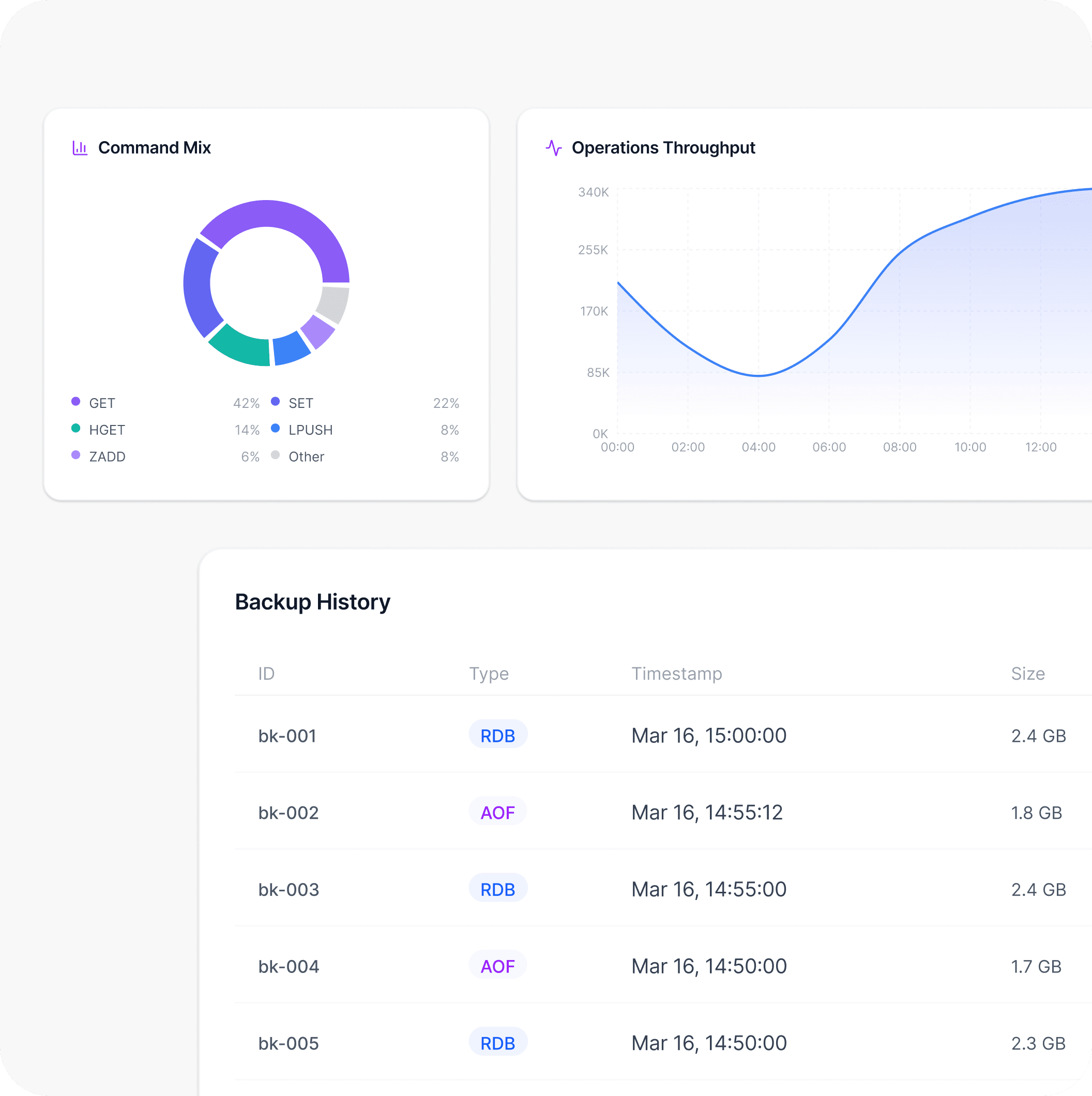
We configure the right balance between speed and safety. By tuning AOF rewrites and RDB snapshots, we ensure your data is backed up to the disk efficiently, preventing the "empty cache" problem after a reboot.
Complete Backend Engineering Services for Enterprises and Companies
Industries-Based Redis Cluster Infrastructure Services
Every Redis deployment has a failure mode. For some workloads, cache loss on restart is a minor inconvenience. For others, it is a transaction integrity problem. We start each engagement by understanding what a Redis failure costs your business, then configure the cluster to make that failure as unlikely as possible.
Redis Cluster Infrastructure by Engineers Who Have Delivered 1000+ Projects
We have fixed clusters where settings were so poorly tuned that storage costs were double what they should have been. We understand the performance schema and how to translate those numbers into a faster app.
We architect a Sharding, Sentinel, and Persistence strategy tailored to your specific data volume.
We go beyond the database to tune HugePages, TCP backlogs, and memory overcommit settings to ensure Redis runs at peak efficiency.
We provide full documentation, sharding maps, and failover runbooks so your team can manage the cluster with confidence.
Our Latest Thinking
FAQs About Redis Cluster Infrastructure Services
We cover cluster mode setup and sharding, Sentinel configuration and failover testing, AOF and RDB persistence tuning, kernel-level host configuration, and capacity planning. The end state is a Redis deployment configured for your workload — not default settings that work fine until memory or a restart becomes a problem.
Most engagements are completed within two to four weeks. Duration depends on the current state of the Redis deployment, whether a cluster migration is required from a single-node setup, and the complexity of the persistence configuration needed for the workload.
We start from the existing deployment. In most cases, tuning and restructuring what is running is faster than rebuilding. When a migration from single-node to cluster mode is necessary, we scope and execute it without cache downtime where possible.
Yes. Every engagement delivers configuration documentation, failover runbooks, and maintenance procedures. Your team is walked through the operational setup before handover.
Running Redis and running a production-grade Redis deployment are different things. Most Redis instances that grew organically have no persistence configured, Sentinel set up without quorum validation, or a single node holding more data than it should. Those gaps stay invisible until a restart or a node failure makes them visible.
Cluster mode configured and validated, Sentinel failover tested, AOF and RDB persistence tuned, kernel parameters set, and full documentation covering configuration decisions, operational runbooks, and recovery procedures.
We work across Redis Cluster, Redis Sentinel, AOF, RDB, redis-benchmark, redis-cli, and kernel-level configuration for Linux hosts running Redis in production.
Yes. Encryption in transit via TLS, access control lists, audit logging, and data residency configurations are part of how we build for organisations with PCI-DSS, SOC 2, or internal security framework requirements.
Persistence and kernel tuning improvements are visible within the first week. Cluster configuration and Sentinel failover validation are complete within two to three weeks. Full documentation and handover are typically completed within three to four weeks.
An internal hire needs ramp time before safely changing the production cache configuration. Our engineers arrive with that experience in place, deliver a documented and tested deployment on a fixed schedule, and carry none of the overhead of recruiting or onboarding.