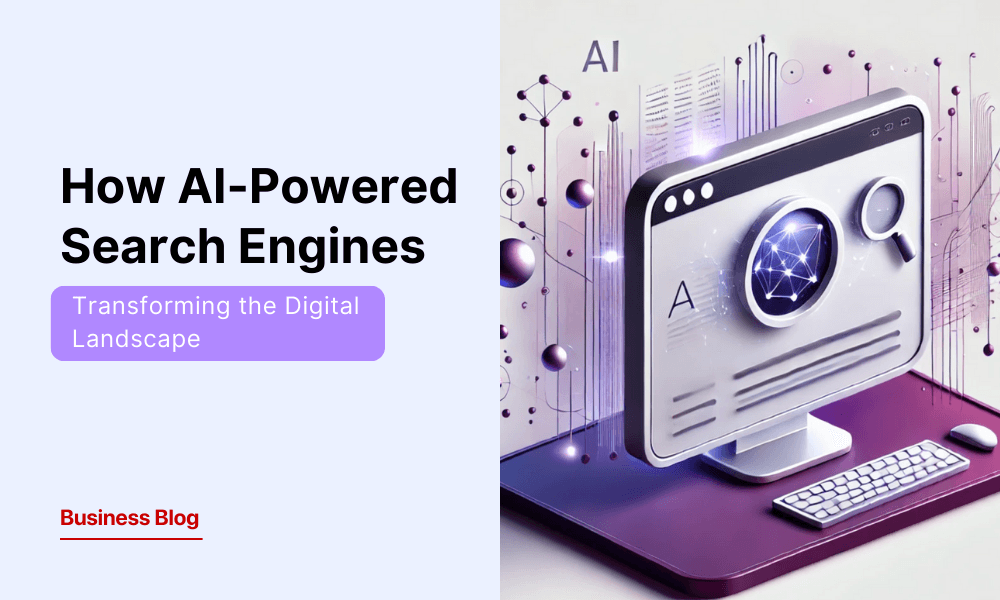

In May 2024, Google introduced AI Overviews, an AI-driven enhancement that delivers direct, summarized answers at the top of search results, reducing the need for users to click through multiple links. At the same time, platforms like Perplexity AI are redefining search by offering conversational, context-aware responses rather than traditional ranked web pages. These advancements mark a fundamental shift in how we access information.
AI-powered search engines are making search faster, smarter, and more intuitive by leveraging machine learning, natural language processing (NLP), and generative AI. They understand user intent more accurately, personalize results based on behaviour, and provide instant, AI-generated insights. However, this evolution also raises concerns about data privacy, algorithmic bias, and the reliability of AI-generated content. This blog explores how AI-driven search is transforming the digital landscape, the benefits it offers, and the challenges businesses and users must navigate.
The Evolution of Search Engines
In the early days of the internet, search engines operated like digital directories, relying on exact keyword matches to retrieve results. Google’s PageRank introduced a ranking system based on backlinks and relevance, but early search models lacked contextual understanding—often returning results that matched words rather than intent.
The rise of AI-powered search transformed this landscape. With machine learning (ML), natural language processing (NLP), and neural networks, search engines moved beyond keyword dependency, learning to interpret meaning, intent, and context. This shift made search more accurate, intuitive, and user-centric.
Key Milestones in AI Search Evolution
- RankBrain (2015): Google’s first AI-driven ranking algorithm, refining search results for complex or unfamiliar queries.
- BERT (2019) & MUM (2021): Enhanced language understanding, enabling search engines to process queries more naturally and contextually.
- Generative AI in Search (2023–2024): The emergence of ChatGPT, Bard, and Perplexity AI, shifting search from ranked links to AI-generated, conversational responses.
Search has evolved from static keyword indexing to AI-driven contextual intelligence, making it smarter, faster, and more intuitive. As AI advances, the way we search, discover, and interact with information will continue to transform.
Key Features of AI-Powered Search Engines
Modern search engines have moved beyond keyword matching, using machine learning and NLP to interpret intent, context, and behaviour with remarkable precision. Whether refining search accuracy, predicting queries, or personalizing results, these advancements are reshaping how users access information—faster, smarter, and with greater relevance.
1. Natural Language Processing (NLP) & Context Understanding
Traditional search engines relied on exact keyword matches, often missing the intent behind a query. AI-driven search engines, powered by NLP, now understand context, phrasing, and user intent to deliver more relevant results.
For example, searching “best laptop for video editing under $1000” no longer pulls up generic laptop listings. Instead, AI identifies user needs, filters specifications like GPU and RAM, and prioritizes results that match both budget and performance requirements.
2. Hyper-Personalization & Behavioral Learning
AI doesn’t just process queries—it learns from user behaviour to tailor search results. By analyzing search history, engagement patterns, and preferences, AI delivers personalized recommendations suited to individual users.
Google Discover, for instance, curates articles based on a user’s browsing habits, while AI-powered search engines dynamically adjust rankings based on past interactions. This makes search results more relevant and increases engagement by predicting what users are likely to click on next.
3. Predictive Search & Generative AI
AI-powered search is becoming proactive rather than reactive. Predictive search anticipates user intent before a query is fully typed, offering auto-suggestions, context-aware recommendations, and AI-generated responses.
Google's AI Overviews and Bing AI Answers now provide summarized insights at the top of search results. This change reduces the need for users to click through many links. Search engines have undergone a fundamental shift. They no longer list sources. Instead, they deliver direct answers, thanks to AI.
Enhanced Search Capabilities with AI
AI-powered search engines have moved beyond simple keyword matching, leveraging advanced machine learning and natural language processing (NLP) to deliver more accurate, personalized, and predictive search experiences. These key features are shaping how users find and interact with information.
Higher Accuracy & Relevance
Search engines no longer just rank pages—they analyze behavioural insights and deep learning patterns to prioritize credible, intent-driven results. Clickbait and low-quality content get pushed aside, ensuring users find reliable, high-value information faster.
Improved Accessibility & Inclusivity
AI is breaking barriers with voice search, visual recognition, and multilingual support. Assistants like Siri and Google Assistant enable hands-free search, while Google Lens allows users to search using images—expanding accessibility beyond text-based queries.
Conversational & Multi-Modal Search
Search is evolving from simple queries to dynamic conversations. AI chatbots like ChatGPT, Bard, and Perplexity AI allow users to refine searches in real-time. Google’s MUM model even enables multi-modal search, letting users ask, “Does this jacket come in other colours?” simply by uploading a photo.
Challenges & Ethical Considerations in AI Search
As AI-powered search engines evolve, they introduce new concerns about privacy, bias, and content reliability. While AI improves search efficiency, its decision-making is shaped by data, algorithms, and human influence, raising questions about transparency, fairness, and trust.
Data Privacy & Ethical AI Concerns
AI-driven search thrives on user data, but how much is too much? The growing reliance on personalized search results pars debates on data collection transparency, surveillance risks, and compliance with regulations like GDPR and CCPA. As AI systems track user behaviour to refine results, businesses must balance convenience with ethical responsibility.
Algorithmic Bias & Search Manipulation
Search engines are only as unbiased as the data they’re trained on. AI models can reinforce societal biases, leading to skewed search rankings, misinformation, and manipulated content visibility. Cases of political bias, exclusion of diverse perspectives, and unethical SEO tactics highlight the risks of AI amplifying misleading narratives over factual accuracy.
The Reliability of AI-Generated Content
AI-generated search summaries aim to provide instant answers, but they also introduce the risk of hallucinations, misinformation, and misinterpretation. Without human oversight or fact-checking, AI may prioritize speed over accuracy, raising concerns about how much users should trust AI-powered results. A hybrid AI-human moderation approach is crucial to maintaining credibility and trust in search experiences.
AI-powered search engines are reshaping digital discovery, but their success depends on ethical implementation, transparency, and continuous refinement to prevent unintended consequences.
The Future of AI-Powered Search
AI search is moving beyond text, integrating with Augmented Reality (AR), IoT, and voice-driven assistants to deliver real-world, context-aware results. Future AI models will process images, gestures, and environmental data, creating seamless, predictive search experiences.
As AI-generated summaries reduce website traffic, businesses must shift toward AI-first content strategies, focusing on structured data, conversational SEO, and AI-driven content optimization. The future of search isn’t just about ranking pages—it’s about delivering instant, multimodal, and intent-driven answers. Businesses that adapt will thrive, while those that don’t risk fading from digital visibility.
Conclusion
AI-powered search is transforming how we find and interact with information—from understanding intent with NLP to delivering AI-generated answers instantly. While this shift enhances accuracy and accessibility, it also introduces challenges around data privacy, bias, and content reliability.
Businesses must adapt to AI-first content strategies and conversational search to stay visible in the evolving digital landscape.
At GeekyAnts, we help businesses navigate these changes with AI-driven search strategies and future-ready solutions. Let’s build the future of search together.