

Restaurants today are no longer merely dining spots—they're transforming into immersive spaces where technology drives every interaction. Augmented reality (AR) is at the forefront of this change, reshaping how customers engage with menus, how staff are trained, and how brands connect with their audience in innovative ways.
For business owners, AR is not just a fleeting trend—it’s a strategic move that unlocks new opportunities.
Ideate a menu that doesn’t just list items but tells a visual story, or staff trained through lifelike virtual environments. AR also allows your brand to transcend physical spaces, creating lasting digital connections with customers. This guide explores how pioneering restaurants are using AR to enhance operations, engage guests, and lead the industry’s next evolution.
Market Insights in the Growing Trend for AR and VR
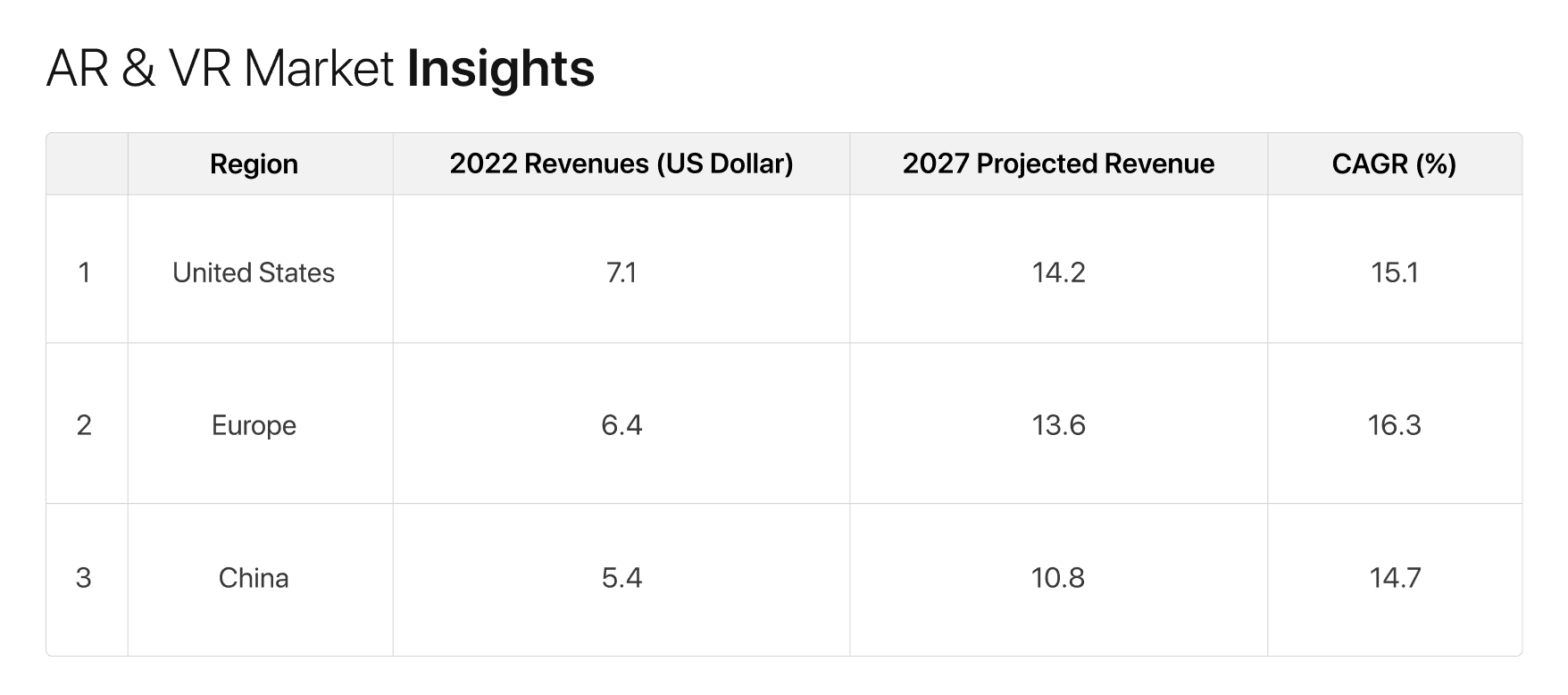
The AR and VR market is expanding at a remarkable rate, offering businesses new opportunities to elevate customer experiences and streamline operations. In 2022, the United States led this surge, generating $7.1 billion in AR and VR revenues. By 2027, that figure is expected to double to $14.2 billion, reflecting a robust annual growth of 15.1%.
Europe is also experiencing rapid adoption, with revenues of $6.4 billion in 2022, projected to grow to $13.6 billion by 2027. China, while smaller, is following a similar upward trend, expected to grow from $5.4 billion in 2022 to $10.8 billion by 2027, with an annual growth rate of 14.7%.
For those looking to stay ahead in the industry, these numbers represent more than just growth—they signal a strategic transformation. AR and VR are no longer simply trends but essential tools for enhancing customer engagement, improving operational efficiency, and building future-proof business models. Companies embracing this shift are positioning themselves at the forefront of innovation, ensuring long-term success in a rapidly evolving landscape.
Benefits of AR and VR in the Restaurant Industry
Restaurants are increasingly embracing augmented and virtual reality not just for innovation but to drive customer engagement and operational efficiency. These technologies have the power to reshape the entire dining experience. For business leaders looking to stay ahead, AR and VR provide a unique opportunity to streamline operations, enhance customer satisfaction, and gain a competitive edge in a crowded market.
- Turning Menus into Experiences
Imagine offering your customers more than just a traditional menu. With AR, diners can explore 3D visuals of their dishes, experiencing the food even before ordering. This kind of interactive engagement simplifies decision-making and enhances the overall dining experience. Restaurants in places like London are already using AR to turn ordering into an experience—an approach that could set your business apart in a competitive landscape.
- Seamless Staff Training with Virtual Reality
Training staff is crucial but can often be resource-intensive. Virtual reality offers a streamlined solution. VR enables your team to practice in a fully simulated restaurant environment, mastering service scenarios without real-world consequences. Leading restaurants in Singapore are already cutting training time and improving efficiency by using VR for immersive training. For business owners, this means better-prepared staff and smoother operations from the start.
- Standing Out with AR-Driven Marketing
AR isn’t just for operations—it’s transforming marketing strategies as well. Imagine your brand leveraging AR to create a memorable, interactive experience. A café could use AR to bring a dessert box to life, telling an animated story that customers can share across social media. This type of engagement positions your brand at the forefront of digital innovation, making it more likely that customers will remember—and return to—your restaurant.
- Keeping Guests Entertained with AR
For family-oriented restaurants, AR can make waiting for food a fun experience, especially for younger guests. With AR games projected onto tables, children are entertained while parents enjoy their meals. This turns downtime into engagement, enhancing customer satisfaction and encouraging repeat visits. In a competitive market, small details like this can set your restaurant apart and keep customers coming back.
By integrating AR and VR, restaurants can position themselves as innovators, offering unique experiences that attract and retain customers. These technologies help streamline operations, enhance training, and create memorable marketing campaigns, making them smart investments for long-term growth.
How Restaurants Can Use AR and VR to Enhance Business
Since restaurants are entering a new phase where the dining experience goes far beyond food, Augmented Reality (AR) and Virtual Reality (VR) are reshaping the industry by offering innovative ways to engage customers, improve operations, and elevate your restaurant’s brand. For business owners, AR and VR provide a strategic opportunity to stand out in a competitive market. Here’s how these technologies can transform your restaurant.
1. Turning Menus into Interactive Experiences
Traditional menus are quickly becoming outdated. With AR, diners can explore detailed 3D models of dishes right on their smartphones before placing an order. This immersive experience doesn’t just engage customers—it builds their confidence in the meal they’re about to enjoy.
- Boosting Decision Confidence: AR allows diners to visualize ingredients, portion sizes, and presentation. In Milan, a restaurant is using AR to showcase every aspect of its dishes, giving diners complete clarity before ordering and reducing the risk of dissatisfaction.
- Elevating Dish Presentation: Chefs can use AR to highlight the artistry and complexity behind each dish, creating a talking point for customers. This not only adds to the dining experience but also strengthens the restaurant’s brand by demonstrating craftsmanship.
2. Seamless Ordering Process with AR Apps
The use of AR apps in restaurants is simplifying the ordering process, making it more efficient and error-free. Imagine customers scanning a dish and adjusting ingredients or portion sizes in real time before confirming their order.
- Personalized Dining Experience: AR apps allow customers to personalize their meals, whether it's adjusting spice levels or swapping ingredients for dietary preferences. At a vegan café in San Francisco, diners use AR to tailor their meals, creating a custom dining experience that keeps them coming back.
- Reducing Wait Time Friction: AR-enhanced apps streamline the ordering process, reducing errors and speeding up service. This results in faster table turnover, improved customer satisfaction, and ultimately higher revenue for the business.
3. Innovative Staff Training with VR Simulations
Staff training is critical to smooth restaurant operations, but it can be resource-heavy. VR offers an immersive, cost-effective way to train employees in a fully simulated environment, ensuring they’re prepared before stepping into real-world scenarios.
- Risk-Free Learning: VR allows staff to practice service scenarios and kitchen operations in a controlled environment. For example, a high-end restaurant in New York uses VR to train its sommeliers, enabling them to handle high-pressure situations with confidence and precision.
- Cutting Training Time: VR training accelerates the learning curve for new hires, allowing them to gain practical experience from day one. This results in a more polished service team, reducing operational errors and improving overall customer experience.
4. Building Loyalty Programs with AR
Loyalty programs can be taken to the next level with AR, making earning rewards more interactive and exciting for customers. This keeps them engaged and encourages repeat visits, driving long-term loyalty.
- Gamified Customer Engagement: Restaurants are using AR to gamify their loyalty programs. At a trendy burger joint in London, customers can unlock badges by trying different menu items or visiting on special days. This gamified experience not only drives repeat business but also adds a level of excitement to the customer’s journey.
- Unlocking Secret Menu Items: AR can reveal exclusive content or secret menu items, creating an incentive for customers to engage with the brand. This gives customers a feeling of exclusivity, keeping them connected to the restaurant and eager to return.
5. Crafting Immersive Marketing Campaigns
AR and VR are changing how restaurants approach marketing, offering interactive campaigns that create lasting impressions. These technologies allow brands to extend beyond traditional marketing efforts, offering customers a more engaging and memorable experience.
- Storytelling Beyond the Plate: Restaurants can use AR to tell their brand’s story. A Mediterranean bistro in Los Angeles, for instance, uses AR to take customers on a virtual journey through its suppliers’ olive groves and vineyards. This deepens the connection between diners and the restaurant, making the experience much more personal.
- Amplifying Social Media Buzz: AR campaigns are naturally shareable, encouraging diners to post their experiences online. This helps increase your restaurant’s visibility while boosting organic social media engagement without the need for extra marketing dollars.
Types of AR/VR Restaurant Applications
AR and VR are quietly revolutionizing how restaurants operate, introducing immersive tools that enhance both customer experiences and daily operations. From interactive menus that let diners explore their meals in new ways to training environments that bring a restaurant's unique pace to life for staff, these technologies are setting a new standard in the industry.
Let’s break down the key types of AR/VR applications in the restaurant industry:
1. Customer-Focused Apps
These apps bring the dining experience to life by making it interactive and informative. With AR, diners can visually explore the dishes before they order—seeing 3D models of the food, reading ingredient details, and even customizing their meals in real-time. It’s about more than just convenience; it’s about creating a deeper connection with the menu and the restaurant.
Example: A restaurant offering an AR-powered menu lets guests see a realistic 3D rendering of each dish, helping them make more confident choices while adding a modern, tech-driven layer to the dining experience.
2. Internal Engagement and Entertainment Apps
These apps serve both employees and customers by focusing on engagement and skill-building. VR simulations are an efficient way to train staff, offering hands-on experience in a virtual setting before they step into real-world situations. For guests, AR apps can turn waiting time into an interactive experience, keeping them engaged and entertained.
Example: A family-friendly restaurant uses AR to create tabletop games for kids while they wait for their meals. This not only improves the customer experience but also creates an atmosphere that makes families eager to return.
3. Operating Apps
Designed to streamline internal operations, these apps focus on improving staff performance and making restaurant processes more efficient. VR can simulate peak-time scenarios, helping new staff learn how to manage high-stress environments, while AR can aid in logistical tasks such as inventory management or kitchen workflow optimization.
Example: A VR training program allows waitstaff to handle virtual busy shifts, honing their skills in a controlled, realistic environment. This approach not only reduces onboarding time but also prepares employees to deliver top-tier service from day one.
How to Integrate AR/VR for Your Step-by-Step Guide to Integrating AR/VR into Your Restaurant Business
Picture a restaurant where menus come alive, where customers explore dishes in 3D before ordering, and where staff perfect their skills in a virtual kitchen before serving the first plate. AR and VR are reshaping the restaurant dining experience, not just for diners but for the entire operation. If you’re considering bringing AR/VR transformation to your restaurant, here’s a step-by-step breakdown of how to do it.
1. Define Your Vision
Start by asking yourself: What’s the real goal? Do you want to enhance customer engagement with interactive menus or improve staff efficiency through virtual training? Clarifying the “why” will guide every other step of the process.
Example: A high-end restaurant might want AR to give customers an immersive preview of signature dishes, elevating the dining experience and setting itself apart from the competition.
2. Assess Feasibility
Next, evaluate whether your infrastructure can handle the demands of AR/VR. Do you have the technology in place? Are your staff and customers ready for this shift? Addressing these questions early ensures a smooth implementation.
For instance: A small bistro may need tablets or AR-capable devices to support the interactive experience, while larger chains might focus on integrating AR with existing customer apps.
3. Design the Experience
This is where vision meets reality. Work with designers and developers to create an intuitive and engaging experience that aligns with your brand. The technology should feel like a natural extension of your restaurant’s ambiance.
Imagine An AR menu that not only shows the dishes but creates a visual story, helping customers engage with your brand long before the food arrives.
4. Build the Core Features
Develop the necessary features, whether it’s a 3D menu or a VR simulation for staff training. The key is to focus on simplicity and functionality, ensuring that the technology enhances the experience rather than complicating it.
5. Integrate Seamlessly
Make sure the AR/VR solutions integrate smoothly with your existing systems, from the point-of-sale (POS) to kitchen orders. This keeps everything running efficiently behind the scenes while delivering a seamless experience for customers.
6. Test and Refine
Before launching, test the experience with real users—both customers and staff. This helps fine-tune the application and address any pain points. The goal is to ensure the technology serves your business and enhances the overall operation.
7. Launch and Learn
Finally, launch your AR/VR experience and observe how it impacts your business. Keep an eye on customer feedback and operational flow. The launch is just the beginning—be ready to adjust and evolve the technology as needed.
By following these steps, AR and VR can bring both operational efficiency and a unique customer experience to your restaurant, setting you apart as an innovator in the industry.
How We Built an AR/VR Menu for a Restaurant- Video Demo With Guide
Building an AR/VR-powered menu is about more than just adding technology—it's about transforming the dining experience. The focus is on making each dish more than just a description—turning it into a fully immersive, visual experience. Customers can see 3D representations of meals, explore ingredients, and visualize portions in real time. This menu merges creativity with cutting-edge technology, offering an interactive tool that enhances customer engagement while integrating seamlessly with the restaurant’s operations. The development process blends intuitive design and innovative tech to create a solution that revolutionizes diners' decisions.
Development Timeline: Speed to Market
Building an AR/VR menu doesn’t just happen overnight—it’s a carefully planned process, designed to move quickly while ensuring quality at every step. Here’s how the timeline breaks down:
1. Prototyping (2-3 weeks)
The first step is to turn the vision into something tangible. During this phase, a prototype is developed to bring the concept to life. Wireframes and basic AR/VR functionality are built to test how the menu will look and feel. Feedback is gathered early, ensuring the design aligns with the restaurant’s goals and enhances the dining experience.
2. Development & Integration (6-8 weeks)
With the concept validated, full-scale development begins. This is where the core features—such as 3D dish visualization and real-time customization—are built. At the same time, the app is integrated with existing systems like POS and kitchen management software, making sure everything works in harmony. Cross-platform compatibility ensures that the app functions seamlessly on any device.
3. Testing & Optimization (2 weeks)
In this phase, the app is put through its paces. Rigorous testing ensures that it runs smoothly under various conditions, from busy dinner rushes to quieter times. Bugs are squashed, and the user interface is fine-tuned, making sure the final product is both beautiful and functional.
Total Timeline: 10-13 weeks
From concept to launch, the entire process takes approximately 10-13 weeks. This timeline ensures a swift, yet thorough, development process, allowing for rapid deployment while maintaining high-quality standards. It enables restaurants to quickly adopt AR/VR technology, transforming the dining experience without delays.
In the second phase, GeekyAnts ensures that the solution integrates seamlessly with existing restaurant systems, whether it’s POS integration or kitchen management tools. By developing custom APIs and ensuring cross-platform functionality, the solution effortlessly fits into the restaurant’s operations, enhancing both customer engagement and operational efficiency without requiring a complete overhaul.
Seamless Integration with Existing Operations
At GeekyAnts, the approach focuses on seamlessly integrating the AR/VR menu into a restaurant’s existing tech stack, ensuring the implementation of innovative technology without the need for a complete overhaul of current systems.
- API Integration: GeekyAnts develops custom APIs that allow the AR menu to communicate efficiently with POS and kitchen systems. This ensures real-time order updates, streamlining the workflow and automating key processes.
- Cross-platform Compatibility: The solution is engineered by GeekyAnts to work flawlessly on both Android and iOS platforms, guaranteeing a consistent experience for customers, whether they are dining in-house or ordering remotely.
By crafting flexible and scalable solutions, GeekyAnts ensures the AR/VR system integrates smoothly into existing operations. This approach allows restaurants to adopt innovative technology effortlessly, providing enhanced customer engagement without interrupting daily operations, leading to better functionality and a higher return on investment.
Watch the Demo in Action
Curious about how AR/VR can transform the dining experience? Check out our Demo Video to see the technology in action.
Watch how this innovative solution integrates seamlessly, showcasing how AR/VR enhances customer engagement and streamlines workflows, giving your business a clear competitive edge.
Tech Stack for Building an AR/VR Ecosystem for Restaurants
Implementing AR/VR in restaurants isn't just about adding flashy features—it's about creating a seamless, functional, and scalable ecosystem that enhances customer engagement and operational efficiency. Here’s a breakdown of the essential tech stack needed to build an AR/VR platform, providing both innovation and business value.
- AR Frameworks
- ARKit (iOS) and ARCore (Android) provide motion tracking, light estimation, and environmental awareness, but quality 3D models are essential. Clients should ideally supply these models or budget time for their creation.
- ModelViewer and Three.js enable smooth rendering of 3D models directly in browsers, allowing diners to interact with AR menu items by rotating, zooming, and exploring visuals.
- 3D Visualization
- Three.js allows for detailed 3D interaction, critical for rotating and viewing menu items.
- Unity can support VR applications, such as virtual dining spaces or kitchen simulations, offering immersive experiences beyond AR.
- Backend & Real-Time Data
- Node.js manages real-time data sync, keeping menu updates and inventory accurate between AR interfaces and restaurant systems.
- GraphQL enhances the speed of data retrieval for instant updates, ensuring a seamless user experience without delays.
- Cross-Platform & UI
- React Native ensures the AR experience remains smooth across Android and iOS, reducing build time.
- Tailwind CSS provides responsive design capabilities, allowing the UI to adjust cleanly for different device screens.
- Graphics and Hardware
- WebGL powers high-quality 3D visuals in browsers, necessary for fluid interactions. For AR compatibility, user devices should be AR-capable (Android 12+ or iOS 13+) and use updated browsers (Chrome v81+).
- Development requires powerful hardware for rendering and model creation, with tools like Blender supporting .glb/.gltf model generation.
- Cloud Storage & Data Sync
- AWS or Firebase manages real-time data and asset storage, essential for syncing menu updates and user preferences across devices.
Why This Matters to Your Business
For restaurants looking to innovate, this tech stack ensures that AR/VR solutions don’t just look impressive—they provide real value by enhancing the customer experience and integrating smoothly with existing systems. By using proven frameworks like ARKit and ARCore, paired with powerful backend and cross-platform tools, the solution is built for scalability, flexibility, and long-term growth.
This stack not only engages customers but also optimizes back-end workflows, ensuring that operational efficiency keeps pace with the added technology. The result is an AR/VR ecosystem that offers both a competitive edge and a significant return on investment.
How GeekyAnts Transforms Restaurants with AR/VR Solutions
Today’s restaurants face the challenge of blending hospitality with innovation, meeting the growing demand for immersive and tech-driven experiences.
GeekyAnts revolutionizes how restaurants utilize AR/VR technology to elevate customer experiences and streamline internal processes. By integrating immersive 3D menus and efficient virtual training systems, GeekyAnts empowers restaurants to create engaging dining experiences while optimizing operations. Every solution is designed for seamless integration, ensuring that restaurants can adopt advanced technology without disrupting their workflows, ultimately positioning them at the forefront of innovation.
How GeekyAnts Helped Darden Restaurants (Olive Garden)
When partnering with Darden Restaurants, GeekyAnts developed a user-friendly mobile app that enhanced customer engagement and loyalty for Olive Garden. The app allowed customers to seamlessly browse menus, place orders, and engage with loyalty programs—all through a streamlined, intuitive interface. As a result, Darden Restaurants saw a 5% increase in user satisfaction and an expanded base of over 1.6 million loyal users
This project is a great example of how leveraging modern tech stacks, real-time data management, and seamless integration can drive significant growth for restaurant businesses. The mobile app featured strong backend integration, robust data handling, and cross-platform functionality, making it accessible and scalable across Darden's extensive network of restaurants.
Applying Proven Solutions to AR/VR Innovation
By leveraging modern tech stacks, real-time data management, and seamless integration, GeekyAnts transformed Olive Garden’s customer engagement and operations, showcasing how technology can drive significant growth. Building on this success, the same principles are applied to our tailored AR/VR solutions for the restaurant industry. With custom APIs and cross-platform compatibility, our solutions enhance customer interaction through interactive menus and streamline operations like virtual staff training, all while ensuring a smooth integration into existing systems without disrupting day-to-day workflows.
Conclusion: The Future of Dining with AR/VR
AR and VR are transforming restaurants by enhancing customer engagement and streamlining operations. From interactive 3D menus to immersive staff training, these technologies offer more than just novelty—they drive efficiency and growth. As the AR/VR market continues to expand, restaurants that embrace these innovations today are positioning themselves for long-term success in a competitive industry. With GeekyAnts' expertise in delivering seamless, scalable solutions, businesses can stay ahead of the curve and maximize the benefits of this game-changing technology.
FAQ’s:
1. How can AR/VR technology enhance the restaurant dining experience?
AR/VR offers immersive 3D menus and streamlines operations, improving both customer engagement and staff efficiency.
2. Can small restaurants with limited resources benefit from AR/VR integration?
Yes, smaller restaurants can adopt cost-effective AR features like interactive menus to enhance customer experience without heavy investment.
3. How is AR/VR Changing the F&B Industry?
AR/VR is revolutionizing F&B by enhancing customer interaction, optimizing staff training, and driving innovative marketing efforts.