

Key Takeaways
- Map every production decision to one named accountable owner using a decision-level RACI matrix, so no call between code and customer sits unassigned.
- Gather release evidence across customer behavior, data, security, and operations, and work it through a production-readiness checklist before any sign-off.
- Hold code authorship and release approval in separate hands on higher-risk changes, so no one authorizes their own work.
- Assign the incident lead, rollback authority, and communication owner while the release is still being planned, and record them on an incident ownership card.
- Judge a delivery partner on how they allocate production ownership, work through the partner-evaluation questions, and agree owners before kickoff.
- Track whether releases get more predictable, rework falls, and incidents recover faster, so the framework earns its place over time.
A well-funded team is shipping faster than a year ago. Features move from ticket to pull request in less time, reviews clear quicker, and the roadmap looks healthier. Yet, we still have some aspects that remain unclear - who approves each release, who accepts the customer-facing risk, and who owns the change once it is live.
That pace is now typical. DORA reported in March 2026 that 90% of technology professionals use AI at work and that more than 80% believe it has raised their productivity. The same research links higher AI adoption to both greater throughput and greater delivery instability. These figures show association rather than proof that AI causes instability or that any ownership framework fixes it.
What the numbers do show is a shift in where engineering effort lands: verification, validation, and observability now carry more weight, and accountability for a live change needs to be explicit rather than assumed.
This article is for the engineering and product leaders who answer for what reaches customers, whether or not the product itself contains AI features. AI assistance belongs in the evidence trail, production accountability belongs to named people, and the place to start is an ownership model that names who holds each production decision.
Who Owns Each Production Decision When AI Writes the Code? The RACI Framework
Most teams answer the ownership question with a job title and stop there. A single title cannot carry every decision that stands between a code change and a customer, so the harder calls end up unassigned until something breaks.
The model below turns that single owner into a decision-level RACI for the AI-assisted Software Development Lifecycle, where each production decision has its own responsible people, one named accountable person, the input it needs, and the point at which it escalates.
The matrix uses four roles.
- The responsible people do the work on a decision.
- One accountable person holds the authority to approve or reject the outcome and answers for it afterward.
- Consulted people supply required input before the decision is made.
- Informed people are told once the decision or its result is settled.
The reason for naming decisions rather than phases is that writing code and approving a release are separate acts of authority, and the person who does the first does not automatically hold the second.
Decision | Responsible | Accountable | Consulted | Informed | Required evidence | Escalation trigger |
Scope and customer behavior | Product and Engineering | Product Owner | Design, Support, Engineering Lead | Release Owner | Approved requirement, acceptance criteria, affected journeys, known exclusions | Material scope change; customer commitment affected |
Approved AI and tool use | Developer | Engineering Lead | Security, Privacy, Legal | Product Owner | Approved-tool record, data-use limits, vendor terms reviewed | Unapproved tool; confidential data exposure; unclear retention terms |
Architecture | Engineering | Engineering Lead | Security, Platform, Data Owner | Product Owner | Architecture decision record, data flow, dependency changes, migration design | New trust boundary; material data-flow change; irreversible migration |
Code acceptance | Author and Reviewer | Engineering Lead | Security or domain specialist | Product Owner | Human review, PR diff, traceability to requirement, generated-code provenance | Reviewer cannot explain behavior; high-severity defect; unreviewable change |
Validation | Engineering and QA | Quality Owner | Product, Security, Platform | Release Owner | Unit, integration, regression, and UAT results; defect disposition | Required test missing or failing; environment not representative |
Risk exception | Engineering documents it | Named Risk Owner | Security, Product, Legal | Release Owner | Impact, compensating control, expiry date, remediation owner | Risk exceeds delegated threshold; exception lacks expiry |
Release authorization | Engineering prepares the package | Release Owner | Product, Security, Operations | Stakeholders | Complete gate evidence, exception record, rollback plan, exact artifact version | Evidence missing; rollback unavailable; approver unavailable |
Deployment execution | Platform or Operations | Platform Owner | Engineering, Security | Release Owner | Approved release record, identified artifact, health criteria | Install failure; health threshold breach; unexpected migration behavior |
Production monitoring | Operations or SRE | Service Owner | Engineering, Security, Product | Support | Dashboards, logs, alerts, service targets, ownership schedule | Required telemetry absent; production signals exceed threshold |
Rollback or containment | Operations Lead | Incident Commander | Engineering, Security, Data Owner | Release Owner, Support | Rollback criteria, last known good artifact, recovery approach | Customer impact rising; recovery target threatened; rollback itself unsafe |
Customer communication | Communications or Support | Communications Owner | Incident Commander, Legal | Leadership, account team | Confirmed impact, approved message, notification requirements | Contractual threshold met; material customer impact; privacy event suspected |
Operational handover | Delivery team | Service Owner | Operations, Support, Security | Product Owner | Runbooks, repositories, IaC access, known-risk register | Missing access or runbook; unresolved ownership; offboarding deadline approaching |
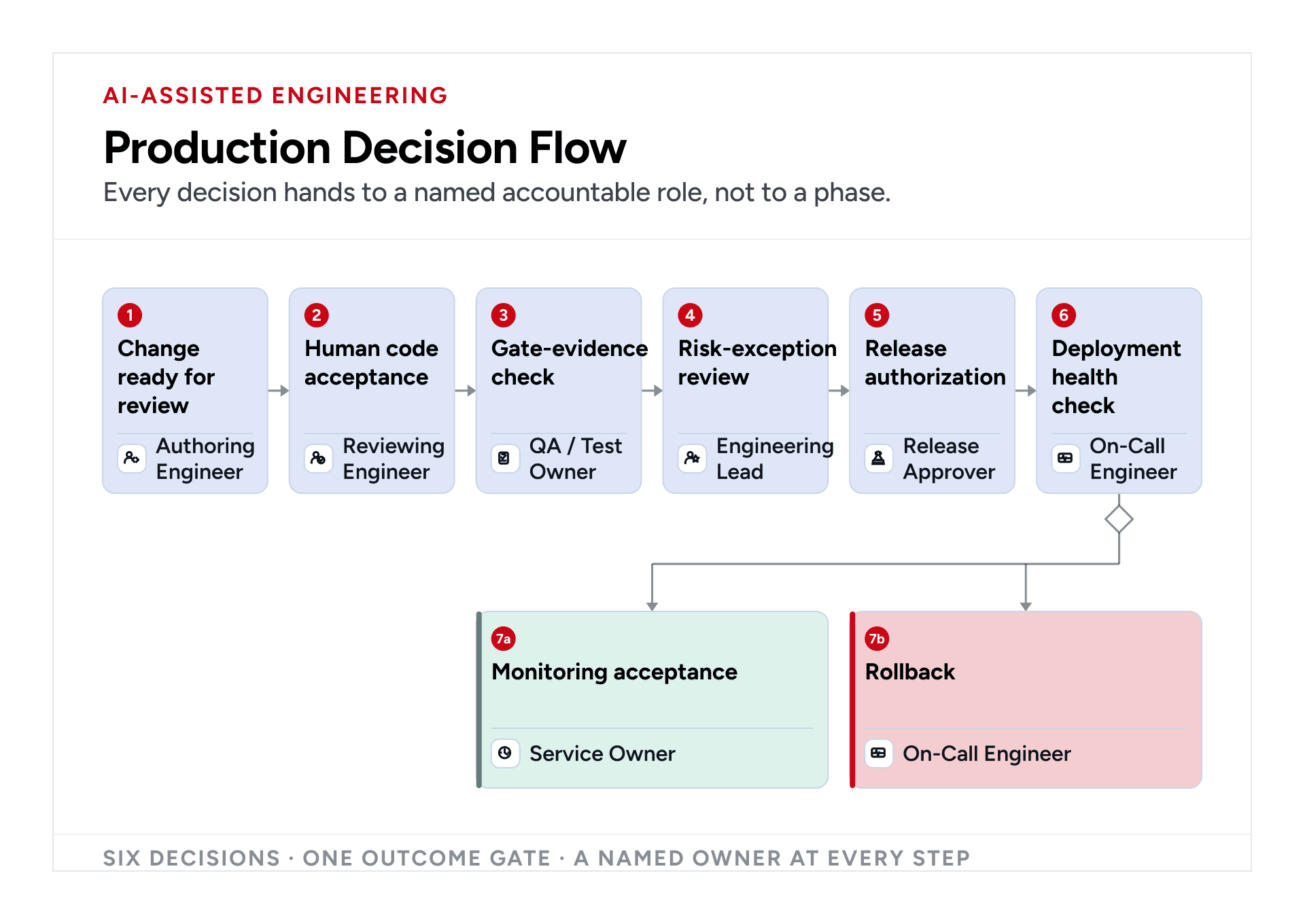
The matrix records decision rights and escalation triggers, and it keeps AI assistance out of the accountable column on purpose. An AI-generated commit, a code suggestion, or a generated test is logged as provenance in the required-evidence column, where it supports a decision without ever holding one.
The role assignments stay with people, and the tool remains part of the evidence a person reviews before they approve.
How the Matrix Plays Out in a Subscription and Payment Change
Take a lean product team shipping an AI-assisted change that lets SaaS customers switch subscription plans, along with an update to the payment-provider integration behind it.
The developer who generates and edits the code is responsible for the implementation, and the engineering lead accepts that code after a human review that traces it back to the requirement.
Validation then produces evidence for upgrades, downgrades, payment failures, retries, authorization checks, and state reconciliation. The release owner authorizes production only once that evidence, live monitoring, and a working rollback route are all in place.
If a payment state can fall out of line with a customer's subscription entitlement and automated recovery has not been shown to work, the release escalates to a named risk owner before it goes any further.
Naming the developer as the owner would still leave four decisions unassigned. The matrix gives each of them a person before the change ships:
Decision the developer's title leaves open | Accountable owner in the matrix |
Who accepts the residual risk | Named Risk Owner |
Who authorizes customer exposure | Release Owner |
Who can reverse the deployment | Incident Commander or Service Owner |
Who speaks to customers if something breaks | Communications Owner |
Writing a change and approving its release are two different jobs. When an engineer produces code with an assistant and reviews it, that tells you the code compiles and reads the way it should. It does not tell you the release is safe, that the payment path recovers cleanly, or that a named person is ready to answer for it once customers are on it. On our teams the person who writes a change is rarely the person who authorizes it, and we keep that separation on purpose.
 Konakanchi Venkata Suresh BabuPrincipal Technical Consultant.
How Can Startups and Mid-Sized Teams Assign Production Ownership Without Filling Every Role?
The matrix names decisions and roles, not headcount. A smaller team runs the same decision rights by giving several rows to one person, so the question is which combinations are safe and which need a second pair of eyes.
How the Two Team Sizes Differ
On a smaller team the roles are cross-functional by necessity, so the same rows sit with fewer people and spread across specialists as the company grows.
Decision area | Eight-engineer startup | 35-engineer company |
Architecture, code acceptance | Founding or lead engineer | Senior engineers and an architect |
Scope, customer communication | Founder or product owner | Product managers and a comms owner |
Deployment, monitoring, rollback | One platform engineer | A platform or SRE function |
Release authorization | Rotating senior engineers | A named release owner, kept separate from the author |
Overlap on high-risk decisions | High, by necessity | Lower, with security review standing apart |
Where combining roles is safe, and where it is not
Routine, reversible decisions can share an owner. Higher-risk decisions need separation and an additional review step, so no one approves their own work and a second qualified person signs off before it ships.
Safe to combine | Keep separate |
Scope, validation, and monitoring on routine changes | Release authorization from the person who wrote the code |
Low-risk code acceptance with implementation | Risk exceptions from whoever created the risk |
Deployment and monitoring under one platform owner | Rollback authority as its own standing role |
Code review is the case that needs care on a small team. One engineer writing and merging their own change removes the second pair of eyes the matrix depends on, so even where headcount is tight, a change above routine risk needs a reviewer who did not write it. The reviewer does not have to be a dedicated role.
A second qualified engineer, a rotating peer, or a part-time external reviewer on higher-risk changes keeps acceptance independent without adding a permanent seat.
Covering the gaps a smaller team already has
Most gaps are capability gaps, and each has a low-cost cover that does not need a new department.
Existing role | Assigned responsibility | Missing capability | Required support |
Founding or lead engineer | Architecture, code acceptance | Independent security review | Contract or part-time security review on high-risk changes |
Founder or product owner | Scope, customer communication | Risk acceptance at scale | A named risk owner for changes above a set threshold |
Rotating senior engineer | Release authorization, validation | Separation from their own code | A second reviewer for releases they wrote |
Platform or DevOps engineer | Deployment, monitoring, rollback | Round-the-clock incident cover | An on-call rota or managed monitoring |
Is it an Ownership Problem or a Capacity Problem?
When a decision goes wrong, name the problem before adding people, because the two causes have different fixes.
Problem | What it means | Fix |
Ownership | No one held the decision | Assign it to a named person |
Capacity or expertise | Someone held it but lacked the time or specialist knowledge | Add review or outside support, not another name on a chart |
Who Approves AI-Generated Code for Production Release?
A passing test suite is one signal among several, and release approval is a human release decision that rests on readiness evidence across five areas.
This section turns technical readiness into an approval a founder, CTO, or product leader can sign, and it keeps pre-production evaluation separate from the confidence needed to put a change in front of customers.
This aligns with NIST NCCoE’s DevSecOps guidance, which treats security as part of the software development lifecycle and integrates security and compliance evidence across development, build, packaging, distribution, and deployment.
The Five Approval Areas: Who Approves Each and What Blocks it?
The five areas are customer behavior, data handling, quality and security, operational readiness, and final release authorization. Each one has an accountable approver and a condition that blocks the release until it is resolved.
Release gate | Required evidence | Accountable approver | Release-blocking condition |
Customer behavior | Acceptance criteria, mapped journeys, regression and critical-path results, documented behavior changes | Product Owner | A core criterion fails, or a customer-facing change is unreviewed |
Data handling | Data-flow record, access review, secrets scan, retention settings, migration recovery evidence | Data or Privacy Owner | Personal data enters an unapproved path, or a migration cannot be recovered |
Quality and security | Human review, test results, SAST, SCA, dependency findings, artifact provenance | Engineering or Security approver | A severe vulnerability is unresolved, or a required test class is missing |
Operational readiness | Config review, logs, metrics, alerts, on-call cover, runbook, executable rollback plan | Service or Operations Owner | No monitoring for a critical failure mode, or no recovery route |
Final release authorization | Identified artifact version, closed blockers, exception records with expiry, recorded human approval | Named Release Owner | Any mandatory gate is incomplete, or an exception exceeds delegated authority |
The Production-Readiness Verification an Approver Works Through
The table above shows who signs each area and what stops a release. The checklist below is the concrete tick-through the approver completes to confirm the evidence is in place before sign-off.
Production-readiness verification |
☐ The change links to approved requirements and acceptance criteria. |
☐ A named human has accepted the code after reviewing the change. |
☐ Required unit, integration, regression, and non-functional tests have completed, with omissions recorded as N/A. |
☐ Security findings from required tools are reviewed, and open ones have named owners. |
☐ Supply-chain provenance for dependencies and artifacts is available. |
☐ Data flows, access controls, logs, and retention are checked for sensitive information. |
☐ Production configuration and capacity are verified, and logs, metrics, alerts, and health thresholds cover the failure modes this change affects. |
☐ A named person owns support during the agreed coverage window. |
☐ Rollback or containment can be run by a named authorized person, with data-recovery implications understood. |
☐ Every open exception records risk, accepter, control, expiry, and follow-up owner. |
☐ The exact artifact version is identifiable and the release owner has recorded the go or no-go decision. |
Passing tests, Accepting Code, and Authorizing Release are Three Decisions
Passing an automated test is also not the same as passing a human review. METR’s 2026 study of SWE-bench Verified pull requests found that roughly half of test-passing AI-generated PRs in its study would not have been merged by repository maintainers.
These often get treated as one event, and they answer different questions with different owners:
- Passing tests confirms the checked behavior works under test, and the automated pipeline produces it for engineering to read.
- Accepting code confirms a person has reviewed the change and stands behind it, and the engineering lead owns that call.
- Authorizing release confirms the change is safe to expose to customers now, and the named release owner makes it.
Any decision that ships with an open exception carries a named accepter, a compensating control, an expiry date, and a follow-up owner, so a temporary allowance does not quietly become permanent risk.
How Review needs Change with the Type of Change
The evidence a reviewer asks for scales with what the change can affect:
- Interface change: customer-behavior and regression evidence.
- Authentication: access-control, failure-mode, and security review.
- Payments: transaction-state, retry and reconciliation, and recovery evidence.
- Sensitive-data handling: data-flow, privacy, access, logging, and retention review.
A demo proves the happy path works while someone is watching it. It says nothing about what happens at two in the morning when a retry storm hits the payment provider and no alert is wired up. I recommend holding a release when I cannot see the failure modes in monitoring, when there is no rollback we have actually tested, or when an open risk has no owner and no expiry. None of that shows up in a demo, and it is exactly what turns a smooth launch into a week of incident calls.
Konakanchi Venkata Suresh BabuPrincipal Technical Consultant.What Separates Demo Readiness from Production Readiness?
A demo confirms that a chosen path works under controlled conditions. Production readiness covers what happens when conditions are not controlled.
Dimension | A successful demo shows | Production readiness also requires |
Monitoring | The path works once, while watched | Logs, metrics, and alerts on the failure modes the change affects |
Recovery | Nothing about failure | A rollback or containment route that has been tested |
Support coverage | The builder is present in the room | A named owner on call for the release window |
Unresolved risks | Usually hidden | Documented, each with an accepter and an expiry |
Who Owns Incident Response and Rollback When an AI-Assisted Release Breaks?
The subscription and payment change is live, and some customers see their plan entitlement out of sync after a switch. The cause is not yet known, so the team treats it as a production incident and waits for evidence before deciding whether the AI-assisted change was involved.
Coordination, recovery, customer updates, and corrective work are handled as separate jobs, which matters most for a team with no dedicated operations department.
This separation also reflects the broader incident-response approach in NIST SP 800-61 Revision 3, which treats incident response as part of cybersecurity risk management and provides recommendations for preparing for, detecting, responding to, and recovering from incidents.
The ownership card is filled in before a release, using people the team already has.
Response element | Owner |
Response lead and incident coordination | Incident Commander |
Recovery decision: rollback, contain, or fix forward | Incident Commander |
Recovery execution: runs the chosen action | On-call engineer with pre-agreed rollback authority |
Escalation route | Named path to security, data, and leadership |
Coverage window | On-call owner for the release period |
Customer communication | Communications or Support lead |
Rollback authority and its thresholds are agreed before the incident, so the on-call owner acts the moment they are met without chasing approvals.
That keeps recovery fast and leaves the communication owner free to update customers while the fix runs. These operational safeguards hold because monitoring and incident responsibilities were assigned when the release was planned.
Once service is stable, a short review updates the system rather than assigning blame. It records:
- the cause, and whether the AI-assisted change was involved
- the ownership or RACI rows that were unclear during the response
- the monitoring and alerts that missed the failure mode
- the release criteria to tighten before the next similar change
Who Owns Production Responsibility When an AI Development Partner Ships Your Code?
An engagement label does not decide who owns production. Whether the work runs in-house, through staff augmentation, or with a dedicated delivery team, the responsibilities follow the agreed scope and the working arrangements, so the useful comparison is how responsibility is allocated rather than the hourly rate.
That comparison gives a buyer a practical way to read competing proposals and see which decisions their own team has to keep. This is also what governed delivery and responsible-AI oversight required in practice, since both depend on a named person holding each decision.
Compare the Three Models by who Holds each Responsibility
The cells below are common defaults, and each one still follows what the contract actually says.
Responsibility | In-house delivery | Staff augmentation | Dedicated delivery team |
Priorities | Your product owner sets and approves | Your product owner sets; added engineers execute | Partner runs discovery; your product owner still approves |
Code acceptance | Your engineering lead | Your engineering lead accepts; added engineers author and peer-review | Partner reviews and remediates; agree whether your review is also required |
Release approval | Your named release owner | Your named release owner | Your release owner unless explicitly delegated, on partner-supplied evidence |
Incident response | Your on-call | Shared; define who is on call and the notification SLA | Partner may run it if authorized; define coverage and escalation |
Operational handover | Stays in-house | Knowledge stays as staff rotate; document it | Formal handover of repositories, IaC, runbooks, and known risks |
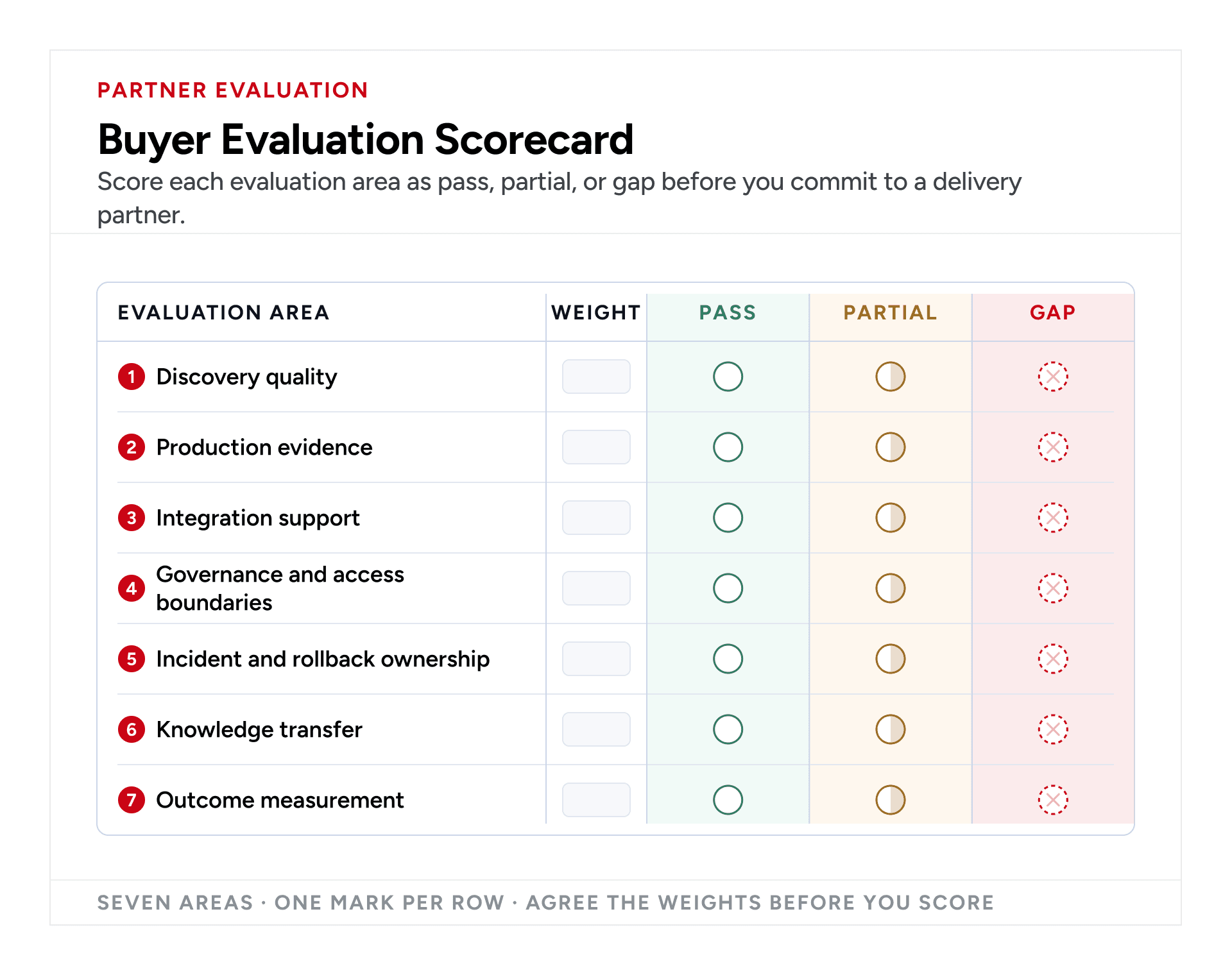
Adding engineering capacity and committing to a delivered outcome are two different things. More hours help only once we have agreed who approves the release, who is on call after launch, and what evidence counts as done. We put those commitments in writing before kickoff, because an engagement built on 'shared ownership' is really just hours with the hard decisions left open.
 Kunal KumarChief Revenue Officer
Agree to These Before Kickoff
Settle each of these in writing so the engagement holds up once work starts.
- Named owners for each production decision
- The customer-side approver who signs the release
- Production access: who is granted it, and its limits
- Support coverage: hours, on-call, and the notification SLA
- Acceptance evidence that defines what "done" means
Warning Signs in a Proposal
Treat any of these as a reason to ask for specifics before signing.
- Undefined "shared ownership" with no named accountable person per decision
- Completion defined only as code delivered, with no acceptance evidence
- No escalation route, or no clarity on who can authorize a rollback
- Post-launch support left unspecified, with no coverage window or notification SLA
This is where GeekyAnts' delivery experience shapes how an engagement is scoped. Engineers who work close to production behave like consultants, questioning requirements and staying accountable after launch, so total cost is best judged by what it takes to reach a reliable production outcome rather than by an hourly rate.
How Do You Measure the Business Value of Clear Production Ownership?
Clear ownership earns its place only if a budget owner can see the value without relying on projected ROI percentages or lines-of-code counts. The measures below track whether delivery becomes more predictable, rework falls, and incidents cost less, using figures a finance or product leader can check against real work. This is where GeekyAnts reads value differently from an output-first engagement: the question is outcomes over output, and what it costs to establish confidence in AI-generated work, rather than how much code the assistant produced.
What to Measure
Several of these measures align with DORA’s software delivery performance metrics, which track delivery performance through measures such as change lead time, deployment frequency, failed deployment recovery time, change fail rate, and deployment rework rate.
Track a small set of delivery signals, and log rework and customer impact as their own figures so they do not disappear inside a throughput number.
Value area | Metric to track | How to read it |
Delivery predictability | Change lead time | Shorter, steadier lead time means releases land when planned |
Release safety | Change fail rate | A falling rate means fewer changes break once live |
Recovery speed | Failed-deployment recovery time | Faster recovery means an incident costs less when it happens |
Avoidable rework | Rework hours, logged separately | Fewer hours mean less effort redoing work that was already accepted |
Customer disruption | Customer-impact incidents, logged separately | Fewer or shorter disruptions mean ownership is reaching the customer |
Set the Value Against Cost
Put any gain next to a simple cost comparison so the figure stays honest. Account for:
- Implementation: the time to map decisions, agree owners, and set up the evidence trail
- Review: the added review steps that higher-risk changes now carry
- Rework: hours spent redoing work that review sends back
- Tooling: the monitoring, scanning, and pipeline changes the framework depends on
- Incident response: the cost of running and recovering from production incidents
Read the Numbers Honestly
Compare similar changes over time rather than claiming a single before-and-after figure. Other shifts in process, team, and tooling move the same metrics, so treat the framework as one contributor to a trend rather than the cause of every improvement.
Keep two distinctions clear when the numbers improve. Recovered engineering capacity is time the team gets back, and it becomes a cash saving only when that time is redeployed or the cost is removed. Faster coding raises throughput, and it becomes a business outcome only once it reaches a customer as a reliable release.
Tie Each Metric to a Leadership Question
Every measure should answer a question a leader already asks, so the data lands in terms the business uses.
Leadership question | Metric that answers it |
Are releases becoming more predictable? | Change lead time trend |
Is rework decreasing? | Logged rework hours |
Are incidents recovering faster? | Failed-deployment recovery time |
Are leaders spending less time resolving ownership disputes? | Count of decisions escalated for unclear ownership |
When we can tell a customer a release will land on a date and hold to it, that changes the commercial conversation. Clear ownership is what makes the date credible, because someone has answered for every decision behind it before we commit. Buyers are not paying for faster code. What they are paying for is a delivery plan they can build their own commitments on, and predictable releases are what give them that.
Kunal KumarChief Revenue OfficerHow Can a Team Implement an AI Engineering RACI Framework in 30 Days?
The four weeks below are an illustrative pilot on one product workflow, run inside a single 30-day window rather than added on top of it. The sequence is bounded and fits inside a busy team's existing delivery cycle, and it is not a guaranteed transformation timeline.
Week | Focus |
Week 1 | Map current responsibilities, list the unanswered ownership questions, and set baseline measures |
Week 2 | Agree accountable owners, approval evidence, escalation, and operational coverage |
Week 3 | Apply the framework to one real change and rehearse a single relevant failure scenario |
Week 4 | Review results, close the gaps found, and assign someone to maintain the matrix inside existing workflows |
Run the pilot as responsibility mapping on a single workflow, then keep it as a governed workflow the team maintains through recurring review rather than a one-off exercise. then kept as a governed workflow the team maintains through recurring review rather than a one-off exercise.
Why Choose GeekyAnts for AI-Assisted Engineering With Clear Production Ownership?
GeekyAnts maps its capabilities to the gaps this article has named, and points to first-party project evidence rather than claims. The same responsible-AI practices the framework asks of any partner apply to how GeekyAnts delivers.
Each gap the article has raised maps to a specific GeekyAnts capability:
- Senior review: code reviews, quality gates, and static analysis before code moves forward
- Release readiness: CI/CD pipelines with automated unit, integration, and end-to-end testing, plus blue-green and canary deployments
- Delivery capacity: engineers who work close to production under a security, CI/CD, and monitoring-first delivery model
- Operational handover: infrastructure tracked in code, with cost and change reviews that leave a clear record
GeekyAnts' published delivery and process transformation approach is the first-party evidence for how it sets up quality gates, automated security scanning, and human code review inside the pipeline.
A verified client example, from a multi-region digital banking platform:
Initial problem | Engineering intervention | Verified outcome |
AWS inefficiencies built up across teams over time, including idle load balancers, oversized compute, and duplicate databases | Removed idle resources, rightsized compute against actual CloudWatch usage, scheduled non-production environments to active hours, and added cost reviews and approvals tracked in Terraform | Monthly AWS cost fell from $8,100 to $3,300, a 60 percent reduction saving over $57,000 a year, delivered with service stability maintained |
Bring these items into the discovery conversation so ownership is settled before any code is written:
- responsibility mapping for the workflow in question
- acceptance criteria that define done
- release evidence and who signs it
- support boundaries and coverage after launch
Internal implementation is enough when the team already holds the accountable roles and the change sits within its expertise. External expertise helps when a gap needs specialist review, added capacity, or independent release evidence, and any commitments are confirmed for the specific engagement.
You can review more of this work in the GeekyAnts case-studies library.
Assign Production Ownership Before the Next Release
AI assistance speeds up how code gets written, and it leaves every downstream decision with a person. The output still has to be reviewed, the release still has to be authorized, and someone still answers for the change once customers are on it.
A RACI that names those owners, states the evidence each one needs, and sets the point where a decision escalates keeps that accountability clear as delivery gets faster. The immediate step is small.
Look at your next release, find one production decision that has no agreed accountable owner, and assign it before the change ships. That single assignment is where clear production ownership starts.
Sources
- DORA, State of AI-assisted Software Development (2025)
- NIST NCCoE, Secure Software Development, Security, and Operations Practices (2026)
- METR, Many SWE-bench-Passing PRs Would Not Be Merged into Main (March 2026)
- DORA, Software Delivery Performance Metrics
- NIST, SP 800-61 Revision 3 (April 2025)
- The EU AI Act's Article 50 transparency