

Key Takeaways
- By 2026, 30% of enterprises will automate over half of their network operations, highlighting the need for self-healing cloud architectures.
- Agentic AI self-healing workflows detect, diagnose, and remediate routine issues while keeping engineers in control of critical decisions.
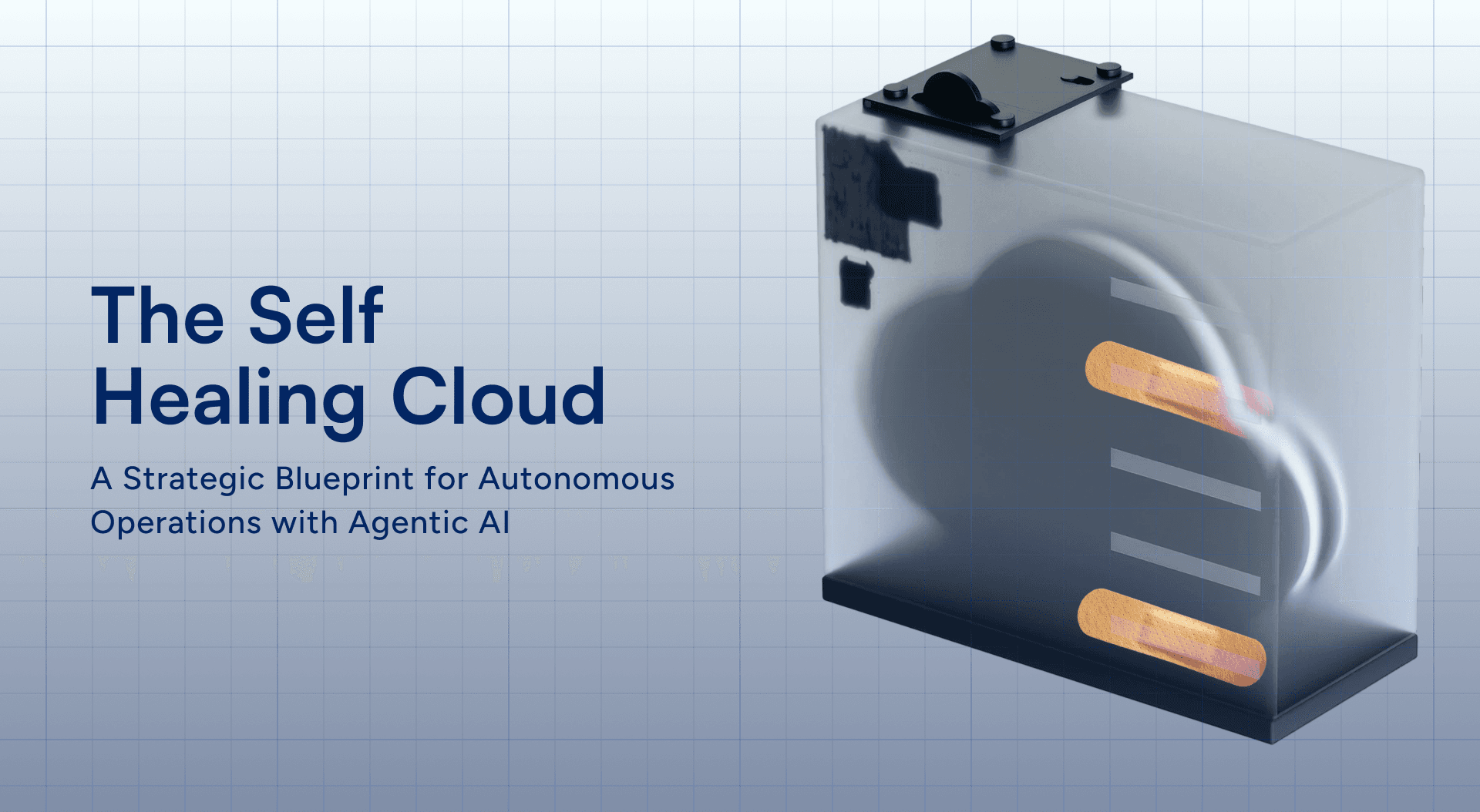
- A self-healing cloud combines observability, AI agents, governance, orchestration, and continuous learning into one operating model.
- Start with observability, validate AI recommendations, then automate low-risk remediation as governance matures.
Why Self-Healing Cloud Operations Are Replacing Traditional Cloud Automation?
“Self-healing cloud operations is simply automation with a fancy layer of AI.”
It is a perspective that is discussed more often when it comes to autonomous operations. It sounds reasonable until you're the engineer staring at a dashboard at 2:43 AM.
Picture a large e-commerce platform during a flash sale. Checkout requests start timing out. CPU usage looks normal. Memory isn't spiking. Kubernetes restarts unhealthy pods after failing liveness or readiness probes. The alerts keep coming. Customers abandon carts. Finance starts asking how much revenue is disappearing every minute.
Now the scramble begins.
An engineer checks deployment history. Another searches logs for a pattern. Someone else compares traces across services hoping one dependency stands out. Thirty minutes later, they discover the culprit: a third-party payment API is slowing down, which is backing up queues, exhausting connection pools, and triggering failures across unrelated services. Every automation rule worked exactly as designed. None of them understood what was actually happening.
That's the difference teams miss.
Why Rule-Based Automation is Reaching its Limits
Traditional automation follows instructions. It waits for a trigger, runs a predefined action, and stops. It works well when the failure looks like something you've already seen. The moment reality changes, those scripts become expensive guesswork.
Gartner predicts that by 2026, 30% of enterprises will automate more than half of their network operations. This shift points toward the fact that the scale and complexity of cloud operations have outgrown rule-based workflows. Modern cloud environments don't fail in predictable ways anymore. Applications spanning hundreds of microservices run across multiple cloud regions while depending on managed services, APIs, containers, and serverless functions. A single incident can leave clues in metrics, logs, traces, deployment events, security policies, and cloud configuration changes at the same time. No one can manually connect every signal that quickly when customers are already feeling the impact.
This is where agentic AI changes the operating model.
Instead of waiting for someone to connect the dots, autonomous agents consume telemetry collected by observability platforms, compare current behavior with historical patterns, investigate related systems, generate possible root causes, rank remediation options, and explain why one action is safer than another. For low-risk issues, they can execute approved playbooks automatically. For higher-risk changes, they pause, present the evidence, and wait for human approval.
The goal is to free operators from repetitive investigative work so they can focus on higher-value operational decisions during incidents.
Market Insight:Worldwide AI spending is forecast to reach$2.59 trillion in 2026, up 47% from 2025. Gartner says AI infrastructure—including AI-optimized IaaS, servers, networking, and processing—will account for more than 45% of AI spending.
As AI workloads increase, managing infrastructure at scale becomes more complex. This is where automated systems trace failures, identify proven fixes, and handle approved recovery steps, which gives teams more time to solve problems that require their experience and judgment.
 Kunal KumarChief Revenue Officer
This guide breaks down what it takes to build a self-healing cloud with Agentic AI. You'll see how observability, intelligent agents, governance, approval workflows, and continuous learning fit together into an architecture that can detect problems, decide on the safest response, and recover systems without sacrificing control.
What a Self-Healing Cloud Means for Enterprise Cloud Leaders?
What is a self-healing cloud in an enterprise environment?
A self-healing cloud is an approach where cloud platforms can monitor their own health, identify why an issue occurred, recommend the next step, and carry out approved recovery actions with limited manual effort. It reduces repetitive investigation and routine recovery work, allowing engineers to focus on improving the platform instead of resolving the same operational issues repeatedly.
Unlike traditional automation, a self-healing cloud goes a step further. It looks at infrastructure metrics, application logs, deployment history, service dependencies, and policies together to understand what happened before deciding what to do next. Every recommendation is checked against governance rules, and higher-risk changes can still require human approval before execution.
For enterprise leaders, the value goes beyond resolving incidents faster. A self-healing cloud helps improve service reliability, reduce time spent on recurring operational issues, lower support costs, and give development teams more uninterrupted time to build and release software. At the same time, governance, security, and compliance remain part of every decision rather than becoming an afterthought.
How is a self-healing cloud different from automation, AIOps, and autonomous cloud operations?
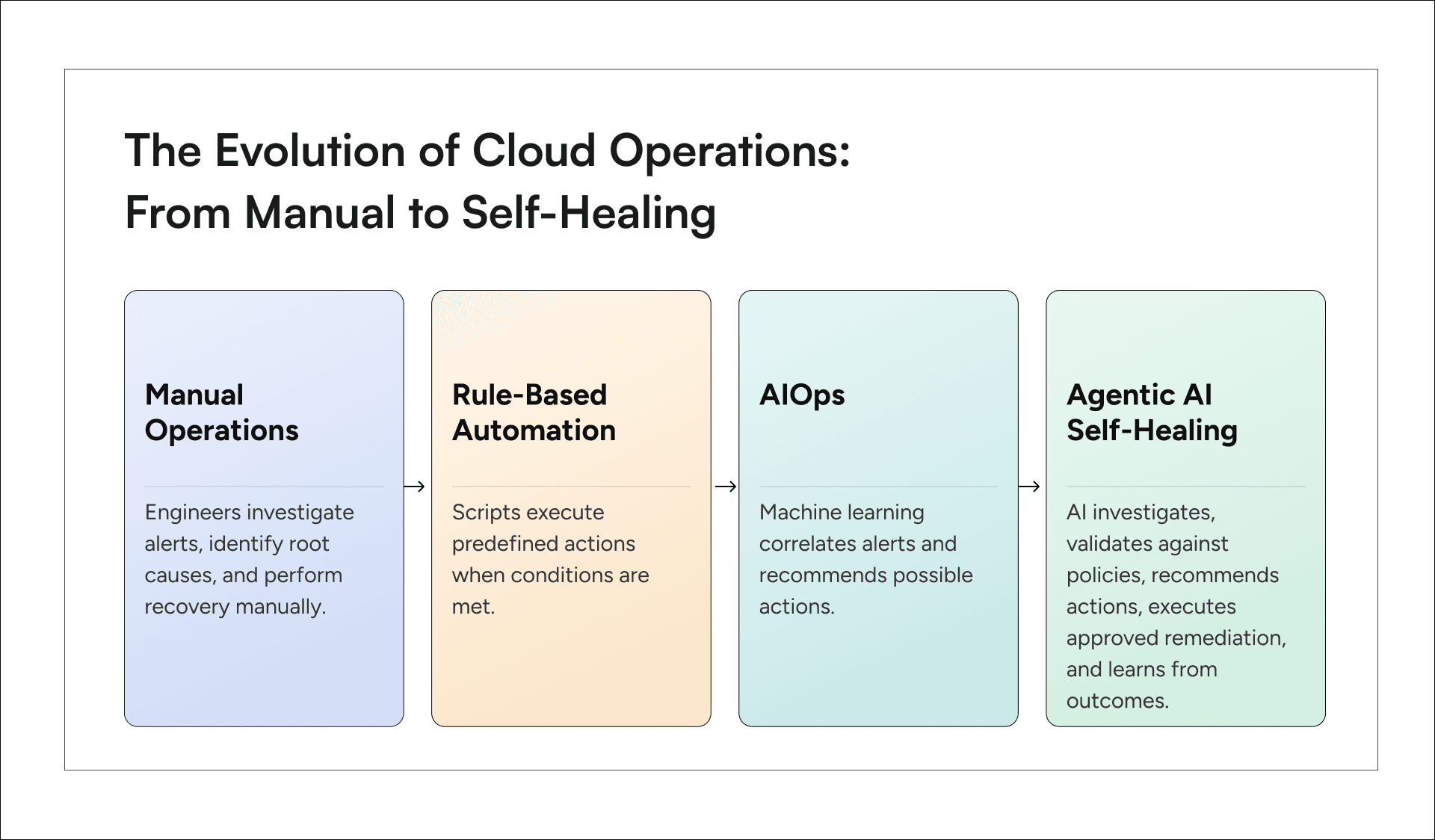
Many organizations already use automation and AIOps, but these capabilities represent different stages of maturity rather than interchangeable concepts.
Capability | Primary Focus | Limitation |
Rule-based automation | Executes predefined tasks when specific conditions are met. | Cannot adapt when failures fall outside predefined rules. |
AIOps | Uses machine learning to correlate events, reduce alert noise, and surface operational insights. | Often stops at detection and recommendations, leaving remediation to engineers. |
Agentic AI self-healing workflows | Continuously detect, diagnose, recommend, validate, and execute approved remediation while learning from previous incidents. | Requires quality data and approval policies. |
Autonomous cloud operations | Represents the long-term operating model where low-risk operational activities can run independently under enterprise guardrails. | Success depends on observability, and continuous oversight rather than complete autonomy. |
This distinction reflects the way enterprises take up autonomous operations. Organizations shift from reactive operations toward governed autonomy gradually, where AI assists engineering teams while humans retain control over critical business decisions.
How do Agentic AI self-healing workflows actually support engineering teams?
An Agentic AI workflow is easier to think of as an operations teammate than a standalone AI model. It doesn't stop at detecting an alert or answering a question. It works toward a goal, whether that's keeping an application available, recovering a failed deployment, or reducing service disruptions.
To do that, the workflow pulls together information from monitoring tools, cloud infrastructure, deployment pipelines, configuration repositories, and past incidents. It pieces the evidence together, identifies the most likely cause, recommends a recovery plan, checks whether that action follows organizational policies, and either carries it out or sends it for human approval. Every incident, recommendation, and outcome is recorded, giving the system more context for handling similar situations in the future.
Over time, this creates a feedback loop where routine investigations take less time and recurring issues are handled more consistently,
Why are enterprises investing in self-healing cloud operations now?
As organizations adopt microservices, Kubernetes, hybrid cloud, and distributed applications, complexity increases much faster than engineering headcount. A single customer-facing incident may involve infrastructure, networking, application code, third-party APIs, and security controls which makes manual troubleshooting increasingly difficult under time pressure.
Imagine a digital banking platform performing during peak transaction hours. If a critical payment service starts experiencing abnormal latency because of an infrastructure issue, the monitoring tool will generate multiple alerts across different systems before engineers identify the root cause. A self-healing cloud can correlate these signals, determine whether the issue is related to infrastructure, deployment, or application behavior, and recommend a policy-approved recovery action. The same operational model applies across industries such as healthcare, manufacturing, retail, telecommunications, and SaaS, where maintaining service availability directly impacts customer trust and business continuity.
Enterprise decision-makers may not view autonomous infrastructure as a strategic advantage. It solely depends on building cloud operations that are resilient by design, governed by policy, and capable of responding to routine issues with greater speed and consistency while ensuring engineers minimize or prevent repetitive firefighting.
How to Design a Self-Healing Cloud with Agentic AI? : A Reference Architecture
The biggest misconception about autonomous cloud operations is that they remove engineers from the loop. Effective architectures automate repetitive operational work while keeping engineers central to high-impact decisions. Every critical action should remain transparent, explainable, and governed. AI should accelerate engineering teams without replacing their judgment.
 Deepanshu GoyalSenior Software Engineer - III
A self-healing cloud is a layered operating model where observability, intelligence, governance, orchestration, and human oversight work together in a feedback loop on a continuous basis. Each layer has a specific responsibility to introduce autonomous capabilities without compromising security, compliance, or operational control.
Instead of rebuilding existing cloud platforms, this architecture can be integrated into AWS, Azure Google Cloud, hybrid environments, Kubernetes clusters, and modern CI/CD pipelines. The objective is to make decisions faster while ensuring every action follows enterprise policies and can be audited or reversed when necessary.
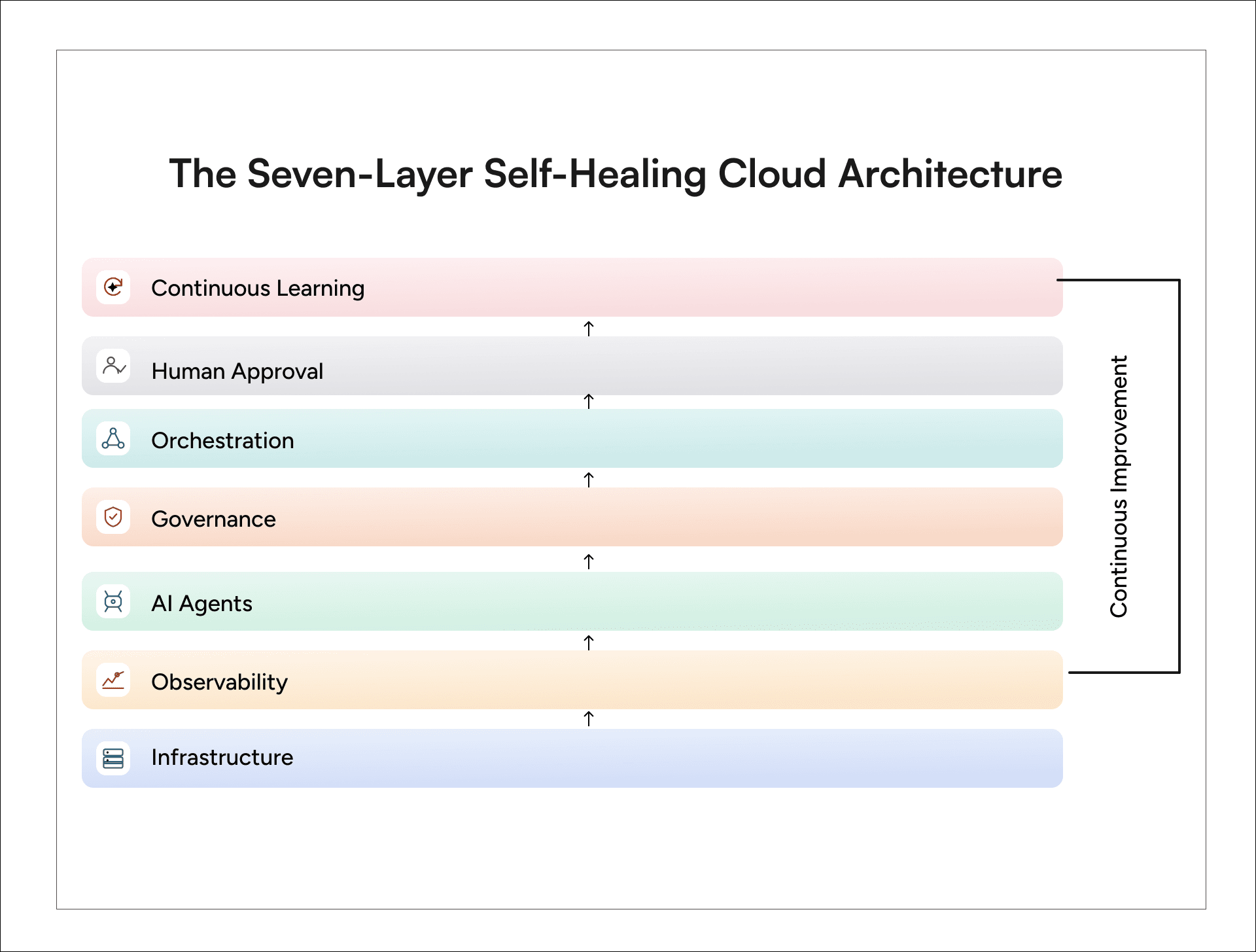
Layer 1: Cloud Infrastructure
This foundation consists of infrastructure where enterprise applications run. That could be public cloud platforms, hybrid environments, virtual machines, Kubernetes clusters, serverless services, or container-based workloads. This is where applications are deployed, requests are processed, and operational issues first begin to surface.
Every workload running in this layer produces information that helps explain what's happening across the environment. Infrastructure metrics, application logs, deployment records, configuration updates, and network activity all become inputs for understanding system health and identifying problems. Infrastructure-as-Code tools such as Terraform help keep these environments consistent by managing changes through version-controlled, repeatable deployments instead of manual updates.
The architecture is designed to work across different cloud environments rather than being tied to a single provider. Whether an organization runs workloads on AWS, Microsoft Azure, Google Cloud, or a combination of cloud and on-premises infrastructure, the same foundation supports the rest of the self-healing cloud architecture.
Layer 2: Observability and Telemetry
A self-healing cloud can only respond to what it observes. If operational data is scattered across different tools, finding the cause of an issue becomes slow and uncertain. This layer brings together metrics, logs, traces, and events into a single view, which makes it easier to understand what's happening across the environment instead of reacting to isolated alerts.
Telemetry collected through platforms such as OpenTelemetry, Prometheus, Datadog, and Azure Monitor provides the signals needed to track how applications and infrastructure behave over time. More importantly, it connects those signals. A deployment change can be linked to a spike in latency. A configuration update can be tied to a service outage. A drop in application performance can be viewed alongside infrastructure activity and user impact. That shared context gives AI agents enough evidence to investigate incidents, identify likely causes, and recommend the next action.
Layer 3: Agentic Intelligence
This is the layer where operational data turns into action.
Instead of reacting to one alert at a time, AI agents look at logs, metrics, traces, deployment records, service dependencies, and configuration changes together. They connect the signals, identify the most likely cause of an issue, estimate its impact, and recommend the next course of action based on the available evidence.
Depending on the organization's needs, frameworks such as LangGraph, LangChain, or the Model Context Protocol (MCP) can coordinate multiple agents, with each handling a different responsibility such as investigation, planning, validation, or documentation. Working together, these agents create a structured workflow instead of a series of isolated tasks.
Layer 4: Policy and Governance
Autonomous cloud operations begin with governance, not automation.
Before an AI agent recommends or carries out any action, it checks the decision against the rules the organization has already defined. These rules can include security requirements, compliance obligations, operational risk, maintenance windows, approval workflows, access permissions, and spending limits. This ensures the system works within the same boundaries that platform and operations teams follow every day.
This layer keeps AI-driven actions aligned with business priorities while reducing the chance of changes that could create security, compliance, or operational issues. It also creates a record of every decision by capturing what the agent recommended, why it made that recommendation, and which policies shaped the final outcome. That visibility makes reviews, audits, and future investigations much easier.
Layer 5: Remediation and Orchestration
Once a recovery action is approved, this layer takes care of carrying it out.
In a mature self-healing cloud architecture, this layer supports actions like restarting failed workloads, rolling back deployments, updating configurations, scaling resources, provisioning infrastructure, or triggering existing incident-response workflows. These actions can be integrated with the operational tools organizations already use, including GitHub Actions, ServiceNow, Kubernetes controllers, and existing CI/CD pipelines.
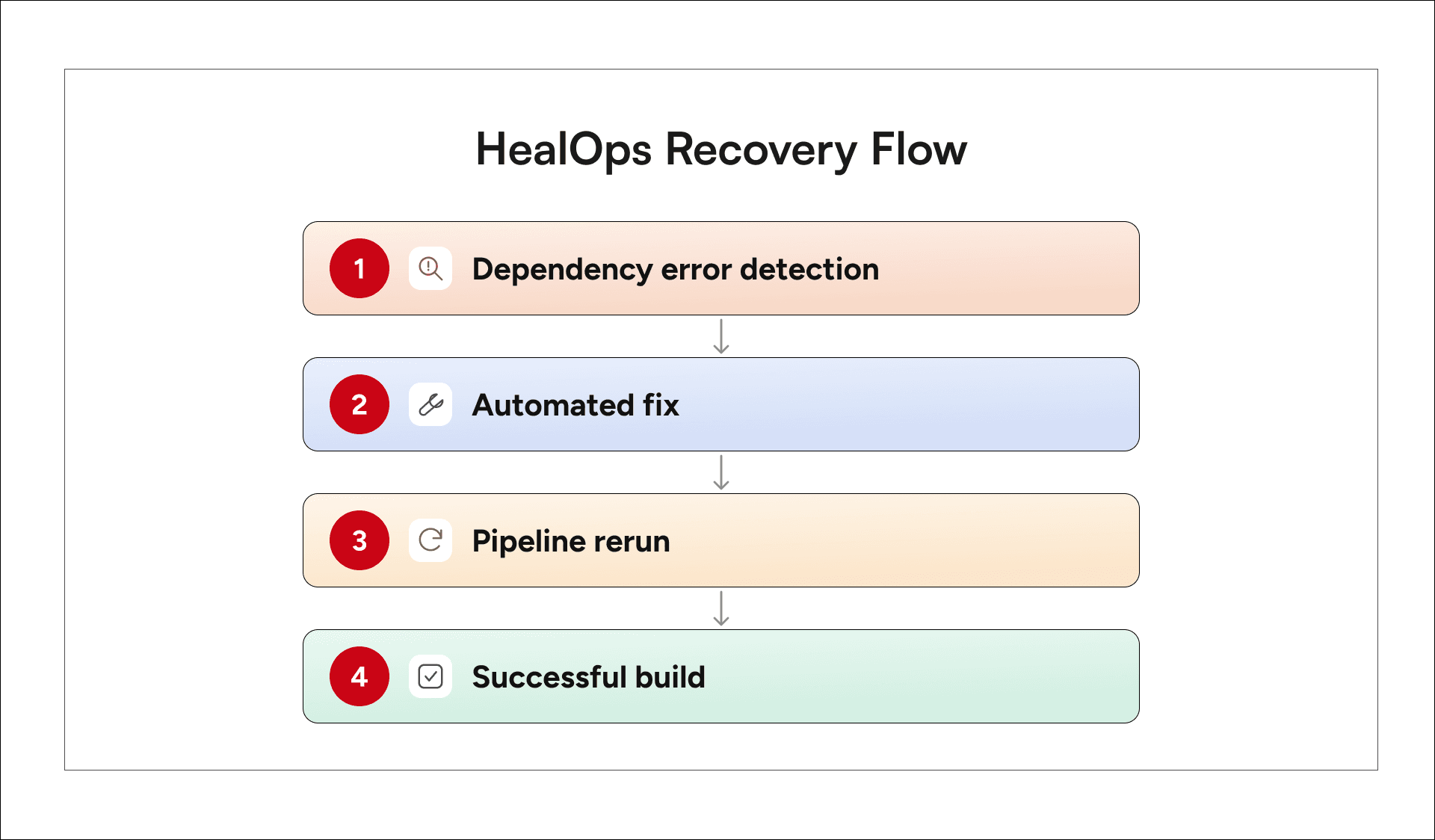
HealOps currently explores a narrower part of this model. Our R&D proof of concept focuses specifically on CI/CD recovery: detecting a failed pipeline, diagnosing the failure, generating a proposed fix, validating that fix through a pipeline rerun, and bringing an engineer into the workflow when review or judgment is required.
Extending the same approach into infrastructure and application-level remediation represents a broader future direction for self-healing cloud operations rather than a capability demonstrated by HealOps today.
Layer 6: Human Approval and Audit
A self-healing cloud still requires human audit.
Routine operational tasks with limited risk can run automatically once they meet the organization's policies. Changes that affect production services, customer experience, security, compliance, or business risk continue through the existing approval process. AI investigates, recommends, and executes approved actions where permitted, while platform owners retain final authority over production decisions.
Every step is recorded along the way. The system captures what was detected, what action was recommended, who approved it, what was executed, and what happened afterward. That audit trail makes it easier to review incidents, support compliance requirements, understand why a decision was made, and build trust in AI-assisted operations over time.
Layer 7: Continuous Learning
A self-healing cloud learns from every incident it handles.
Each resolved issue adds to the system's operational knowledge. It records what caused the problem, which recovery approach worked, which attempts failed, how deployments behaved after the fix, and when human approval was needed. Over time, that history helps the system recognize similar patterns, prioritize incidents more effectively, and recommend responses based on what has worked before.
This creates a feedback loop where the platform improves through day-to-day operations while updating scripts for every new situation. As applications, infrastructure, and business needs change, the self-healing system adapts alongside them.
Why Does This Architecture Scale for Enterprise Operations?
A layered architecture gives organizations a way to introduce autonomous cloud operations without changing everything at once. Each layer has a role which makes it possible to improve one capability at a time. Teams can start by strengthening observability, add AI-assisted investigation, introduce governance and approval policies, and then expand automated remediation for the required operational outcomes.
As every layer works independently, the same architecture fits different technology environments. It can support workloads running across multiple cloud providers, Kubernetes clusters, virtual machines, hybrid infrastructure, and existing CI/CD pipelines without requiring organizations to rebuild the way they operate.
How Do You Govern Self-Healing Cloud Operations Without Losing Human Judgement?
Trust is the biggest barrier to adopting self-healing cloud operations, even when the technology is ready.
Most engineering leaders already believe AI can help investigate incidents, correlate telemetry, or recommend fixes. The hesitation begins when those recommendations turn into production changes. No business would want an AI agent restarting customer-facing services, modifying infrastructure, or rolling back deployments without knowing why it made that decision or what could happen next.
That's why successful autonomous cloud operations begin with governance.
A well-designed self-healing cloud defines the boundaries around what an agent can observe, what actions it can recommend, what it is allowed to execute, and when a human must step in. Every decision follows the same operational policies that engineering teams already use today. The difference is that routine work happens faster, while high-impact decisions remain under human oversight.
What makes autonomous cloud operations trustworthy?
Trust comes from controls, not intelligence.
Before an AI agent can remediate an incident, it should answer the same questions an experienced platform engineer would ask:
- What evidence supports this diagnosis?
- Has this issue occurred before?
- Which systems will be affected?
- Does the proposed action comply with security and policies?
- Can the change be reversed if the outcome is unexpected?
If the system cannot explain its reasoning, the safest action is often no action at all.
This is why explainability should be treated as an operational requirement that must be incorporated in every AI-assisted decision. Every recommendation needs supporting evidence, whether it comes from infrastructure metrics, deployment history, service dependencies, configuration changes, or previous incident records. Teams should be able to trace every decision from the original alert to the final remediation without guessing how the conclusion was reached.
Which controls should every self-healing cloud include?
Governance becomes practical when every remediation passes through a consistent set of safeguards.
- Human approval for critical actions ensures that changes affecting production databases, customer-facing services, or security configurations are reviewed before execution.
- Least-privilege access limits what each AI agent can do. An agent responsible for restarting containers should not have permission to modify IAM policies or delete infrastructure resources.
- Policy-based remediation prevents agents from acting outside predefined operational rules. If a remediation violates security, compliance, or cost policies, the workflow should stop automatically instead of requesting forgiveness later.
- Audit trails record every observation, recommendation, approval, execution, and rollback. This becomes essential during compliance reviews, post-incident analysis, and internal security investigations.
- Rollback mechanisms give teams a recovery path when remediation produces an unexpected result. Every automated change should include a defined way to return systems to a known stable state.
- Sandbox validation and canary remediation reduce risk before production changes. Instead of applying a fix across an entire environment, the workflow can test it in an isolated environment or roll it out to a small percentage of workloads. If health metrics remain stable, the change continues. If not, the system stops and restores the previous state.
Operational limits matter too. AI agents should be aware about rate limits, maintenance windows, cloud spending thresholds, and deployment policies just as engineers do. Governance is not about slowing automation down. It ensures automation behaves predictably under pressure.
Which remediation actions should AI handle automatically?
Different incident types require different levels of automation based on the level of operational risk involved.
Risk Level | Example Actions | Recommended Execution |
Low risk | Restarting a failed container, clearing cache, scaling replicas, retrying a failed job | Autonomous execution after policy validation |
Medium risk | Rolling back a deployment, updating infrastructure configuration, reallocating workloads | Human approval before execution |
High risk | Database schema changes, IAM policy updates, network security modifications, deleting cloud resources | Manual execution with engineering review |
This approach allows organizations to automate repetitive operational work while keeping strategic decisions under human control.
How do organizations move toward autonomous cloud operations safely?
Organizations in banking, healthcare, retail, and manufacturing require autonomous systems, as modern cloud environments produce more operational signals than engineers can investigate manually. Governance is what makes that scale manageable. It creates the confidence to automate routine work without sacrificing security, compliance, or accountability. In practice, the most successful self-healing cloud is the one that knows when to act, when to ask, and how to prove every decision it makes.
Stage | What Happens |
Advisory mode | AI detects issues and recommends actions. Teams execute every change. |
Assisted remediation | AI gathers evidence, identifies root causes, and prepares remediation plans. |
Human-approved execution | Approved actions are executed automatically after engineering review. |
Autonomous execution for low-risk actions | Routine remediation runs independently within predefined policies and limits. |
Governed self-optimization | The platform learns from incidents on a continuous basis, improves remediation playbooks, and refines future decisions while remaining fully auditable. |
Related reading: Self-Healing AI Agents: Governance to Production Guide - A deeper look into the guardrails that help AI agents operate safely in production.
HealOps: How We Built an AI Agent That Automatically Diagnoses and Fixes CI/CD Pipeline Failures - A GeekyAnts R&D Experiment
Every growing business reaches the same point sooner or later. The delivery pipeline becomes another product to maintain. A failed deployment doesn't always mean broken code. Sometimes it's a dependency update that behaves differently across environments. Sometimes it's infrastructure drift. Sometimes a configuration changes without anyone noticing. The pipeline turns red, releases stop, and someone has to spend the next hour reading logs instead of shipping features.
During GeekyAnt’s internal research on autonomous cloud operations, we kept seeing the same pattern. Most pipeline failures weren't unique problems. They were familiar issues appearing in different repositories, different branches, and different projects. Yet teams were diagnosing each failure from scratch.
That observation led to HealOps, our research initiative exploring how Agentic AI can reduce repetitive operational work in modern software delivery pipelines. Instead of waiting for someone to investigate every failed build, HealOps watches pipeline events, understands what failed, searches previous fixes, proposes a solution, validates it, and escalates only when human judgment is required.
The Challenge We Wanted to Solve
Modern CI/CD pipelines fail for many reasons, including:
- Dependency mismatches after package updates
- Configuration drift between environments
- Infrastructure provisioning failures
- Build and runtime inconsistencies
- Test regressions introduced during development
Individually, these issues are manageable. Across dozens of repositories and hundreds of deployments, they become a constant drain on delivery velocity. Teams spend hours switching between GitHub, CI tools, log platforms, Slack, and dashboards simply to answer one question:
Why did this pipeline fail?
Why We Built HealOps?
HealOps was designed as an AI-assisted pipeline recovery system that takes on repetitive investigation, fix generation, and validation while keeping engineers responsible for changes that require review or judgment.
Instead of treating every failure as a fresh incident, the system follows a structured decision process:
- Detection-Watches GitHub webhook events and immediately identifies failed pipeline executions.
- Log Analysis- Cleans noisy build logs, isolates meaningful errors, and gathers related source code for context.
- Semantic Search- Compares the failure with previously resolved incidents stored in a vector database to identify similar patterns.
- AI Diagnosis- Classifies the failure, evaluates possible fixes, and generates a remediation plan with confidence scoring.
- Fix and Validation- Creates a pull request, reruns the pipeline, and verifies whether the proposed change resolves the issue before requesting review.
The objective is to shorten the time between failure detection and a validated fix.
How Is HealOps Architected for Autonomous Pipeline Recovery?
HealOps follows a distributed, event-driven architecture designed to separate detection, decision-making, and execution into independent services. This modular approach improves scalability, simplifies maintenance, and allows individual components to evolve without affecting the rest of the system.
The platform consists of three core operational layers:
- Detection Layer- Continuously monitors CI/CD pipelines, captures failure events, and collects execution context from build systems.
- Reasoning Layer- Analyzes logs, pipeline metadata, dependency information, and historical incidents to determine probable root causes and recommend remediation.
- Orchestration Layer- Coordinates approved recovery actions, validates outcomes, updates records, and feeds successful resolutions back into the learning system.
HealOps itself is built as an Nx monorepo with separate backend, worker, and frontend applications which enables an independent scaling of pipeline processing, AI reasoning, and user experience.
Which Technologies Were Used to Build HealOps?
HealOps was built using technologies that support reliability, asynchronous execution, and AI-assisted reasoning.
Key components include:
Layer | Technology |
Backend APIs | NestJS, TypeScript |
Frontend | |
Database | PostgreSQL with Drizzle ORM |
Semantic Search | pgvector |
Queue & Caching | Redis, BullMQ |
AI Orchestration | LangGraph, LangChain |
LLM Gateway | OpenRouter |
AI Models | Claude Sonnet 3.5 (replaceable) |
This architecture intentionally keeps AI services loosely coupled which allows different language models or orchestration frameworks to be evaluated without redesigning the platform.
What Results Did HealOps Demonstrate?
During internal experimentation, HealOps demonstrated improvements in recovery efficiency for recurring CI/CD failures. By automating diagnosis, fix generation, and validation, the system reduced repetitive investigation while keeping each step of the recovery workflow visible to engineers.
During internal experimentation, HealOps demonstrated improvements in recovery efficiency for recurring CI/CD failures. By automating diagnosis, fix generation, and validation, the system reduced repetitive investigation while keeping each step of the recovery workflow visible to engineers.
Metric | Traditional Pipeline Operations | HealOps |
Mean Time to Recovery | 30 - 60 minutes | ~3 minutes |
Estimated Cost per Incident | ~$150 in engineering effort | ~$0.05 in AI inference cost* |
Developer Interruptions | Frequent | Significantly reduced |
Night & Weekend Pipeline Failures | Manual intervention required | Eligible for automated recovery (based on governance policies) |
This test illustrates the recovery loop HealOps was designed to handle, that involved moving from a failed pipeline to a validated fix while reducing the need for repetitive manual investigation.
Safety Incorporated in Every Decision
Autonomous systems should earn trust before they receive any permissions. HealOps follows the principle of least privilege throughout the remediation process.
- Changes are written only to temporary branches.
- Protected branches remain inaccessible.
- Every code change requires human review before merging.
- Retry attempts are capped to prevent endless repair loops.
- The agent ignores its own generated branches to avoid recursive execution.
This keeps automation inside clearly defined guardrails while allowing teams to benefit from faster recovery.
One Dashboard Instead of Five Different Tools
HealOps also includes a Next.js dashboard that brings the entire remediation lifecycle into one place.
Teams can view connected repositories, browse branches, inspect individual commits, and track pipeline status from a single interface. Each pipeline run records what failed, what the AI agent changed, whether validation passed, and why the recommendation was made. Instead of opening multiple dashboards and reading raw logs, decision-makers get a complete audit trail from failure detection to proposed resolution.
Why Does This Matter for Self-Healing Cloud Operations?
HealOps serves as our CI/CD proving ground for the broader self-healing cloud model. Its current scope centers on pipeline recovery: detecting a failure, reading the logs, identifying what likely went wrong, preparing a fix, and rerunning the pipeline to validate the change. When review, risk assessment, or production judgment is required, the engineer takes over.
This keeps the repetitive recovery loop moving while engineers remain responsible for decisions where context matters.
How to Build Production-Ready Self-Healing Cloud Operations? - An Enterprise Implementation Roadmap
Self-healing cloud operations require a phased implementation that builds on existing monitoring, automation, and operational processes. Most enterprise teams already have monitoring tools, automation scripts, and incident runbooks. The challenge is getting these pieces to work together in a way that reduces effort without increasing operational risk.
The safest approach is to introduce autonomy in stages. Each phase should solve a specific problem, produce measurable outcomes, and prove that the next level of automation is safe. The roadmap below helps cloud leaders move from reactive operations to governed self-healing systems without disrupting production environments.
Phase | Primary Goal | Expected Outputs |
1. Assess Cloud and Observability Readiness | Review telemetry coverage, monitoring quality, logging, tracing, and infrastructure visibility. Identify blind spots before introducing AI-driven decisions. | Architecture map, observability assessment, telemetry inventory |
2. Prioritize Incidents and Workflows | Identify repetitive incidents that consume engineering time. Focus on failures with predictable recovery paths such as failed deployments, disk space issues, pod crashes, certificate renewals, or resource exhaustion. | Use-case backlog, incident priority matrix, remediation candidates |
3. Design Agentic Workflows | Define how cloud agents will detect problems, collect evidence, diagnose root causes, recommend actions, and validate outcomes. Establish clear responsibilities between agents and human operators. | Workflow diagrams, agent tooling matrix, remediation playbooks |
4. Build Governance and Policy Controls | Decide what agents can observe, recommend, and execute. Define approval requirements, rollback rules, access permissions, audit logging, and compliance checks before any production action is allowed. | Risk register, approval matrix, governance policies |
5. Launch in Advisory Mode | Run agents without allowing them to change infrastructure. Compare their recommendations with actions taken by SREs and platform engineers. Measure accuracy and identify gaps before enabling execution. | Recommendation reports, accuracy benchmarks, policy refinements |
6. Enable Human-Approved Remediation | Allow engineers to approve low-risk remediation actions while agents handle diagnosis, planning, and execution. Every action should generate evidence and remain fully traceable. | Approved remediation workflows, playbooks, audit records |
7. Expand Autonomous Remediation for Low-Risk Actions | Once governance is reliable, automate repetitive, low-impact fixes such as restarting unhealthy services, clearing temporary storage, scaling workloads, or replacing failed nodes. Human approval remains mandatory for higher-risk actions. | Autonomous remediation catalog, policy updates, rollback validation |
8. Continuously Learn and Optimize | Review incidents after execution, evaluate outcomes, refine policies, and improve decision quality using historical data. The system becomes better through operational feedback instead of accumulating more scripts. | ROI measurement framework, updated playbooks, continuous improvement backlog |
Each phase should end with measurable progress rather than assumptions. If a team cannot explain why an agent recommended a recovery action or cannot safely reverse it, it signals towards the fact that the implementation is moving too quickly.
Success should also be measured beyond uptime. Traditional infrastructure metrics remain important, but enterprise teams should also track how operations improve over time.
Monitor KPIs such as:
- Mean Time to Resolution (MTTR)to measure how quickly incidents are resolved.
- Change Failure Rate to understand whether automated actions introduce new problems.
- Deployment Frequency to determine whether engineering teams release software more confidently.
- Incident Volume to verify that recurring operational issues decline over time.
- Alert Fatigue by tracking unnecessary alerts and manual investigations.
- Developer Interruption Hours to measure how much engineering time shifts from firefighting to product work.
- Cloud Cost Anomaly Response Time to evaluate how quickly unusual spending patterns are detected and addressed.
- Customer-Impacting Outage Minutes to measure improvements that users actually experience.
The roadmap is intentionally incremental because enterprise operations reward predictability over speed. Teams that begin with governance, validate recommendations before execution, and automate only where confidence is high usually. This expands autonomy faster than teams trying to automate everything from day one.
The destination is to get to a cloud platform where engineers spend less time chasing repetitive failures and more time improving performance and customer experience. And that is exactly what production-grade self-healing cloud operations need to provide.
Why Choose GeekyAnts for Agentic AI and Self-Healing Cloud Initiatives?
The right place to start an AI initiative is to assess the processes that consume most of the business's time. Once those processes are clear, teams can identify where an AI agent can take action, where human judgment is needed, and where it can create the required value.
Kunal KumarChief Revenue OfficerBusinesses are increasingly exploring AI to make everyday work faster and more connected. They want customer support teams to find answers in seconds, internal knowledge to be accessible across departments, and routine workflows to run with less manual effort. That's where AI agents make a difference by fitting into existing workflows and helping people get more done with the systems they already use.
GeekyAnts builds AI agents that connect with enterprise systems, understand business context, reason through tasks, and take action within defined policies and human approval workflows. The focus is always on helping businesses automating work while maintaining transparency and control.
Every organization has different operational priorities. Some need AI agents to monitor cloud infrastructure and respond to incidents. Others want agents that coordinate workflows across business applications, retrieve knowledge from enterprise systems, or support decisions with the right context. We design each solution around the way the business operates, ensuring the agent fits naturally into existing technology and workflows.
Our work combines strategic consulting with hands-on product engineering. From identifying the right use cases and defining agent behavior to integrating enterprise data, LLMs, cloud platforms, and business applications, we help businesses take Agentic AI from concept to production. Governance, security, and human oversight remain part of every implementation, allowing organizations to adopt autonomous systems with confidence
We also invest in our own R&D to validate ideas before recommending them to clients. Projects like HealOps and the Estimation Builder show how we approach product development by solving operational problems first, then use AI where it delivers value.
Should Enterprises Invest in Self-Healing Cloud Operations?
Self-healing cloud operations give teams a better way to manage growing cloud complexity. Instead of spending hours tracing failures across dashboards, logs, and deployment histories, they can rely on Agentic AI to investigate incidents, connect the evidence, recommend the right response, and carry out approved actions within defined guardrails.
Adoption doesn't happen overnight. It begins with stronger observability, better governance, and carefully selected use cases before expanding into broader responsibilities. Organizations that follow this path build platforms that recover faster, reduce operational overhead, and maintain visibility in every decision. This creates a positive impact in cloud operations where routine issues consume less time, critical decisions remain under human control, teams spend less time fixing recurring problems and more time building and improving products customers will use.