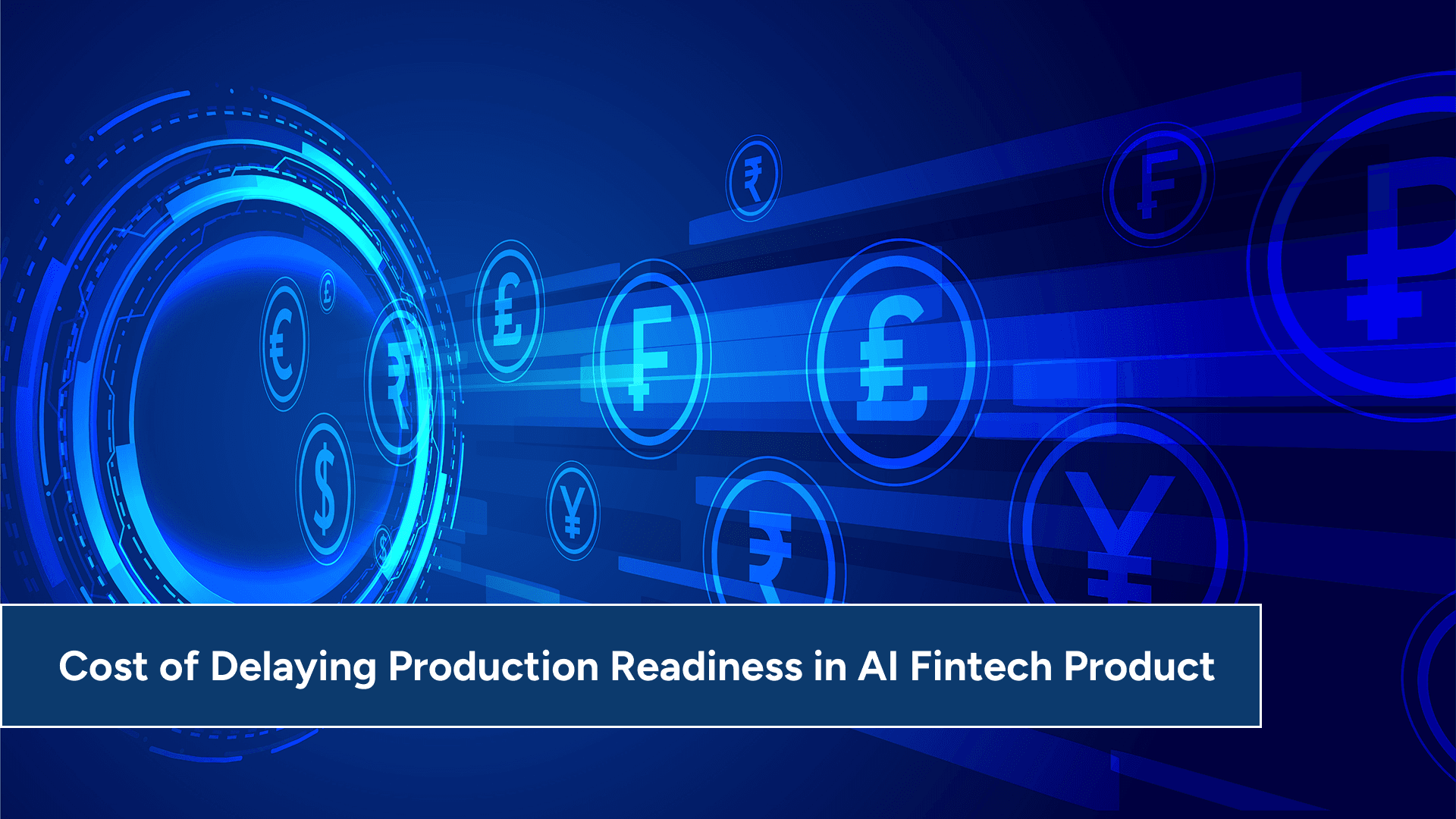

AI product development in fintech has reached a scale where production readiness determines the outcome of the entire investment. McKinsey's State of AI 2025 found that 94% of organizations report no significant value from their AI investments, even as deployment has grown across business functions. In fintech, where regulatory pressure, data sensitivity, and real-time performance requirements leave little room for error, that number points to a specific and recurring problem. AI products are reaching production without the architecture, data integrity, and compliance alignment required to perform at that stage, and the decisions responsible for that outcome are made long before launch.
The Line Between a Working Pilot and a Production-Ready System
Fintech AI products that fail in production are compromised at the scoping stage. Data availability is assumed before anyone has verified what the production environment holds. The business problem gets defined in broad terms, leaving the team with goals that cannot be tracked or validated. Compliance obligations, data handling requirements, and performance thresholds get scheduled for a later phase of the build, at a point when incorporating them carries a higher cost.
By the time these gaps become visible, the product is deep into development. Addressing them at that stage demands significant time and budget, and stakeholder confidence in the investment erodes. In fintech, where regulatory requirements are fixed and the market window for a new product is finite, absorbing that cost late in the build is a problem that the initial scoping decisions created.
Why Production Readiness Gets Pushed to the Back of the Build
Shipping an AI product in fintech involves competing demands that pull the build in different directions from the start. Investor timelines, competitive pressure, and internal delivery targets push teams toward speed, and production readiness work is what gets deprioritized when those pressures mount.
The production environment in fintech has specific conditions that shape how an AI product performs. Fraud detection models encounter live transaction patterns with a volume and variability that expand well beyond what historical datasets hold, and the rework that follows disrupts timelines and consumes budget. Credit decisioning systems that cleared internal review surface data quality issues the moment they connect to live sources, stalling deployment at the point where the product was supposed to start delivering value. Compliance requirements that were noted early become structural problems when they are addressed after the architecture has been built, at a stage where fixing them means dismantling decisions the rest of the build depends on.
In fintech, where regulatory timelines are fixed and market windows are narrow, these are the conditions that determine whether an AI product reaches its intended scale, and how much it costs to get there.
The Business Cost of Getting There Late
An AI product that arrives at production underprepared generates costs across multiple dimensions simultaneously. They accumulate across delayed timelines, unplanned rebuilds, and a growing distance between what the product was scoped to deliver and what it is capable of delivering in a live environment.
A build that requires significant rework after deployment consumes budget that was allocated to product improvement and future development. In fintech, that rework often surfaces alongside regulatory exposure. The SEC obtained $8.2 billion in financial remedies in fiscal year 2024, the highest amount in its history, and a meaningful share of those actions targeted governance and compliance gaps in production systems across financial services.
Fintech companies with production-ready AI systems are compressing development cycles and building cost structures that set the pace for the broader market. The teams absorbing remediation costs at the production stage are drawing on the same resources required to maintain that pace, and the pressure from both directions compounds over time
How Readiness-First Development Changes the Outcome
Scoping a fintech AI product for production means verifying data availability against the environment before engineering begins, defining success in measurable terms, and treating compliance obligations as architectural inputs. The business problem gets defined with enough precision that success has a measurable standard before a line of code is written. Data availability gets verified against the actual production environment, accounting for the inconsistencies and access constraints that emerge outside controlled testing conditions. Compliance obligations get incorporated into the architecture at a point where they inform design decisions, at a stage when the cost of doing so is manageable.
The build moves through distinct checkpoints, each one answering a specific question before the next stage receives investment. A proof of concept establishes whether the approach is technically feasible. A pilot confirms whether the system performs under conditions that resemble actual use. Full deployment follows when both stages have produced evidence that the system is ready for the environment it will operate in. This structure keeps expensive production failures from compounding, because the conditions that produce them get resolved earlier in the process.
For fintech product teams, a system built on this foundation arrives at production with the architecture, data integrity, and compliance alignment already in place. The product reaches users performing at the standard the environment demands, and the investment behind it delivers what it was scoped to deliver.
Building Toward the Standard That Is Coming
Fintech is moving toward a point where production-ready AI is the baseline expectation. The companies that build toward that standard now will have the operational foundation to compete as that expectation takes hold. The investment required to get there is the same investment that the build demands. The difference lies in where the decisions get made and when.
GeekyAnts has worked through this process across fintech and financial services engagements, from payment platforms processing over 400 million transactions annually to compliance-critical migrations executed without service disruption. If your team is evaluating an AI product investment or working through what a responsible delivery process looks like at any stage of the build, explore our case studies or start a conversation with the team.