

Key Takeaways
- The subscription is the base of the cost, and the work on your side routinely exceeds it.
- Integration, data preparation and human review are the costs that decide whether the purchase holds up.
- Usage fees compound with volume, so compare vendors on three-year cost rather than the first-year quote.
- Score every vendor claim against a document, since what they cannot produce tells you more than what they can.
- Write data rights, performance metrics and exit terms into the contract before signing, while leverage remains.
- The 25 questions and the four-stage checklist in this article put those decisions in order.
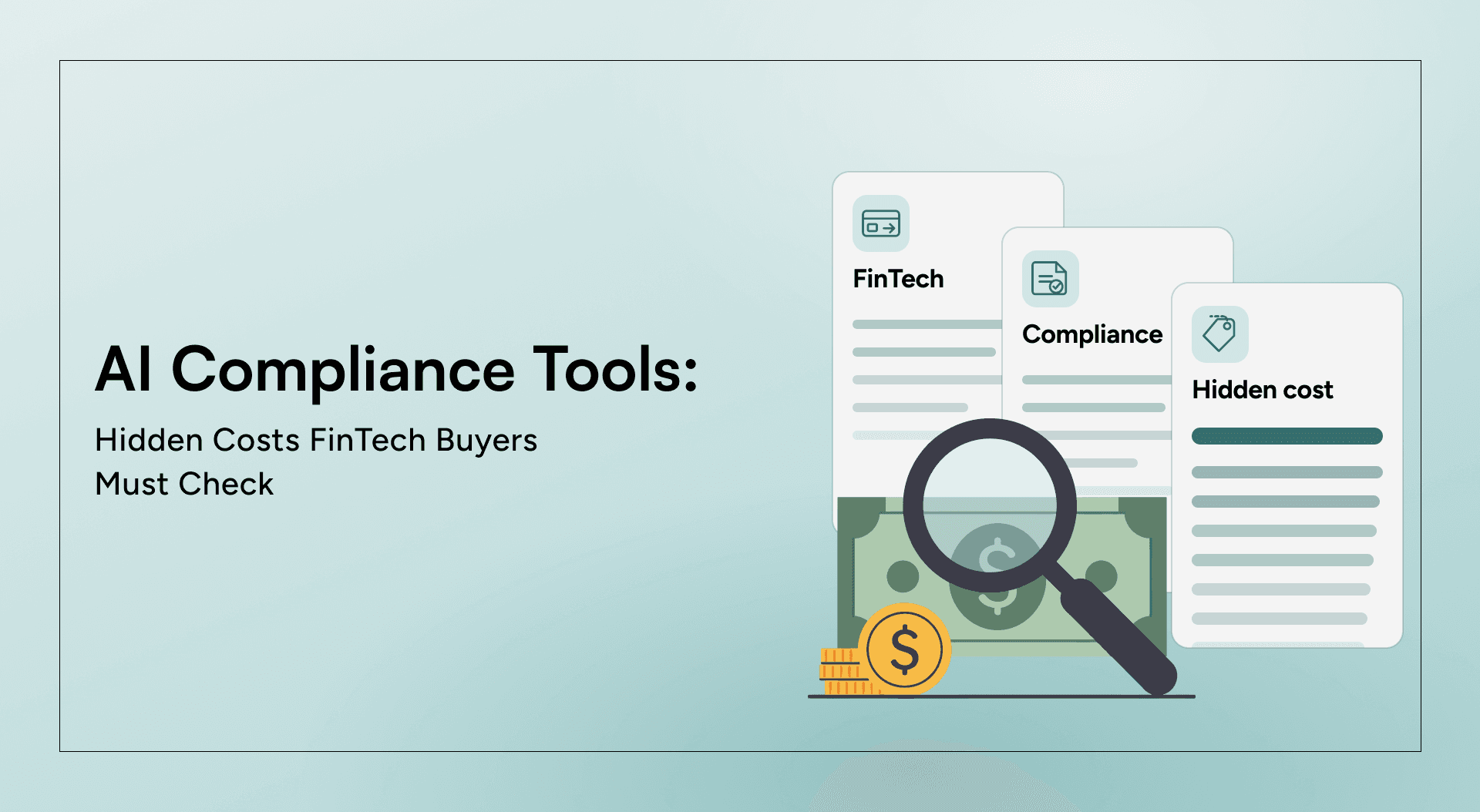
What an AI Compliance Tool Actually Costs a FinTech
Most AI compliance vendors lead with the same three promises: faster reviews, fewer manual checks, lower alert volumes. You’ll notice these proposals usually come with a subscription figure attached.
Though accurate, oftentimes it's incomplete.
A year into the contract, finance teams commonly find costs that were never quoted. Overhead costs tend to push the base price much higher.
Compliance already accounts for a large share of spending in financial services, and the burden falls hardest on smaller players. Federal Reserve research found compliance costs averaging 7.2% of non-interest expenses across surveyed institutions, rising above 8% at the smallest and falling below 3% at larger ones. Meanwhile the global cost of financial crime compliance has reached $61 billion across the US and Canada and $85 billion across EMEA, rising for almost every institution surveyed.
The gap between the quoted price and the real one comes down to where the work sits.
Subscription fees, usage limits, premium modules and contract terms belong to the vendor. Implementation, data preparation, integration, monitoring, human review and regulatory updates belong to you. That second group splits into two kinds of cost, and neither appears on a quote flagging major issues as overhead costs.
The cost conversation usually happens at the wrong point. Teams negotiate hard on the license, sign, and then find that most of the remaining work sits in their own backlog: mapping data, building connectors, keeping the audit trail defensible. By then there is no leverage left to renegotiate. The buyers who avoid this bring engineering into the evaluation rather than the implementation.
 Jani Hardik SanjayProduct Owner I
For a fintech operating at scale, the useful question is not how much the tool costs. It is what the platform will cost to run, govern, integrate, scale and eventually replace. That question gets harder to answer during a demo, and it is one that determines whether the purchase holds up over three years.
Why the Subscription Price Tells Only Part of the Story
Pricing models for AI compliance tools look simple on a rate card and behave very differently once volume moves. Before comparing vendors, it helps to know what you are actually being charged for.
- Subscription and per-user pricing is predictable in the first year. It stops being predictable when compliance headcount grows.
- Per-transaction and per-alert pricing ties cost directly to growth. Every new customer, every processed payment and every triggered alert adds to the bill.
- API and inference charges are the line item buyers most often miss. Screening calls, document checks and model queries are frequently metered separately from the base license, and the volume is hard to estimate before deployment.
- Minimum commitments lock in spend regardless of use. Premium modules - sanctions screening, case management, regulatory reporting, advanced analytics - often sit outside the base package despite appearing in the demo.
None of this is hidden in a dishonest sense. It is disclosed, usually accurately, in documents that arrive late in procurement and get read by fewer people than the proposal.
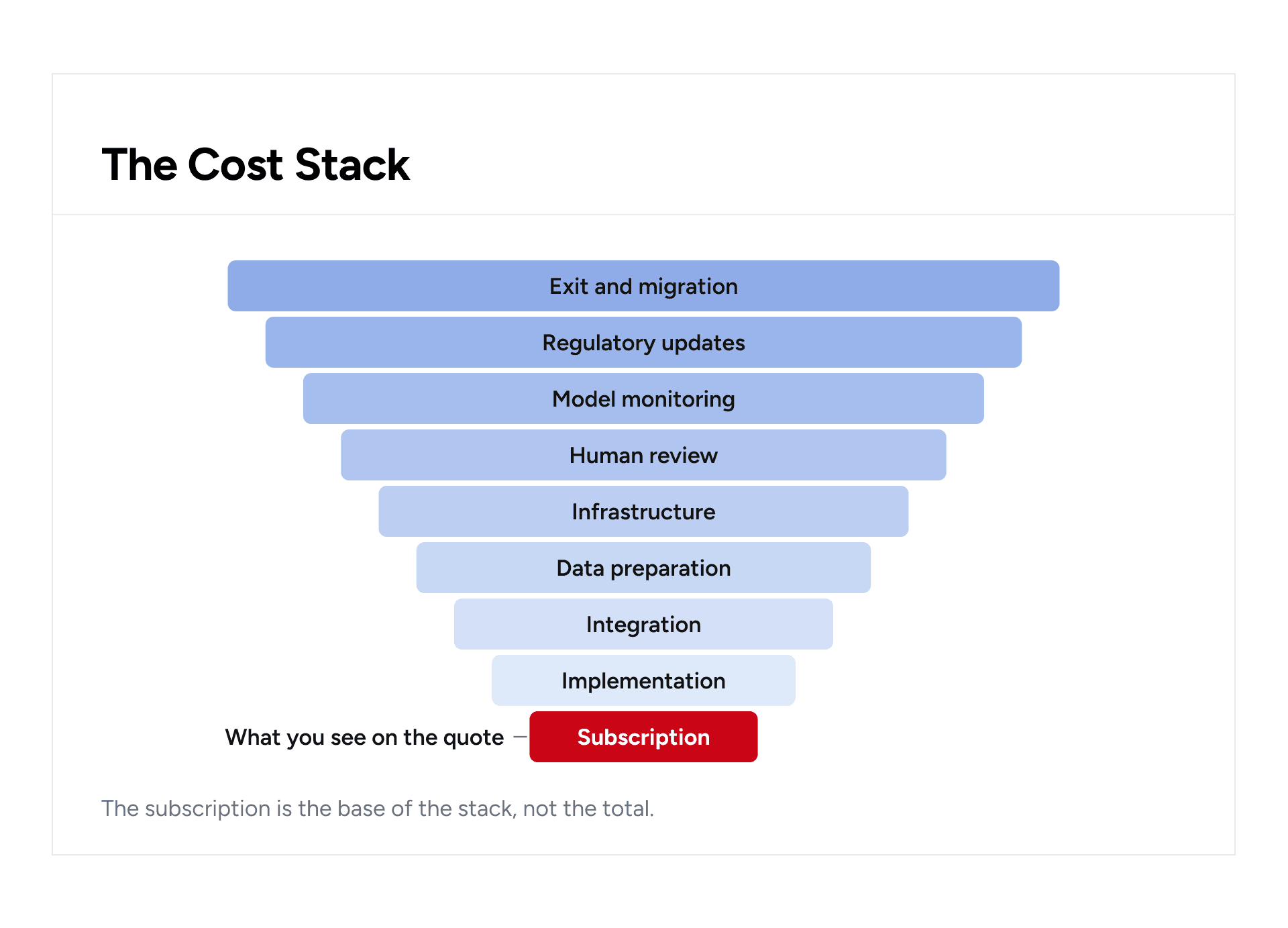
What sits Outside the Quote
The costs that determine whether a deployment succeeds rarely appear in vendor pricing at all.
- Implementation: configuration, rule setup, model tuning, testing, documentation
- Integration: connecting core banking, payments, KYC, AML, fraud and case management systems
- Data preparation: cleaning, mapping, normalizing and resolving records before the model can use them
- Infrastructure: cloud compute and storage, particularly where data residency requirements apply
- Internal engineering: the team time consumed by all of the above, then again by maintenance
- Compliance validation: proving to your own risk function that the system works as intended
- Human review: the analysts still investigating alerts after go-live
- Monitoring: tracking model performance and catching degradation
- Regulatory updates: reconfiguring controls when rules change
- Exit: extracting data, cases, configurations and audit history when the contract ends
Each of these is a real budget line which ends up on your side of the contract, eventually.
The practical consequence is that two vendors quoting similar subscription fees can differ substantially in total cost.
This is also why first-year comparisons mislead. Usage charges, human review and monitoring do the opposite: they start small and compound as volume grows. Comparing year one flatters exactly the wrong vendor.
The 10 Hidden Costs FinTech Buyers Need to Model
This is the part of the evaluation that determines whether an AI fintech compliance purchase holds up. Each cost below includes the question to put to the vendor and the document to ask for. The documents matter more than the answers.
An over-budget deployment is not due to a spectacular failure. It can be because the data turns out more complex than expected or that some integration expected to be off-the-shelf requires a special build. The problem is usually a matter of not having posed the correct questions at the start.
Jani Hardik SanjayProduct Owner I1. Implementation and Configuration
Deployment is rarely turnkey. Budgets exceed when there is no distinction between what the license covers and what professional services cover.
Ask: What implementation work is included in this price, and what requires professional services?
Request:
- The implementation statement of work
- Estimated hours
- Timeline
- Responsibilities
- Professional services day rates.
2. Integration with your Existing Stack
This is the largest under-estimated cost in AI for compliance in banking, and the most common reason timelines slip.
The tool has to communicate with core banking, payment processors, CRM, KYC and KYB providers, AML systems, fraud platforms, case management, data warehouses, identity systems and API gateways. Compliance work already consumes a high capacity at many fintechs, and a new tool adds to that figure before it reduces it.
Ask: Which integrations are production-ready today, and which require custom engineering?
Where legacy components are involved, sequencing the integration usually costs less than working around them. Our guide to modernizing a fintech app without a full rebuild covers that approach in detail.
3. Data Preparation and Data Quality
Models perform on clean, mapped and resolved data. Most fintechs need normalization and entity resolution before the first model run.
Regulators expect this independently of any vendor. SR 11-7 requires a rigorous assessment of data quality and relevance for any model in production use.
Ask: What data quality does your model assume before deployment, and who pays for cleansing, mapping and normalization?
4. Usage-based Pricing and Cost at Scale
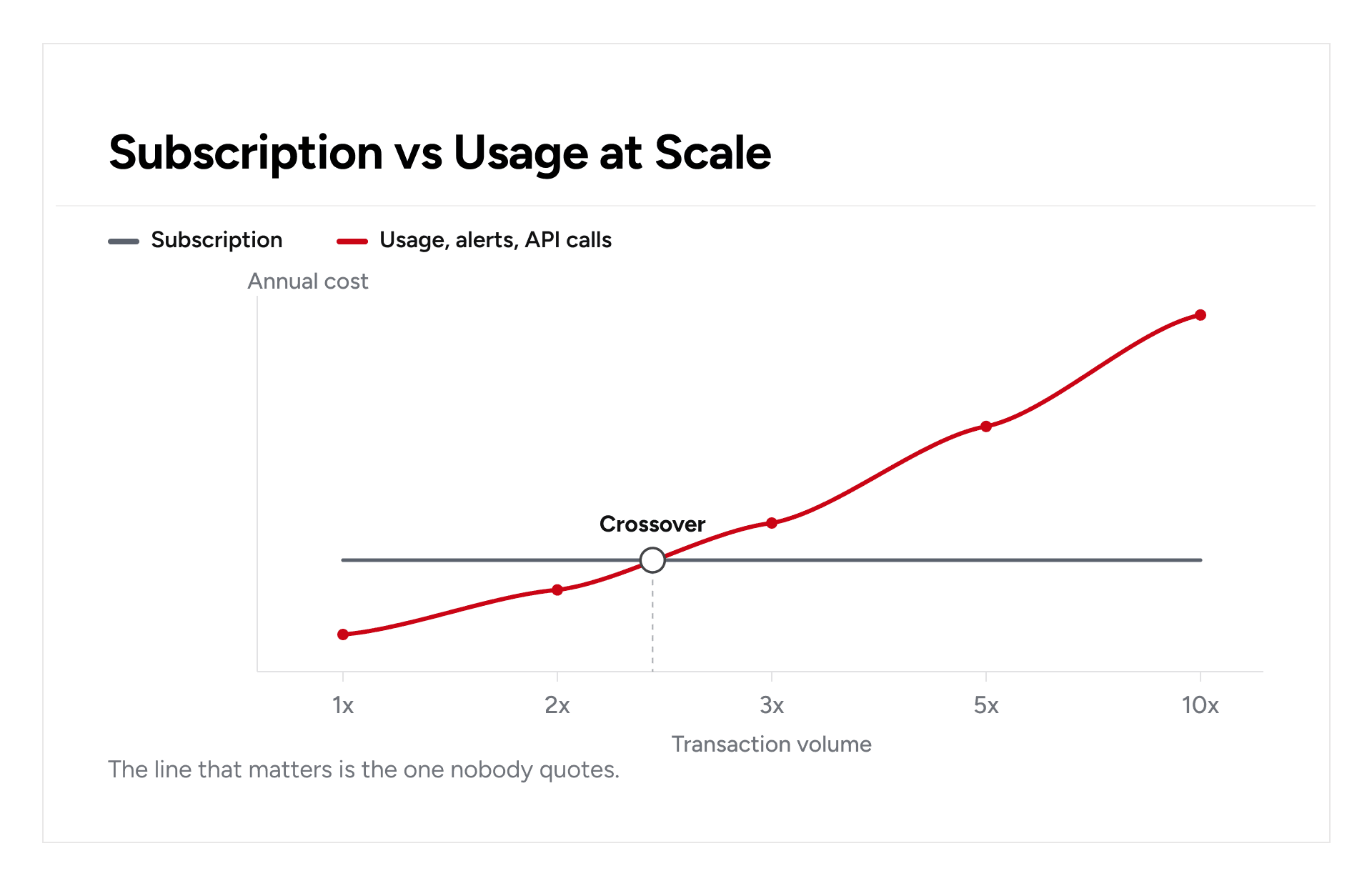
A per-unit price that looks trivial at current volume becomes the dominant line item at ten times that volume.
Ask: Show us the projected bill at two, three and ten times our current transaction volume.
Request
- Volume tiers
- Overage rates
- API rate limits
- Storage charges in writing.
A vendor who cannot produce this either has not modeled it or would rather you did not.
5. Human-in-the-loop Cost
AI does not remove compliance obligations, rather it changes where human compliance is required.
The economics here decide the business case. In conventional transaction monitoring, roughly 95% of alerts turn out to be false positives. Industry cost analyses put investigations at $25-$50 per alert, and a single suspicious activity report at $1,000-$5,000 once investigated and filed.
Run that arithmetic against your own alert volume before comparing license fees. A tool that generates thirty percent more alerts at a twenty percent lower license price costs more within the first year.
Ask: What percentage of cases does the system resolve without human intervention, and how is that figure calculated?
Vendors calculate automation rates differently, and some exclude the categories that generate the most work.
6. Model Monitoring and Drift
Model accuracy decays due to factors like customer behavior shifts, laundering typologies change and model performances changing with time. Research on retraining economics treats this as a continuing trade-off between stale predictions and compute cost rather than a one-off task.
Buyer conversations routinely skip this, which is why it surfaces as an unbudgeted cost in year two.
Ask: Who monitors model performance after deployment, how is drift detected, and what happens contractually when performance falls below the agreed threshold?
7. Audit and Evidence Generation
Automation still has to produce evidence a regulator will accept: decision logs, timestamped records, model versions, input and output traceability, human overrides, and a history of rule changes.
Don’t mistake asking whether a platform is auditable is not useful since most vendors say yes, right off the bat.
Ask: Show us the complete audit trail for a single compliance decision, from input to outcome.
8. Regulatory Change Management
Regulatory change increasingly arrives through advisories and typology guidance rather than formal rules, and Thomson Reuters expects compliance teams to be inundated with them through 2026 — each carrying an implicit expectation that institutions build it into daily controls. Every update lands on somebody's desk, and the contract determines whose.
Ask: When a regulation changes, what does your team update, what must our team update, and what additional fees apply?
9. Security, Data rights and Model training
A financial services breach now averages $5.56 million, and data-use terms in AI contracts are frequently vague.
Ask: Will our customer, transaction or compliance data be used to train your models or any third-party model?
Follow it with the question that matters: can you guarantee that contractually?
Confirm data ownership, retention periods, the subprocessor list, data residency, the deletion process, and who owns AI-generated outputs.
10. Exit and Switching Costs
The cost nobody models, because it only becomes visible when you try to leave. Data exports, historical cases, configurations, custom rules, integrations and audit records all have to move, and the replacement implementation starts from scratch.
Under EBA outsourcing guidelines, a documented exit strategy is a supervisory expectation rather than an optional clause.
Ask: If we terminate after three years, exactly what data, configuration and audit history can we export, in what format, over what period, and at what cost?
What Questions Should FinTechs Ask Before Buying AI for Compliance in Banking?
Once you’ve got your hidden cost categories down, the next step is to transform them into vendor questions that must be answered in writing before the procurement moves ahead.
A vendor demo is designed to show the product working. It is not designed to reveal what the product costs to run, what it assumes about your data, or what happens when you want to leave.
The 25 below are organized into five areas. Send them to the vendor in writing before the second meeting. How quickly and completely a vendor responds tells you as much as the answers themselves, because everything here is knowable to a company that has deployed its product more than a handful of times.
A. Pricing and Total Cost
Start here, because every later answer has a price attached to it. The aim is to understand not just what you pay now, but what you will pay once the platform is embedded and your volumes have grown.
- What is included in the base subscription, and can we see that in writing rather than as a summary?
- Which features shown in the demo require paid modules, and what do those modules cost?
- What usage limits apply to transactions, alerts, API calls, documents and storage?
- What are the overage rates when we exceed those limits?
- Which costs increase as transaction volume grows, and can you model our bill at two, three and ten times current volume?
B. Integration and Implementation
This is where most timelines and budgets come apart, so the questions need to be specific enough that a vague answer becomes obvious. Pay attention to how the vendor describes your systems. A team that describes integration as straightforward, without naming anything, has usually not done it at your scale.
- Which integrations to our stack are native and in production with other clients today?
- Which requires custom development, and roughly how much engineering time does that take?
- Who owns implementation, and what is included before professional services rates begin?
- What internal engineering resource do you expect from our side, expressed in people and weeks?
- What does a typical enterprise implementation involve, and can we see a plan from a comparable client?
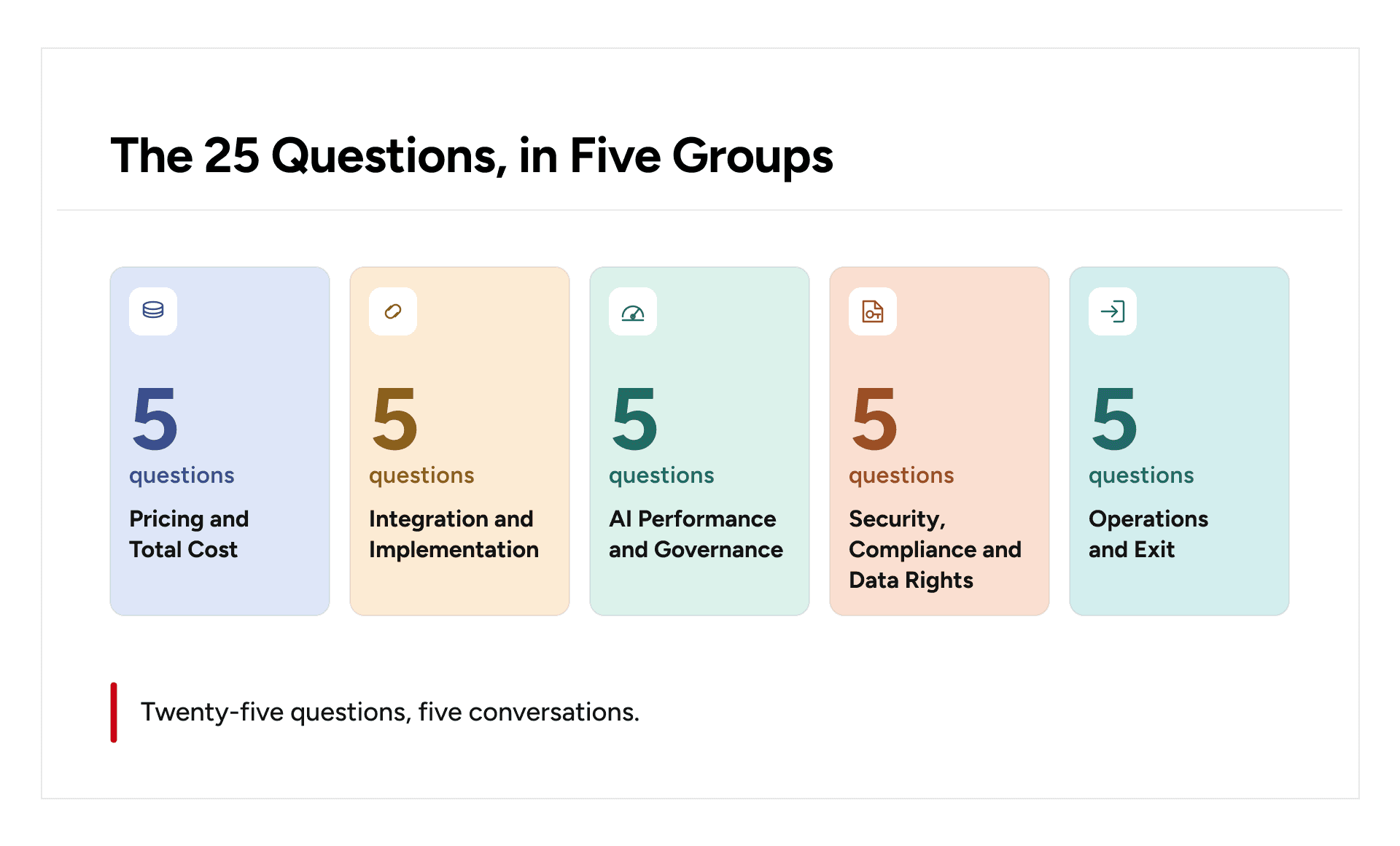
C. AI performance and Governance
The use of AI in finance has moved faster than the vocabulary around it, and "AI-powered" now covers everything from a well-validated machine learning model to a rules engine with a language model attached to the reporting layer. These questions establish which one you are buying.
- What model or method powers the product, and how does it reach a decision?
- What data was it trained on, and can you confirm that no client transaction data was used?
- What benchmark results can you share from a deployment comparable to ours?
- What are the known limitations, and which case types does the system handle poorly?
- How do you detect model drift, how often do you retrain, and who bears that cost?
D. Security, Compliance and Data rights
These questions belong in the contract discussion rather than the sales conversation, but asking them early tells you whether the vendor has already thought them through.
- Will our customer, transaction or compliance data be used to train your models or any third-party model, and will you guarantee that contractually?
- Where is our data stored, and can we require specific residency?
- Which subprocessors can access our data, and can you share the current list?
- What security and governance certifications can you evidence, including SOC 2 Type II, ISO 27001 and any AI management standard?
- What happens to our data after termination, including the deletion process and its timeline?
E. Operations and Exit
The final group covers what daily life with the platform looks like, and what leaving it involves. Buyers routinely skip the last question, which is precisely why it belongs in the first conversation rather than the last.
- What percentage of cases does the system resolve without human review, and how is that percentage calculated?
- How do you monitor production performance, and what visibility do we have into it?
- How frequently do you update regulatory controls, and what do we remain responsible for updating ourselves?
- What service levels apply to functions that are critical to our compliance obligations?
- If we terminate the contract, how do we export our data, case history, configurations and audit records, in what format and at what cost?
Taken together, these twenty-five questions do something a feature comparison cannot.
They shift the conversation from what the product does to what running it will actually require from your teams, which is the difference between evaluating a demo and evaluating a three-year commitment.
What Evidence Should an AI Compliance Vendor Provide Before Procurement?
Documents are the most important piece of evidence and record when it comes to multiple meetings and handoffs. Every item below either exists or it does not, and the ones an AI compliance vendor cannot produce tell you more than the ones they can.
Document | What it proves | Red flag |
SOC 2 Type II | Security controls have operated over a period, not just been designed | Type I only, or an audit that has been "in progress" for over a year |
ISO 27001 | A managed information security system | Expired, or scoped to exclude the product you are buying |
ISO/IEC 42001 | A certifiable AI management system | No AI governance standard of any kind |
Security architecture and data-flow diagram | You can see where your data travels and rests | Cannot produce one, even under NDA |
Subprocessor list | You can meet third-party risk obligations | Undisclosed or "commercially sensitive" |
Model documentation | Purpose, training data and limitations are recorded | "Proprietary" offered as a complete answer |
Model evaluation results | Performance has been measured rather than claimed | Marketing figures with no methodology |
SLA, business continuity and disaster recovery plans | The service survives an outage and someone is accountable | Best-efforts language, no tested recovery |
Data retention and deletion policy | You can meet GDPR obligations | Vague or indefinite retention |
Sample audit trail | A single decision can be reconstructed end to end | Cannot produce one on request |
Sample implementation plan | Delivery is planned rather than improvised | No scope, no timeline, no named responsibilities |
Sample enterprise pricing model | Cost at scale is knowable before you sign | Pricing deferred until after go-live |
Customer references | Peers run this in production at your scale | No reference in your segment or region |
NIST's AI Risk Management Framework offers a simple test here. If a vendor cannot describe how they govern, map, measure and manage model risk, governance has been added to the pitch rather than built into the product.
How Do You Calculate the Real Cost of an AI Compliance Tool?
Total cost of ownership is the standard way to answer this: the direct and indirect cost of a product across its full lifecycle, from procurement through operation to decommissioning.
A. First-year cost
- License, implementation, integration engineering and data preparation
- Cloud infrastructure, compliance validation and team training
- Human review and audit work from go-live onwards
B. Recurring annual cost
- Renewal, usage and transaction fees, infrastructure
- Model monitoring, retraining and regulatory updates
- Human oversight, audit and assurance, ongoing data management
C. Opportunity cost, which buyers usually omit
- Delayed launches and slower onboarding, and the conversions lost to both
- Engineering capacity spent on integration and maintenance rather than product
- Migration costs if the platform turns out to be the wrong fit
None of these appear on an invoice, which is exactly why they escape the business case.
Put together, the three categories reduce to a single equation:
Three-year TCO = First-year cost + Year-two recurring cost + Year-three recurring cost + Opportunity cost + Exit provision |
Price the two recurring years at projected transaction volume rather than current volume, since usage fees, human review and monitoring all rise with it. The exit provision covers data export, migration and the overlap period when two platforms run in parallel, and it stays small only when the contract defines portability terms upfront.
Model three years. First-year comparison flatters the vendor with a low license and a high integration burden, because the integration cost has not yet been felt.
How Should FinTechs Compare Two AI Compliance Vendors Beyond Price?
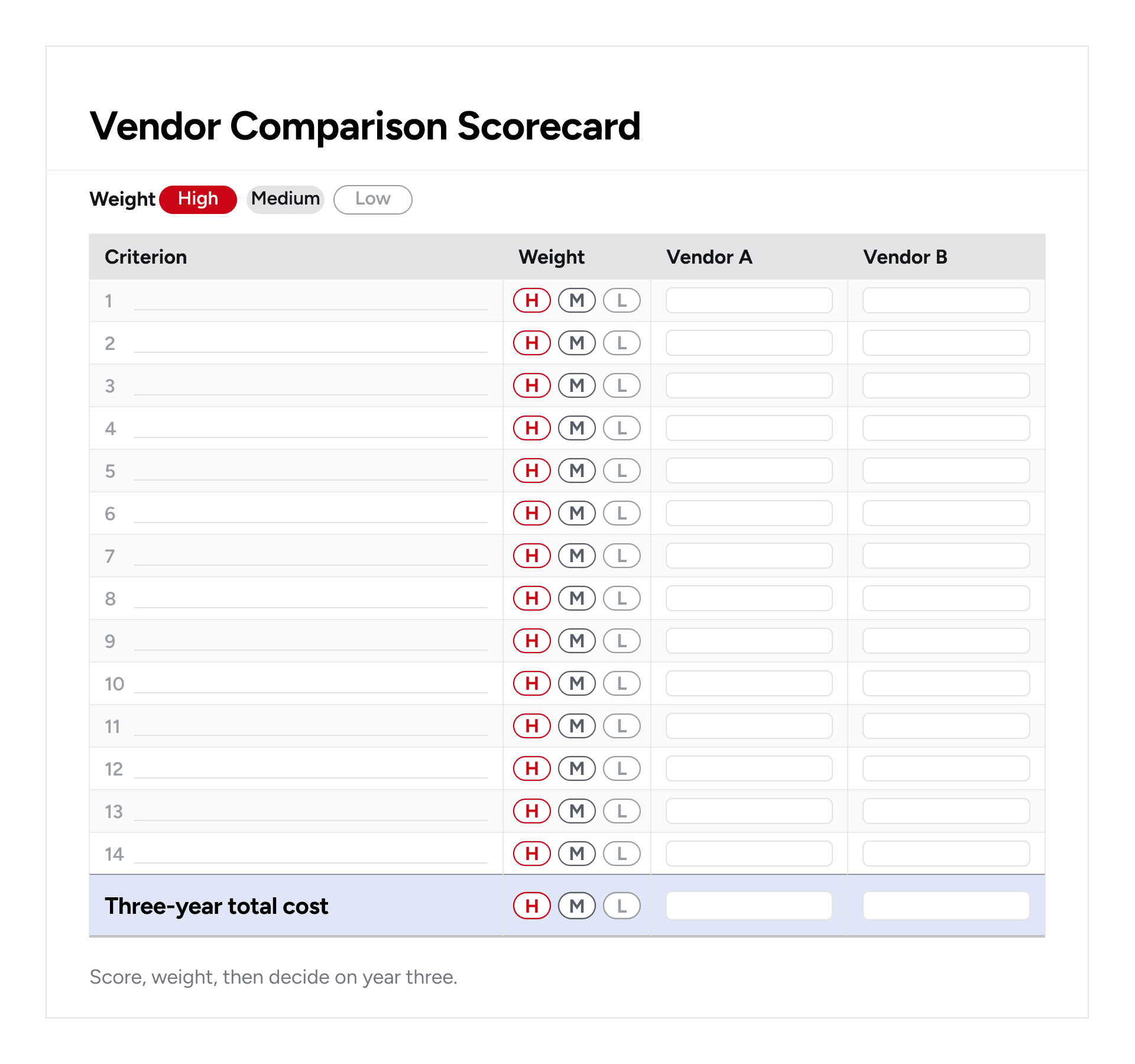
Feature comparisons rarely separate two credible vendors, because both will tick most boxes. Hence, we check the work and risks associated with either. Score each area from 1-5, weigh the rows that carry real cost, and let the final line decide.
The example below shows two vendors of the kind most fintechs end up choosing between. Vendor A leads on price. Vendor B leads on everything that costs money after signing.
Evaluation area | Weight | Vendor A | Vendor B |
Base license | Low | 5 — 30% cheaper annually | 3 — higher list price |
Usage pricing at 3x and 10x volume | High | 2 — per-alert billing, no volume tiers | 4 — tiered, capped overage |
Implementation scope | Medium | 2 — scope undefined, priced later | 4 — fixed scope, written SOW |
Integration effort | High | 1 — two native connectors, rest custom | 4 — core banking and KYC in production |
Data preparation burden | High | 2 — assumes clean, mapped data | 4 — mapping included, spec provided |
Internal engineering required | High | 1 — estimated 12-16 engineer weeks | 4 — estimated 3-4 engineer weeks |
Human review requirement | High | 2 — automation rate unevidenced | 4 — benchmarked at comparable client |
Auditability | High | 2 — described but no sample shown | 5 — full sample trail provided |
Model monitoring | Medium | 2 — client-side responsibility | 4 — vendor-monitored, thresholds in contract |
Regulatory updates | Medium | 3 — included, cadence unclear | 4 — quarterly, scope documented |
Data rights | High | 2 — training restriction verbal only | 5 — contractual, written |
SLA | Medium | 3 — standard uptime, no compliance-specific terms | 4 — tiered by function criticality |
Exit costs | High | 1 — no portability terms offered | 4 — formats and timeline defined |
Three-year total cost | Decisive | Higher | Lower |
Vendor A wins the row most buying committees look at first and loses almost every row that follows. That pattern is common enough to be worth planning for. A license discount of thirty percent is straightforward to quantify in procurement, while twelve additional engineer weeks and an unevidenced automation rate are not, so the cheaper option keeps winning committee votes it should lose.
Three points on how to use this properly.
- Weight before you score. Base license sits low deliberately, because it is the row buyers over-weight by habit and the one least likely to determine the outcome. Integration effort, human review and exit costs sit high because each can double the real cost of a deployment without appearing anywhere in a proposal.
- Score against evidence, not answers. A vendor claiming strong auditability scores a two until they show you a sample trail. The scoring only works if a document sits behind each number.
- Let the final row decide. If your three-year model contradicts your row-by-row scoring, the model is usually right and the scoring has been generous somewhere. Go back and find where.
What Red Flags Should Stop an AI Fintech Compliance Evaluation?
Most gaps in a vendor's answers can be worked through during procurement. A few cannot, because they point to problems that appear after signing, once the cost of fixing them sits on your side of the contract. When any of the following shows up in an evaluation of AI for compliance in banking, pause the process until the vendor closes the gap in writing.
"AI-Powered" Without Explaining the Model
A vendor who cannot describe how the system reaches a decision cannot support the model risk review SR 11-7 expects. Your risk function inherits that gap on the day the tool goes live.
No Clear Usage Limits
Pricing that leaves transaction, alert and API volumes undefined leaves the year-two bill undefined with it. Get the limits in writing before the commercial discussion moves any further.
No Written Implementation Scope
Scope described verbally gets priced later, at professional services rates, after the signed contract has removed your room to challenge them.
No Model Performance Benchmarks
Performance that was never measured at a comparable client is performance you will be measuring for the first time in production, at your own cost.
No Data-Training Restrictions
A vendor who will not state in the contract that your customer and transaction data stays out of model training has left the door open to using it. Verbal assurance carries no weight in an audit.
No Production Monitoring
When drift detection sits with the client by default, the monitoring cost covered earlier in this article arrives unbudgeted, and the model risk arrives with it.
No Clear Audit Trail
A platform that cannot reconstruct one decision on request will not reconstruct a thousand under a regulator's deadline.
No Exit or Data-Portability Terms
Missing portability language means every future negotiation happens without an alternative on the table, and renewal pricing tends to reflect that.
The Vendor Cannot Explain What Changes When Regulations Change
Maintained regulatory content is half the reason to buy instead of build. A vague update process removes that half of the value.
Any one of these may have an innocent explanation. Several together describe a vendor that has not yet operated in a regulated production environment at your scale, and no demo can make up for that.
When Does AI in Financial Compliance Actually Save Money?
Everything above argues for buying carefully, and none of it argues against buying. Pointed at the right problem, AI in financial compliance produces savings that hold up under review, and the pattern of where compliance automation works is consistent. An AI-powered compliance tool earns its cost when it:
- Cuts the repetitive analyst work of reviewing false positives, which is where most compliance labor goes today
- Generates audit evidence automatically instead of leaving analysts to assemble it after the fact
- Raises investigation throughput so case backlogs shrink without headcount growing
- Clears low-risk customers at onboarding and shortens time to first transaction
- Reduces the engineering effort spent maintaining rules, connectors and integrations
- Delivers regulatory updates as vendor releases rather than internal projects
- Keeps unit costs steady as transaction volume grows
HSBC's transaction monitoring system cut false positives by over 60% while detecting more confirmed suspicious activity, and that result shows what a genuine saving looks like: less noise at the same or better coverage.
Each item on the list can be measured against the compliance labor cost you calculated before the demo, which is why that number belongs in the evaluation from the start.
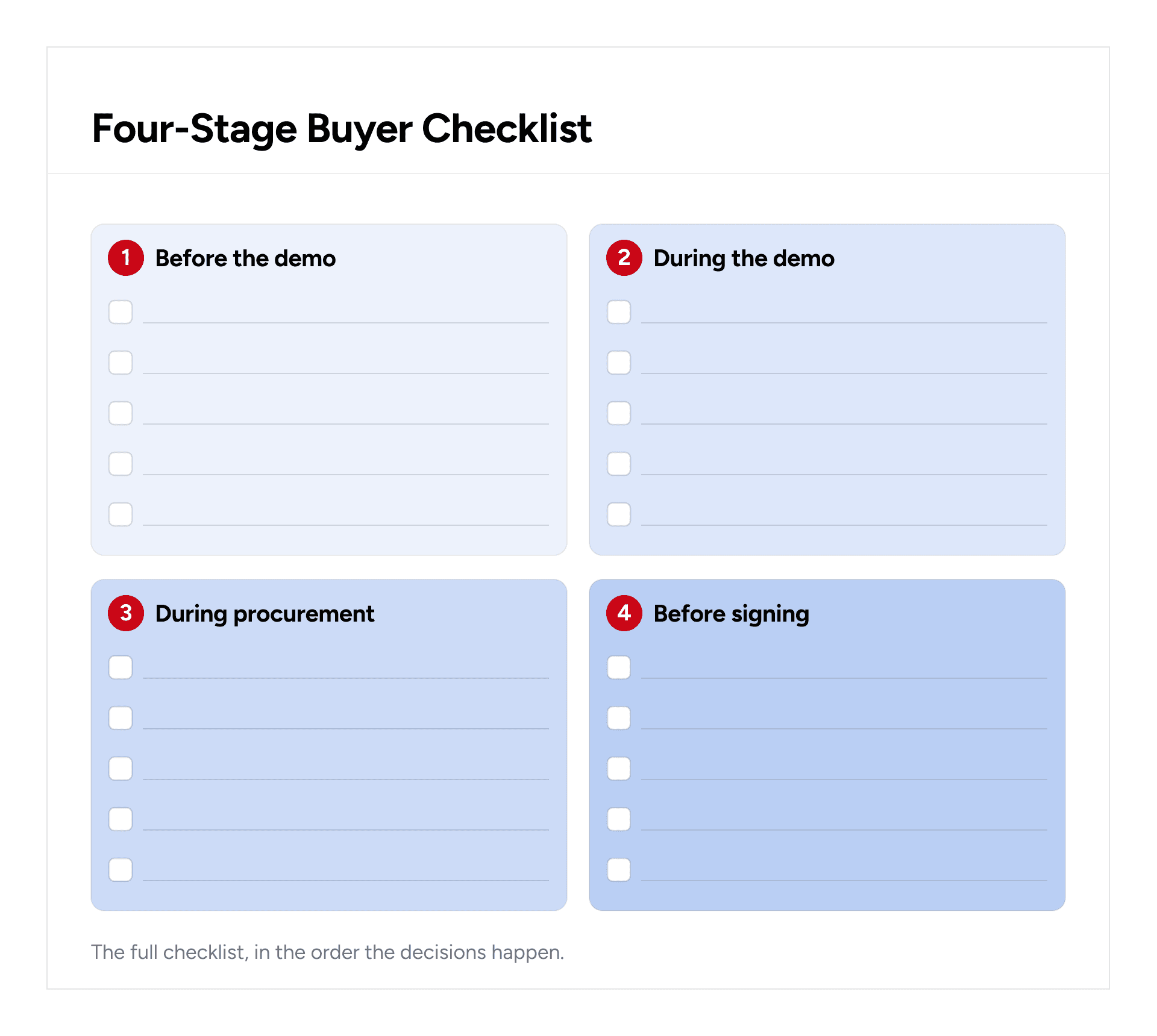
The FinTech AI Compliance Vendor Checklist: What to Check Before Signing
Most of the cost decisions in this article are made before a contract exists. This checklist puts them in order. Work through each stage, and treat an unticked box as a reason to slow down rather than a detail to catch up on later.
1. Before the Demo
- Have we defined the compliance workflows the tool has to support?
- Do we know our transaction and case volume today and at three times current levels?
- Have we listed every system requiring integration, including the legacy ones?
- Do we know what compliance labor costs us now, so savings can be measured?
- Have we set target KPIs and brought engineering into the evaluation, not just procurement?
2. During the Demo
- Has the vendor explained how the model reaches a decision, and what it handles poorly?
- Do we have performance evidence from a client of comparable size?
- Have we tested one representative workflow using our own data shape?
- Has the vendor walked us through a complete audit trail for a single decision?
- Do we know how exceptions are handled and what share of cases still needs human review?
3. During Procurement
- Do we have the full cost model rather than the license quote alone?
- Have we reviewed usage pricing, overage rates and behavior at higher volumes?
- Is the implementation scope in writing, along with what falls outside it?
- Do we understand the exit terms, and spoken to comparable customers in our region?
- Have we reviewed security documentation, data rights, SLAs and regulatory-update obligations?
4. Before Signing
- Have we validated the three-year TCO model against the vendor's own figures?
- Is every fee in writing, including professional services rates?
- Are data ownership and model-training restrictions documented in the contract?
- Have we agreed the performance metrics and what happens when they are missed?
- Is data portability confirmed, covering formats, timeline and cost?
Buy the Compliance Outcome, Not the AI Label
"AI-powered" describes how a product is built, not what it delivers. It tells you nothing about false-positive rates, integration effort, audit defensibility or cost at scale, and those four things determine whether the purchase works.
The fintech buyers who get this right treat the evaluation as an engineering decision with a commercial wrapper rather than the reverse. They ask what the platform assumes about their data, what it requires from their teams, what evidence it produces for a regulator, and what leaving it would involve. Then they write the answers into the contract as measurable outcomes: fewer alerts requiring review, faster onboarding, audit records available on request, predictable cost as volume grows.
That approach costs more time upfront and considerably less over three years. Everything else is a demo.
Sources and Citations
- Federal Reserve Bank of St. Louis — Bank Size, Compliance Costs and Compliance Performance in Community Banking
- Federal Reserve, OCC and FDIC — Supervisory Guidance on Model Risk Management (SR 26-2)
- Google Cloud — Anti Money Laundering AI
- Thomson Reuters Institute — 10 Global Compliance Concerns for 2026
- European Banking Authority — Guidelines on Outsourcing Arrangements
- NIST — AI Risk Management Framework
- HSBC — Harnessing the power of AI to fight financial crime
- FCA and Bank of England — Artificial Intelligence in UK Financial Services 2024