

Key Takeaways
- Free up engineering capacity by reducing the legacy maintenance burden, which accounts for 60-80% of technology spending at many large banks, according to McKinsey.
- Reduce operational risk throughout the core banking modernization process while managing critical banking services.
- Improve customer-facing experiences faster by decoupling digital journeys, APIs and payment capabilities from legacy release cycles.
- Create a stronger foundation for AI and data initiatives with proper data flow, well-defined interfaces, and better system observability.
How Can Banks Modernize Their Core Banking Systems Without Disrupting Live Operations?
A bank cannot completely shut off their payments, deposits, lending, cards, or digital channels while it replaces the technology that is operating underneath them.
Customers still need to transfer or receive money, merchants still need payments to settle, and loan applications still need to move through the systems. Even a short disruption can become an operational, regulatory, or customer problem.
Core banking modernization requires a different approach from a typical application upgrade.
Where Does Operational Drag Come From?
Over the years, the core systems have been tied to payment platforms, customer channels, fraud systems, reporting tools, batch jobs, third-party providers, and business rules that are not documented anywhere, except for the teams maintaining them. A small change in the system is likely to trigger failures in several layers of the system.
These changes can result in operations drag where the releases could take longer time, there are increases in rounds of testing, maintenance consumes engineering capacity, and teams become cautious about changing systems they no longer are fully aware of. McKinsey reports that 60 to 80 percent of technology spending at many large banks continues to go toward maintaining and operating existing systems, which limits the resources available for innovation and AI-enabled transformation.
Why is Progressive Modernization a Better Fit?
There is an increasing pressure to modernize banking operations. McKinsey’s 2026 analysis of Indian banks highlights progressive core renewal, API-first architectures, and hybrid-cloud adoption as approaches that can address legacy constraints while allowing banks to modernize without disrupting mission-critical operations.
In addition, customers are more inclined towards platforms that have faster releases, quick service availability, and consistent digital experiences. So banks need to get a better understanding about which existing technology estates are creating operational drag, and how we can modernize them without putting the system of record or customer transactions at risk.
A big-bank core banking migration adds too many dependencies in one change window. Progressive modernization takes a different route where banks can introduce API layers, event-driven services, modern customer journeys, better observability, and selected cloud-native capabilities while the existing systems continue to process critical transactions. This approach avoids the complication that comes with waiting for a single replacement event to deliver the benefits of modernization.
How Does Modernization Support AI Readiness?
For AI readiness, AI applications need access to reliable data, usable interfaces, and systems that can support automation at scale. A tightly coupled core surrounded by undocumented integrations and batch-dependent processes can make data access and controlled automation more difficult. Modernizing the underlying architecture can remove some technical constraints that make data access, information processing, and controlled automation more difficult.
This guide looks at how banks can reduce release friction, simplify dependencies, improve resilience, and protect transaction integrity while modernizing incrementally around systems that continue to support day-to-day banking operations.
Core modernization involves the challenge of keeping critical banking operations running while reducing the dependencies, manual work, and release constraints that have built up around the legacy system. A progressive approach lets banks address those constraints in stages, measure the impact, and reduce migration risk along the way.
 Kunal KumarChief Revenue Officer
Why Does Core Banking Modernization Fail When it Starts as a Technology Upgrade?
Replacing existing legacy infrastructure with a new platform sounds like a modernization plan. On paper, it can be. In practice, the difficult part begins long before the migration process itself. Years of fixes and integrations leaves behind dependencies that are difficult to identify until someone changes them. That is why a technology-first approach shifts workloads to new infrastructure while leaving the operational friction unresolved.
What does the technology-first modernization miss out on?
A useful modernization strategy starts with understanding business capabilities, dependencies, data ownership, and operational friction. An infrastructure migration can move the workload to a new environment without changing the processes that make them difficult to operate. Whereas, a vendor replacement can provide a modern platform while leaving teams with duplicated logic, complex integrations, manual reconciliation, and long release cycles.
Where does operational drag show up across the bank?
Operational drag shows up as regression-heavy releases and brittle dependencies. In addition to this, this also appears as inconsistent APIs and duplicated product logic across channels. The drag creates observability gaps, performance sprawl, and cost pressure while delaying improvements in onboarding process, payment journeys, and customer-facing product releases.
1. Release Friction: A small change can require extensive regression testing because teams cannot predict which downstream system will be affected. Engineers could end up spending time protecting old behavior instead of building new capabilities.
2. System Complexity: APIs follow different standards; if the product logic gets repeated across channels, mobile apps, web platforms, and partner channels could implement slightly different versions of the same rule.
3. Platform Sprawl: New cloud services that exist alongside legacy infrastructure, observability may become fragmented, and the bank could end up paying to operate two technology estates without a clear plan to retire either one.
4. Inconsistent Customer Experience: A new onboarding journey may take months to release, a product change may depend on a core release cycle, and customers could end up facing different experiences across channels due to lack of underlying product logic.
What factors create operational drag in legacy banking environments?
Several factors tend to accumulate over time:
- Manual Reconciliation: Teams compare records across systems to confirm that balances, transactions, or settlement states match.
- Batch Windows: Processes designed around scheduled jobs can restrict when data becomes available and when changes can safely be deployed.
- Duplicate Business Logic: Rules for eligibility, fees, limits, or customer status may exist in the core infrastructure, digital channels, middleware, and reporting systems.
- Undocumented Dependencies: A service may rely on another application or database without that relationship appearing in the current architecture documentation.
- Change Freezes: Teams avoid releases during periods when transaction volumes or operational risks are high.
- Long Testing Cycles: A tightly coupled environment requires broad regression testing even when the change affects a small capability.
- Vendor-controlled Release Timelines: Product teams may have to wait for a vendor release, customization, certification cycle, or upgrade window before shipping a change.
Each of the processes adds a usual amount of time. Together, they can help make the bank cautious about changing anything connected to the core system.
How Can Banks Modernize the Core Banking Platform Without Disrupting Live Operations?
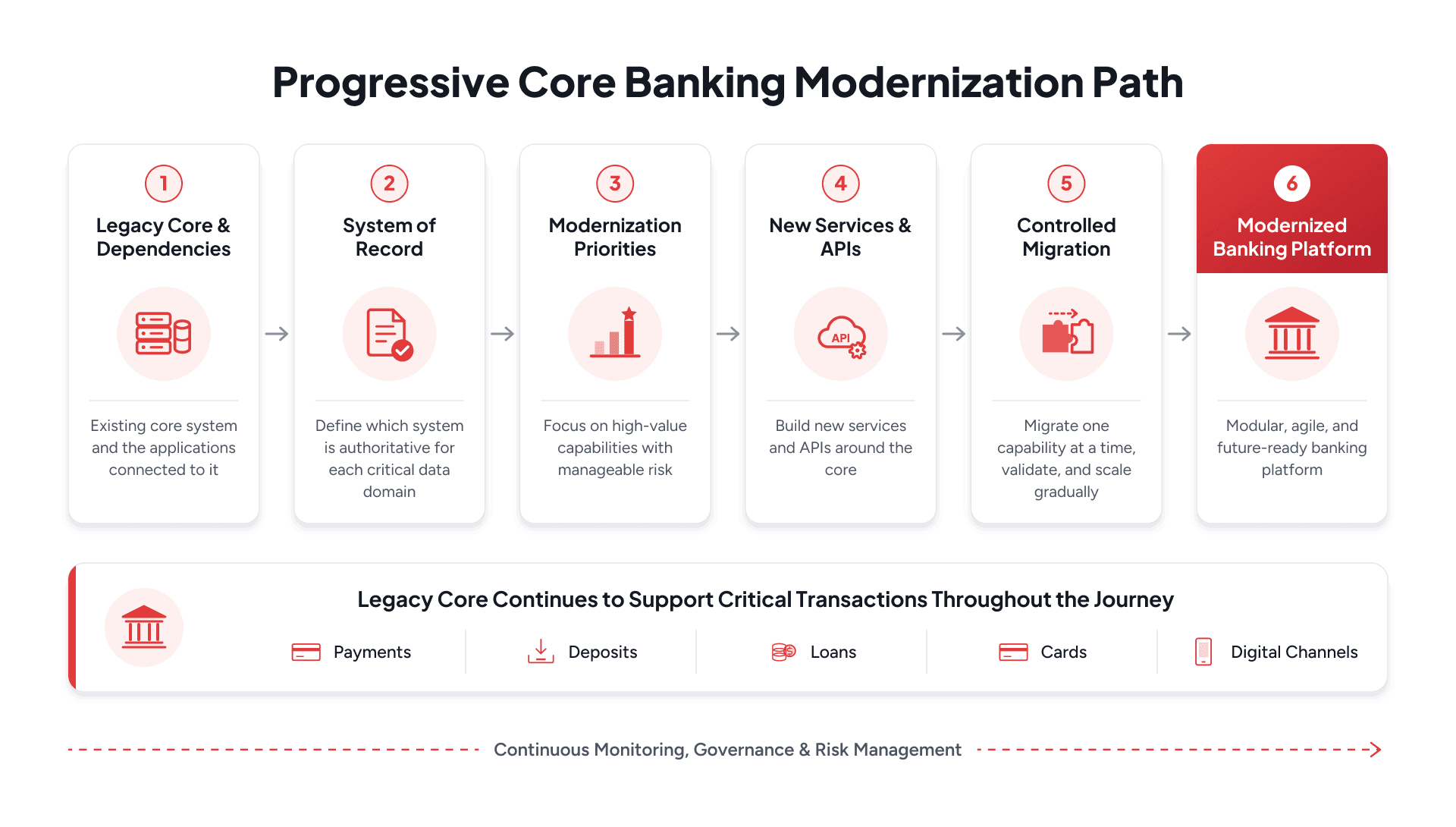
A progressive core banking modernization process needs to start with a simple rule to avoid moving the highest-risk component first just because it exists in the center of the architecture. A practical model starts with three decisions:
- Map the current state and its dependencies.
- Establish which system remains authoritative for each critical data domain.
- Prioritize capabilities where the business benefit is high and migration risk is manageable.
The result is a modernization path that can progress while critical banking workloads continue to run.
The first question in a core modernization program should be ‘What system can we change in a safe manner?’ Once the bank understands its dependencies, defines where the source of truth exists, and identifies the areas creating the most operational drag, modernization becomes a sequence of controlled decisions rather than one high-risk migration.
 Jani Hardik SanjayProduct Owner I
Step 1: How Do You Map the Current Core Banking Environment and Their Dependencies?
Before deciding what to replace, create an inventory of existing systems.
- Core applications and their functions
- Databases and the systems that read or write to them
- APIs connecting internal and external services
- Batch jobs that move, reconcile, or transform data
- Downstream systems such as reporting, fraud, compliance, and analytics platforms
- Upstream channels including mobile, web, branch, ATM, partner, and contact-center systems
- Third-party integrations for payments, identity, credit, messaging, and other services
- Data flows between applications and databases
- Business rules embedded in applications, middleware, stored procedures, or channel code
Step 2: How Do You Identify the System of Record Before Core Banking Transformation?
Once dependencies are visible, we need to identify which system is authoritative for each piece of data. During the migration process, two systems may temporarily contain similar information. That does not mean both the systems should be allowed to make independent decisions about it. For each important data domain, it is crucial to establish:
- Which system is authoritative today?
- Which system will become authoritative?
- Can another service own the capability without owning the underlying ledger data?
- Which data needs synchronization?
- How quickly must that synchronization occur?
- Which transactions require strong consistency?
- Where is eventual consistency acceptable for downstream or derived data, and where is stronger consistency required for transactional state?
- What happens when the two systems disagree?
This distinction becomes critical when introducing services outside the core infrastructure and reduces the risk of creating two competing versions of the same transaction. It also helps teams decide where the modernization process should stop.
Step 3: Which Banking Capabilities Should You Modernize First?
The ledger is highly critical and often has a deep dependency footprint. Its importance and interconnectedness can make it a higher-risk starting point for modernization. Moving it first creates a large blast radius before the organization has had a chance to validate their migration processes.
The following scores are illustrative rather than universal. Actual prioritization should be based on the bank’s architecture, business criticality, regulatory obligations, dependency complexity, transaction volumes, and modernization goals. Instead, evaluate the modernization process using four factors:
Component | Business criticality | Change frequency | Dependency complexity | Modernization priority |
|---|---|---|---|---|
Customer experience APIs | High | High | Medium | High |
Reporting | Medium-High | Medium | Low-High | Medium-High |
Payment orchestration | High | High | High | Medium-High |
Core ledger | Critical | Varies | Very high | Low initially |
A bank should be able to adjust their requirements based on their architecture, regulatory requirements, transaction volumes, and product roadmap. The point is to avoid confusing business importance with modernization priority; a component can be critical to the bank but still be the wrong place to begin. The ledger exists at the other end of the spectrum, while its importance is obvious; that is precisely why many banks may choose to address it after establishing stronger integration, observability, testing, reconciliation, and rollback capabilities.
How Should Banks Choose the Right Core Banking Modernization Strategy?
EY’s 2025 core banking technology research suggested that 92% of the financial institutions surveyed had already started modernizing their core banking platforms, while 83% reported realizing benefits even while their modernization programs were still underway. The findings suggest that banks do not necessarily need to wait for full core system replacement to begin seeing value from the modernization process. So, it becomes imperative for banks to choose the right strategy from the very start if they have to reap the benefits even during the actual modernization and migration process.
A large institution with hundreds of integrations also faces a different migration challenge from a bank with a simpler technology update.
The right choice depends on what needs to change, how much risk the bank can absorb, how mature the existing core is, and at which stage the business needs to move in next. Therefore, the modernization pattern selection involves decision about risk tolerance, product roadmap, regulatory exposure, data dependencies, integration complexity, and the bank’s ability to operate two environments.
Which core banking modernization pattern should you choose?
Modernization Pattern | Changes Required | Most Suitable Fit | Main Considerations |
|---|---|---|---|
1. Encapsulation | Legacy capabilities are exposed through APIs or integration layers | Stable core with integration and channel constraints | The underlying legacy complexity remains |
2. Replatforming | Existing workloads move to a new infrastructure or runtime with limited application change | Infrastructure is the main constraint | Moving the workload does not automatically remove application debt |
3. Refactoring | Applications are reworked to improve structure, maintainability, or performance | Business logic remains valuable, but the implementation is difficult to change | Requires engineering effort and careful regression testing |
4. Replacing | A legacy capability is retired and replaced with a new platform or service | A component is no longer fit for purpose | Migration and data-cutover risk increases |
5. Composable Modernization | Capabilities are separated and assembled through modular services and APIs | Banks need product-level flexibility and independent change cycles | Requires strong integration, governance, and ownership |
6. Cloud-native Rebuild of Selected Capabilities | Selected capabilities are redesigned for cloud-native operation | A specific capability needs scalability, resilience, or faster delivery | A rebuild can create new complexity if boundaries are poorly defined |
When should you not modernize the core ledger first?
The core ledger should not be modernized when the ledger is stable and the surrounding architecture is causing most of the problems. If the ledger processes transactions reliably but digital channels are slow to change, replacing the ledger may solve the wrong problem.
Architecture Patterns that Support Core Modernization Without Causing Downtime
A stable ledger has to be given different treatment from a customer-facing API and a batch-heavy reporting process needs to have another architecture from a payment workflow that needs transaction-level consistency.
1. How does the Strangler Fig pattern support core banking modernization?
The Strangler Fig pattern lets a bank incrementally replace selected legacy capabilities by introducing new services alongside the existing core and gradually redirecting traffic or functionality where the legacy architecture allows those interactions to be intercepted and routed. This approach works best where the bank can identify clear capability boundaries and control how requests reach the legacy functionality. Batch-oriented or tightly coupled legacy components may require a different migration approach.
2. What should API-led integration look like in a modernized banking architecture?
APIs connect systems and define the boundaries through which capabilities interact. A banking API layer should address:
- API gateways for routing, policy enforcement, and traffic management
- Service boundaries that define what each capability owns
- Authentication and authorization for internal, partner, and customer-facing access
- Rate limiting to prevent uncontrolled traffic from affecting downstream systems
- Versioning so services can evolve without breaking existing consumers
- Observability across requests, errors, latency, and dependency health
These factors are important since banks have multiple channels consuming the same capability.
3. Where does event-driven architecture reduce coupling in banking?
A simplified workflow could have the core banking system generate a transaction event that is consumed by payments, fraud, notifications, customer platforms, and analytics services. Transactions that require immediate consistency still need appropriate synchronous controls.
The catch is governance. Event-driven systems need clear event contracts, ownership, delivery guarantees, retry behavior, idempotency, ordering rules where required, and monitoring. Without those controls, teams can trade one form of coupling for another that may not be easy to trace.
4. Should banks choose microservices or a modular monolith?
A bank can create dozens of independently deployed services and still end up with a difficult system to operate. A modular monolith can be a better fit when:
- Transactional consistency is important.
- The domain has strong internal dependencies.
- The engineering team is not large enough to operate many services.
- Independent deployment provides little business value.
- The capability can be separated into clear modules without separate runtime infrastructure.
Microservices become more useful when capabilities genuinely need independent scaling, deployment, ownership, or release cycles.
5. How does composable banking architecture support core modernization?
Composable architecture takes the idea of modularity further by allowing banking capabilities to be assembled from services that can change independently. Instead of focusing on one large application for everything, the bank can separate capabilities such as accounts, payments, lending, identity, fraud, customer data, notifications, and reporting.
How Can Banks Minimize Service Disruption During Core Banking Modernization?
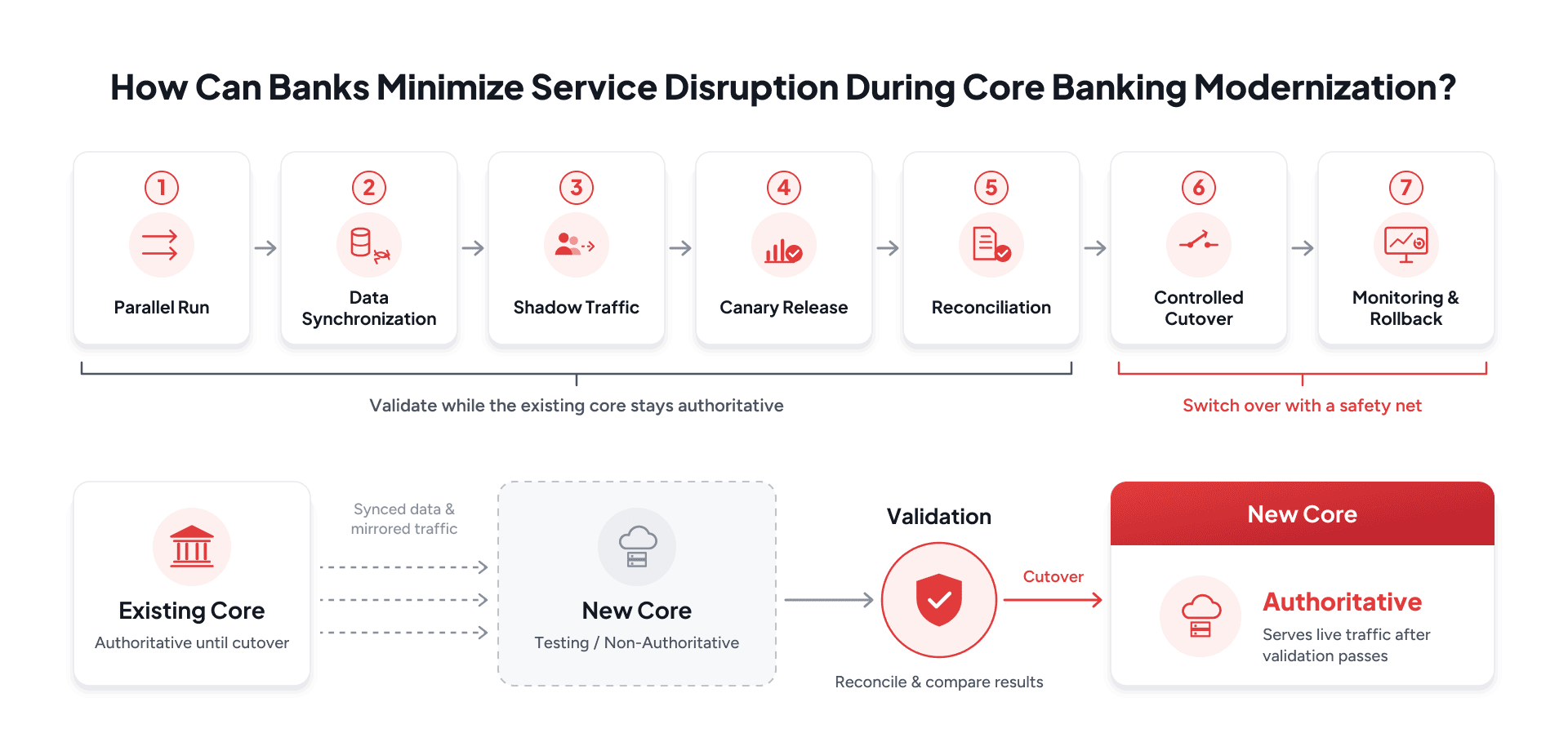
The safer approach is to make the migration itself a controlled operating process designed to minimize customer and service disruption. Migration controls should give teams several points to detect problems, contain them, and reverse changes before they affect customers.
1. When is ‘Dual-Write’ a Crucial Process in Core Banking Migration?
Dual-write means an application or migration process writes corresponding data to two systems. It is useful when the bank needs the legacy and modern environments to remain synchronized while responsibility moves from one system to the other.
But dual-writing creates a consistency problem if one writer succeeds and the other fails; that is why dual-writing should not be treated as a default migration pattern. Teams need mechanisms such as idempotent operations, retry handling, reconciliation, failure monitoring, and a clearly defined source of truth wherever dual-write is used.
2. How Can Shadow Traffic Validate the Modernized Banking Component?
Shadow traffic helps a modernized component to receive copies of production requests or production-like requests without becoming responsible for the customer transaction. For workloads with side effects — such as payments, transfers, disbursements, or account updates — the shadow path must prevent duplicate financial actions. Requests may need to be simulated, replayed against isolated data, or otherwise handled without committing a second transaction.
3. How Can Canary Release Protect Core Banking Modernization?
A canary release pushes a controlled portion of live traffic to the modernized capability while the existing implementation serves the rest of the traffic. The bank might begin with a controlled segment and increase traffic only after the new component meets health and business criteria that have been predefined.
The exact percentage depends on the architecture and risk profile. The important point is that traffic does not move from zero to one hundred percent in a single step.
4. When Should Banks Use Blue-Green Deployment During Migration?
Blue-green deployment maintains two production environments so that traffic can be directed to one environment at a time. The existing environment can continue serving customers while the new environment is prepared, tested, and validated. Once the new environment meets the agreed criteria, traffic can be switched to it. If a serious problem appears, traffic can be redirected to the previous environment, provided the application and data design support that rollback.
How Can Banks Migrate Core Banking Data Without Breaking Transaction Integrity?
Data integrity is a cutover requirement, not a post-migration cleanup task. Before a modernized platform becomes the source of truth, the bank needs to know what data exists, who owns it, how it changes, and whether the migrated records reconcile with the legacy environment.
1. How Should Banks Build a Data Inventory Before Core Banking Migration?
Start by finding where the data actually exists. A useful inventory should be able to cover databases, applications, files, APIs, batch processes, reports, downstream systems, and manual processes that create or modify banking data. It should also show how data moves between these systems.
For each dataset, document:
- What the data represents.
- Which system creates it.
- Which systems consume it.
- How frequently it changes.
- Whether it is used in financial transactions.
- Whether another system depends on it.
- Who owns the data?
- What retention or regulatory requirements apply.
If a dependency is missed, the new platform may have correct data but still produce incorrect results because another system is working from an outdated record.
2. How Should Banks Clean and Normalize Legacy Data Before Migration?
Legacy environments can contain duplicate customer records, missing out on invalid values, inconsistent formats, obsolete records, conflicting records, conflicting identifiers, invalid product or account mappings, and historical records that require special treatment. The bank should define the rules for cleaning and transforming this data before migration begins. It is important to test these transformations against representative datasets before production migration.
3. Who Owns the Data During Core Banking Modernization?
Data ownership needs to be settled before systems start exchanging records. The bank should define which system is authoritative for each important data domain and which teams are responsible for its accuracy. For every critical dataset, define:
- The system of record.
- The system allowed us to write changes.
- Systems that consume the data.
- Synchronization requirements.
- Reconciliation rules.
- Ownership of exceptions.
- The conditions for transferring authority to the modernized platform.
4. Which Core Banking Data Migration Strategy Should Banks Choose?
There is no single migration method that fits every bank or every capability. The choice depends on transaction volume, data dependencies, risk tolerance, the maturity of the target platform, and how long the two environments need to coexist.
Migration strategy | How it works | Where it fits | Main consideration |
|---|---|---|---|
Big-bang migration | Moves the defined data and workload to the new platform in one cutover. | Smaller or more contained environments where dependencies are well understood. | Leaves little room to discover and correct issues after cutover. |
Phased migration | Moves selected products, capabilities, or customer segments in stages. | Large environments where risk needs to be contained across multiple releases. | Requires clear boundaries and coordination between migrated and non-migrated workloads. |
Parallel migration | Runs legacy and modern environments together while outputs are compared. | High-risk workloads where validation before cutover matters. | Requires clear ownership, synchronization, and reconciliation between systems. |
Incremental replication | Continuously propagates changes from one environment to another during migration. | As a supporting technique for phased or parallel migration. | Replication failures, ordering issues, conflicts, and recovery mechanisms need to be managed. |
Now, the decision should be based on the risk profile of the overall migration approach, including the combination of migration methods and synchronization techniques being used.
5. How Should Banks Validate Data Before Switching the Source of Truth?
A practical migration process involves extracting the data, transforming it, loading it into the target system, reconciling the results, validating the data, running it in shadow mode, completing the cutover, and monitoring the system.
- Extract: Did the bank capture the required source data?
- Transform: Was the data converted according to the agreed mapping and business rules?
- Load: Did the target system receive the expected records and values?
- Reconcile: Do source and target systems agree on the defined financial and operational measures?
- Validate: Does the migrated data behave correctly in the target application?
- Shadow: Can the modernized capability process production-like requests without becoming authoritative?
- Cutover: Has the target met the predefined criteria to become the source of truth?
- Monitor: Are transactions, data flows, integrations, and customer journeys behaving as expected after the switch?
Depending on the capability being migrated, teams may need to compare account balances, transaction totals, ledger positions, settlement states, customer records, and other business-level measures. The bank should also test exceptions like failed transactions, reversals, duplicate records, pending settlements, and incomplete updates, which can expose problems that aggregate totals hide.
How Can Banks Modernize the Core Banking Platform Without Increasing Integration Complexity?
A bank can move workloads to new platforms, add APIs, and introduce event-driven services while creating dozens of new connections that remain difficult to understand and operate. The problem usually appears when every new capability gets its own integration, data contract, monitoring approach, and exception process.
Integration can become one of the most expensive parts of the core modernization process. McKinsey estimates that integrating a new core banking system with the existing tech stack can cost more than $50 million for a medium-sized bank, while costs of $300 million to $400 million are not unheard of for larger banks depending on complexity.
Modernization should reduce the number of dependencies that teams need to understand and maintain. That requires standards around how systems connect, communicate, share ownership, and expose operational health.
1. Establish API Standards
APIs should provide defined boundaries between the core and the systems while establishing rules for authentication, authorization, naming, versioning, error handling, rate limiting, and lifecycle management.
2. Reduce Point-to-Point Integrations
Point-to-point integration becomes a problem when every system connects with every other system. Banks can reduce this burden by introducing shared integration capabilities that are predictable across the modernized architecture.
3. Introduce Event Contracts
An event contract includes the structure and meaning of the information being published while specifying event name, required fields, data types, versioning approach, producer, consumers, and rules for handling changes.
4. Define Domain Ownership
Build ownership around business domains such as accounts, payments, customer identity, lending, or transaction monitoring. Each domain should have authority for its critical data and business rules for preventing the same logic from being recreated across several services.
5. Standardize Observability
A bank should establish common observability standards across APIs, services, databases, event streams, and infrastructure to trace transactions across system boundaries and determine where it had slowed down, failed, or produced an unexpected result.
6. Control Customization
The customization process causes legacy infrastructure complexities to arise within the modernized platform. So before recreating a customization, identify what business requirement it is serving and whether that requirement still exists. Any of the custom extensions can introduce unrelated dependencies, or some other release path or component that has to be monitored by someone.
Where Can AI Reduce the Effort and Time Involved in Core Banking Modernization?
AI can reduce some of the most time-consuming work in a core modernization program while engineers, architects, domain experts, and risk teams take up responsibility for validation and decisions. The technology’s strongest role is helping teams understand what they already have, produce the documentation they need, and test whether the new system operates similarly to the old one.
AI can help teams understand and document legacy systems much faster, but the output still needs to be treated as an input to engineering and business validation. In banking, identifying a rule is not the same as proving that it is the rule the new system should implement.
Jani Hardik SanjayProduct Owner IA model can identify a dependency or suggest a business rule, but the bank still needs people to confirm that interpretation before it affects a live transaction flow.
1. Reverse-Engineering Legacy Code
Years of fixes, patches, and customizations can leave the teams dealing with code that only a few people will understand. AI-assisted analysis scans large volumes of legacy source code and surface candidate functions, data relationships, business logic, and application flow for engineering review.
2. Dependency Discovery
Chances are that some of the most difficult dependencies may not have been documented. AI-assisted discovery can analyze source code, configuration, data relationships, logs, and application artifacts to surface links between core applications and surrounding systems.
3. Business Rule Extraction
Legacy systems often contain business rules that could have been used for calculating interest, applying a fee, determining eligibility, or handling an exception but may never have been written down. AI can extract candidate business rules from source code and convert them into draft specifications for business and technology teams to review.
4. Automated Documentation
AI can generate application summaries, data dictionaries, dependency descriptions, interface documentation, and technical specifications from existing system artifacts. Engineers can then review and correct the output instead of starting each document from a blank page.
5. Test Generation
Modernization creates a difficult testing problem where the new implementation must preserve important operations. AI can help generate test cases from extracted business rules, existing code paths, interface definitions, and historical test suites.
6. Migration Validation
AI can also help compare source and target systems during migration. Teams can use automated analysis to identify differences in records, transaction outputs, data mappings, and business-rule results.
7. Human Approval Gates
Every material output should pass through the people responsible for the system. They must verify technical mappings and architecture, confirm business rules, review controls, and assess regulatory requirements.
How Can Banks Measure Whether Core Modernization Is Reducing Operational Drag?
Modernization should produce measurable changes in how the bank builds, releases, operates, and supports its systems. If releases remain slow, reconciliation relies on spreadsheets, and every change requires extensive testing, moving workloads to new infrastructure has not addressed the underlying problem.
Executives need a before-and-after view that connects technology changes to operating results.
1. How Should Banks Build a Before-and-After Modernization KPI Framework?
KPI | Before modernization | Target state |
|---|---|---|
Release lead time | High | Lower |
Deployment frequency | Low | Higher |
Change failure rate | High | Lower |
Mean time to recovery (MTTR) | High | Lower |
Core-related incidents | High | Lower |
Manual operational tasks | High | Lower |
Integration delivery time | Long | Shorter |
Infrastructure maintenance cost | High | Lower |
API availability | Variable | Higher |
Data reconciliation effort | Manual | Automated |
These are directional targets, not universal benchmarks. Each bank should set its target from its own baseline, regulatory requirements, product roadmap, and modernization scope.
2. Which Operational KPIs Show Whether the Bank is Actually Removing Drag?
Track the number of manual reconciliation tasks, batch-dependent processes, manual approvals, operational handoffs, and overnight jobs that remain after each modernization phase.
Integration delivery time is another useful measure. If connecting a new product still requires changes across several legacy systems, then modernization has not removed enough integration friction. A reduction indicates that customer-facing and peripheral capabilities are becoming less dependent on changes within the core system.
3. Which Customer Experience KPIs Should Be Connected to Core Modernization?
Customers notice when an account opens faster, a payment completes without an error, or a new feature arrives without months of waiting. So it is important to keep track of KPIs such as:
- Digital onboarding completion time.
- Payment or transaction failure rates.
- Time required to launch customer-facing features.
- API response times for customer journeys.
- Availability of critical digital banking journeys.
- Customer support contacts caused by system failures.
4. How Can Banks Measure the Financial Impact of Core Modernization?
Teams should track infrastructure and licensing costs, legacy maintenance expenses, engineering hours spent on operational support, cost per integration, and the cost of incidents before and after the modernization process.
What Does a Practical Core Banking Modernization Roadmap Look Like?
Core banking transformation works better as a sequence of controlled decisions than as one large migration project. The goal here is to create enough visibility and control to modernize one capability, prove the approach, and use what the team learns to guide the next move.
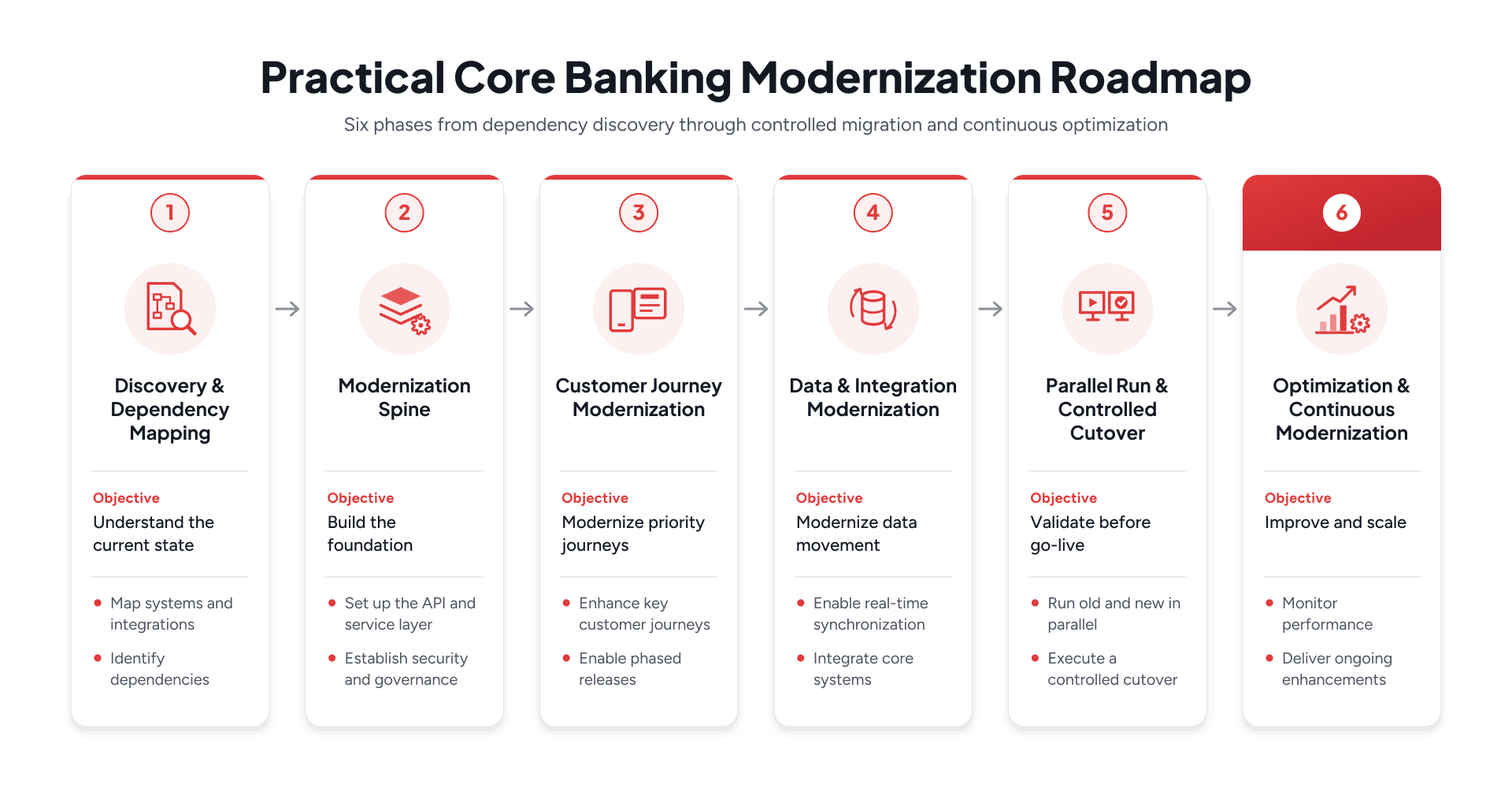
Phase 1: How Should Banks Start with Discovery and Dependency Mapping?
- Objective: Build a reliable picture of the current technology and operational landscape before changing it.
- Key activities: Inventory core applications, databases, APIs, batch jobs, integrations, business rules, data flows, and upstream and downstream dependencies. Identify undocumented interfaces and processes that still depend on the legacy core. Establish the current baseline for release time, incidents, reconciliation effort, operating cost, and other modernization KPIs.
- Owner: The CIO or CTO should sponsor the phase, with the Head of Architecture or Platform Engineering leading the technical assessment alongside business and risk stakeholders.
- Risks: Teams may miss undocumented dependencies, manual processes, or business rules embedded in legacy code.
- Exit criteria: The bank has an approved current-state architecture, dependency map, system-of-record definition, modernization baseline, and prioritized list of candidate capabilities.
Phase 2: How Should Banks Build the Modernization Spine?
- Objective: Create the integration and engineering foundation that allows new capabilities to coexist with the legacy core.
- Key activities: Establish API standards, service boundaries, authentication, observability, event contracts, CI/CD controls, and integration patterns. Define domain ownership so that business logic does not spread across multiple channels and services.
- Owner: The Head of Platform Engineering or Chief Architect should own the technical foundation, with Security, Data, and Application Engineering involved in the design.
- Risks: The bank can replace one set of dependencies with another if every new capability creates a point-to-point integration. Excessive microservices can also increase operational overhead without creating useful separation.
- Exit criteria: The bank has a governed integration layer, defined API and event standards, monitoring in place, and at least one modernization path that can run alongside the existing core.
Phase 3: Which Customer-Facing Journeys Should Be Modernized First?
- Objective: Use customer-facing capabilities to deliver measurable value without making the core ledger the first migration target.
- Key activities: Identify journeys with high customer friction and manageable core dependencies, such as onboarding, account servicing, payments, or selected product journeys. Move appropriate experience and orchestration logic into modern services while keeping the legacy core authoritative where required.
- Owner: The Head of Digital Platforms or Head of Digital Products should lead with Product, Engineering, CX, and Architecture teams.
- Risks: A new front end cannot fix a process that still depends on slow batch jobs or tightly coupled core functions.
- Exit criteria: The selected journey runs through the new architecture, customer and operational metrics have improved against the baseline, and the bank has not introduced unresolved reconciliation or transaction-integrity issues.
Phase 4: How Should Banks Modernize Data and Integration Without Losing Control?
- Objective: Reduce the data and integration constraints that prevent the bank from moving capabilities away from the legacy core.
- Key activities: Clean and normalize legacy data, define data ownership, establish authoritative sources, introduce controlled replication where required, and replace fragile point-to-point connections with governed APIs and events. Validate data through reconciliation before changing the source of truth.
- Owner: The Chief Data Officer or Head of Data should work with Platform Engineering, Architecture, Application Engineering, and Risk.
- Risks: Data duplication can create conflicting records. Dual-write patterns can produce consistency problems if one system accepts a transaction while the other fails to record it.
- Exit criteria: Data ownership is documented, synchronization mechanisms are tested, reconciliation is repeatable, and the bank can demonstrate that the migrated capability produces consistent results across source and target systems.
Phase 5: How Can Banks Run a Parallel Migration and Controlled Cutover?
- Objective: Move production workloads without requiring a single irreversible switch.
- Key activities: Run legacy and modern components in parallel where the workload supports it. Define rollback triggers based on error rates, latency, transaction failures, data discrepancies, and customer impact. Reconcile balances, transaction counts, ledger positions, settlement states, and customer records before changing the source of truth.
- Owner: The CTO or Head of Engineering should own execution, with Operations, SRE, Security, Risk, Compliance, and business owners involved in go-live decisions.
- Risks: Synchronization failures can create inconsistent data, while poorly defined rollback procedures can make an incident harder to contain.
- Exit criteria: The modern capability meets agreed performance and reliability thresholds, reconciliation shows no unexplained material discrepancies, rollback has been tested, and the accountable business and risk owners approve the cutover.
Phase 6: How Should Banks Optimize After the Core Migration?
- Objective: Turn modernization into an ongoing engineering and operating discipline rather than a one-time program.
- Key activities: Decommission retired integrations and infrastructure, reduce remaining legacy dependencies, review API and event usage, tune infrastructure capacity, automate operational tasks, and track modernization KPIs against the original baseline.
- Owner: The CTO or Head of Platform Engineering should own the technical roadmap, while product and business leaders continue to prioritize the next capabilities.
- Risks: Teams may keep old systems running indefinitely after new capabilities are introduced. Without clear decommissioning criteria, the bank can end up paying for both architectures and supporting duplicate processes.
- Exit criteria: The migrated capability has a stable operating history, legacy dependencies that are no longer required have been removed, target KPIs are being tracked, and the next modernization candidate has been selected using evidence from the previous phase.
What Common Core Banking Modernization Mistakes Increase Operational Drag?
Core banking modernization can reduce operational drag, but the wrong decisions can move the same problems into a new platform. A technology change can leave the existing dependencies, manual work, and ownership gaps in place.
1. Starting With Technology Instead of Business Capabilities
Modernization should start with the banking capabilities the institution needs to improve, not with a decision to adopt a specific platform or architecture.
2. Treating Microservices as the Default Architecture
Microservices can help teams deploy and scale services independently, but they also add APIs, network calls, monitoring, deployment pipelines, and operational overhead.
3. Migrating Data Before Understanding Dependencies
Moving data without mapping where it is created, changed, consumed, and reconciled can break processes that depend on it.
4. Recreating Legacy Customizations in the New Platform
A modernization program can lose its value if every old workaround is rebuilt in the new system. Review each customization against the business requirement behind it and retire, simplify, or redesign it when the original constraint no longer exists.
5. Ignoring Operational Teams Until Late in the Program
Operations teams know where the current system creates manual checks, overnight jobs, exception queues, and recurring incidents.
6. Running Two Systems Without Clear Ownership
Parallel operation creates a useful safety net only when teams know which system owns each capability and which system is authoritative for each data set. Define ownership, synchronization rules, escalation paths, and cutover conditions before the legacy and modern systems begin running together.
7. Measuring Migration Completion and Business Outcomes
Teams need to track outcomes such as release lead time, MTTR, core-related incidents, and infrastructure expenses alongside migration milestones.
8. Retiring Legacy Components Too Late
Set retirement criteria before beginning the migration process and remove each legacy component once its replacement has passed reconciliation, operational validation, and the agreed rollback window.
What Should Executives Check Before Starting Zero-Downtime Core Banking Modernization Process?
Use this as a pre-cutover executive checklist. Each question should have an owner and a documented answer before the program moves forward.
Architecture and Dependencies |
|---|
The bank should be able to prove that the new system works before it handles upcoming transaction activities. If the answer is no, the migration is not ready for cutover.
Why Choose GeekyAnts for Core Banking Modernization?
Banks aiming to modernize their operations need to ensure that they understand the current system, find the seams where change can happen safely, and carry the work from architecture through production.
A Product Engineering Partner for Core Modernization
Engineering leaders need people who can understand legacy system operations, design the target architecture, build integrations, test migration paths, and operate the resulting platform.
GeekyAnts brings engineering depth across backend systems, architecture, QA, DevOps, cloud, and mobile development.
What Does This Look Like in Practice?
GeekyAnts has worked on banking infrastructure where a domain migration involved 100+ integrations and required the existing services to keep operating during the transition. This experience reinforces that the challenge in modernization is understanding the existing dependencies, sequencing the transition carefully, and validating the new path that is ready to take over.
GeekyAnts also highlights fintech work involving 60% cloud cost reduction, $57K+ in annual savings, and 100% platform reliability maintained for a financial platform. Its BFSI experience spans digital banking, payments and digital wallets, RegTech, compliance automation, insurance, and fintech application development.
In banking modernization, the strongest outcomes come from making the right changes in the right order. Our approach is to understand the existing architecture and business dependencies first, then modernize the areas that can create the most value without putting critical operations under unnecessary risk. Combining product engineering, APIs, cloud, data, QA, DevOps, and observability into one delivery approach facilitates modernization to progress from strategy to production with clear ownership and measurable outcomes.
 Saurabh SahuChief Technology Officer (CTO)
GeekyAnts’ Expertise in Banking Migration
Our team migrated a legacy PHP/Laravel online banking platform to a configuration-driven, multitenant system that is built to support multiple financial institutions more consistently. The redesign strengthened security by keeping sensitive banking session information on the server side. The team reviewed the legacy system feature by feature to get a better understanding about its behavior in production and made sure the new platform preserved the right behavior while introducing intentional improvements.
What Does a Successful Core Banking Modernization Process Look Like?
Core banking modernization is not complete when the new platform goes live. It is complete when the bank can release changes faster, reduce manual work, control integration complexity, and run critical transactions without depending on the limitations of the old system.
The goal is to remove the operational drag that keeps banking teams from improving the products and journeys customers rely on.