

Key Takeaways
- Map regulatory obligations to a specific workflow before selecting AI capabilities. Customer onboarding and transaction monitoring call for different data and review controls.
- Existing tools may meet standard requirements. Custom or hybrid development becomes relevant when integrations, approval workflows, or regulatory coverage create gaps.
- High-impact decisions need an evidence trail: source records, rule versions, AI recommendations, reviewer actions, and reasons for escalation or closure.
- Pilot one workflow against baseline false positives, missed suspicious activity, and investigation time. Include regulatory updates, model monitoring, and maintenance in the budget.
Why Are Financial Institutions Investing in AI-Powered RegTech Software?
Financial institutions often manage customer screening, transaction monitoring, and regulatory reporting across separate systems. When an alert requires investigation, compliance teams must assemble customer records, transaction histories, and screening evidence before deciding what to do. As transaction volumes grow, these manual handoffs can create backlogs and make it harder to resolve cases consistently.
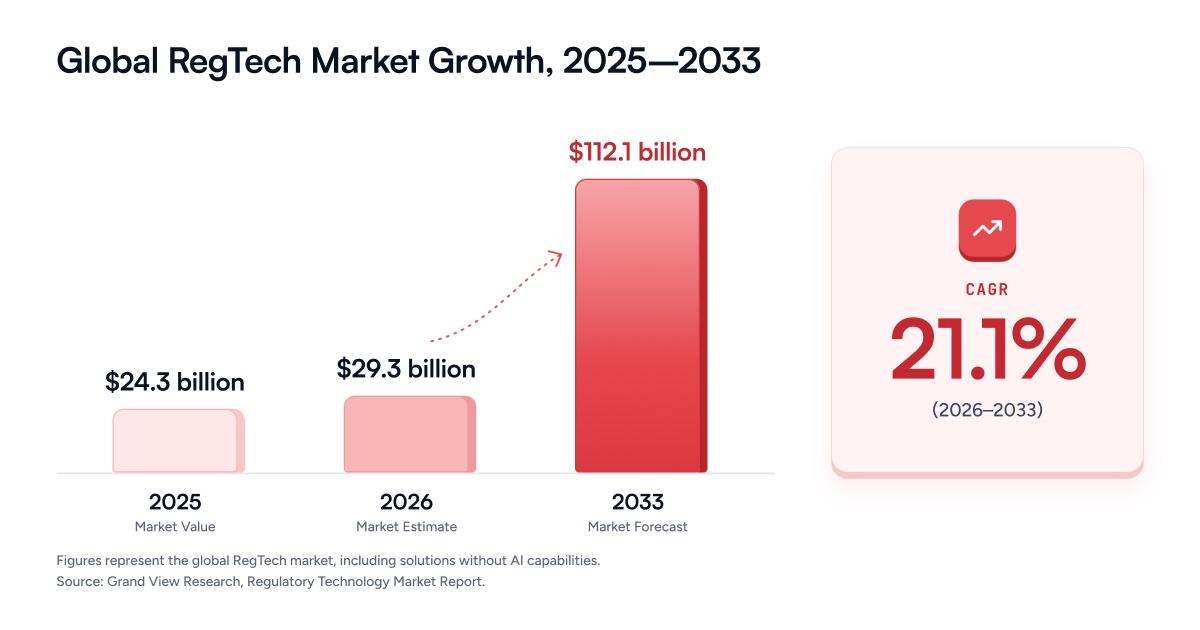
These pressures help explain the growing investment in regulatory technology. Grand View Research estimates that the global RegTech market will grow from $24.3 billion in 2025 to $112.1 billion by 2033. The forecast covers the broader RegTech market, including tools without AI capabilities. For financial institutions considering AI-powered RegTech software development, the starting point is identifying which compliance workflows need improvement and where AI can contribute.
AI can identify suspicious patterns, extract information from documents, and help investigators prioritize cases. Financial institutions must determine which recommendations require human approval, what information AI can access, and which records must be retained to support regulatory examinations.
If a bank wants AI in compliance, I want to identify the bottleneck in its casework. Is the delay in sanctions screening, evidence collection, investigator assignment, or approval? Each problem has a different cost. Funding an AI model before measuring these handoffs can increase alert volume without reducing the effort required to resolve a case.
 Kunal KumarChief Revenue Officer
The workflow should also determine how the investment is measured. For transaction monitoring, teams need to assess investigation time and detection quality together. For customer onboarding, they should track verification time, completion rates, and cases requiring escalation. These measures give teams a basis for deciding whether to extend existing software, build custom capabilities, or combine the two.
This guide examines platform capabilities, development stages, compliance risks, costs, and the criteria for evaluating implementation partners.
What Is AI-Powered RegTech Software, and Which Workflows Justify Custom Development?
AI-powered RegTech software connects regulatory requirements with the records and workflows used to meet them. It combines defined compliance rules with AI-assisted analysis, helping teams identify cases for investigation, examine supporting information, and document decisions.
Which Compliance Workflows Can RegTech Support?
Customer and transaction compliance: Know Your Customer (KYC) and Know Your Business (KYB) automation support identity checks. Sanctions screening identifies potential matches against restricted-party lists. Anti-money laundering (AML) and transaction monitoring, fraud detection, and risk scoring help investigators identify suspicious activity and prioritize cases.
Regulatory operations: Regulatory change management tracks changes in relevant requirements, including FATF recommendations (international AML standards) and the Reserve Bank of India's KYC directions (India). Policy monitoring checks adherence to approved procedures, while compliance document review, audit preparation, and regulatory reporting support evidence collection and required submissions.
Extended oversight: Third-party risk management evaluates external providers and their compliance exposure. AI governance and model-risk monitoring examine model performance, changes, and accountability for AI-assisted decisions.
What Makes Custom Development Worth the Investment?
Commercial compliance platforms can address standard screening and reporting requirements. Regulatory compliance software development becomes a consideration when existing products cannot support specialized approval workflows, complex banking integrations, or obligations across the institution's operating markets.
Consider a lender using an established identity-verification provider. Its loan products may require different investigation paths, escalation rules, and reporting records. Building those workflows around the existing service could make more financial sense than replacing the entire compliance system.
The decision comes down to integration effort, control over workflows, vendor dependencies, and long-term ownership costs. A hybrid AI RegTech platform can retain existing compliance tools while supporting custom approval workflows.
Which Features Should an AI-Powered RegTech Platform Include?
A transaction-monitoring tool may flag a suspicious payment without giving an investigator enough context to resolve it. Feature selection should account for the complete case, from the rule that triggered the alert to the evidence supporting its resolution.
Which Core Features Support Compliance Casework?
- Configurable rules engine: Gives compliance teams control over screening thresholds, review conditions, and escalation routes, with approval processes for rule changes.
- KYC/AML screening: Checks customer identities and transactions against defined risk criteria, sanctions lists, and financial crime indicators.
- Case management: Brings alerts, investigator notes, supporting records, assigned responsibilities, and resolution outcomes into one workspace.
- Reporting and submissions: Regulatory reporting software prepares submissions from validated compliance records and identifies missing information before review.
- Audit trails: Preserve rule versions, user actions, approval records, and evidence supporting compliance decisions.
Which AI Capabilities Improve Investigation Quality?
AI can help investigators process information and identify cases that warrant closer examination. Anomaly detection highlights unusual transaction patterns. Intelligent document processing extracts information from identity records, financial documents, and compliance forms for verification.
Risk scoring helps teams prioritize investigations based on defined indicators. Regulatory intelligence identifies updates in regulatory publications that may require changes to internal policies or screening rules.
These capabilities need controls that support accountability. Explainable AI should provide reviewers with evidence and relevant factors behind recommendations. Human-in-the-loop review assigns high-impact decisions to designated reviewers and records approvals and escalations.
RegTech Architecture: What Makes Compliance Decisions Defensible?
RegTech architecture must preserve the evidence behind each compliance decision, from the source record and applicable rule to an AI recommendation and reviewer approval. This creates a record of the decision process that compliance teams can examine during investigations and audits.
Which Architecture Layers Connect Data to Compliance Decisions?
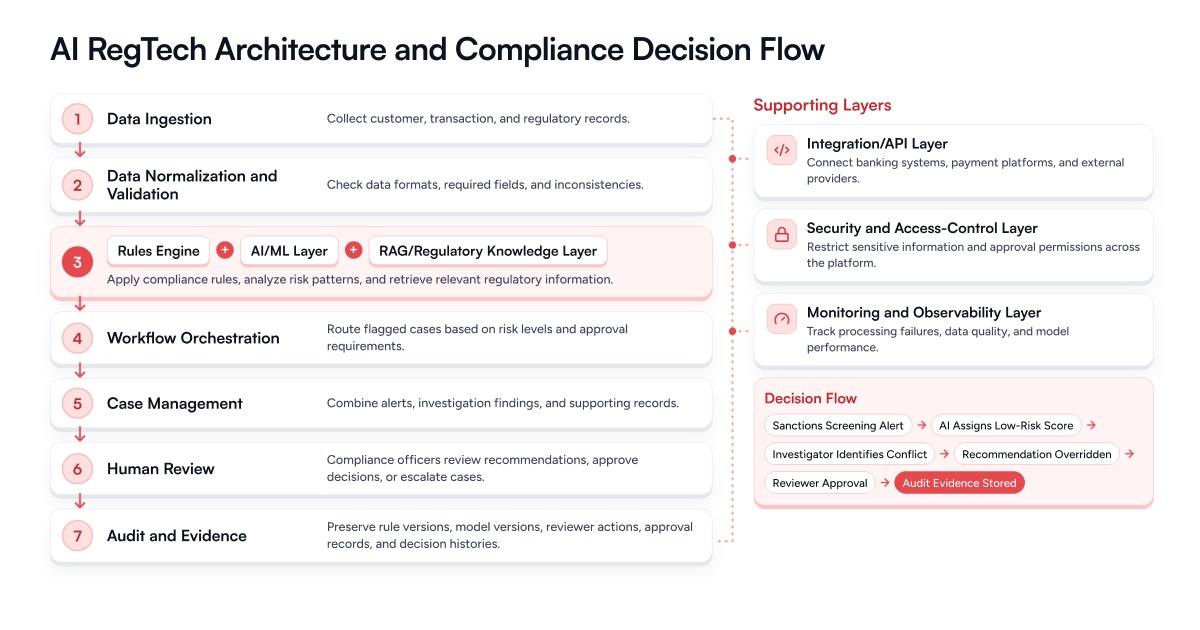
The data ingestion layer receives customer, transaction, and regulatory records through an integration/API layer connecting banking systems, payment platforms, and external providers. A data normalization and validation layer checks formats, required fields, and inconsistencies that could affect compliance assessments.
The rules engine applies approved compliance criteria and screening thresholds. The AI and machine learning (ML) layer identifies patterns and produces risk assessments. A retrieval-augmented generation (RAG) and regulatory knowledge layer retrieves relevant regulations and internal policies to support investigations. AI recommendations provide supporting information, with final decisions remaining under authorized human control.
The workflow orchestration layer routes flagged activities based on risk levels and approval requirements. The case management layer brings alerts, supporting records, and investigation findings into one case file. The human review layer enables authorized personnel to examine recommendations, approve decisions, or escalate cases.
The audit and evidence layer preserves source records, rule versions, model versions, reviewer actions, and decision histories. The security and access-control layer restricts access to sensitive information and approval functions, while the monitoring and observability layer tracks integration failures, data quality issues, processing delays, and model performance.
What Evidence Supports a Compliance Decision During an Audit?
Consider an illustrative sanctions-screening case. A screening rule flags a payment because the customer's name resembles an entry on a sanctions list. An AI model assigns the alert a low-risk score, but the investigator identifies conflicting information and overrides that recommendation.
The platform records the screening rule and AI model versions, sanctions-list data, transaction details, and investigator findings. The case record contains the reason for the override, reviewer identity, timestamps, and final approval.
During an audit, compliance teams can reconstruct the decision, identify the evidence considered, and establish whether the investigation followed the controls in effect at that time. This record provides a basis for examining the decision without depending on the investigator's recollection.
How Do You Build AI-Powered RegTech Software? A Six-Phase Development Process
AI-powered RegTech software development follows six phases, from regulatory discovery to monitored deployment. Each phase assigns a lead owner, requires recorded evidence, and ends at an approval gate. Compliance, product, engineering, and security teams review the gate before work advances.
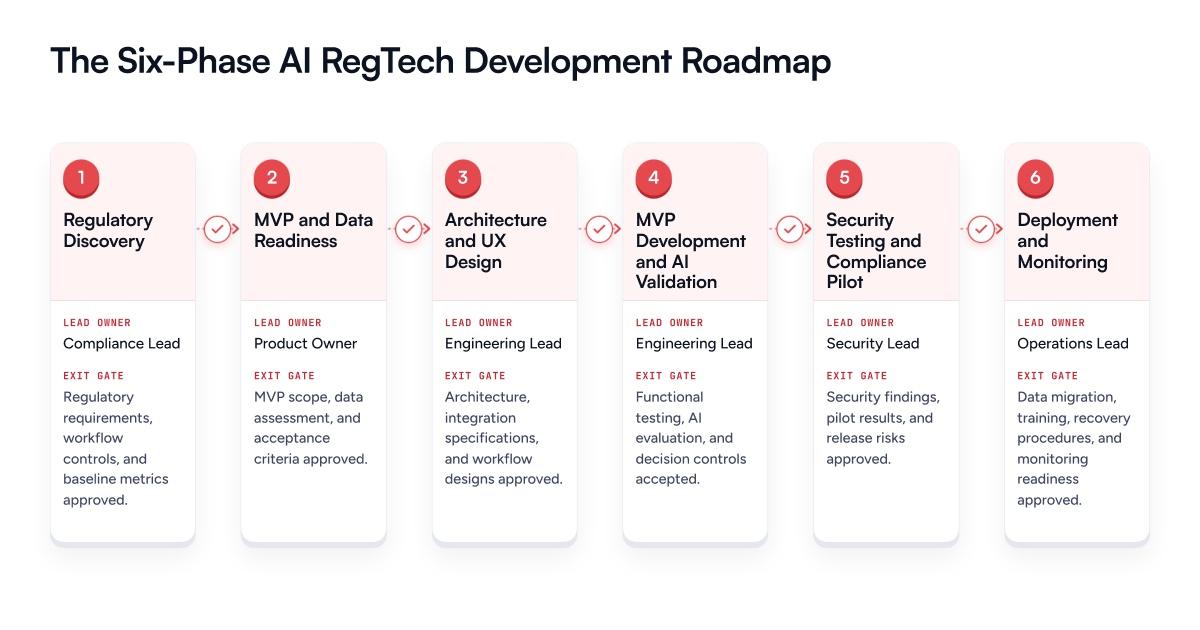
Phase | Lead Owner | Exit Gate |
|---|---|---|
1. Regulatory Discovery | Compliance Lead | Regulatory requirements, workflow controls, and baseline metrics approved |
2. MVP and Data Readiness | Product Owner | MVP scope, data assessment, and acceptance criteria approved |
3. Architecture and UX Design | Engineering Lead | Architecture, integration specifications, and workflow designs approved |
4. MVP Development and AI Validation | Engineering Lead | Functional testing, AI evaluation, and decision controls accepted |
5. Security Testing and Compliance Pilot | Security Lead | Security findings, pilot results, and release risks approved |
6. Deployment and Monitoring | Operations Lead | Data migration, training, recovery procedures, and monitoring readiness approved |
1. Define the Compliance Problem and Map Regulations
The Compliance Lead identifies the workflow requiring improvement, such as sanctions investigations, customer verification, or regulatory reporting. The team maps affected products, operating jurisdictions, reporting obligations, and approval responsibilities.
For US operations, applicable requirements may include the Bank Secrecy Act (BSA), anti-money laundering controls, and Financial Crimes Enforcement Network (FinCEN) reporting rules. EU institutions must assess relevant anti-money laundering requirements, the General Data Protection Regulation (GDPR), and the Digital Operational Resilience Act (DORA). They should account for applicable EU AI Act obligations and the EU Anti-Money Laundering Regulation (EU) 2024/1624, which has a general application date of July 10, 2027.
Translate applicable obligations into screening criteria, review responsibilities, escalation conditions, and evidence requirements. Establish baseline investigation time, false-positive rates, onboarding duration, and audit evidence retrieval time. Missing jurisdiction-specific controls can invalidate a workflow that meets its technical specifications.
FATF's 2025 guidance reinforces proportionate, risk-based customer due diligence, including simplified measures for assessed lower-risk situations. Product teams must translate these distinctions into verification requirements and escalation paths, subject to local regulations.
Exit Gate: The Compliance Lead approves the regulatory workflow map, control ownership, reporting requirements, and baseline measurements.
2. Prioritize Use Cases, Assess Data, and Scope the MVP
The Product Owner evaluates potential use cases against regulatory exposure, operational impact, data availability, and integration effort. The first release should address one defined compliance workflow with measurable acceptance criteria.
Assess data ownership, source-system access, required fields, historical records, and integration dependencies. For KYC workflows, confirm whether identity documents, provider responses, screening results, and risk indicators support the proposed verification process.
Incomplete customer records, inconsistent identifiers, and unavailable provider data can cause incorrect classifications or stalled investigations. Define how the product handles missing information, failed verification checks, and cases requiring compliance review.
Create a minimum viable product (MVP) backlog covering approved features, excluded capabilities, data requirements, exception handling, and test scenarios. Resolve critical data-access dependencies before development begins.
Exit Gate: The Product Owner obtains compliance and engineering approval for the MVP scope, data-readiness assessment, and acceptance criteria.
3. Plan the Architecture, Integrations, and User Experience
The Engineering Lead translates the approved workflow into an architecture plan covering system connections, data handling, security controls, and approval responsibilities.
Map the architecture layers described earlier in this guide. Define how data ingestion and validation connect with the rules engine, AI models, and regulatory knowledge layer. Establish how workflow orchestration routes alerts into case management, human review, and audit evidence storage.
Document API contracts, data mappings, authentication methods, and access permissions. Specify how the platform handles duplicate records, provider timeouts, failed transactions, and missing screening results. Without these decisions, integrations can produce inconsistent case information or incomplete audit records.
Design investigator screens showing alert context, supporting records, risk recommendations, and approval histories. Compliance users should review these workflows against representative cases before implementation.
Exit Gate: The Engineering Lead obtains product, compliance, and security approval for the architecture, integration specifications, data mappings, and workflow designs.
4. Build the MVP and Validate AI Against Approved Rules
The Engineering Lead coordinates development of the core compliance workflow, provider integrations, approved rules, case management, reporting functions, and evidence capture.
For planning purposes, a narrowly scoped MVP may use a 2–3-month development window. The final timeline depends on data readiness, integration complexity, AI requirements, and compliance validation.
Develop rule-based controls for defined regulatory scenarios. Evaluate AI recommendations against reviewed case data and agreed acceptance criteria. Measure false positives and missed suspicious activity as separate outcomes. Lower alert volumes can mask missed suspicious activity.
Test provider failures, incomplete records, model-version changes, and human overrides. Record the rule and model versions, evidence supporting recommendations, reviewer actions, and final decisions. Risk scores based on incomplete verification data must follow an approved exception-handling process.
Exit Gate: Engineering, product, and compliance representatives approve the tested MVP, AI evaluation results, exception-handling behavior, and audit records before the compliance pilot.
Before I sign off on an onboarding flow, I write the KYC failure paths into the acceptance criteria. If a provider times out or returns incomplete data, the product needs a defined retry, fallback, or escalation route. An AI risk score built on partial data should never clear a customer automatically, and every retry, override, and escalation should leave a record the compliance team can review.
 Rupsa DasProduct Owner I
FATF's 2025 guidance reinforces proportionate, risk-based customer due diligence, including simplified measures for assessed lower-risk situations. This affects RegTech product design because onboarding workflows need separate review paths for different risk levels, subject to local regulations. Product teams must define the verification requirements, escalation criteria, and supporting evidence for each path before development.
5. Review Security, Test Workflows, and Run a Compliance Pilot
The Security Lead reviews how the platform protects customer information, screening records, approval functions, and connections with external providers.
Test encryption during transmission and storage, role-based permissions, authentication controls, API credentials, and access logging. Verify that unauthorized users cannot modify screening rules, approve restricted actions, or retrieve sensitive investigation records.
Assess security vulnerabilities, provider outages, failed integrations, processing loads, and attempts to alter audit records. Test backup restoration, incident handling, and recovery procedures against defined acceptance criteria.
Conduct a compliance pilot using representative cases, including false matches, incomplete verification responses, escalation failures, and human overrides. Compare investigation time and detection results against the baseline established in Phase 1.
Critical access failures, missing audit evidence, or unresolved escalation defects must prevent production release. Document each finding, its owner, corrective action, and retest result.
Exit Gate: Security and compliance leads approve the security assessment, pilot results, remediation evidence, and outstanding release risks.
6. Deploy, Monitor, and Support the Platform
The Operations Lead coordinates production deployment, historical data migration, compliance-user training, monitoring, and recovery preparation.
Map existing cases, supporting documents, and decision histories to the new system. Reconcile transferred records, verify approval statuses, and confirm retention and access permissions. Missing case histories or incorrect status mappings can disrupt investigations and weaken audit evidence.
Train compliance officers to review alerts, assess AI recommendations, document overrides, and handle provider failures. Establish operational procedures for incident response, regulatory updates, model monitoring, and integration maintenance.
Track false-positive rates, missed suspicious activity, investigation time, onboarding duration, and evidence retrieval against the baseline established in Phase 1. These measurements support the ROI assessment covered later in the guide.
Assign owners for monitoring failures, updating screening rules, reviewing model performance, and investigating recurring exceptions. Changes affecting compliance decisions require documented testing and approval.
Exit Gate: Operations, engineering, security, and compliance representatives approve migration reconciliation, training completion, recovery readiness, production monitoring, and operational ownership.
Which Compliance Risks Must Teams Address in AI-Powered RegTech Development?
AI compliance software can expose financial institutions to regulatory and operational harm through unsupported recommendations, data breaches, and outdated rules. Each risk needs an assigned owner, preventive controls, and evidence of their effectiveness.
For businesses subject to EU requirements, the General Data Protection Regulation (GDPR) governs personal data processing, the Digital Operational Resilience Act (DORA) addresses financial-sector technology risks, and the EU AI Act establishes risk-based obligations for covered AI systems. Applicability depends on the institution and its use cases.
For India, the Digital Personal Data Protection Act, 2023, has a phased commencement schedule covering personal data protection requirements.
Risk | Business Consequence | Practical Mitigation |
|---|---|---|
AI hallucinations and limited explainability | Invented regulatory interpretations or unexplained risk scores can misdirect investigations. | Check AI outputs against approved sources, provide supporting evidence, and send unsupported recommendations for human review. |
Bias and model drift | Unequal treatment or declining detection accuracy can affect customers and compliance outcomes. | Test results across relevant customer groups, track false positives and missed cases, and require approval for model changes. |
Data privacy and cybersecurity | Customer records can be exposed through weak access controls, insecure storage, or attacks. | Minimize data collection, encrypt sensitive records, restrict access by role, and test security controls and incident response. |
Provider outages, data retention practices, or processing locations can create compliance exposure. | Review vendor contracts, data-use restrictions, hosting locations, security evidence, and fallback arrangements. | |
Regulatory changes and audit gaps | Outdated rules or missing evidence can leave decisions unsupported during examinations. | Assign rule owners, assess regulatory updates, test changes before release, and preserve rule versions and case records. |
Insufficient human oversight | Unchecked AI recommendations can trigger unjustified account restrictions or missed escalations. | Set decision limits, require authorized approval for high-impact actions, and record overrides with reasons. |
These controls need to match the institution's regulatory obligations and risk appetite. Compliance, security, and engineering leaders should agree on control ownership and escalation criteria before expanding AI-assisted workflows.
What Does AI-Powered RegTech Software Development Cost?
RegTech software development cost depends on the number of compliance workflows, regulatory jurisdictions, AI capabilities, and systems requiring integration. A focused compliance MVP requires a smaller investment than a platform covering multiple financial products and reporting obligations.
What Budget and Timeline Should Businesses Expect?
The following ranges are planning estimates for one-time build costs.
Development Scope | Estimated Cost (USD) | Timeline | Scope |
|---|---|---|---|
MVP | $20,000 - under $40,000 | 2–3 months | One compliance workflow, limited integrations, and basic screening or reporting |
Mid-market platform | $40,000 to under $80,000 | 4–6 months | Multiple workflows, AI-assisted analysis, case management, and system integrations |
Enterprise-scale platform | From $80,000 | 6–12 months | Complex integrations, broader regulatory coverage, advanced AI capabilities, and governance controls |
The estimates cover design, development, testing, and initial deployment. They exclude recurring expenses, third-party licensing, and regulatory legal review. Custom AI models, stricter security requirements, and multi-jurisdiction coverage can increase costs.
Which Factors Influence Development and Ownership Costs?
Four factors shape the initial investment:
- AI capabilities: Data preparation, model development, testing, explainability, and performance validation.
- Integrations: Connections with banking systems, identity providers, transaction databases, and reporting platforms.
- Security: Access controls, encryption, security testing, and audit requirements.
- Regulatory complexity: Jurisdiction-specific rules, reporting obligations, and compliance validation.
Cloud deployments accounted for 65% of global RegTech market revenue in 2025. For teams choosing cloud hosting, the budget needs to account for transaction processing, data storage, audit-log retention, backup, and recovery alongside development. Total cost of ownership also includes third-party APIs, software licenses, security assessments, regulatory updates, maintenance, and model monitoring. Estimate these expenses against expected usage and retention requirements before comparing build, buy, and hybrid options.
Which Is More Cost-Effective: Build, Buy, or Hybrid?
Approach | Cost Considerations | Suitable Scenario |
|---|---|---|
Build | Higher initial investment, with ownership of maintenance and future development costs | Specialized compliance workflows and complex integrations |
Buy | Lower initial investment, with recurring licensing and usage fees | Standard compliance requirements supported by existing software |
Hybrid | Custom integration costs alongside vendor subscriptions | Existing compliance tools meet part of the requirements |
What ROI Metrics and Partner Capabilities Matter in RegTech Platform Development?
A reduction in compliance alerts offers little value if suspicious activity escapes detection. Financial institutions need to measure operational savings against investigation quality, customer onboarding performance, and the cost of maintaining the platform.
What ROI Metrics Should You Track?
Measure false positives using reviewed case outcomes, with separate checks for suspicious activity the system failed to detect. A closed alert is insufficient evidence of a false positive. Compare investigation time from alert assignment to resolution, onboarding time from application to verification, and audit readiness through evidence completeness and retrieval time.
Use the pre-launch baseline to quantify savings in investigations, corrections, and customer processing. ROI equals (measurable benefits minus total costs) divided by total costs for the same period. Exclude savings without supporting evidence.
What Should You Look for in a RegTech Development Partner?
RegTech expertise requires project evidence beyond a general fintech development portfolio. Ask potential partners about compliance case management, regulatory reporting, and integrations with banking or payment systems.
Evaluate their approach to customer data protection, rule and model versioning, audit evidence, and access permissions. Confirm who owns AI validation, regulatory updates, incident response, and maintenance after deployment. Request sample acceptance criteria and evidence of delivery against comparable compliance requirements.
What Does GeekyAnts Offer for AI-Powered RegTech Software Development?
GeekyAnts develops compliance automation software for banks and fintech companies working with connected financial systems. Its RegTech capabilities include integrating 13+ KYC providers into onboarding workflows, alongside AML monitoring, fraud detection, regulatory reporting, and audit management.
Its KYC orchestration approach connects identity verification, risk scoring, provider fallback, and case reviews within one workflow. Engineering capabilities extend to AI-assisted transaction analysis, configurable compliance rules, and audit records that preserve screening results and reviewer decisions.
I would expect a RegTech proposal to show the bank's path to improving screening and case management while retaining its existing systems. At GeekyAnts, that means defining integration ownership, approval responsibilities, and the evidence handed over to compliance teams. Those details give decision-makers a basis for evaluating the investment and its operating costs after launch.
Kunal KumarChief Revenue OfficerCloud deployments accounted for 65% of global RegTech market revenue in 2025. Hosting decisions affect customer data location, access to audit records, provider exit options, and recurring infrastructure expenses. Buyers should assess these commitments alongside development costs to understand their long-term ownership responsibilities.
Conclusion
The success of a RegTech investment depends on whether a financial institution can defend the decisions its software supports. A tested workflow, measured results, and retained evidence provide a stronger basis for expansion than a broad automation rollout.
Sources and Citations
- https://www.grandviewresearch.com/industry-analysis/regulatory-technology-market
- https://www.fatf-gafi.org/en/publications/Fatfrecommendations/Fatf-recommendations.html
- https://www.rbi.org.in/scripts/BS_ViewMasDirections.aspx?id=11566&utm
- https://commission.europa.eu/law/law-topic/data-protection_en
- https://eur-lex.europa.eu/legal-content/EN/TXT/?uri=uriserv:OJ.L_.2022.333.01.0001.01.ENG&utm
- https://eur-lex.europa.eu/legal-content/en/TXT/?qid=1790822129312&uri=CELEX:02024R1689-20260727&utm
- https://www.meity.gov.in/static/uploads/2025/11/c56ceae6c383460ca69577428d36828b.pdf
- https://geekyants.com/industry-expertise/banking-finance-insurance/regtech-compliance-automation
- https://www.fatf-gafi.org/content/dam/fatf-gafi/guidance/Guidance-Financial-Inclusion%20-Anti-Money-Laundering-Terrorist-Financing-Measures.pdf
- https://www.grandviewresearch.com/press-release/global-regulatory-technology-market