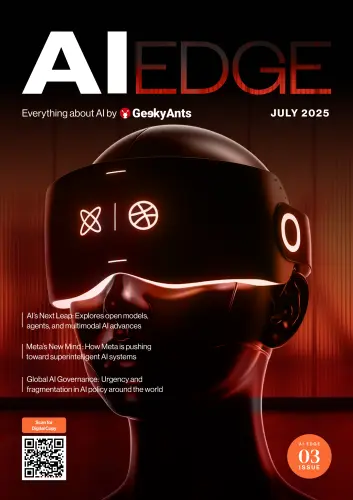
Issue 1: AI Edge Magazine
AI Edge is your monthly pulse on all things artificial intelligence — from breakthroughs to build tips. Packed with insights, tools, and trends, it's crafted for developers, designers, and curious minds alike.
The LLM Will See You Now: How Hobbes Health is Revolutionizing Nutrition Tracking
Credit: Surjeet Singh
“AI is perhaps the most transformational technology of our time, and healthcare is perhaps AI's most pressing application.”
— Satya Nadella, CEO of Microsoft
We have never quite shaken our obsession with food as medicine, nor our anxiety over what it means to eat "correctly." Now, in an age when even our toothbrushes collect data, a new actor steps onto the stage with the kind of confidence only afforded by silicon and code: Hobbes Health, an AI-driven nutritional platform that doesn’t just log what you eat, but attempts to understand it—perhaps better than you do yourself.
Hobbes Health is not a Fitbit-fueled dopamine experiment or a MyFitnessPal clone with prettier colors. Hobbes Health is not interested in your aesthetic aspirations or the half-hearted resolution you made in January. It is a fundamentally more ambitious proposition: a convergence of artificial intelligence, nutritional science, and behavioral psychology wrapped in the sleek promise of personalized healthcare system. It is, for lack of a better term, the panopticon of your plate.
First Bite Goes to the Camera
The camera eats first—an idiom once reserved for Instagrammers has now become a core feature of Hobbes Health’s operating philosophy. At the heart of the platform lies a vision system that deploys computer vision models not unlike those used in military surveillance or autonomous vehicles. This technology doesn’t simply see; it discerns, decomposes, and diagnoses. A single photo of your lunch—once a narcissistic indulgence—is parsed for caloric content, macronutrient balance, portion estimates, and even food variety.
And here lies the seductive appeal of Hobbes Health. What began with crude calorie tables in 19th-century military rations and blossomed into the pseudo-science of dietetic trends now enters its next logical phase: food as a computable object. Your burrito is no longer a subjective mess of carbs and shame—it’s a quantifiable unit of bioenergetic input, reduced and reassembled by AI.
Yet one must ask, as Orwell might have when faced with such a machine: Who owns the data? And what becomes of the eater once the eating is over?
The Chatbot Will See You Now
More unsettling—and perhaps more impressive—is Hobbes Health’s conversational AI engine. This is no customer service bot with cheerful typos. This is a system built to adapt to your dietary quirks, track your emotional hunger, and maintain the kind of context that most spouses would envy. It engages in a multi-modal dialogue—text, voice, image—offering real-time feedback not just on what you've eaten, but on what you should eat next, and how you might feel about it later.
It is not difficult to imagine a not-too-distant future where this voice becomes authoritative, if not absolute. When the AI tells you to skip the crème brûlée, is it a suggestion? A recommendation? Or, as Bentham’s disciples might phrase it, a “nudge” toward socially acceptable behavior in the guise of self-care?
Ronald Razmi, in his polemic AI Doctor, writes that “AI is the solution, enhancing every stage of patient care from research and discovery to diagnosis and therapy selection.” One might add: and now, it wants to eat with us.
Architecture for the Post-Human Diet
The technical scaffolding that supports this Orwellian nutritionist is as impressive as its aspirations are unnerving. Hobbes Health operates on an event-driven architecture, a design borrowed from systems where lives depend on speed—stock trading, battlefield command, and now... your sandwich. It processes inputs asynchronously, delivering streaming feedback that makes legacy health apps feel like rotary phones in a 5G world.
Images are analyzed in real-time. Voices are parsed with NLP models trained to detect not only linguistic nuance but also emotional valence. Over time, the system constructs a probabilistic model of your eating habits, correlating them with mood states and metabolic outcomes. This isn’t health tracking—it’s health surveillance, gilded with good intentions.
One is reminded of Foucault’s notion of the medical gaze, expanded here into a full-blown sensory apparatus that watches not just the patient, but the meal, the moment, and the mind.
The Algorithm as Apothecary
The coup de grâce is Hobbes Health’s “intelligent health coach,” a virtual entity whose sole job is to analyze your food intake across time and deliver judgment. It offers more than daily recommendations—it offers a philosophy. You can inquire about your protein intake over the last quarter, check your fiber peaks, or trace emotional eating patterns across weeks of breakups and board meetings. It is, in essence, a confessor for the modern soul, armed with citations from medical journals instead of scripture.
But what happens when the machine knows too much? Eric Topol, in Deep Medicine, envisions AI as the tool that restores “the precious and time-honored connection and trust—the human touch—between patients and doctors.” But when that trust is outsourced to a circuit, when we turn to a chatbot for nutritional absolution, do we gain clarity or merely a deeper form of alienation?
The Road Ahead: Of Panaceas and Power
Hobbes Health is a product of our times: a tool born of anxiety, precision, and the insatiable need to measure the unmeasurable. It is stunning in its ambition, terrifying in its scope, and brilliant in its execution. It may very well become the standard by which future health apps are judged—not by how well they collect data, but by how convincingly they impersonate wisdom.
Oliver Kharraz, CEO of Zocdoc, once remarked, “AI could enhance or replace numerous functions currently performed in healthcare, leading to more efficient and higher-quality patient care while reducing costs.” That, one imagines, is the hope. But history teaches us to regard such promises with suspicion. For every utopia, there is a shadow. And while Hobbes Health may help us live longer, eat better, and track more precisely, one must ask: will we remain the masters of our appetites, or merely obedient eaters in the age of artificial intelligence?
As always, the future of health is not in the technology itself, but in how we choose to use it—or allow it to use us.
RAG with Snowflake Cortex: Revolutionizing AI Applications
Every organization, across every industry, is now tasked with turning data into intelligence to drive meaningful outcomes for their customers, employees, and partners. At Microsoft, we often say that the next generation of applications will be AI-native and data-first. Retrieval-Augmented Generation (RAG) exemplifies this transformation.
RAG represents a fundamental shift in how generative AI systems interact with enterprise data. Traditional language models, while powerful, are inherently limited by their training cutoffs and lack of access to proprietary, real-time knowledge. RAG addresses this by enabling dynamic grounding—connecting language models to an organization’s data at the moment of inference. It brings together the best of both worlds: the fluency and reasoning capabilities of LLMs and the factual, contextual relevance of internal knowledge sources.
Snowflake Cortex: Simplifying the AI Stack
Implementing a RAG pipeline from the ground up has traditionally required complex orchestration of components—vector databases, embedding pipelines, large language model endpoints, and serving infrastructure—all governed under the lens of security and compliance. Snowflake Cortex changes that paradigm.
With Snowflake Cortex, RAG is no longer a multi-vendor, multi-surface effort. It becomes a seamless, governed, and scalable process within the Snowflake Data Cloud. Expert AI Developers and data teams can now build AI applications directly next to the data, eliminating the cost and risk of moving data across disparate systems and architectures.
As Thomas Bodenski of TS Imagine shared: “We exclusively use Snowflake for our RAGs to power AI within our data management and customer service teams, which has been game-changing. Now we can design something on a Thursday, and by Tuesday it’s in production.”
This is what true digital agility looks like.
RAG: From Model-Centric to Data-Centric Intelligence
In the early years of generative AI, the focus was scale—train ever-larger models and trust in emergent capabilities. But scale alone does not deliver context, nor does it ensure accuracy. Retrieval-Augmented Generation unlocks a new dimension: real-time reasoning.
RAG systems comprise three essential components:
A Retriever that semantically searches the knowledge base for content relevant to the user query.
A Generator, typically an LLM, that synthesizes this content into coherent, human-like responses.
A Knowledge Base, optimized for vector search, storing the structured and unstructured data that grounds these responses in reality.
This architecture unlocks use cases that were previously infeasible—where factual precision, compliance, and recency are non-negotiable. Whether it’s a customer support assistant referencing the latest policy documents, or a compliance tool parsing regulatory filings, RAG ensures that AI speaks with the voice of the enterprise.
As Dr. Sarah Lim has put it: “Retrieval Augmented Generation is a game-changer in the world of large language models.” We couldn’t agree more.
How Snowflake Cortex Powers End-to-End RAG
Snowflake Cortex brings AI innovation to the fingertips of every organization, simplifying RAG development into three integrated capabilities:
Text Embedding Generation
With SNOWFLAKE.CORTEX.EMBED_TEXT(), businesses can convert textual data—FAQs, contracts, product specs—into semantic vectors that preserve meaning and context. Embeddings are stored natively in Snowflake, eliminating data duplication and preserving lineage.
Vector Storage and Semantic Search
Cortex enables fast, precise document retrieval using VECTOR_COSINE_SIMILARITY and other built-in functions. The tight coupling of compute and storage in Snowflake ensures that retrieval scales seamlessly and securely.
Large Language Model Completion
With SNOWFLAKE.CORTEX.COMPLETE(), developers can invoke powerful LLMs like Mistral or Meta directly within the data environment. These models generate responses using both retrieved knowledge and user queries, ensuring every interaction is context-aware and grounded.
All of this occurs within Snowflake’s governance perimeter—meeting the stringent requirements of data residency, access control, and auditability.
Real-World Impact Across Industries
The true measure of AI is not in its novelty, but in its ability to solve problems. Snowflake Cortex is already powering production-grade RAG applications across sectors:
Healthcare
At Alberta Health Services, physicians use a Cortex-based tool that records, transcribes, and summarizes patient interactions—all securely within Snowflake. As Jason Scarlett reports:
“We’re seeing a 10–15% increase in the number of patients seen per hour. That means less-crowded waiting rooms, less paperwork for doctors, and better-quality notes.”
Cortex also enables clinical decision support, surfacing real-time treatment guidelines and medical literature—all while staying HIPAA-compliant.
Financial Services
In banking, RAG-driven assistants help answer customer queries with precision. A customer asked “What’s the prepayment penalty on my mortgage?” receives a context-specific response drawn from policy documents and transaction history, without compromising sensitive PII.
Legal and Compliance
Legal teams are using Cortex to parse dense regulatory texts like GDPR and SOC 2. Instead of manually scanning pages, users query directly—retrieving clauses, interpretations, and cross-referenced documentation in seconds.
These examples underscore a broader truth: the future of AI is useful, grounded, and secure by design.
Looking Ahead: The Road to Multimodal RAG
The innovation does not stop here. Snowflake is actively exploring support for multimodal RAG—enabling AI systems to reason over not just text, but images, videos, and structured datasets. Already, experiments using Snowflake Cortex Search are pushing the boundaries of hybrid retrieval.
This is the next frontier: applications that can take a legal document, a chart, and a voice note, and return a unified, accurate insight—powered by the same secure, scalable infrastructure that today handles the world’s most critical enterprise workloads.
AI That Knows Your Business
At the heart of every digital transformation is a belief: that technology should serve human ambition, not overwhelm it. Snowflake Cortex embodies this principle by making Retrieval-Augmented Generation simple, secure, and enterprise-ready. It brings AI closer to the data—and therefore, closer to the business.
As we look toward a future where every application will be infused with intelligence, platforms like Snowflake Cortex will be foundational. They don’t just help us build smarter apps—they help us build organizations that are faster, more responsive, and more aligned with the ever-changing needs of their customers.
And that is what progress looks like.
Finding a Voice: Experiments with Orpheus TTS and the Future of AI Speech
Credit: Aman Soni
“The real Turing Test for AI isn't just about passing as human in text — it's about sounding human in voice.”
— Zac Zuo, Creator of Orpheus TTS
When Code Speaks – The Birth of a Human Voice
Subheading: A Curious Journey into Synthetic Speech
It started like most weekend experiments — curiosity, some free time, and a question: Can machines talk like us, really? I stumbled across Orpheus TTS, an open-source text-to-speech system from Canopy AI, promising “human-quality” voices powered by large language models.
Orpheus TTS doesn’t just read words. It performs them — as if every sentence was written for a stage. Backed by Meta’s Llama-3b, trained on over 100,000 hours of audio, it knows not just what to say, but how to say it.
Imagine giving your app a voice — not robotic, not dull, but one that sighs with you, laughs with you, and pauses… when words aren’t enough.
“Orpheus doesn’t just read. It performs.”
The Magic Inside – A Peek Under the Hood
Subheading: How It Works, Simplified
For the non-techies: Orpheus TTS has three secret ingredients.
- Llama-3b Language Model: This is the brain — it understands how people talk and why it sounds natural.
- SNAC Decoder: Think of this like a voice conductor, orchestrating timing, pitch, and speed so it sounds fluid.
- Zero-Shot Voice Cloning: The wow factor — you can clone any voice just from a short clip. No training, no wait.
It’s the same kind of tech you’d expect behind a voice assistant, a game character, or even a digital replica of your grandmother's voice reading bedtime stories.
“This isn’t text-to-speech. It’s thought-to-voice.”
Building with Feelings – Emotion Tags & Real-Time Wonder
Subheading: Making the Machine Feel Human
What really stunned me was the emotional intelligence built into Orpheus. You can add simple tags like <excited>, <sad>, or <angry> and the voice shifts. It doesn’t just say the words — it feels them.
And latency? Just 200 milliseconds. That’s faster than the time it takes for a person to blink. Which means you can build AI that speaks back in real-time — useful for support bots, AI therapists, or narration apps.
“Emotion is the next interface. Voice is how we access it.”
Why This Matters – Everyday Use Cases
Subheading: Where You Might Already Hear AI Speak
Orpheus isn’t just for hackers and coders. Its voice might already be in:
- Accessibility tools helping someone who lost their voice.
- AI storytellers in educational apps or audiobooks.
- Customer support agents that are finally warm, not robotic.
- Creators on YouTube doing multilingual dubs, instantly.
And if you’re a product builder — this tech lets you go global without hiring 100 voice artists.
“AI doesn’t replace your voice. It helps you speak more languages with it.”
Final Words: When AI Speaks, We Listen Differently
We often say actions speak louder than words. But what if it’s not about the words or actions — but the voice between them?
Orpheus TTS proves that voice matters. In an age where we text more than we talk, it reminds us that emotion, rhythm, and silence are also part of communication.
And maybe — just maybe — machines are learning to listen to us, because they’ve finally learned how to speak like us.
Psychological Audio Exploration: Exploring the Mind Through Sound with the Audio Research
Credit: Aman Soni
In the quiet corners of therapy rooms and the meticulously observed domains of academic labs, human voices tell stories far richer than language alone can convey. We pause, we stammer, we raise our tone or lower it to a hush—our emotional registers sneak past the syntax. A spoken sentence might say, “I’m fine,” but pitch, energy, and cadence tell us everything else. That subtle symphony of human feeling—long overlooked by machines—is now being captured with remarkable nuance by an innovation deceptively simple in name: the Audio Research API.
This isn't just a backend service. It’s an auditory mind-reader, built not only to hear speech, but to understand what lies beneath it. Crafted with FastAPI, powered by OpenAI, and engineered with real-time WebSocket updates, this API acts like a digital therapist-meets-linguist-meets-sound engineer. Its mission: to listen with clinical precision and emotional sensitivity.
The voice, once a mere vessel for words, becomes a dataset—a living, breathing input of identity, mood, and intent. In the hands of a psychologist reviewing a therapy session, a researcher charting anxiety in interview data, or a startup building the next generation of mental health tech, this tool offers more than transcription. It offers revelation.
“It’s no longer about what people say — it’s how they say it.”
At the foundation lies OpenAI’s Whisper, a model designed to transcribe English with remarkable fluency—even when the audio quality is far from pristine. But transcription is merely the first movement in a longer composition. After capturing the words, the API extracts acoustic and paralinguistic features: pitch, energy, speech rate, jitter, shimmer, and voice breaks. These subtle metrics are the digital fingerprints of emotion—markers of hesitation, excitement, exhaustion.
And then, like a seasoned therapist with a stethoscope to your soul, the API engages a large language model to interpret the emotional payload. It doesn’t flatten the human condition into binaries like “happy” or “sad.” Instead, it draws from a broader emotional spectrum—anxious, frustrated, resigned, guilty, neutral, mixed—and returns insights that mirror the complexity of real psychological states.
“When a voice trembles,” one of the developers quipped, “the system doesn’t guess. It empathizes.”
But for all its poetic ambition, this is not a fragile lab experiment. The architecture is industrial-grade—designed for practitioners and professionals who don’t have the luxury of babysitting flaky systems. The API processes chunked audio, ideal for long sessions and lectures. It can analyze files in bulk, allowing researchers to process hundreds of hours of material with a single command. And with live updates via WebSockets, users are never left in the dark—status flows in, frame by frame. It fails gracefully, with smart error handling that tells you what broke and how to fix it.
“You don’t need to babysit it,” said one researcher. “Just feed it audio — and listen to the results.”
And while the technology is robust, its heart is human. It was built for people who work with people: therapists monitoring a client’s emotional trajectory, mental health apps seeking to offer more than generic encouragement, researchers studying vocal stress, and developers hoping to give their applications a touch of psychological depth. It opens the door for diagnostic tools that can flag early signs of burnout or depressive spirals—not with invasive sensors, but with the raw data of the human voice.
“This is not just a backend. It’s a backend that cares.”
Getting started is almost disarmingly simple. If you have Python 3.9+, FFmpeg, and an OpenAI API key, you’re halfway there. Within minutes, a few lines of code can turn an ordinary audio file into a psychological sketch—one that might otherwise have taken hours of manual listening, annotation, and interpretation.
In an age where text is overanalyzed and speech is underutilized, the Audio Research API doesn’t just fill a gap. It reorients the map entirely. It tells us that machines don’t need to mimic humanity to support it—they just need to listen, carefully and without assumption.
Because in the end, voice is more than vibration. It’s memory, mood, and meaning. And now, at long last, we have a machine that hears it all.
Getting Started – From Console to Cognition
Setup in Minutes, Impact for Months
Here’s how you can get this running in your own project:
Prerequisites
- Python 3.9+
- FFmpeg
- OpenAI API Key
Setup
Set your environment variables in .env and run:
uvicorn app.main:app --reload
You now have a full emotional analysis suite running at http://localhost:8000.
Endpoints That Matter
- POST /api/v1/analyze – Analyze one audio file
- POST /api/v1/analyze-batch – Analyze many
- POST /api/v1/openai/analyze – LLM-powered insight
- WS /api/v1/ws/{task_id} – Real-time progress
Pull Quote:
“From console to cognition — in under 10 minutes.”
Professional Caution: This Is Assistive, Not Diagnostic
- AI-generated insights are suggestive, not definitive.
- Always pair results with clinical evaluation.
- Currently optimized for English audio only.
Never Miss a Release. Get the Latest Issues on Email
*By submitting this form, you agree to receiving communication from GeekyAnts through email as per our Privacy Policy.
Other Issues
Explore past issues of the GeekChronicles from the archives.

Let's Innovate. Collaborate. Build. Your Product Together!
Get a free discovery session and consulting to start your project today.
LET'S TALK