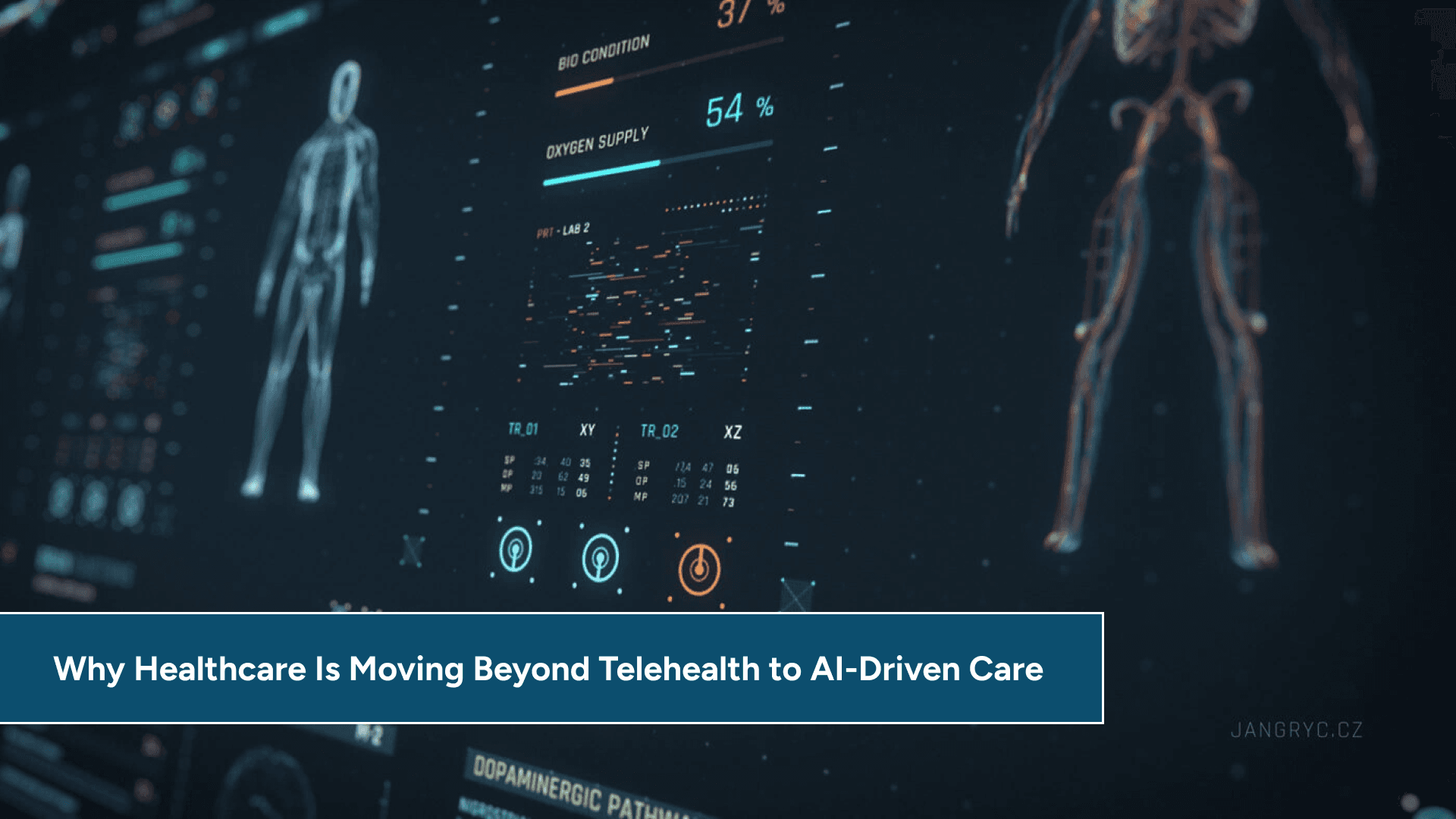

Telehealth solved a distribution problem, moving doctors closer to patients without requiring anyone to travel. Healthcare systems are now hitting the limits of that solution: virtual care usage keeps climbing year after year, yet a growing share of health systems report financial losses on their digital service lines, according to Healthcare IT News reporting from the HIMSS AI in Healthcare Forum. Reimbursement models built for phone calls and video visits have not caught up with the actual cost of running a digital care operation, and platform licensing, care coordination, and clinician time all add expenses that fee schedules have not kept pace with. That gap explains part of the shift: healthcare organizations are looking past video-based telehealth, toward AI systems built to run care operations rather than replicate an office visit through a screen.
Why Telehealth Alone Stopped Being Enough
Telehealth was the first step toward digital care. The next step runs deeper into how the operation works. The organizations pulling ahead are connecting AI into scheduling, documentation, monitoring, and coordination as a single system built to work as one. Systems integration is the harder problem here, well ahead of vendor selection. The rigor required matches any other clinical infrastructure decision: clean data, defined accountability, a plan for how each piece talks to the others. The organizations moving past telehealth are rebuilding how care decisions get made. That is where the return on investment comes from.
The financial picture reinforces the point. Utilization of virtual care and remote monitoring is rising, but many health systems are not breaking even on the services. Reimbursement rates in several markets have not moved to reflect what it costs to run a digital care line: infrastructure, coordination staff, and clinician hours. For an executive team weighing where to invest next, virtual care in 2026 has become as much a financial planning question as a technology one.
What AI-Driven Care Adds
Healthcare systems have moved past asking whether to adopt AI. Seventy-five percent of US health systems already use AI or plan to in 2026, and half of those organizations run three or more AI applications at once, according to a survey reported by Fierce Healthcare. More than half of the systems that tracked return on investment reported at least double their spend back.
The shift is in what the AI does. Early tools flagged risk: a patient likely to be readmitted, a claim likely to be denied. Newer systems coordinate the response that follows. At a Forbes Technology Council roundup, leaders from Coforge and Think AI called 2026 the year AI stops producing insights and starts running care management. The tasks shift from flagging a problem to acting on it: assigning follow-ups, routing referrals, closing the gaps between clinicians, payers, and patients. An AI chatbot bolted onto a website cannot do that. A system built into how the hospital runs can.
Where the Real Value Is Showing Up
Documentation is the clearest case. The adoption numbers back this up. 68% of health systems now use clinical note-taking tools, a jump of 62% from the prior year, according to the same Fierce Healthcare survey. Documentation improvement tools show a similar climb: 59% growth, reaching 43% adoption. Behind those figures sit systems such as Microsoft Nuance DAX and Abridge, which record a patient encounter and turn it into a structured note without a clinician typing through the visit. Vendor studies report accuracy in the high 90% range under controlled conditions, though results vary by specialty and workflow design.
Remote monitoring is following a similar path. A nurse reviewing readings on a fixed schedule is giving way to something else. AI-based triage systems take over that job: they flag which patients need attention first and route each case to the right person. Regulatory approval tells the same story. As of February 2026, the FDA had cleared more than 1,357 AI-enabled medical devices, over double the 2022 count. The market reflects that same trajectory: projections put the global AI healthcare market at $39 billion in 2025, growing to $504 billion by 2032, a curve that tracks the move from pilot programs into standard operations.
What This Means for Healthcare Leaders
None of this works without clean data moving between systems. Interoperability, the ability of different software platforms to share patient information without manual re-entry, is the foundation everything else sits on. An AI tool fed incomplete or delayed data produces weak recommendations, no matter how advanced the model behind it is. Executives at a Becker's Hospital Review roundup on healthcare operations pointed to data aggregation and API-based exchange as the starting point, before AI tools ever touch the workflow.
Regulatory oversight remains part of the picture. The EU AI Act places many diagnostic and clinical AI systems in the high-risk category, a classification that comes with conditions: decisions must stay explainable, a clinician must retain final responsibility, and patient data governance must meet strict standards. The American Medical Association and the American College of Physicians have a term for this: augmented intelligence, AI that extends a clinician's capacity while the final judgment call stays with the clinician. Treat AI as a stand-alone product, and a health system tends to hit this wall inside the first year of deployment. The ones that treat it as infrastructure, tied into existing records, staffing systems, and compliance workflows, are the ones reporting the return on investment numbers cited earlier.
Where This Leaves Health Systems
Telehealth was the first step toward digital care. The organizations pulling ahead are connecting AI into scheduling, documentation, monitoring, and coordination as a single system, built to work as one from the start. Integration is the hard part here, and it takes the same rigor as any other clinical infrastructure decision: clean data, defined accountability, and a plan for how each piece talks to the others. The organizations moving past telehealth are rebuilding how decisions get made, and the return on investment follows from that work. For digital healthcare system leaders, the starting question is simple: where does data get stuck between systems, and what would it take to move it. GeekyAnts works with healthcare organizations on that exact assessment, mapping the gap between current AI pilots and a connected platform built to run at scale.