

One of the most important challenges faced by hospitals in order to provide quality patient outcomes through elevated healthcare services is to reduce the waiting time at hospitals, especially in India. If the waiting time in the emergency department is arduous, the essence of having the department itself is moot as it hinders hospital staff from providing their patients with the kind of immediate care that they need. This goes on to show how timely access to clinicians in the emergency department is critical for quality healthcare management. This challenge is global and there are a few healthcare communities that have taken substantial steps to address this challenge.
Why Should Hospitals Focus On Reducing Patient Wait Time?
Here are some observations because of which hospitals should give importance to reducing wait time for better healthcare services:
1. Reduction in mortality rate:
The mortality rate/ death ratio increased because patients were not provided care at the right time. Evaluating who needs care and who can wait and defining the priority in which patients should be treated is critical for healthcare providers who want to offer optimum services.
2. Increase in revenue:
There is a reduction in revenue because patients who have to wait for long tend to lose patience and trust. Because of this, they may even switch to another care facility, clinic or hospital which can attend to the patient faster because of which financial consequences and the hospital tend to lose its credibility as well.
3. Better resource management:
Managing resources, their allocation and keeping employees motivated is critical and should be addressed. 31% of clinicians globally & 47% of US healthcare professionals are planning to leave their current roles due to burnout and stress. Reducing wait time plays a pivotal role in improved morale.
With the above pointers, we have understood how critical it is to reduce the patient waiting time and why hospitals must invest their time and effort to work on this.
5 Ways Digital Healthcare Reduces Patient Wait Times In Hospitals
There are many healthcare technology solutions that help in reducing patient waiting time. Let’s explore some of them in this article:
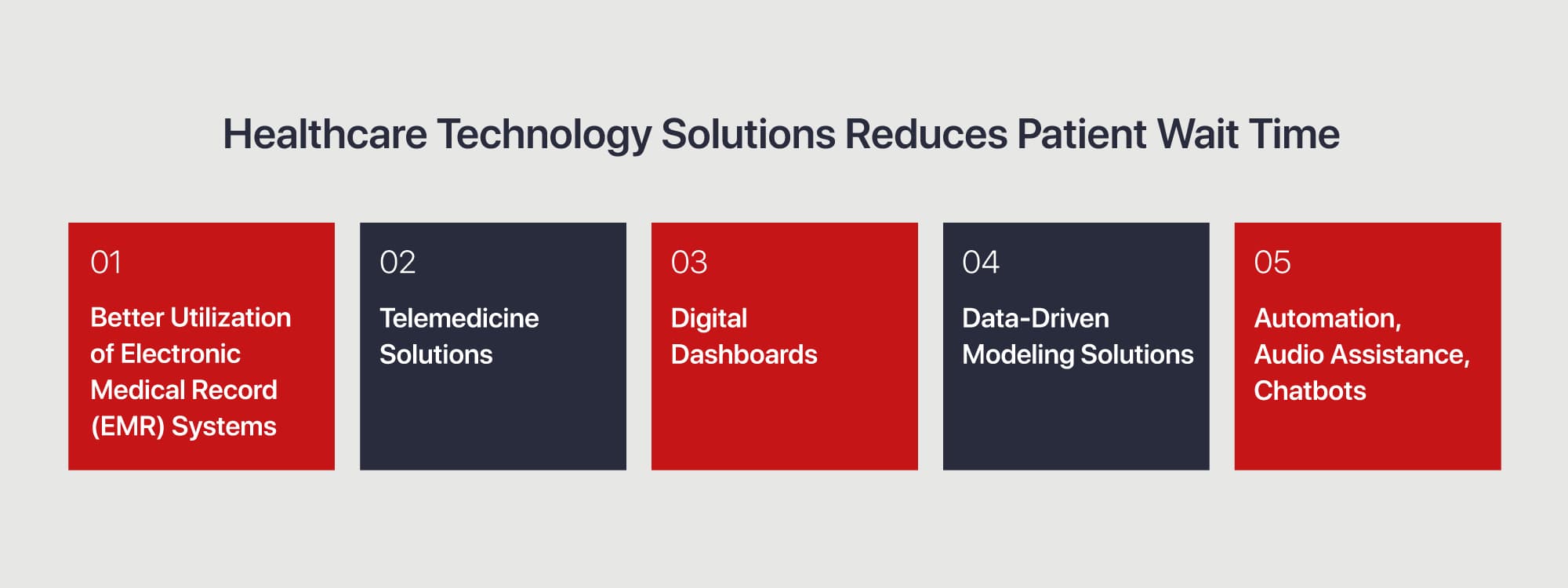
1. Better Utilization of Electronic Medical Record (EMR) Systems:
EMR systems are hospital management tools to collect patient records, lab reports, and patient history as well as to manage prescriptions and doctor’s notes. All of the mentioned activities can be expedited faster when there is an EMR system in place to streamline the way things are done. The patients can fill in the details using apps prior to their arrival if provided with the right digital tools and help in decreasing wait time.
2. Telemedicine Solutions:
There are many apps present in the stores to reduce travel time and waiting time as well as schedule appointments as per patient availability. In such cases, telemedicine solutions can be integrated with the provider's healthcare systems for the provision of better services.
3. Digital Dashboards:
Healthcare companies are trying to streamline technology solutions with single touch points. Streamlining day-day operations is done within the hospital infrastructure itself by using the right digital tools and there are digital dashboards that can monitor and track things like levels of infections, cleanliness and other important data from the sensors throughout the hospitals. This kind of cloud-enabled infrastructure provides insights and helps hospitals and healthcare providers to take the right action by providing reports. Digital dashboards also help us to access real-time information and intervention becomes faster, thus helping in emergency cases.
4. Data-Driven Modeling Solutions:
In order to reduce the waiting time at the hospital, the senior management along with clinicians spend substantial amounts of time understanding patient data and finding out ways by which they can optimize time. Understanding all the touch points of patients and their interactions with the system can help find out areas for improvement - right from patient interaction at reception, getting basic tests done by a nurse (BP, Height, Weight, Temp check, etc) till the time patient accesses lab services or the pharmacy.
With the help of data-driven modeling, hospitals get a better picture of the output and the impact of the services they are providing. Knowing factors like the patient’s arrival time, the hospital’s utilization capability, and variability in supply and demand help clinicians understand the waiting time for the patients. Providers along with data scientists can then calculate waiting time by changing different factors like utilization capability at the hospital. Using technology and the many tools that are available in the market, healthcare providers can calculate the waiting time for patients and provide the right kind of intervention.
5. Automation, Audio Assistance, Chatbots:
Implementation of hospital management software to manage patient records, coordinate with pharmacy and laboratories, doctor’s prescriptions, health records of patients (history), and booking management can reduce waiting time at the hospitals. AI-enabled chatbots also help hospitals resolve a lot of patient queries which otherwise can be a lot more time consuming.
Conclusion
There are start-ups focused on building healthcare tools that reduce the patient waiting time at the hospital. Companies are investing in building patient portals, chatbots, interoperable data exchange, telehealth apps, and advanced imaging AI-enabled solutions. We, at GeekyAnts- Design and Development Studio, have realized how important it is to have optimum healthcare services in place and we have built apps that have helped to provide better healthcare through strategized digital solutions.