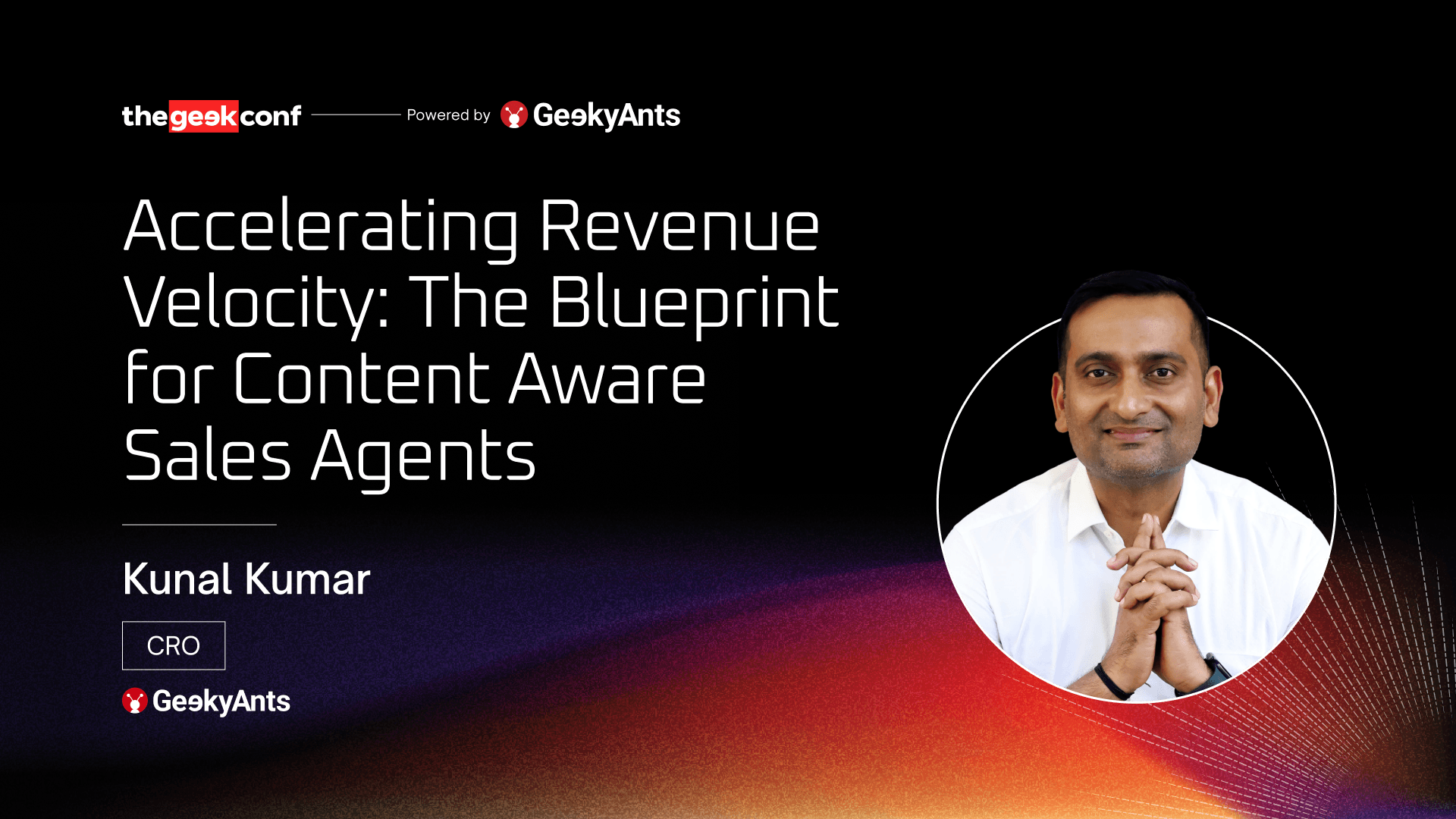

Editor’s Note: This blog is adapted from a talk by Kunal Kumar, Chief Revenue Officer at GeekyAnts, at thegeekconf 2025. As a CRO, Kunal explores why traditional chatbots have failed to impact the bottom line and introduces a blueprint for context-aware agents that accelerate revenue velocity. His session moves past the hype of basic chat interfaces to examine how the Model Context Protocol (MCP) can transform the enterprise sales funnel.
I am Kunal Kumar, Chief Revenue Officer at GeekyAnts. People often sit in these sessions wondering how to actually step up their revenue. I have a simple question for you: how many of you use chatbots but find they fail to impact your revenue? You are not alone. We feel this inside our own company. We often find ourselves chatting with colleagues rather than getting the right information that increases our revenue.
The Swivel Chair Dilemma
I want to focus specifically on the sales funnel aspect. In many enterprises, I see a situation that I call the swivel chair dilemma. Imagine your sales rep for one minute. Once a lead comes into the ecosystem, they pick up the call, check emails, and chat on WhatsApp. Then they enter lead data into the CRM by hand.
If they need a pricing quotation, they have to go into a pricing engine or an Excel sheet to fetch the data. They then relay that data to the client. We think this is inefficient once we have AI in our ecosystem. Everyone feels that AI can do this work autonomously, but this manual process is the real phase of the enterprise segment right now.
To move toward an autonomous way of working, you need a context-based agent to fetch the right data. I believe these agents understand keywords and give me data by understanding complex business logics. This means every chat we have should provide the information needed to accelerate proposal drafting.
The Universal Adapter for Data
We saw a real example of this through a prototype by Apollo Tires and IBM. The Model Context Protocol (MCP) functions as a unified access adapter. I think of it like the universal adapters you use when you travel to different cities. Without a universal adapter, you have to swap between four or five different plugs.
The MCP protocol sits as a context layer on top of your data sources. It gets relevant data based on the request from the AI agent. Agents utilize this context layer to ensure secure data retrieval. This allows the agent to provide answers that are based on the actual context of your enterprise data.
Reducing Response Time from Days to Minutes
A relevant example of this happens with tender and RFP requests. In the ideal situation today, a sales rep has to dig deep into documentation to understand technical aspects, geography, and compliance. It typically takes 3 to 5 days to review documentation. Then it goes to a senior stakeholder for the final pricing and submission.
By creating the right context layer on individual data sources, we change the equation. Some companies have tested this and reduced that 3-to-5-day window to just 3 to 5 minutes. This is a big win. We are providing the sales rep with the relevant data they need to create that first draft proposal fast.
This does not mean we are removing people from the process. I want our sales reps to focus on their key work. They should be having general discussions, making relationships, creating strategies, and negotiating costs. They should not be spent finding documentation from a sea of CRM data.
Building the Technical Foundation
CIOs typically seek instant implementation upon hearing this explanation. However, these AI agents are built specifically for your unique ecosystem. I believe this is a custom solution that must be trained based on your specific industry and existing data. We are still struggling to convince some stakeholders who are less technical, but those who invest in experiments are seeing the results.
You need a solid technical foundation to make this work. This requires a mix of full-stack engineering, cloud knowledge, and security expertise. When you combine that with AI knowledge, you can orchestrate the entire ecosystem. At GeekyAnts, we are building these foundations for our clients. I always tell our clients that generative AI is not a magic trick. It takes time. It can take a year just to understand the ecosystem and connect the different CRM systems for full usability.