

Key Takeaways
- Treat ISO 42001 implementation as an enterprise management program with executive ownership across technology, security, legal, risk, and procurement.
- Define the AIMS scope, including the AI systems, business units, teams, and responsibilities covered by the certification program.
- Build AIMS evidence into the workflows where AI systems are approved, evaluated, deployed, monitored, changed, and retired.
- Establish certification readiness through implemented controls, internal audit evidence, and management review records for assessment by an independent certification body.
Why Should Enterprises Prepare for ISO 42001 Certification in 2026?
Enterprise AI has moved past the experimentation phase. It is being embedded into products, internal operations, customer experiences, and increasingly, decisions that carry real business consequences. In 2025, 88% of organizations reported using AI, according to the Stanford AI Index. But as adoption accelerated, so did the warning signs: documented AI incidents increased from 233 in 2024 to 362 in 2025.
That creates an uncomfortable question for enterprise leaders: has AI governance matured as quickly as AI adoption has?
It is relatively easy to approve another AI tool, integrate a new model, or launch an AI-enabled feature. It is much harder to answer, consistently and with evidence, who owns the risks, what data is being used, how third-party models are evaluated, what happens when systems change, and who has authority to intervene when something goes wrong.
Those questions are no longer confined to internal governance meetings. They are increasingly showing up in RFPs, security assessments, procurement reviews, customer evaluations, and contractual discussions. For CIOs, CTOs, CISOs, compliance and risk leaders, legal teams, procurement teams, and AI digital product owners, fragmented governance can therefore become more than a compliance problem. It can delay deals, weaken customer confidence, create inconsistent approval decisions, and force expensive control changes after AI systems are already operating in production.
The stakes rise further as enterprises give AI systems greater autonomy and decision-making authority. Governance cannot remain a collection of policies sitting alongside the technology. Organizations need defined ownership, repeatable controls, risk and impact assessments, supplier oversight, monitoring, and evidence that shows those processes are actually working.
ISO/IEC 42001 brings that operating discipline into a formal Artificial Intelligence Management System (AIMS). Rather than treating AI governance as an exercise that begins when an auditor arrives, enterprises can use the framework to establish how AI is governed, reviewed, documented, and improved as part of everyday operations.
Enterprise buyers are asking deeper questions about AI governance during technology evaluations. They want to know where AI is used, who owns the associated risks, how third-party models are assessed, and what happens when a system changes after deployment. When an organization has defined ownership, controls, and evidence for these areas, procurement discussions can move from governance claims to proof of how AI is managed.
 Kunal KumarChief Revenue Officer
AI governance is becoming part of enterprise technology evaluation. RFPs, procurement reviews, security questionnaires, and customer assessments can require vendors to explain AI use, ownership, data practices, third-party dependencies, risk controls, and monitoring processes. An established AIMS gives teams a common source of governance evidence for these reviews. This can reduce the need to reconstruct answers across sales, security, legal, engineering, and compliance teams each time a customer requests proof of AI governance.
What Is ISO 42001 Certification, and Which Enterprises Need It?
ISO/IEC 42001:2023 is the world’s first AI management system standard. Published in December 2023, it arrived as organizations were moving AI beyond isolated experiments and embedding it into products, business processes, and enterprise operations.
ISO 42001 is not the first ISO standard related to artificial intelligence. Earlier standards and guidance addressed areas such as AI terminology and risk management. What makes ISO 42001 different is that it introduces a formal management-system approach to AI governance, giving organizations a structured framework for managing AI across its use, development, and delivery.
It sets requirements for establishing, implementing, maintaining, and continually improving an Artificial Intelligence Management System (AIMS). The standard is intended for organizations that develop, provide, or use AI systems and addresses areas such as accountability, risk and impact management, oversight, controls, and continual improvement.
The significance of ISO 42001 therefore goes beyond the introduction of another AI standard. It gives enterprises a certifiable management framework for making AI governance part of ongoing organizational operations, rather than treating governance as a collection of individual policies, technical controls, or one-time assessments.
What Is an Artificial Intelligence Management System?
An AIMS establishes how an organization manages AI within a defined scope. It connects policies and objectives with the responsibilities, processes, controls, reviews, and improvement activities required to govern AI systems consistently.
The scope identifies the AI systems, business functions, processes, teams, and responsibilities covered by the certification program. This allows organizations to define where the AI management system applies and establish ownership and evidence around the AI activities within that boundary.
ISO 42001 certification applies to this defined AIMS scope. It does not represent blanket approval or certification of every AI model, product, or use case across the organization.
Who Can Pursue ISO 42001 Certification?
Organizations can pursue certification when they develop AI systems, provide AI-enabled services, integrate third-party AI, or use AI within business operations. Certification is voluntary, though contracts or procurement requirements can make it a commercial requirement. It does not replace applicable laws or regulatory obligations.
Which Business Triggers Make Certification a Priority?
Business trigger | Leadership consideration |
Regulated AI use cases | Align AIMS governance with applicable regulatory requirements. |
Enterprise procurement requests | Address certification requirements within RFPs and contracts. |
Customer assurance | Provide independent evidence of AI governance practices. |
Multi-region operations | Establish shared governance while addressing regional legal requirements. |
Rapid AI portfolio growth | Maintain clear ownership, controls, and evidence across the AI portfolio. |
What Is the ISO 42001 Implementation Roadmap for Enterprises?
ISO 42001 implementation requires a program that connects business objectives with ownership, controls, evidence, and executive decisions. Legal, compliance, procurement, security, data, engineering, product, HR, and business units need defined responsibilities within the AIMS.
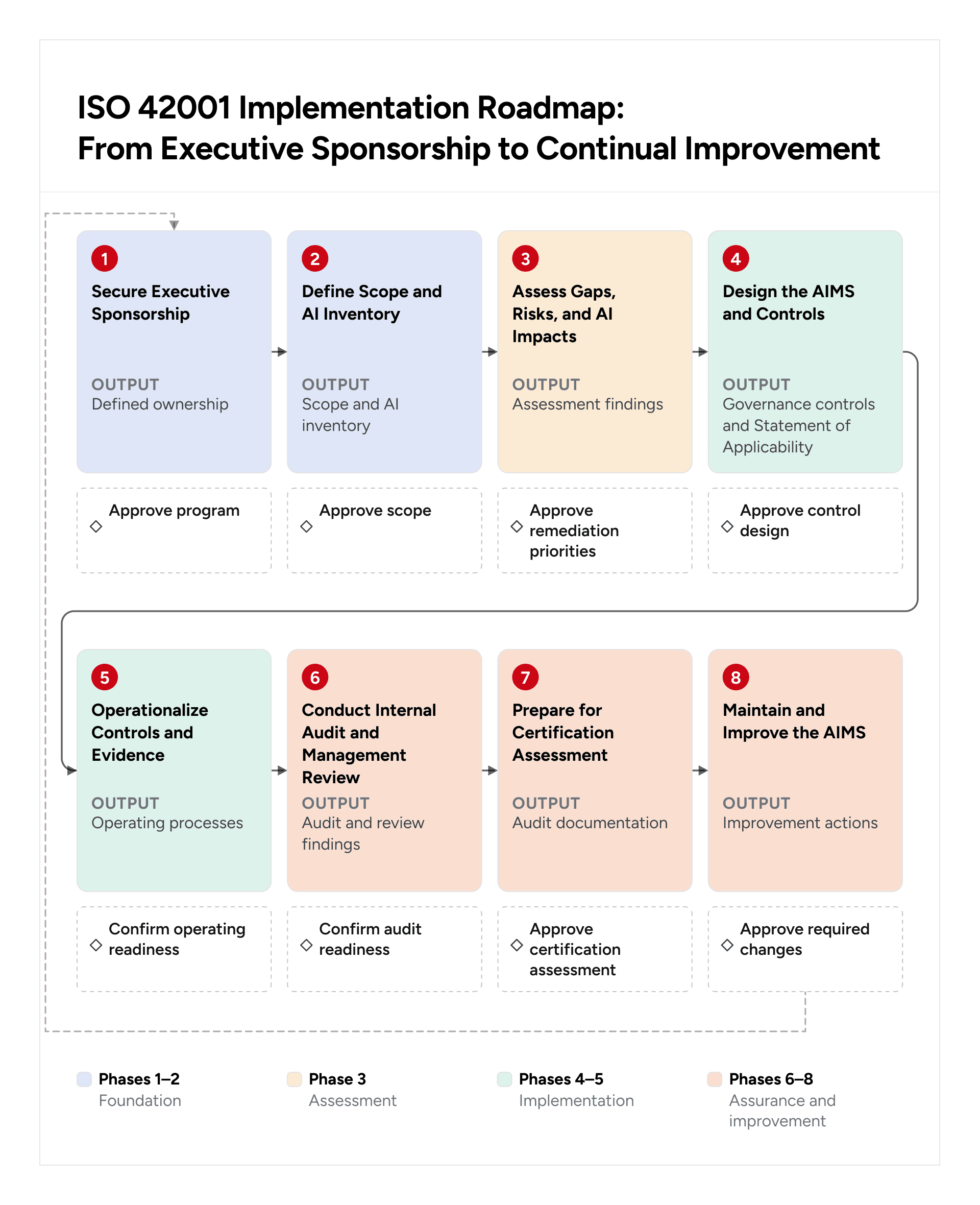
The roadmap below shows how an enterprise can approach ISO 42001 implementation, moving from executive sponsorship and scope definition to certification assessment and continual improvement.
Phase | Business Objective | Primary Owner | Required Output | Evidence | Executive Gate |
1. Secure Executive Sponsorship and Define Business Outcomes | Establish leadership accountability, program objectives, responsibilities, and resources. | Executive sponsor | Defined program objectives, governance responsibilities, and resource plan | Sponsorship record, assigned responsibilities, approved program objectives | Approve the AIMS program and leadership ownership |
2. Establish Scope and Inventory Enterprise AI Systems | Define the AIMS boundaries and identify the AI systems, processes, suppliers, and business functions within scope. | AIMS owner | Defined AIMS scope and AI inventory | Scope documentation, AI inventory, ownership records, system and supplier information | Approve the certification scope |
3. Complete Gap, Risk, and AI Impact Assessments | Identify governance gaps, AI risks and impacts, existing controls, and remediation requirements. | AIMS owner with Risk and Compliance | Assessment findings and prioritized remediation plan | Gap assessment, risk records, impact assessments, control mapping, remediation actions | Approve remediation priorities |
4. Design the AIMS and Implement Proportionate Controls | Establish governance processes and controls based on assessment findings and the AIMS scope. | AIMS owner with control owners | Implemented governance processes, controls, and Statement of Applicability | Control documentation, approval records, procedures, Statement of Applicability | Approve the control design and implementation plan |
5. Operationalize Evidence, Training, and Monitoring | Put controls into operation and establish the records needed to demonstrate their performance. | AIMS owner with functional owners | Operating controls, trained personnel, monitoring processes, and evidence records | Training records, monitoring records, approvals, operational records, control evidence | Confirm operating readiness |
6. Conduct the Internal Audit and Management Review | Evaluate the AIMS and identify issues that require action before certification assessment. | Internal Audit and executive management | Internal audit findings, corrective actions, and management review outcomes | Audit records, findings, corrective-action records, management review records | Confirm certification readiness |
7. Prepare for Stage 1 and Stage 2 Certification Audits | Organize AIMS documentation and operating evidence and address findings identified during certification assessment. | AIMS owner | Certification assessment package and resolved readiness findings | AIMS documentation, operating evidence, corrective-action records, certification assessment records | Authorize progression through the certification assessment |
8. Maintain the AIMS Through Continual Improvement | Maintain the AIMS as AI systems, suppliers, risks, controls, and organizational conditions change. | AIMS owner with executive oversight | Improvement actions and updated AIMS records | Monitoring results, incident records, change records, audit findings, management reviews, updated assessments | Approve material AIMS changes and improvement priorities |
AI inventory, impact assessment, supplier governance, monitoring, incident handling, internal audit, and management review remain continuing processes across the AIMS. Implementation duration depends on scope, AI-system count, existing certifications, evidence maturity, subsidiaries, remediation needs, and third-party dependencies.
How Can Enterprises Assess ISO 42001 Certification Readiness?
ISO 42001 certification readiness requires clear ownership, implemented controls, and evidence that supports independent assessment. The review should consider business risk, certification impact, remediation effort, and responsibility across the defined AIMS scope.
ISO 42001 Enterprise Readiness Scorecard
Assess each readiness area against four maturity levels: Not Established, Partially Established, Operational, and Audit-Ready. Base the rating on whether ownership is defined, the required process exists, the process operates within the AIMS scope, and evidence demonstrates its operation.
Not Established means the required process is absent. Partially Established means the process exists but has gaps in ownership, coverage, or evidence. Operational means the process operates within scope and produces records. Audit-Ready means the enterprise can demonstrate ownership, operation, evidence, and review during assessment.
An Audit-Ready rating should require more than the existence of a policy or control. The enterprise should be able to identify the accountable owner, show that the process operates across the defined scope, and produce evidence for assessment. Areas below that threshold become inputs to the prioritized remediation roadmap.
Readiness Area | What to Assess | Not Established | Partially Established | Operational | Audit-Ready |
Leadership | Executive sponsorship, AIMS ownership, decision authority, management review | No defined owner or governance structure | Ownership exists, but authority or responsibilities have gaps | Defined owners govern AIMS activities within scope | Leadership decisions, responsibilities, reviews, and supporting evidence can be demonstrated |
AI Inventory | In-scope AI systems, owners, intended use, suppliers, dependencies, changes | No defined AI inventory | Inventory exists but has coverage or ownership gaps | Inventory is maintained for AI systems within scope | Inventory is current, reviewed, owned, and supported by records |
Risk Management | Risk identification, assessment, treatment, ownership, review, records | No defined AI risk process | Risk process exists but has coverage, ownership, or evidence gaps | AI risks are assessed, treated, owned, and reviewed | Risk decisions, treatment actions, reviews, and supporting evidence can be demonstrated |
Impact Assessment | AI impacts, affected parties, response actions, ownership, review | No defined impact-assessment process | Assessments exist but have coverage or evidence gaps | Impact assessments operate for applicable in-scope AI systems | Assessments, decisions, actions, ownership, and reviews can be demonstrated |
Data Governance | Data ownership, approved use, quality, controls, review | No defined ownership or governance process | Data controls exist but have ownership, coverage, or evidence gaps | Data controls operate within relevant AI workflows | Ownership, controls, reviews, and supporting records can be demonstrated |
Lifecycle Controls | Approval, evaluation, deployment, change, monitoring, retirement | No defined lifecycle controls | Some lifecycle controls exist, but coverage or ownership has gaps | Lifecycle controls operate across applicable stages | Control decisions, approvals, changes, reviews, and supporting evidence can be demonstrated |
Supplier Oversight | Third-party AI assessment, responsibilities, contractual requirements, monitoring, review | No defined supplier governance process | Supplier review exists but has coverage or evidence gaps | Supplier controls operate for relevant third-party AI | Assessments, decisions, requirements, monitoring, and review records can be demonstrated |
Competence | Role requirements, responsibilities, training, competence records | No defined competence requirements | Requirements or training exist but have role or evidence gaps | Role-based competence requirements and training operate | Role requirements, training, competence, and review records can be demonstrated |
Monitoring | Control performance, system monitoring, issues, incidents, escalation, action | No defined monitoring process | Monitoring exists but metrics, ownership, or response processes have gaps | Monitoring produces records and drives defined actions | Monitoring results, issues, actions, ownership, and reviews can be demonstrated |
Internal Audit | Audit scope, objectivity, findings, corrective action, closure, management review input | No internal audit process for the AIMS | Audit planning exists but scope, execution, or evidence has gaps | Internal audit is conducted and findings are managed | Audit evidence, corrective actions, closure, and management review input can be demonstrated |
Put the assessment into action. Download the editable ISO 42001 Enterprise Readiness Scorecard to record a rating for each area, identify the evidence behind it, assign an owner, and prioritize gaps before defining your certification scope.
Download the Enterprise Readiness Scorecard
How to Define a Defensible Initial Certification Scope
The initial AI management system certification scope should reflect where the enterprise can establish clear ownership, apply AIMS controls, and produce evidence across the systems and processes included. A broader scope can increase coordination across teams, systems, suppliers, locations, and supporting processes.
Potential scope | When to consider it | Scope factors to assess |
Single product | The organization wants to begin with one defined AI product and its supporting processes. | Product ownership, shared services, data dependencies, suppliers, and supporting teams |
Business unit | AI governance and operating responsibility sit within a defined business function. | Unit ownership, shared platforms, cross-functional dependencies, and centralized controls |
Subsidiary | A legal entity has distinct AI operations, governance responsibilities, or local requirements. | Local ownership, group policies, shared systems, suppliers, and intercompany dependencies |
Shared AI platform | A common AI platform supports multiple products, teams, or business functions. | Platform ownership, user groups, connected systems, common controls, and downstream dependencies |
Enterprise-wide | Governance processes and evidence can be coordinated across the organization. | Business units, AI portfolio, locations, shared services, suppliers, control ownership, and evidence consistency |
Scope should not be selected on organizational boundaries alone. Leadership should test whether the proposed boundary captures the AI systems, supporting processes, dependencies, and accountable owners needed to operate the AIMS and produce evidence. Dependencies that sit outside the proposed scope should be identified before the scope is approved.
What a Certification Readiness Gap Analysis Must Produce
Each finding should record its business risk, certification impact, responsible owner, evidence requirement, dependencies, remediation effort, and remediation date. These factors help leadership prioritize findings, assign resources, and assess readiness for independent certification.
What Governance and Evidence Does ISO 42001 Implementation Require?
An operational AI management system connects accountability with evidence created through product, ML, data, DevOps, procurement, and business workflows. These records demonstrate how governance requirements function across AI systems within scope.
Who Owns the AIMS Across the Enterprise?
Role | Responsibility |
Board or executive sponsor | Set direction and review AIMS performance |
AIMS owner | Coordinate scope, controls, evidence, and reviews |
Legal | Address legal and contractual obligations |
Risk | Maintain risk and impact assessment processes |
Security | Maintain security controls and related evidence |
Data | Maintain data governance requirements and records |
Engineering | Apply technical controls across AI systems |
Product | Define intended use and lifecycle approvals |
Procurement | Maintain AI supplier assessments |
HR | Maintain role and training requirements |
Internal audit | Assess AIMS operation and record findings |
What Evidence Must Business and Technology Teams Maintain?
AIMS evidence should come from the workflows where AI decisions and controls take place. Product, engineering, data, security, procurement, and business teams should know which records their processes must produce and who remains accountable for maintaining them within the defined AIMS scope.
Governance requirement | Source workflow | Accountable owner | Evidence produced |
Define intended use and approve AI use | Product governance and approval | Product | Intended-use records and approval decisions |
Assess AI risks and impacts | Risk and impact assessment | Risk | Assessments, treatment decisions, and action records |
Govern data used by AI systems | Data governance | Data | Data ownership, use, control, and review records |
Evaluate AI systems before release | System evaluation and release review | Engineering | Evaluation results and release records |
Control deployment and system changes | Deployment and change management | Engineering | Deployment approvals and change records |
Govern third-party AI providers | Supplier assessment and procurement | Procurement | Supplier assessments, approval records, and review records |
Monitor AI systems and controls | System and control monitoring | Engineering | Monitoring results, identified issues, and resulting actions |
Manage AI-related incidents | Incident management | Security | Incident records, response actions, and closure evidence |
Maintain role competence | Training and competence management | HR | Role requirements, training records, and competence evidence |
Retire AI systems under control | Product and system retirement | Product | Retirement decisions, approvals, and supporting records |
How Should AI Systems Be Governed Across Their Lifecycle?
Evidence requirements should follow the AI lifecycle from intended use and assessment through deployment, monitoring, change, incident handling, and retirement. Changes to an AI system, its intended use, data, supplier, or operating context should prompt teams to assess which controls and evidence require review.
How Should Third-Party Models and AI Vendors Be Controlled?
Procurement, legal, security, data, and product teams should maintain supplier assessments, usage requirements, data requirements, contractual controls, and monitoring responsibilities for third-party AI within the AIMS scope.
An AI policy defines what an organization expects, but an operational AIMS has to connect those expectations with decisions. When a team approves an AI system, changes its intended use, introduces a new data source, replaces a model provider, or responds to an incident, the organization needs clear ownership and evidence of the action taken. That connection between governance requirements, operating workflows, and evidence is what makes the management system defensible during an assessment.
 Varun Kumar SahuChief Digital & Privacy Officer
A policy can exist without changing how AI systems are governed. The implementation gap appears when product, engineering, data, security, procurement, privacy, and risk teams use separate approval processes or maintain disconnected records. An operational AIMS connects governance requirements with the workflows that generate evidence. Risk assessments, impact assessments, approvals, evaluation records, supplier reviews, monitoring results, incident records, change decisions, and management reviews then show how controls operate across the defined AIMS scope. ISO describes an AIMS as a set of interconnected organizational elements that establish policies, objectives, and processes for responsible AI management.
How Does ISO 42001 Certification Align With ISO 27001, NIST AI RMF, and the EU AI Act?
Enterprises that already operate security, risk, or regulatory governance programs may be able to use existing processes and evidence when building an AIMS. Reuse should depend on whether the existing process addresses the ISO 42001 requirement within the defined AIMS scope. A mapped process does not make two frameworks equivalent or remove separate legal, regulatory, or certification obligations.
Framework | What existing work can support ISO 42001? | What still requires separate action? | Primary owner of the remaining work |
ISO 27001 | Risk management, internal audit, management review, corrective action, supplier governance, and documented management processes where they apply to the AIMS | AI-specific risks, impacts, objectives, controls, responsibilities, and evidence required within the AIMS | AIMS owner with security, risk, product, data, and engineering |
NIST AI RMF | Existing AI governance, risk identification, measurement, monitoring, and risk-treatment practices that map to AIMS requirements | ISO 42001 management-system requirements, certification evidence, internal audit, management review, and requirements not covered by the existing AI RMF implementation | AIMS owner with risk and AI system owners |
EU AI Act | AI inventory, risk records, governance processes, technical records, oversight processes, and evidence where they support applicable obligations | Legal classification, role-specific duties, regulatory requirements, and obligations that apply to each AI system under the Act | Legal and compliance with product, risk, data, and technology owners |
ISO 42001 | Existing processes from other management, risk, and governance programs when they satisfy AIMS requirements | Gaps identified against the defined AIMS scope and ISO 42001 requirements | AIMS owner with relevant control owners |
ISO 42001 and ISO 27001
Organizations with an established ISMS can assess which risk, audit, supplier, management review, corrective-action, and documented processes can support the AIMS. AI-specific requirements still need defined ownership, implementation, and evidence within the ISO 42001 certification scope.
ISO 42001 and the NIST AI RMF
Organizations using the NIST AI RMF can map existing Govern, Map, Measure, and Manage practices against ISO 42001 requirements. The mapping can identify reusable processes and evidence, as well as requirements that need separate implementation for the AIMS.
ISO 42001 and the EU AI Act
As of September 2026, the EU AI Act has entered its general application phase. ISO 42001 can provide governance processes and evidence that support regulatory work. EU AI Act obligations require a separate legal assessment based on the organization’s role and AI systems.
Where Separate Legal and Sector Assessments Are Still Required?
Legal, privacy, security, risk, and compliance owners must assess applicable contractual, jurisdictional, product, and industry obligations. Evidence from ISO 42001 can support those assessments where requirements align.
ISO 42001 can give enterprises a strong governance foundation, but certification does not answer every compliance question around AI. The moment you look at a real system, privacy, regulation, contracts, industry rules, and even the organization’s role all start to matter. The real work is in understanding how those requirements apply to each use case and then building them into the AIMS.
Varun Kumar SahuChief Digital & Privacy OfficerEnterprises do not need to build ISO 42001 readiness from scratch. Many already have pieces of the governance foundation in place through security, risk, compliance, and AI oversight programs.
An established ISO 27001 program may already provide useful processes around security controls, incident management, supplier governance, internal review, and management oversight. Teams using the NIST AI RMF may also have mature practices for identifying, assessing, measuring, and responding to AI risks.
ISO 42001 can bring these existing efforts into a more connected AI management system, with clearer ownership, defined controls, regular review, and evidence that shows how governance works in practice.
The important distinction is that overlap does not mean equivalence. ISO 42001 can help organize and strengthen an enterprise’s AI governance, but it does not absorb every legal or regulatory obligation into the certification. Privacy requirements, contractual commitments, sector rules, and regulations such as the EU AI Act still need to be assessed against the organization’s role, systems, data, and operating environment.
That is where the real value lies: not in replacing existing frameworks, but in bringing the right pieces together into one operating structure for AI governance.
How Much Time, Cost, and Internal Work Does ISO 42001 Certification Require?
ISO 42001 certification planning should account for readiness, remediation, evidence operation, certification assessment, corrective action, and post-certification maintenance. The workload depends on the AIMS scope, AI portfolio, existing controls, and evidence requirements.
What Happens During Stage 1 and Stage 2 Audits?
Internal audit and management review precede the certification assessment. Stage 1 reviews AIMS documentation and certification readiness. Stage 2 examines implemented controls and operating evidence. Identified findings may require corrective action. Certification is followed by surveillance audits and recertification.
What Determines the ISO 42001 Certification Timeline?
AIMS scope, AI portfolio size, existing management systems, control gaps, remediation workload, evidence-operating periods, locations, and certification-body availability influence the timeline.
What Determines ISO 42001 Implementation and Certification Cost?
The total program cost can include implementation support, compliance tooling, internal labor, training, remediation, and independent certification-body fees. Cost estimates should account for scope, portfolio complexity, existing controls, evidence requirements, locations, and remediation workload.
Function | Likely involvement |
Executives | Sponsorship and management review |
AIMS owner | Program and evidence coordination |
Engineering | Technical controls and remediation |
Data | Data governance and evidence |
Security | Security controls and risk records |
Legal | Legal and contractual assessment |
Procurement | Supplier governance |
HR | Competence and training records |
Internal audit | Audit testing and findings |
How Should Enterprises Select an Accredited Certification Body?
Enterprises should assess accreditation scope, AI competence, industry experience, audit availability, locations, language support, and independence when selecting a certification body.
How Does GeekyAnts Support ISO 42001 Implementation Readiness?
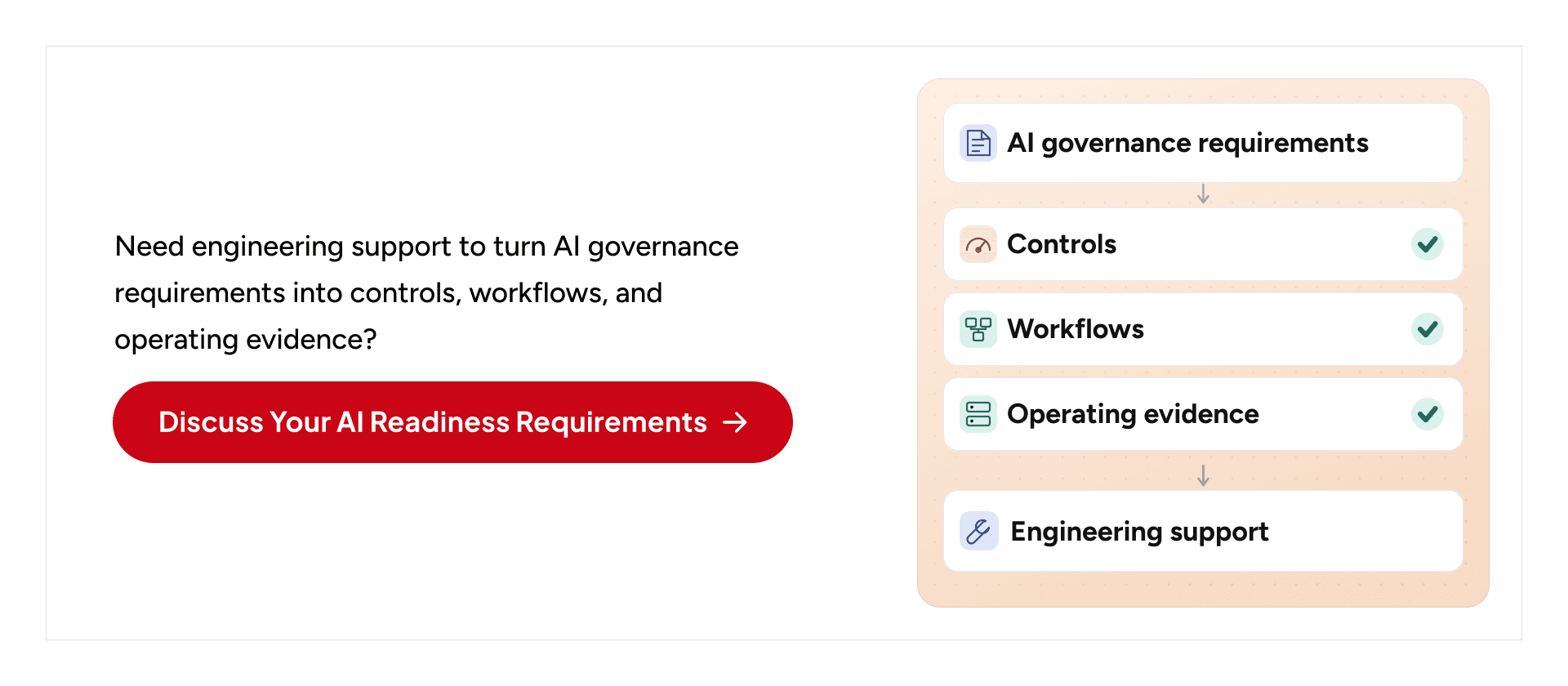
GeekyAnts supports enterprises in converting AI governance requirements into controls, system changes, workflows, and evidence across the AIMS scope. Its product engineering experience spans two decades, including the delivery of production systems.
From Readiness Gaps to Operational Controls
A readiness assessment can expose gaps in AI inventories, lifecycle controls, monitoring, supplier processes, data governance, system integrations, and operating evidence. GeekyAnts can support the engineering and process changes required to address these gaps across AI, data, security, DevOps, QA, and enterprise systems.
Readiness gap | Implementation support | Operational outcome |
Incomplete AI inventory | Connect system, product, ownership, and dependency information | Maintainable records for AI systems within scope |
Weak lifecycle controls | Add approval, evaluation, deployment, change, and retirement workflows | Control records across the AI lifecycle |
Missing monitoring | Implement system and control monitoring within existing workflows | Monitoring records, identified issues, and response evidence |
Fragmented evidence | Connect evidence-producing workflows and enterprise systems | Evidence linked to responsible processes and owners |
Third-party AI gaps | Integrate supplier assessment and review requirements into procurement workflows | Supplier governance and review records |
Legacy system constraints | Implement required controls and integrations around existing systems | Governance controls that operate within the current technology environment |
Cross-Functional Implementation Without Separating Governance From Delivery
The engagement can move from discovery and readiness assessment to a prioritized remediation roadmap, implementation support, and evidence validation. This allows governance requirements identified during readiness work to become changes within the systems and workflows where AI is built, integrated, deployed, monitored, and maintained.
Readiness Support That Remains Independent of Certification
GeekyAnts supports the engineering and operational work required for certification readiness. Compliance tooling can organize governance activities and evidence. An accredited certification body conducts the independent assessment and makes certification decisions.
Trust becomes meaningful in an enterprise deal when a vendor can support its claims with evidence. A certificate can strengthen that position, but the stronger signal comes from the operating discipline behind it: defined accountability, controlled changes, supplier oversight, monitoring, and records that withstand customer scrutiny. For AI companies competing for enterprise contracts, that level of readiness can become part of how buyers distinguish between vendors with similar product capabilities.
Kunal KumarChief Revenue OfficerISO 42001 readiness can give enterprise customers a structured basis for evaluating how a provider governs AI across its operations. During due diligence, the organization can present defined ownership, risk records, control evidence, supplier assessments, monitoring records, and management oversight instead of relying on policy statements. This can strengthen procurement confidence and support competitive positioning when customers compare providers on governance maturity alongside product, security, delivery, and commercial requirements. ISO identifies stakeholder confidence, traceability, transparency, responsible AI use, and stronger governance among the benefits associated with an AIMS.
How Can Enterprises Turn ISO 42001 Readiness Into an Operating Capability?
ISO 42001 readiness becomes an operating capability when governance decisions produce evidence across the workflows where AI is built, bought, deployed, monitored, changed, and retired. Enterprises can begin by appointing an executive sponsor and completing a readiness assessment to identify ownership, control, evidence, and remediation priorities.
Sources and Citations
- https://hai.stanford.edu/ai-index/2026-ai-index-report/economy
- https://hai.stanford.edu/ai-index/2026-ai-index-report/responsible-ai
- https://www.nist.gov/itl/ai-risk-management-framework
- https://www.iso.org/standard/42001
- https://ai-act-service-desk.ec.europa.eu/en/ai-act/eu-ai-act-implementation-timeline
- https://digital-strategy.ec.europa.eu/en/policies/regulatory-framework-ai
- https://www.iso.org/standard/42006