

Key Takeaways
- The company that ships an AI built app holds the liability for it. The AI tool used to build it holds none, so accountability planning belongs on the roadmap from day one.
- Enterprise buyers treat AI governance, documented data sources, and human review processes as due diligence requirements before they sign a contract.
- A defensible AI built app depends on traceable decisions: who approved a feature, what data trained it, and what license governs the code running in production.
- Security and legal checkpoints built into the development process catch a problem before launch, which protects both the release timeline and the company's standing with regulators and customers.
Why AI-Built Apps Still Carry Full Legal Accountability?
Artificial intelligence has compressed the app development timeline from months to days. Teams now ship products with a smaller engineering team and a shorter build cycle. Legal exposure has stayed constant through this shift. The rules that determine who owns a breach, who answers for a discriminatory outcome, and who compensates a user harmed by faulty output remain the same as they were before AI entered the workflow.
AI generated software has moved past the pilot stage. Companies deploy AI built apps across finance, healthcare, hiring, and customer service, inside systems that touch regulated data and real financial decisions.
Regulatory bodies have responded with specific rules. The EU AI Act classifies certain applications as high risk systems and requires conformity assessments for use cases in critical infrastructure, healthcare, and financial services. The GDPR sets penalties as high as €20 million or 4% of global annual turnover for a single violation, and this standard applies to any company processing data belonging to EU residents, independent of where the company is based.
The company that builds and launches the product carries this liability. The AI tool used to write the code carries none of it.
The conversation around AI built apps has shifted from whether a team can build the product to whether the business can defend how it was built. Revenue teams feel this shift, since a strong product needs a legal and governance story that matches its engineering.
I sit in enough enterprise conversations to see the pattern. The technical demo gets everyone excited, and the contract stalls the moment someone with a security or legal title joins the call. The paper trail behind the product closes the gap, and building that trail is work a revenue team has to plan for before a deal reaches the room.
 Kunal KumarChief Revenue Officer
What Counts as an AI Built App?
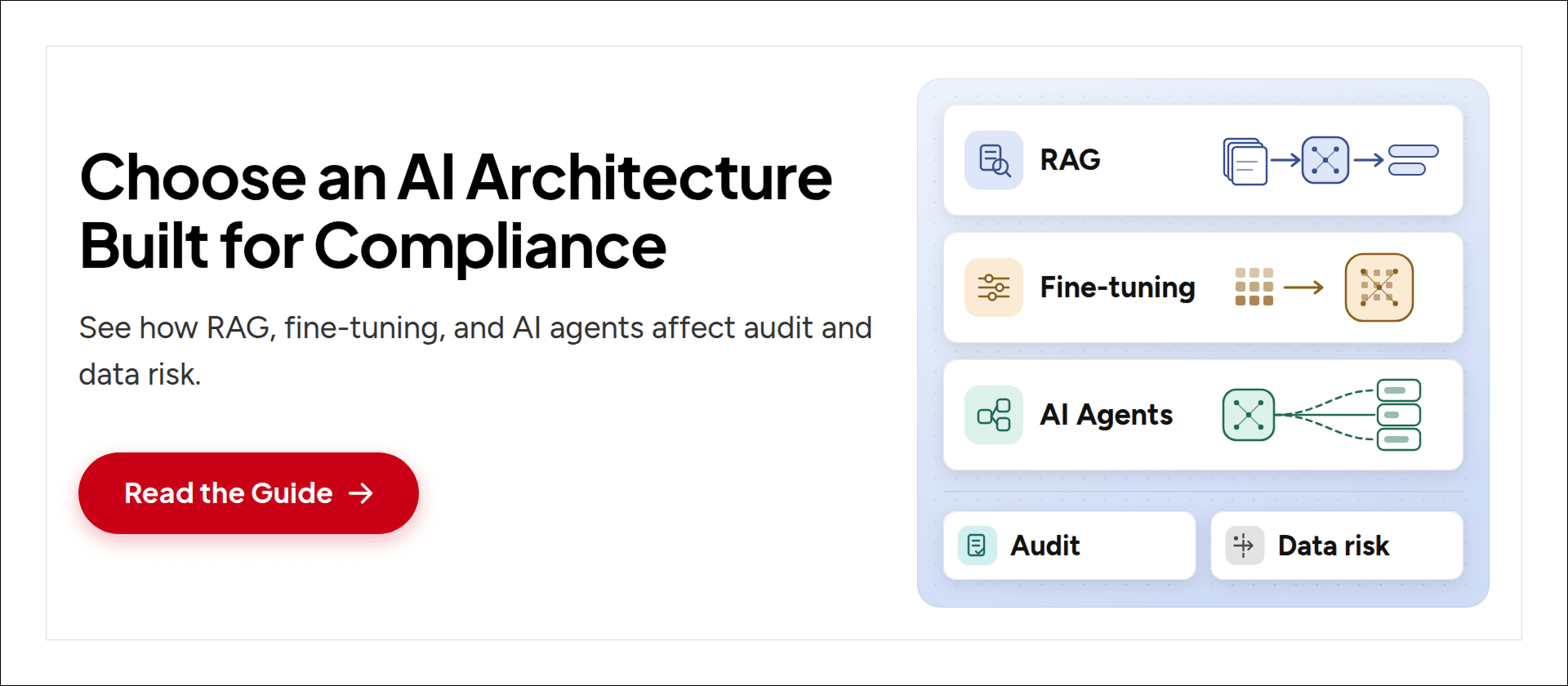
An AI built app is a product where artificial intelligence has a role in its code, its features, or both. This covers four categories. Some apps are fully generated through AI coding tools with minimal human authorship. Others are accelerated, where developers write core logic and use AI to speed up specific tasks. A third category relies on third-party AI APIs for functions like image recognition or language processing. A fourth category embeds AI features into the product itself, including chatbots, copilots, retrieval-augmented generation, personalization engines, recommendation systems, and workflow automation.
The category a product falls into determines its liability exposure, its IP ownership position, its data handling obligations, its explainability requirements, and its QA needs. Risk increases when a team cannot trace which parts of the code came from a human author, which came from an AI tool, and which data sources trained the AI system involved.
Courts are already hearing lawsuits tied to copyright infringement, privacy violations, discriminatory outcomes, and inaccurate AI generated advice. This guide serves digital founders and engineering leaders who prepare an AI built application for enterprise level deployment. It does not offer legal advice. It maps the risk areas a technical or product leader should understand and plan for before release.
Can Founders Get Sued Over AI Built Apps? What the Law Says
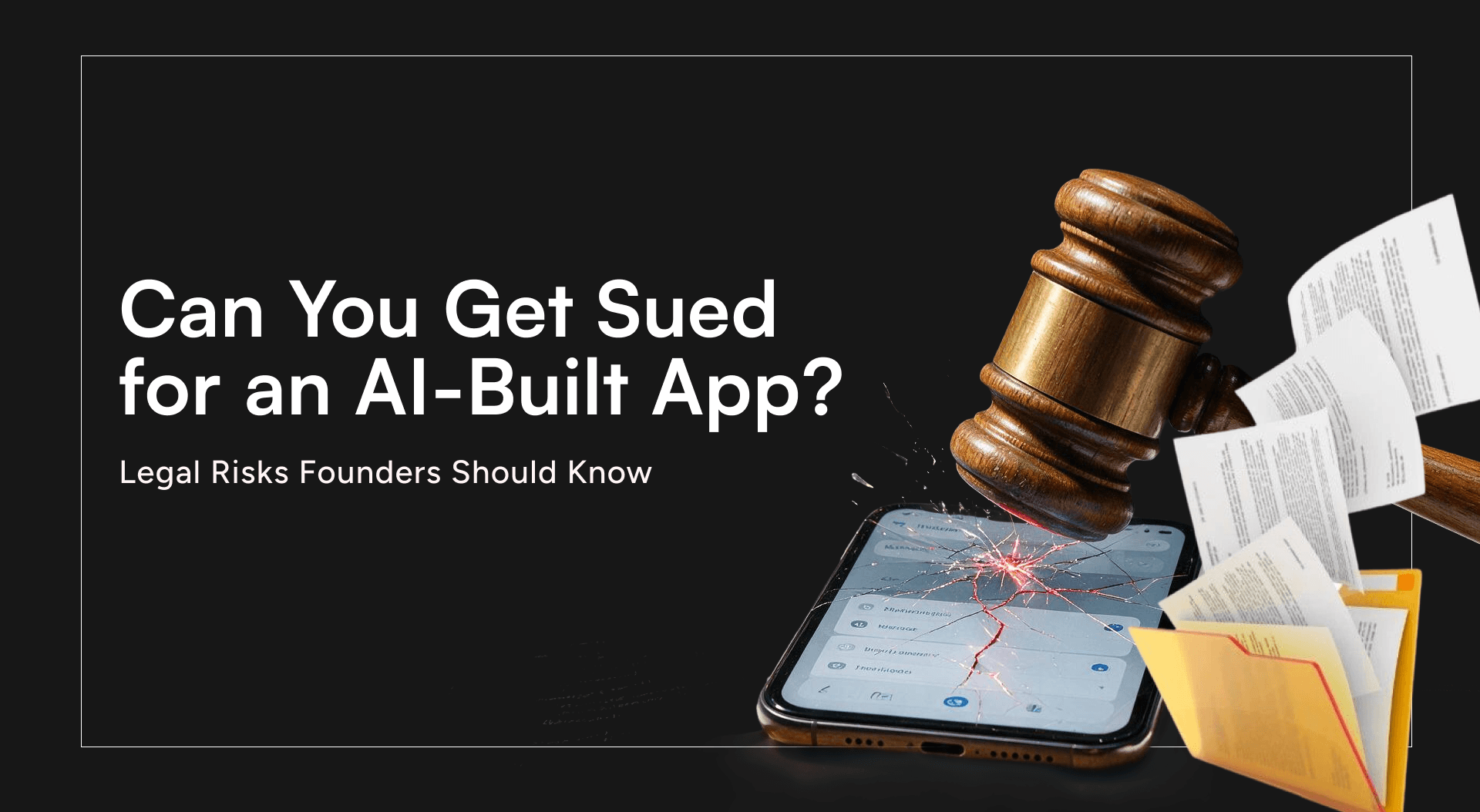
Yes. A business faces the same legal exposure over an AI built app that it faces over any product it designs, deploys, markets, or operates. "AI wrote the code" holds no weight as a legal defense, since courts assess who controlled the decisions behind the product, not which tool typed the syntax.
Why Doesn't AI Involvement Remove Product Liability?
AI functions as a tool in the development process. A digital product owner cannot transfer responsibility to a coding assistant, a model provider, or a third-party API. Courts examining an AI built app look at three parties: the creator of the product, the provider of the service built on top of it, and the controller of the data the product processes. Each of these roles carries its own accountability, and a founder or engineering team can occupy more than one role at once.
Is the Founder Liable, or Is the Company Liable?
In most cases, the company holds the liability as a legal entity, structured through incorporation, contracts, and insurance. Personal liability for a founder becomes a possibility in specific situations, including fraud, gross negligence, or a documented failure to act on a known risk.
Companies limit this exposure through enterprise accountability structures built ahead of a lawsuit. These structures include indemnification clauses in vendor and customer contracts, liability insurance suited to the product's actual risk profile, board-level oversight of AI governance decisions, and a documented chain of approval for any AI built feature that reaches production. A company with these structures in place can show a court, a regulator, or an acquiring party that accountability was assigned and tracked from the start.
Readers should consult qualified legal counsel for guidance specific to their jurisdiction and business structure.
The 7 Legal Risk Areas Engineering Leaders Should Review Before an AI Build App Launch
Most enterprises describe their AI governance as strong when a team asks. Due diligence reviews tell a different story once a buyer asks for the actual record. That gap between the governance a company reports and the governance a company can prove is where a lawsuit or a stalled deal starts.
Every client team I review can tell me their AI feature is secure and compliant. A small number of them can hand me the record that proves it. A due diligence reviewer asks who approved the model, what data trained it, and why a particular vendor was chosen over another. A stalled review kills more deals than an actual security gap does, and the stall happens because the answer lived in someone's memory instead of a document.
 Konakanchi Venkata Suresh BabuPrincipal Technical Consultant.
Each risk area below carries a different exposure point. The table maps what can go wrong, why a buyer or regulator cares, and what an engineering team should document to prove the risk was managed.
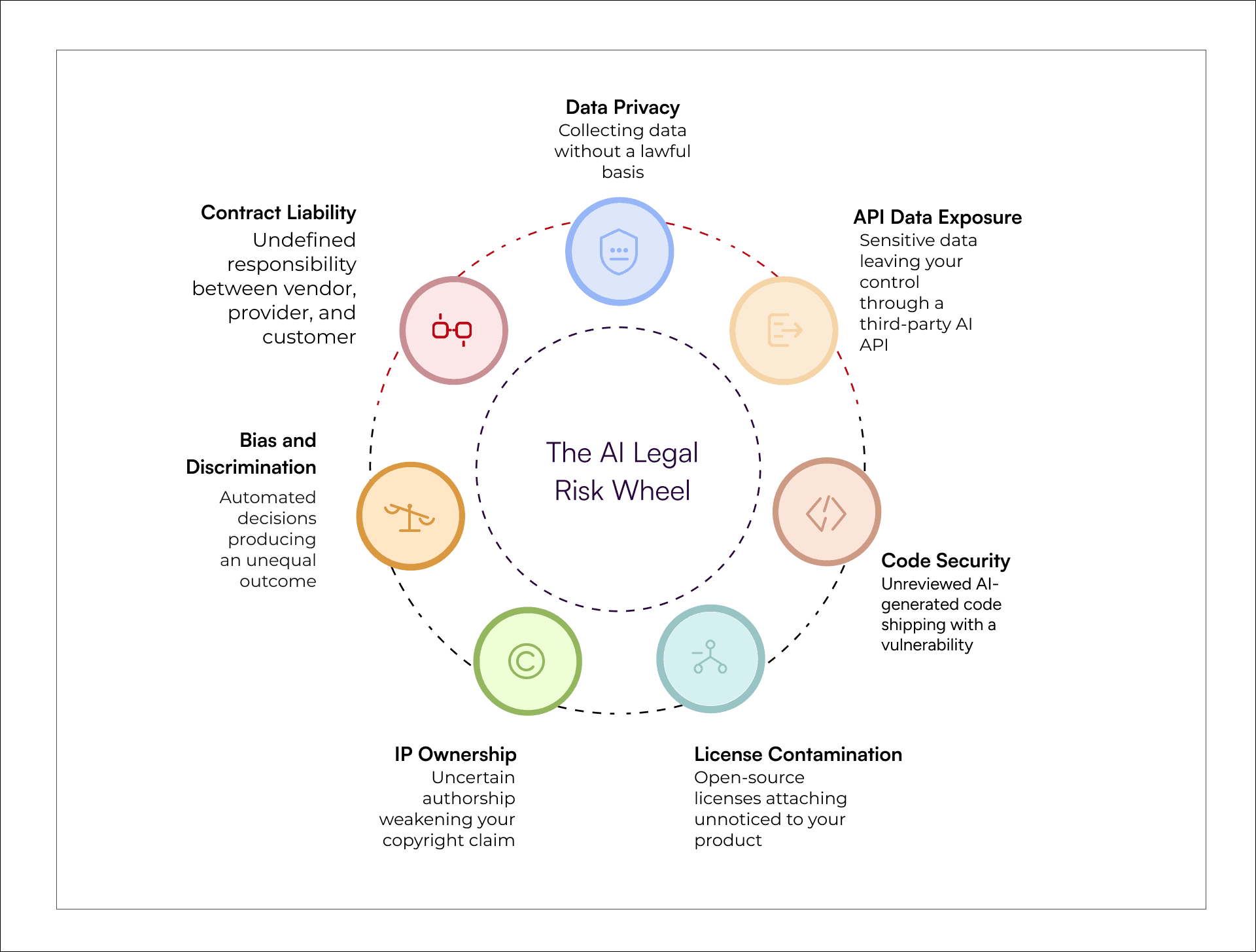
Risk Area | What Can Go Wrong | Why It Matters to Buyers | What to Document |
Data privacy and consent | The app collects or processes personal data without a documented, lawful basis | Enterprise due diligence teams treat a consent gap as a blocking issue that stops a deal | Consent records, data flow maps, lawful basis assessments |
Sensitive data exposure through AI APIs | User data passes to a third-party AI API without a data processing agreement in place | The buyer's data can leave their control and enter a vendor's training pipeline | API data processing agreements, retention policies, redaction logs |
AI-generated code security flaws | Suggested code contains a vulnerability no human reviewed before merge | The company carries the negligence, since the company selected and shipped the tool | Code review logs, static analysis reports, penetration test results |
Open-source and license contamination | Suggested code carries a copyleft license the team did not catch | The license can force the entire product into open-source terms or trigger an infringement claim | License scan reports, dependency audit records |
Copyright and IP ownership | Uncertain human authorship weakens the product's claim to copyright protection | Valuation and acquisition readiness depend on a defensible IP position | Human contribution logs, authorship and edit history |
Bias, explainability, and automated decision-making | A model produces a discriminatory outcome in hiring, lending, or a similar decision | Regulators and civil rights bodies treat this as a legal exposure with real financial consequence | Bias testing results, explainability reports, human override logs |
Contract, vendor, and customer liability | Liability between vendor, model provider, and customer stays undefined when a failure occurs | Enterprise contracts require a clear allocation of liability before signature | Vendor agreements, indemnification clauses, SLA terms |
What Copyright Risks Come With AI-Generated Code?
An AI coding tool draws its suggestions from existing code stored in its training data. If that source code carries a restrictive license, reusing it can count as infringement. Microsoft, GitHub, and OpenAI faced a $9 billion class action over this exact issue with Copilot. Copyright protection for the finished product depends on originality, a standard that requires a documented human contribution beyond the automated suggestion.
What Data Privacy Rules Apply to AI Built Apps?
GDPR applies to any application that processes data from an EU resident, with fines that reach €20 million or 4% of global turnover. CCPA and CPRA extend similar obligations to California users. Healthcare data triggers HIPAA. Financial and education data trigger their own frameworks. Cross-border data transfer adds a separate compliance layer for any team operating outside a single jurisdiction.
What Happens When an AI Application Produces Wrong or Harmful Output?
An AI feature can generate incorrect financial guidance, an unsafe healthcare recommendation, or a defamatory statement about a real person. These outputs expose a company to claims of negligence, misrepresentation, and consumer protection violations, since the business that shipped the feature carries responsibility for what it tells a user.
Can AI Built Apps Create Bias or Discrimination Claims?
Hiring platforms, lending tools, insurance underwriting systems, and customer support agents built on AI models can produce outcomes that treat protected groups unfairly. The Equal Credit Opportunity Act requires a clear explanation behind any algorithmic credit denial, and civil rights bodies apply the same scrutiny to hiring and insurance decisions built on automated logic.
What Security Risks Does AI Introduce Into the Development Process?
AI features open a product to prompt injection, unintended data leakage, model manipulation, and abuse of autonomous agents. Each of these gaps can trigger regulatory penalties, contract disputes, and loss of enterprise trust.
Who Is Legally Responsible When AI Built Apps Cause Harm?
An AI built app touches five parties, and each one carries a distinct share of the responsibility when something goes wrong. A dispute over harm names more than one of these parties at once.
What Responsibility Do Founders Carry?
Founders hold responsibility for the decisions that shaped the product: which features shipped, which risks the team accepted, and which governance steps the team skipped. The company holds this responsibility in most cases, with personal exposure reserved for the exceptions covered earlier in this guide.
What Responsibility Do Software Vendors Carry?
The vendor that builds and maintains the app holds responsibility for its security, its quality assurance process, and the promises made to the customer through a contract or service agreement. This responsibility stays with the vendor regardless of which tools its engineering team used to build the product.
What Responsibility Do AI Model Providers Carry?
A model provider's responsibility depends on the contract terms attached to the model. Output ownership is one example: if a model is trained on data with restrictive licensing, the outputs it produces can carry the same restrictions, and some providers limit what a customer can do with those outputs, including resale or use in further training. A contract that states who owns the output, and under what conditions, removes this ambiguity before a dispute begins.
What Responsibility Do Enterprise Customers Carry?
The enterprise customer that deploys the app inside its own systems holds responsibility for how the team configures, monitors, and governs the tool once it operates inside their environment. A customer that bypasses vendor safeguards or ignores documented risk assumes a share of the resulting harm.
What Responsibility Do Third-Party Integrations Carry?
A third-party API or plugin holds responsibility for failures inside its own component. The primary vendor's responsibility to the end customer stays in place when a third-party integration causes the failure, unless the contract states a different allocation.
Responsibility Matrix
Party | Typical Responsibility | Key Contractual Safeguard |
Founders | Product decisions, governance, and risk acceptance | Board oversight records, documented approval chains |
Software Vendors | Security, QA, and contractual commitments to the customer | Service agreements, warranty and liability clauses |
Model behavior and output ownership terms | Licensing agreement, output rights clause | |
Enterprise Customers | Configuration, monitoring, and internal governance | Deployment agreement, internal usage policy |
Third-Party Integrations | Failures within their own component | Integration agreement, liability allocation clause |
Are Enterprise AI Lawsuits Real? The Cases Defining Legal Risk for AI Built Apps
The cases and settlements below show that legal risk around AI products is already moving through courts, regulators, and enforcement agencies.
What Is Happening in AI Copyright Litigation?
The New York Times sued OpenAI and Microsoft in December 2023 over the use of its articles to train ChatGPT, and the case remains in discovery, with a sanctions motion filed in July 2026 over a dispute about withheld evidence. Anthropic settled a separate copyright class action for 1.5 billion dollars, covering close to 500,000 books downloaded from pirate sources, and the settlement did not grant a license for future training.
What Privacy Violations Have AI Companies Faced?
Clearview AI built a facial recognition database from images collected off public websites without consent from the people in them. The practice led to a settlement near 51.75 million dollars under the Illinois Biometric Information Privacy Act, alongside separate fines from European regulators that reached thirty million euros in a single market.
What Consumer Protection Cases Involve AI?
The Federal Trade Commission has brought a series of cases against companies that overstated what an AI product could do. DoNotPay paid a settlement after marketing its chatbot as a substitute for a licensed attorney without testing its output against that standard. A newer set of cases targets undisclosed chatbot use inside consumer transactions.
What Algorithmic Discrimination Cases Are in Court?
A federal court allowed age and race discrimination claims to move forward against Workday, where applicants alleged the company's AI screening tools rejected candidates over forty and Black candidates at a higher rate than candidates with comparable qualifications outside those groups. The Equal Employment Opportunity Commission has stated that an algorithm's involvement provides no defense under existing civil rights law, a position the agency applied in an earlier settlement with iTutorGroup.
What Legal Risks Hide Inside Your AI Built App Development Process?
The biggest risks in an AI build rarely show up in the finished product. They form earlier, inside the development process itself, in the steps a team skips under deadline pressure.
What Happens When Teams Use AI-Generated Code Without Review?
Code reaches production without a human check for security flaws, license conflicts, or broken logic. Each unreviewed commit becomes a gap a due diligence team or a court can point to.
What Risk Comes From Training Models on Unverified Data?
A model trained on data with no confirmed source or license carries a hidden risk of contamination. This risk surfaces once the model runs in production and a client or court asks where the training data came from.
Where Does Storing Sensitive Customer Information Create Exposure?
AI features tend to collect and retain more customer data than a product needs. Stored data a team no longer uses becomes a liability the moment a breach occurs.
Why Does a Lack of Human Oversight Increase Legal Risk?
An automated decision made without human sign-off removes a company's ability to explain or defend that outcome. Regulators and courts treat this gap as a governance failure.
What Happens When Audit Trails Go Missing?
A missing record of who approved, tested, or changed an AI feature removes the evidence a company needs to show it acted with reasonable care during an investigation or a lawsuit.
What Risk Comes From Uncontrolled Third-Party Models?
A team that connects to an external model without a contract defining data use, output ownership, and liability inherits whatever terms the provider sets by default.
How Do You Build a Risk Assessment Framework for AI Built Apps?
Five checkpoints catch most risk before a product reaches production. Each stage answers a distinct question a due diligence team will ask.
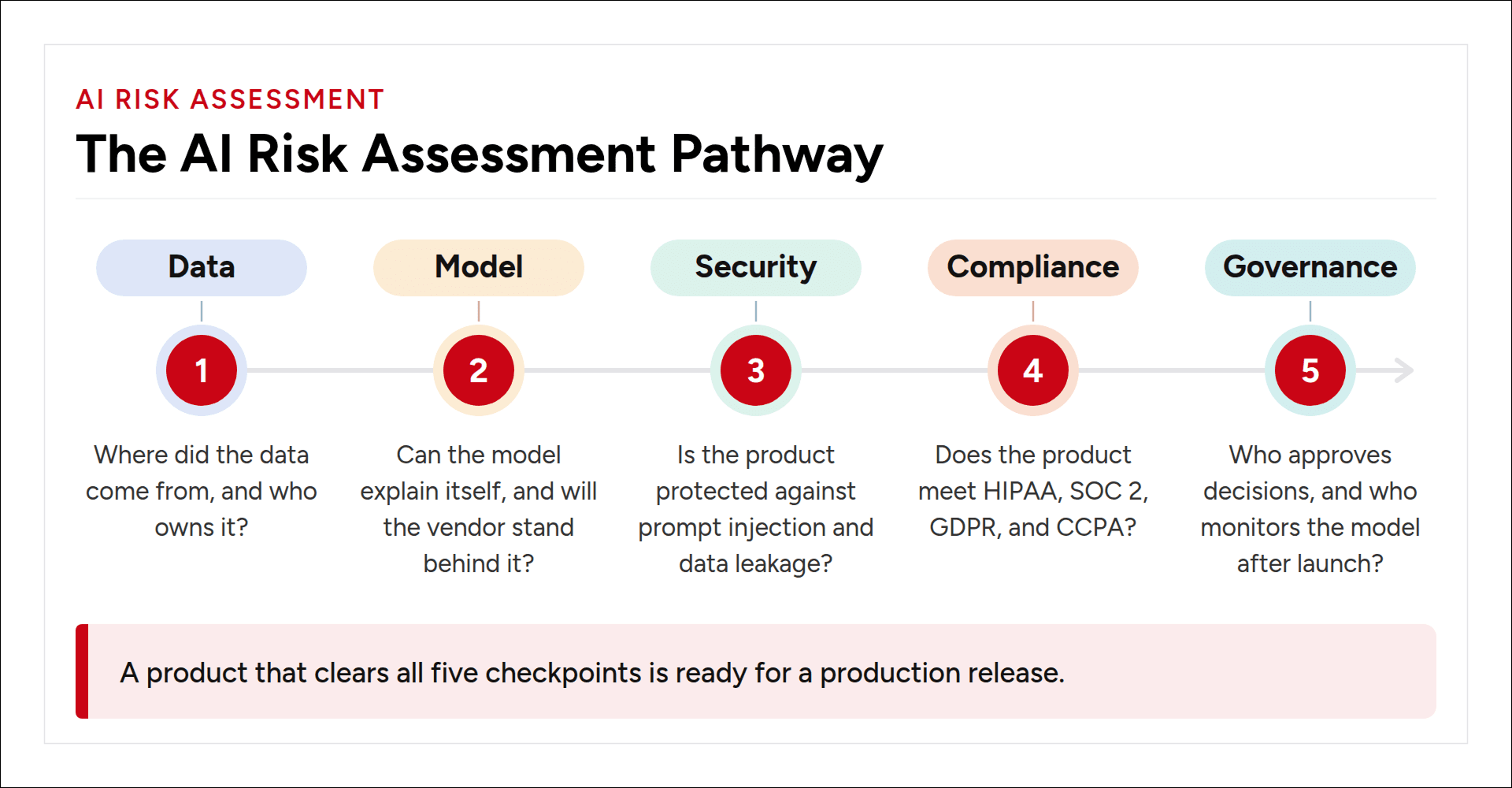
1. Where Did the Data Come From, and Who Owns It?
A team cannot move to model selection until it can name the data's origin, confirm who owns it, and show that its license permits training use.
2. Can the Model Explain Itself, and Will the Vendor Stand Behind It?
Two questions decide whether a model earns a place in the product: can its output be explained, and will the vendor offer indemnification if it fails?
3. Is the Product Protected Against Prompt Injection and Data Leakage?
If a model can be manipulated through prompt injection or leak data through a poorly scoped connection, this stage catches it before launch instead of after a breach.
4. Does the Product Meet HIPAA, SOC 2, GDPR, and CCPA Requirements?
These requirements apply only where the product actually touches the data each law protects, so this stage checks the product against its real data footprint rather than a generic checklist.
5. Who Approves High-Impact Decisions, and Who Monitors the Model After Launch?
This stage closes with two safeguards: a documented approval step for high-impact decisions, and a monitoring system built to flag a failure while it is still small.
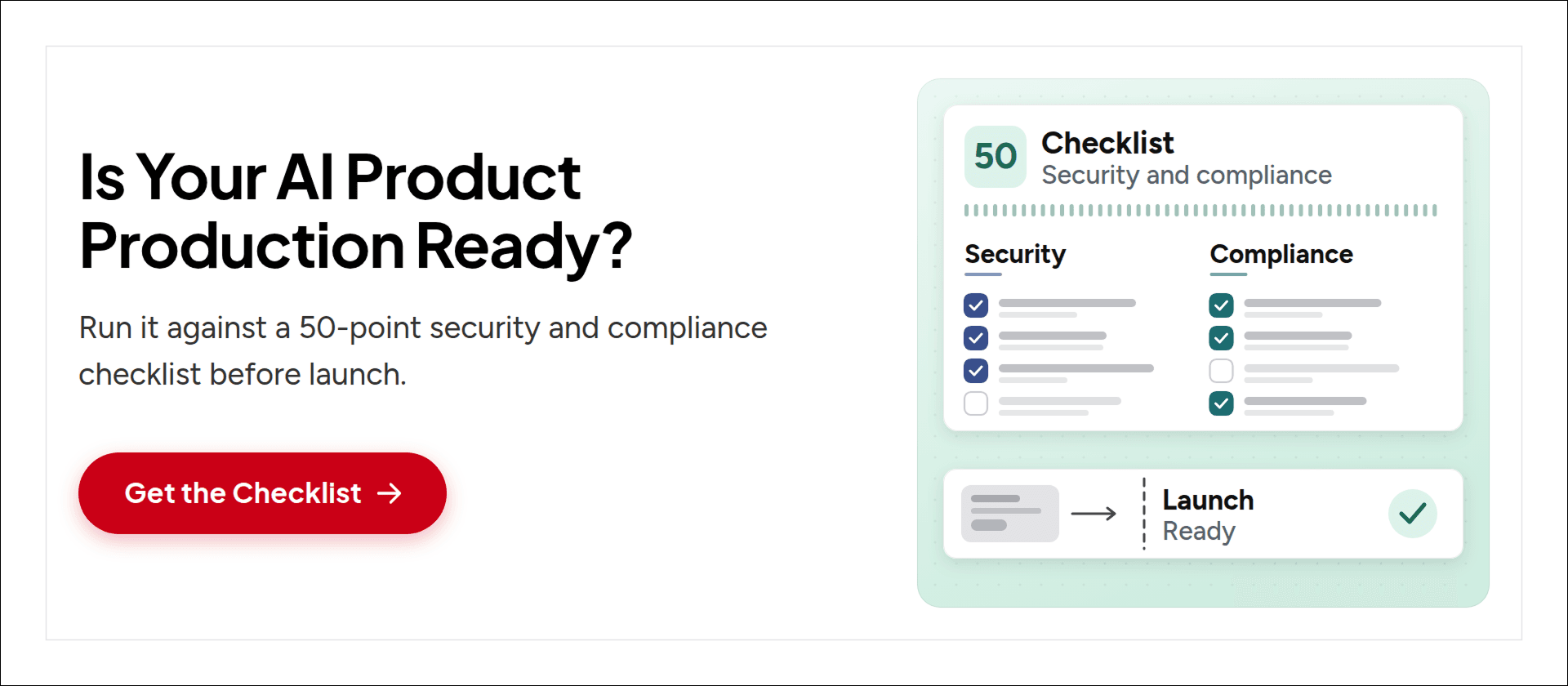
The AI Build App Release Checklist: Is Your Product Ready?
Run this checklist against the product before it reaches a single production user. An AI build app that skips even one of these categories can pass every functional test and still fail a legal or security review after launch.
Legal
An AI build app carries legal risk the moment code enters production, most of it tied to ownership and licensing. This checklist item confirms the product's intellectual property position holds up under scrutiny before a customer, investor, or regulator asks. A completed review covers AI-generated code, training data licenses, and output ownership.
Compliance
Every AI build app touches a different mix of regulations depending on the data it processes and the market it serves. A compliance review confirms the product meets the frameworks that apply to its actual data footprint, not a generic checklist borrowed from another product. This includes a regulatory review against every relevant framework, including GDPR, CCPA, and HIPAA where applicable.
Security
Security testing for an AI build app has to account for risks unique to how a model processes and stores information, on top of the vulnerabilities a conventional application already carries. Prompt injection lets an attacker manipulate a model into producing an output it was never meant to generate. Data leakage happens when a model exposes information it should never surface, including another user's data or the underlying prompt itself. A full review runs penetration testing against both risks, alongside the broader performance and security posture of the system the product runs on.
Product
An AI build app that makes a decision without a human check removes a company's ability to explain that decision after the fact. This checklist item confirms a documented human review process exists for any AI-generated decision, output, or recommendation that reaches a user.
Governance
Governance turns good intentions into a record a company can produce during an audit or a legal review. Monitoring and audit logs give a company the evidence needed to show a feature was tested, approved, and tracked from build to release, with a clear record of who approved, tested, and changed each AI feature.
Vendor Management
An AI build app depends on more than one company's code, and every vendor or model provider in the stack carries a share of the risk. This checklist item confirms contracts have been reviewed for every AI vendor and model provider, with output ownership and liability terms confirmed in writing.
Risk Transfer/Insurance Coverage
An AI build app can carry residual risk even after legal, compliance, security, and governance reviews are complete. This checklist item confirms insurance coverage is in place for the company's actual exposure, spanning IP, errors and omissions, and cyber liability where the product handles sensitive data.
How Do You Reduce Legal Risk Without Slowing Down AI Built Apps Development?
Teams that build safeguards into the SDLC catch a legal or security issue during development, before it reaches production. Risk reduction built this way works as an engineering accelerator, since it removes rework, late-stage audits, and last-minute legal escalation from the release schedule.
What Does a Secure Architecture Look Like for an AI Built App?
Secure-by-design architecture starts with the assumption that a model can be manipulated or a data flow can leak, and builds controls around that assumption from day one. Every integration a product connects to, whether a model API or a third-party plugin, gets the same scrutiny as an internal service.
Where Does Human Review Fit Without Slowing a Team Down?
Human-in-loop review applies to the outputs that affect a user's finances, health, or legal standing, a smaller set than every output a model produces. A documented workflow records who built each AI feature, what data trained it, and who approved it for release, which turns review into a fast checkpoint instead of a bottleneck.
How Do Teams Control Which Models and Data Get Used?
A short, approved list of models and tools keeps every engineer working from the same standard, and clear boundaries around prompts and data define exactly what a model can access.
What Keeps Governance Fast Enough for a Product Team and Strong Enough for an Enterprise Buyer?
Automated testing and monitoring catch a failure the moment it happens, and a legal or security checkpoint before release confirms the product meets its own standard ahead of a customer encountering it. Governance built this way stays light for a product team's daily use, and thorough for an enterprise buyer's due diligence team to trust.
The Release Readiness Standard
- Every AI feature traces back to an approved model, a documented data source, and a named owner
- High-impact decisions carry a human checkpoint before release
- Legal and security review happens as a standing step before launch
Why AI Built Apps Need an Engineering Partner That Builds for Legal and Security Review?
Enterprise buyers now raise AI governance during the first procurement call. A vendor that walks into that call without a clear answer on model review, data sourcing, and sign-off loses time in the sales cycle, and time lost at that stage is difficult to recover later in the deal.
I have watched other vendors lose momentum in the room when a buyer's legal team asks a question their engineering side cannot answer on the spot. The missing piece is proof, the record that shows how a model was reviewed, what data trained it, and who signed off before it shipped. Our teams walk into that same room with that record ready, and it changes the pace of the conversation.
Kunal KumarChief Revenue OfficerEvery risk covered in this guide gets easier to manage when the underlying product has sound engineering behind it. GeekyAnts works as an AI-powered digital product engineering and consulting partner for companies that need to build, modernize, and scale AI products for production. The value sits in the engineering itself: architecture a legal team can trace, security practices a due diligence team can verify, and a build process that documents decisions instead of leaving them buried in a codebase.
The relevant strengths for this work include AI product engineering, scalable app architecture, product modernization, security-aware delivery practices, and enterprise-grade implementation, each one a direct answer to the risk areas this guide covers.
GeekyAnts is not a law firm and does not replace legal counsel. Its role is to build AI applications that are technically sound, scalable, secure, reviewable, and easier for legal, security, and enterprise procurement teams to assess.
Case Studies: AI Built Apps in Production
AI Document Intelligence Platform That Cut Manual Effort by 99%
GeekyAnts built an automated pipeline on AWS Bedrock that replaced a manual, inconsistent reporting process, processing ten thousand pages in two minutes with accuracy above 85%.
Production-Grade RAG System for Real Estate Property Inspections
GeekyAnts built a retrieval-augmented generation assistant that answers property questions in real time during physical tours and QR code scans, with a confidence-based fallback to a human agent when certainty drops.
Healthcare Platform Modernization That Cut Onboarding Time by 40%
GeekyAnts rebuilt Dentify's clinical workflow with an AI transcription and RAG system, reducing doctor onboarding time by 40% and improving treatment planning efficiency by 35%.
The Bottom Line on AI Built Apps and Legal Risk
Speed and accountability can coexist inside the same product. A team that builds legal, security, and governance checkpoints into its process ships an AI built app that survives due diligence, scales into enterprise contracts, and holds up under regulatory scrutiny. The risk areas in this guide are the specifications for building the innovation responsibly.
Sources and Citations:
- https://digital-strategy.ec.europa.eu/en/policies/european-approach-artificial-intelligence
- https://gdpr.eu/fines/
- https://www.bakerlaw.com/the-copilot-litigation/
- https://oag.ca.gov/privacy/ccpa
- https://www.consumerfinance.gov/rules-policy/regulations/1002/
- https://money.usnews.com/investing/news/articles/2026-07-09/new-york-times-led-group-asks-court-to-sanction-openai-in-us-copyright-dispute