

The GeekyAnts Agentic Development Life Cycle (ADLC) is a product engineering model built around AI agents working across the development lifecycle under human oversight. AI supports planning, implementation, testing, documentation, and analysis, while engineers retain ownership of architecture, security, quality, and release decisions.
This approach responds to a change in how software gets built. AI can produce code and other development artifacts within minutes. The challenge for product teams is making sure that increased output meets the standards required for production software. ADLC puts review, governance, and production readiness into the same lifecycle as AI-assisted development.
What Is the GeekyAnts Agentic Development Life Cycle?
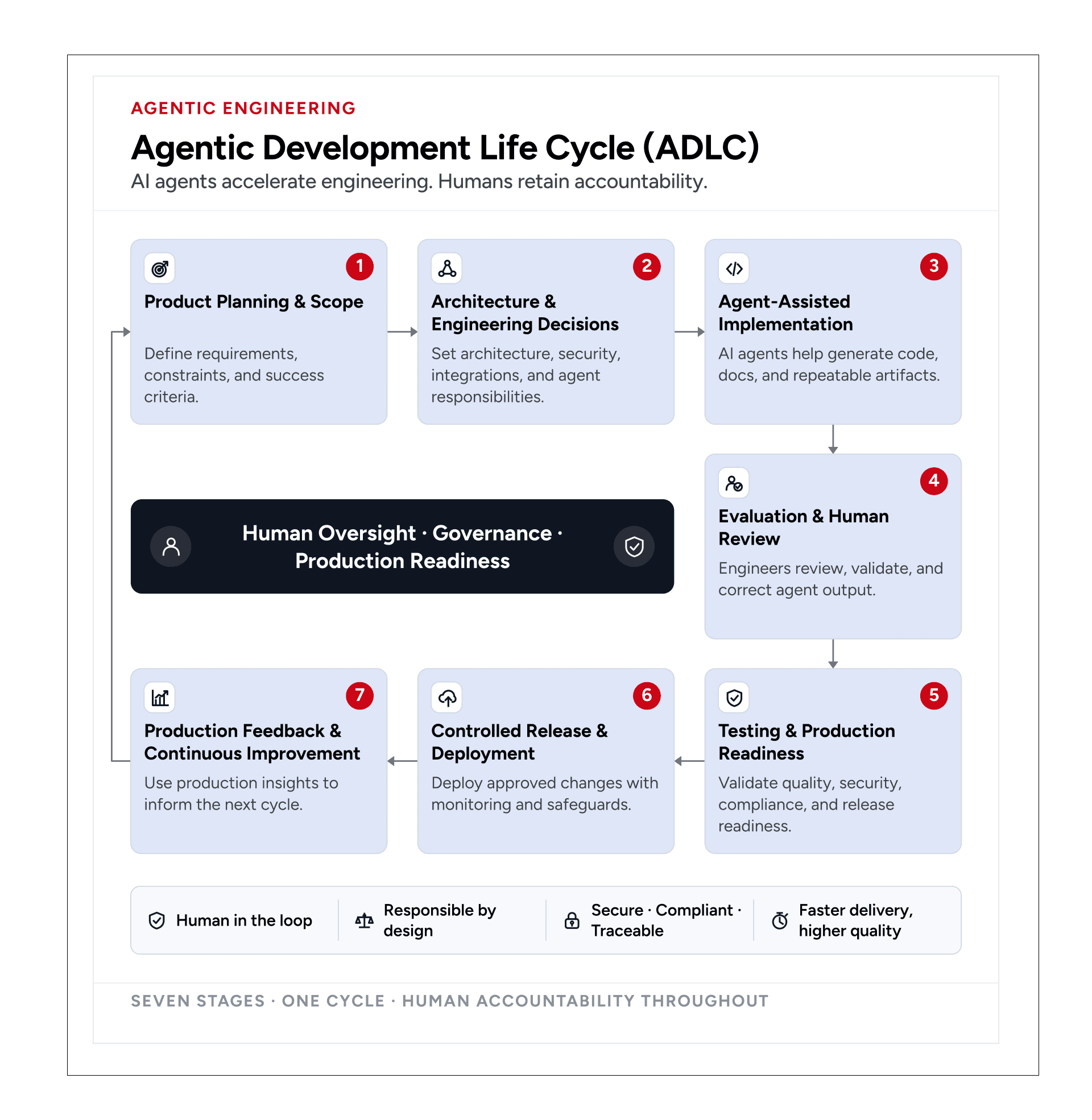
ADLC expands the role of AI beyond code generation. Agents can support work across product planning, development, testing, evaluation, documentation, and operations. Human checkpoints govern decisions that carry product, security, or business risk.
This distinction separates ADLC from adding an AI coding assistant to an existing software development life cycle (SDLC). An AI-assisted SDLC can use tools to generate code or tests while leaving the development process unchanged. ADLC designs AI participation into the lifecycle itself, with defined responsibilities for agents and engineers.
The need for these controls becomes clear when AI output reaches engineering teams. The 2025 Stack Overflow Developer Survey found that 84% of respondents use or plan to use AI tools in development. At the same time, 46% distrust the accuracy of AI-generated output. The survey also found that 66% of developers encounter AI solutions that are close to correct but require intervention.
For ADLC, speed and validation have to work together. AI can reduce the work required to produce an output. Engineers decide whether that output belongs in the product.
ADLC Is Also an Engagement Model
At GeekyAnts, ADLC shapes the development process and the structure of a product engineering engagement.
ADLC Product Engineering brings a cross-functional team into planning, implementation, testing, governance, release, and product improvement. The model fits products that require continued engineering work instead of a fixed development scope followed by handover.
AI agents can take on repeatable development tasks within this structure. Engineers review their work, resolve issues, and make decisions where product context or technical judgment is required. Product requirements, implementation decisions, test results, and release checks remain connected throughout the engagement.
This model also changes how teams measure progress. The amount of code an agent generates says little about whether a product is ready for users. Working features must pass the engineering and business checks defined for the product.
ADLC vs Conventional Product Engineering
Conventional product engineering and ADLC share core stages such as planning, development, testing, deployment, and maintenance. The difference lies in how work moves through those stages when AI agents become active participants.
Area | Conventional Product Engineering | GeekyAnts ADLC |
Development | Engineers perform implementation work with development tools | Engineers and AI agents contribute to implementation |
Review | Teams review code and features during development | Human checkpoints validate agent-generated work |
Governance | Governance follows the organization's development process | Governance requirements guide agent actions and human approvals |
Production readiness | Teams prepare the product for release through testing and release processes | Release requirements remain connected to development and agent output |
Post-release | Teams monitor and maintain the deployed product | Production results inform the next development cycle |
This difference becomes significant as agents take on larger tasks. Giving an agent permission to generate a test is different from giving it permission to approve a release. ADLC defines where automation can act and where human judgment remains required.
What ADLC Changes for Product Teams
ADLC changes the developer's role in parts of the engineering process. Engineers can spend less time producing repeatable artifacts and more time reviewing architecture, resolving complex problems, checking AI output, and making product decisions.
It also brings production requirements into development decisions. In AI products, this can include data controls, model evaluation, security checks, documentation, monitoring, and approval requirements. GeekyAnts has applied this thinking to AI development in regulated sectors, where a working model must meet engineering and governance requirements before it reaches production.
ADLC treats AI agents as participants in product engineering rather than standalone development tools. The goal is to gain value from AI-generated work while preserving the human accountability required to build, release, and maintain production software.
Build AI Into Your Engineering Strategy
ADLC gives product teams a structured way to use AI agents across development without losing the engineering controls required for production software. The value comes from combining faster execution with human judgment, clear governance, testing, security, and accountability throughout the lifecycle.
GeekyAnts works with product and engineering teams to apply AI across new product development, existing platforms, and engineering workflows. If you are evaluating where AI agents can improve your development process or planning an AI-powered product, our team can help you define the right architecture, controls, and path to production.
Planning an AI development initiative?
Talk to our AI engineering team to discuss where ADLC can fit into your product and development strategy.