

When the stakes are high and the odds are legal, everyone wants a seat at the table. That’s the story of sports betting in the U.S.—a $149 billion market built in just a few years.
Since the 2018 repeal of PASPA, online sports betting has exploded across 30+ U.S. states, driven by mobile-first app platforms like FanDuel and BetMGM. But while the opportunity is massive, building a successful betting app involves more than real-time odds and flashy interfaces. It requires navigating regulations, monetization, data integrity, and scalable architecture.
In this blog, we will break down how to build a U.S.-compliant sports betting app—from features and frameworks to legal pitfalls and cost structures—using proven insights from real-world builds.
Most Popular Types of Sports Betting Apps
Sports betting has evolved far beyond the traditional sportsbook. Today’s platforms cater to a wide range of betting preferences, each offering a unique experience. If you are planning to launch a solution, understanding these app types is foundational.
1. Traditional Sportsbook Apps
This is the go-to format for most U.S. bettors. Apps like FanDuel Sportsbook and DraftKings let users place bets on major leagues—NFL, NBA, MLB—with features like live odds, parlays, and promotional boosts. They offer real-time odds and are backed by licensing in regulated states, making them a trusted choice for mainstream audiences.
2. Daily Fantasy Sports (DFS) Apps
Unlike traditional betting, DFS is skill-based. Users build fantasy lineups and compete in cash contests based on real-game performance. FanDuel’s DFS platform made this format popular in the U.S., especially during the NFL and NBA seasons when users actively draft rosters and track scores in real-time.
3. Betting Exchange Apps
A model still growing in the U.S., betting exchanges—like the UK’s Betfair—allow users to bet against one another rather than the house. This peer-to-peer model offers better odds and more flexibility, giving users the ability to set their lines or lay bets, which adds a layer of strategy.
4. Social Betting Apps
Platforms like BetBull brought social gamification into betting by letting users follow expert tipsters, join group bets, and compete on leaderboards. These apps blur the lines between community engagement and wagering, creating a more interactive betting culture, especially among younger users.
5. Live Betting Apps
Live or in-play betting is one of the fastest-growing segments. Apps like PointsBet focus heavily on this model, letting users place bets while the action unfolds, down to individual plays or quarters. This requires a robust backend, real-time data feeds, and fast UX.
6. eSports Betting Apps
For digital-native users, platforms like GG. Bet offers markets for tournaments in League of Legends, Dota 2, or Counter-Strike. With eSports now a billion-dollar industry, these apps are designed for speed, visuals, and the familiarity of gaming culture.
7. Crypto Betting Apps
In regions with fewer banking integrations or higher demand for anonymity, apps like Stake.com let users place bets using Bitcoin, Ethereum, and other cryptocurrencies. These platforms attract users looking for low-friction deposits, fast withdrawals, and privacy.
Why Betting Big on Sports Apps Like BetMGM Is Strategy, Not Speculation
When 60+ million Americans engage with sports betting platforms—and the industry is projected to hit $48.6B by 2027—you’re no longer looking at a trend. You’re looking at an investment thesis. Platforms like FanDuel and BetMGM have proven that digital sportsbooks are not only sticky—they’re scalable, regulated, and deeply monetizable.
Engagement
With peak user sessions exceeding 90 minutes per game, these platforms offer sustained engagement. Real-time odds, player stats, and micro-bets drive constant interaction, fueling repeat usage and loyalty.
Revenue
In 2024, FanDuel generated $5.79B, while BetMGM crossed $2.1B, thanks to diversified revenue streams: entry fees, ads, premium subscriptions, and in-app purchases.
Scalability
Real-time data, AI-driven personalization, and seamless payment integrations allow these apps to serve millions with precision—and scale profitably without friction.
Regulation
With 30+ U.S. states legalizing sports betting and more on the horizon, the legal environment is steadily opening up. FanDuel now operates in 26 states, showcasing how fast scalability can be achieved within compliant frameworks.
For entrepreneurs, this is not a gamble—it’s a rare alignment of market demand, technology, and regulation. The field is open. The users are ready. The infrastructure exists. What’s needed now are bold builders.
Key Features of a Successful Fantasy Sports Betting App
Building a high-performing fantasy sports betting app requires more than flashy design—it demands functionality that drives engagement, ensures compliance, and scales with user demand. Here are the essential features that define market leaders like FanDuel and BetMGM:
1. Seamless Onboarding
Quick signup via email or social accounts, two-factor authentication, and profile customization make the first experience smooth and secure.
2. Real-Time Game Data
Live scores, player stats, and match updates fuel engagement and informed decision-making. Push notifications keep users in the loop during gameplay.
3. Payment & Withdrawals
Support for cards, wallets, and bank transfers. Fast payouts and transparent transaction history build user trust.
4. AI-Driven Analytics
Smart suggestions for team lineups, performance forecasts, and user behavior tracking for tailored experiences.
5. Social & Competitive Features
Leaderboards, private leagues, referral bonuses, and community chat boost retention through social interaction and gamification.
6. Custom Leagues & Personalization
Users can set rules, invite friends, choose themes, and control notifications, making the app feel personal and sticky.
7. Cross-Sport, Multi-Language Support
Coverage for multiple sports and languages ensures broad user reach. Localized time zones improve event accuracy.
8. Security & Compliance
Data encryption, regular audits, and adherence to local betting laws are non-negotiable. These ensure safe, scalable operations.
9. Responsive UI/UX
Fast-loading screens, intuitive navigation, and mobile-first design are key to user satisfaction, especially during live matches.
10. 24/7 Support
In-app chat, FAQ sections, and feedback tools ensure users are never left without answers.
How to Build a Sports Betting App In the USA Like FanDuel & BetMGM: Step-by-Step Guide
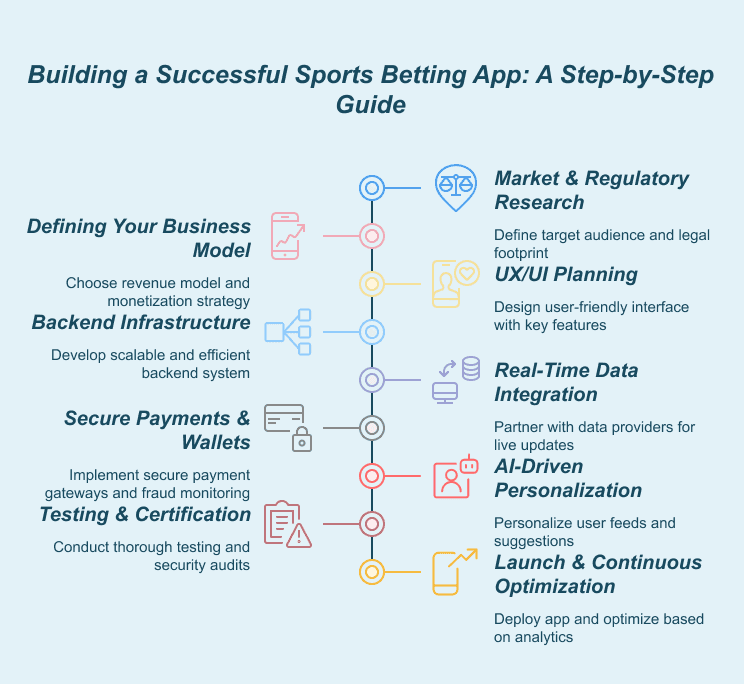
At GeekyAnts, we have worked closely with global product teams to build platforms that handle real-time data, user personalization, and secure payments—exactly the building blocks of successful sports betting apps. While we have built everything from fantasy leagues to gamified e-sports ecosystems, this guide distils what we have learned into a step-by-step playbook tailored for betting apps targeting the U.S. and global markets.
1. Market & Regulatory Research
Start by defining your target audience and legal footprint. In the U.S., over 30 states now permit some form of online betting, but licensing requirements differ dramatically. Internationally, markets like the UK and Australia have stricter gambling regulations and demand proactive legal structuring. Teams must align early with legal counsel to define what's allowed and what must be geo-fenced or restricted.
2. Defining Your Business Model
The revenue model will influence everything, from UI to backend load. Apps like FanDuel earn through entry fees, ads, and premium subscriptions. Decide whether you’ll run real-money contests, free-to-play formats, or affiliate-driven models before you design.
3. UX/UI Planning
User retention in betting apps depends heavily on interface clarity and speed. Features like live score feeds, seamless bet placement, and instant wallet updates need to be front and center. In one of our fantasy sports projects, we saw a 22% improvement in retention after simplifying the match entry flow.
4. Backend Infrastructure
This is where the platform either scales or stalls. The backend must support real-time updates, user wallet management, match data feeds, odds calculations, and transaction logs. Think microservices, not monoliths. We recommend Node.js or Go for performance, backed by cloud services like AWS with event-driven architecture.
5. Real-Time Data Integration
Partner with data providers like Sportradar or Stats Perform to integrate real-time odds, player updates, and event triggers. For one of our clients, we used a WebSocket-based streaming setup to push live data to over 100,000 concurrent users without lag.
6. Secure Payments & Wallets
Support major gateways (Stripe, Razorpay, Apple Pay), but also include withdrawal logic, KYC, and fraud monitoring. Many apps now add AI-driven payment pattern analysis to flag anomalies. This improves trust and minimizes chargeback risk.
7. AI-Driven Personalization
Modern betting apps personalize feeds, odds boosts, and match suggestions using behavioral data. Integrating machine learning to rank events based on a user’s history or preferences can significantly increase engagement—one platform saw a 17% increase in time-on-app using such features.
8. Testing & Certification
Before going live, simulate high traffic (especially during peak match hours), test your payout engine, and run multiple rounds of security audits. For regulated markets, independent testing labs may be required to certify fairness and compliance.
9. Launch & Continuous Optimization
Deploy with analytics baked in—track churn, beat conversion rates, and feature engagement. Use this data to iterate on your roadmap. In one white-labeled case, we optimized post-launch onboarding to reduce drop-offs by 19% in the first 7 days.
How Much Does It Cost to Build a Fantasy Sports Betting App Like FanDuel?
The cost of developing a fantasy sports betting app varies widely, but not unpredictably. It depends on what you’re building, how deep your feature set goes, and where your team operates.
Key Factors That Shape Development Cost
- Feature Scope: Basic platforms (user login, team creation, leaderboards) cost less. Advanced ones with AI, real-time analytics, and multi-sport coverage demand more effort and budget.
- Platform Choice: Native apps (iOS/Android) cost more than cross-platform builds like Flutter or React Native, but may offer better performance.
- Design Complexity: A clean, intuitive UI/UX design improves retention but increases initial design investment.
- Backend Infrastructure: A scalable backend is essential for live scoring, user data, and secure payments.
- APIs & Compliance: Live score APIs, payment integrations, and legal requirements (especially in the U.S.) add to both development and maintenance costs.
Location-Based Development Cost
Region | Hourly Rate | Total Project Estimate |
North America | $200–$300/hr | $1600–$240/hr |
Western Europe | $1600–$2400/hr | $240,000 – $400,000 |
Eastern Europe | $80–$140/hr | $160,000 – $300,000 |
South Asia (India) | $50–$100/hr | $100,000 – $200,000 |
Southeast Asia | $40–$80/hr | $80,000 – $180,000 |
Development Phase–Wise Breakdown
Phase | Estimated Cost |
Planning & Requirement Gathering | $10,000 – $30,000 |
UI/UX Design | $20,000 – $50,000 |
Frontend Development | $40,000 – $100,000 |
Backend Development | $50,000 – $120,000 |
API/Third-Party Integration | $20,000 – $60,000 |
QA & Testing | $10,000 – $30,000 |
Deployment | $6,000 – $20,000 |
Annual Maintenance | $20,000 – $40,000 |
These are average benchmarks. The actual cost depends on scope, tech stack, regulatory requirements, and how well you plan the MVP versus the scaling roadmap. For startups, starting lean with core features and expanding post-validation is often the smarter route.
Legal Considerations for Developing Fantasy Sports Betting Apps
Legality in the United States
When it comes to launching a fantasy sports betting app in the U.S., there's no one-size-fits-all rulebook. While federal law allows fantasy sports under certain exemptions, each state decides its own boundaries—creating a legal patchwork developers must navigate carefully.
Some states explicitly permit daily fantasy sports (DFS), while others remain silent or restrict operations entirely. This means you can operate legally in one state while facing penalties in another. The key is localized compliance.
Developers must account for:
- State-specific licensing or registration
- Minimum age restrictions (typically 18 or 21)
- Taxation requirements—especially around user winnings and platform revenue
If your platform operates nationally, you'll need a clear compliance strategy for each jurisdiction. Failing to do so can result in legal bans, financial penalties, or forced exits from specific markets.
Global Outlook: UK and Australia
Outside the U.S., fantasy sports are generally seen through a gambling lens, especially in countries like the UK and Australia.
In the United Kingdom, operators must secure multiple licenses to offer real-money competitions. The legal process is formal and compliance-heavy, including background checks and software certifications.
In Australia, laws vary by state. While fantasy sports are typically categorized as games of skill—and therefore legal—specific features like entry fees, cash prizes, or betting mechanics could trigger gambling regulations. Licensing may be required depending on the structure of your app.
Understanding regional nuances is non-negotiable. What qualifies as legal innovation in one country could be considered unlawful gambling in another.Licensing: More Than Just a Checkbox
Licensing is where regulation meets reputation. It’s not just about getting approval—it’s about building trust with users, regulators, and potential partners.
Here’s what most licensing processes include:
- Hefty application fees depending on region and app model
- Background checks on founding and leadership teams
- Proof of technical safeguards—like geo-blocking, age verification, and data protection
- Regular audits and reporting to maintain active status
Whether you are targeting one state or going global, licensing should be treated as a strategic priority from day one. It’s your ticket to long-term scalability—and a protective layer that keeps legal risks at bay.
Disclaimer: Before initiating the development of a fantasy sports betting app, it's essential to understand that regulatory approval is required in most jurisdictions. Licensing requirements vary by country and region, depending on local gambling and data protection laws. Always consult with a qualified legal advisor to assess compliance obligations before proceeding with development or launch.
How GeekyAnts Can Help You
Why GeekyAnts?
At GeekyAnts, we specialize in building high-performance sports betting platforms designed for real-time responsiveness, scalability, and compliance. From backend infrastructure to user experience, our systems are built to handle high-concurrency loads and adapt to evolving regulatory requirements.
Our Track Record
We’ve delivered production-grade solutions across the sports and gaming ecosystem:
- MPL – Scalable e-sports platform built for peak user traffic and low-latency gameplay.
- My Sports Family – Fantasy sports app integrating live game data with interactive features.
- CoreSports – Real-time sports training simulation platform.
- LoyalJoys – Social gaming app combining community engagement with scalable architecture.
Built to Win, Built to Last
Our platforms use microservices-based architecture, real-time data streaming, and AI-driven modules for personalization and fraud prevention. With ISO-certified security and flexible compliance frameworks, we build systems that scale reliably, perform under pressure, and evolve with market needs.
Ready to build your FanDuel-level platform? Contact us today to get started.
Real-World Challenges and How to Solve Them
Building a sports betting app is like managing a packed stadium during a live match—every second matters, and users expect instant results, airtight security, and a flawless experience.
Here’s what goes wrong—and how experienced teams respond.
1. Laws Changed Mid-Launch. Users Got Locked Out.
A betting platform geared up to launch in the U.S. Northeast. Days before going live, one state tightened ID and tax laws. The app had no way to adapt regionally, and thousands of users were suddenly blocked.
Solution:
Use a modular compliance system tied to user location. Build workflows that respond to legal shifts without needing code changes. Connect to live regulation feeds where available.
2. A Match Crashed the System. Ratings Plummeted.
A high-stakes football final brought traffic 3x above normal. Odds lagged, slips froze, and the app eventually crashed. Ratings dropped to 2.3 stars in hours.
Solution:
Use autoscaling microservices. Separate traffic-heavy components like odds and wallets. Run pre-launch chaos testing to simulate and fix stress points before they happen.
3. Live Odds Lagged by 7 Seconds. Trust Was Gone.
A user bet on a goal after it happened. Odds were delayed. Trust vanished, and support flooded with refund requests.
Solution:
Implement WebSockets for real-time odds. Stream data with Kafka or Redis, and cache updates at the edge. Partner with top-tier providers offering sub-second delivery.
4. Too Many Steps. Users Quit Before Betting.
A user downloaded the app but dropped off during onboarding. ID, address, and banking were all required upfront. Completion rate fell below 30%.
Solution:
Split onboarding into stages. Let users explore or place demo bets before triggering full KYC. Ask for personal info only when necessary, like at first deposit.
5. Withdrawals Took Days. Users Walked Away.
A weekend winner waited 72 hours for a payout. Complaints piled up. A Reddit post spread, and active users dipped.
Solution:
Use real-time payout tools like RazorpayX or ACH push. Add a live withdrawal tracker inside the app to set expectations and reduce anxiety.
6. The App Felt Like a Spreadsheet.
Odds were clean, but the interface lacked energy. It looked functional, not fun. Casual users didn’t come back.
Solution:
Design for emotion. Show trending bets, add subtle animations, and use streaks or leaderboards for engagement. Gamify lightly without cluttering the core experience.
How Do Fantasy Sports Betting Apps Generate Revenue?
Fantasy sports betting apps operate on high-volume engagement and diversified revenue models. The platforms that succeed do more than collect entry fees—they build ecosystems that monetize attention, competition, and convenience.
1. Entry Fees and Contest Commissions
Most apps charge a fee to enter daily or season-long contests. A small commission (usually 10–20%) is retained from the prize pool, generating steady revenue at scale.
2. Subscription Models
Many platforms offer premium tiers with access to advanced analytics, exclusive contests, and expert insights. This ensures recurring monthly revenue while rewarding power users.
3. In-App Purchases
Custom team avatars, performance boosters, or extra draft entries can be purchased to personalize the user experience and drive microtransactions.
4. Ad Monetization
With millions of active users, these mobile betting apps are prime territory for banner ads, sponsored content, and interstitials—especially during live game windows when engagement peaks.
5. Affiliate Partnerships
Referral commissions from sportsbook integrations, merchandise links, or ticketing partners help extend monetization without adding user friction.
6. Data Licensing
Aggregated, anonymized user data—like gameplay trends or user behavior—can be packaged for sports analytics, ad targeting, or industry research.
7. Technology Licensing
Some platforms white-label their infrastructure to other brands, enabling them to launch custom apps using proven backend systems.
A winning monetization strategy blends these models based on the app’s user profile and growth stage. The most successful products balance profitability with user value, earning more not by charging more, but by being built to engage smarter.
Conclusion
The sports betting industry in the U.S. is evolving rapidly, with shifting regulations, rising user demand, and new technologies shaping how platforms are built and scaled. This blog outlined the key steps, challenges, and considerations for launching a successful betting app in today’s competitive landscape. Whether you're entering the market or optimizing an existing product, aligning strategy with execution is essential for long-term growth.
Need a tech partner to bring your idea to life? GeekyAnts can help.
FAQs
1. How do I make my own sports betting app?
To build a betting app, start with legal research and licensing. Define your business model, select a reliable tech stack, design an intuitive UI, and integrate real-time sports data and secure payments. Development typically takes 6–12 months, depending on features and compliance needs.
2. How do fantasy sports betting apps generate revenue?
These apps make money through:
- Entry fees and commission on contests
- In-app purchases and premium features
- Ads, sponsorships, and affiliate partnerships
Platforms often combine multiple revenue streams to increase profitability.
3. What are some successful examples of sports betting apps?
FanDuel, DraftKings, BetMGM, and Bet365 are top players known for seamless UX, real-time odds, secure transactions, and broad sports coverage.
4. How long does it take to build a sports betting app like FanDuel?
A full-featured app like FanDuel typically takes 6 to 12 months to build, depending on complexity, team size, legal clearances, and third-party integrations.
5. Which technology stack should I choose?
Most teams use:
- Frontend: React Native or Flutter
- Backend: Node.js or Python
- Database: PostgreSQL or MongoDB
- Real-time updates: Firebase, WebSockets
- Payments: Stripe, Razorpay, or Apple Pay
Choose based on performance needs and scalability goals.
6. Can you use AI for sports betting?
Yes. AI can forecast outcomes, personalize betting options, detect fraud, and optimize user engagement. Many top platforms already use AI to boost retention and conversion.
7. How do you ensure the security of a sports betting app?
Security begins with data encryption, secure logins, and real-time fraud monitoring. Add regular audits, compliance checks, and secure payment integrations to keep both user data and transactions protected.