
Editor’s Note:
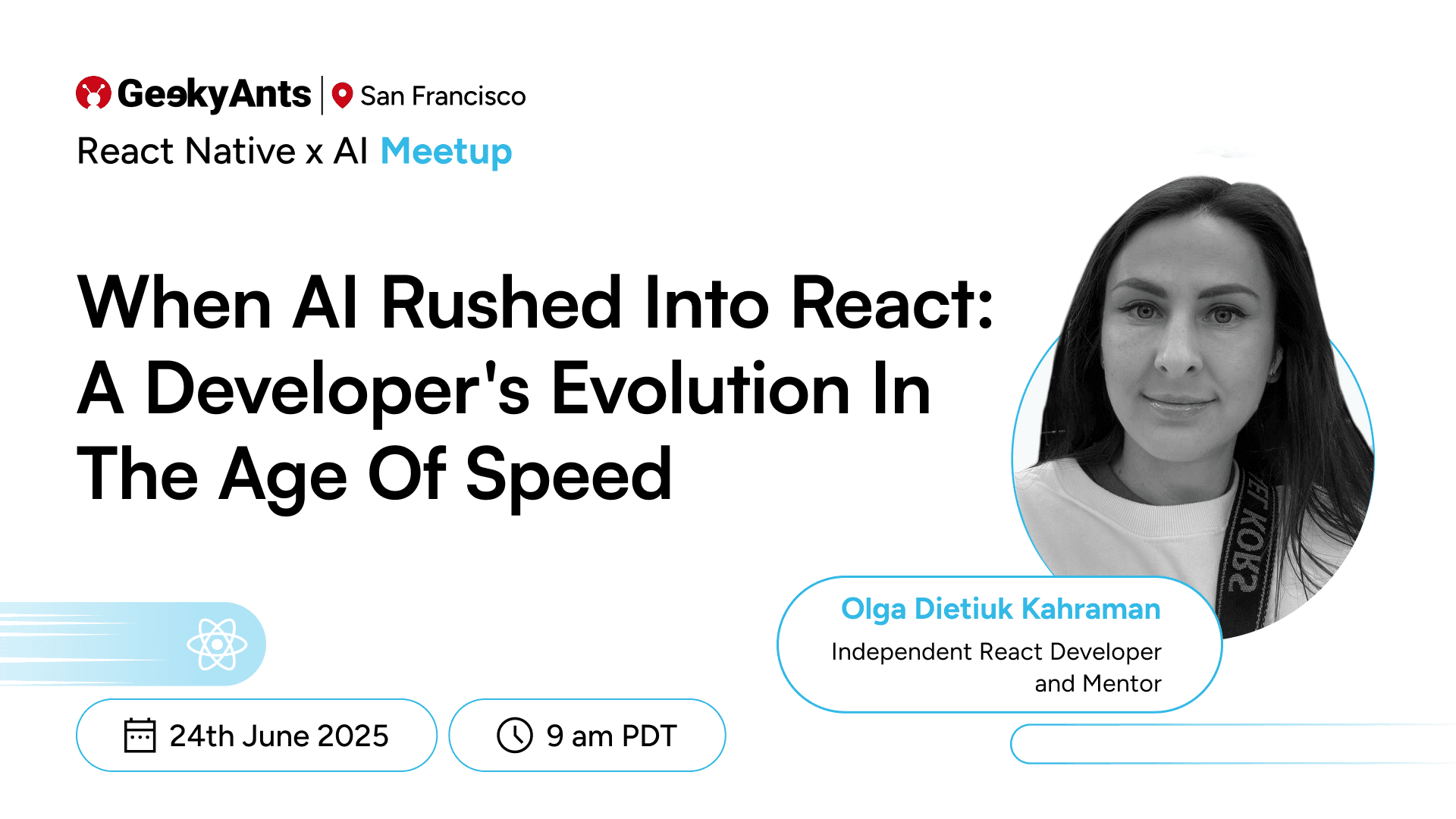
This blog is based on a React Native meetup hosted by GeekyAnts. The session was led by Olga Dietiuk Kahraman, an independent React developer and mentor based in Jersey City, who shared her experience navigating the cultural and technical shift brought by AI in frontend development. This blog chronicles her evolution from React developer to team mentor in a world where AI has transitioned from novelty to necessity.
From Clean Code to Conversational Interfaces: A Shift in Mindset
React developers used to measure success in terms of clean architecture, reusable components, and responsive design. For Olga, that was the foundation of her role in October 2024 when she joined a team building BookTalk, a literary discussion app. It had all the familiar development hurdles—state management, context API, UI responsiveness—but the goal was clear: write good code.
Nobody on the team even mentioned AI. Architecture was king. Metrics focused on reducing merge conflicts and improving team velocity. The codebase was a fortress of precision—no unpredictability, no third-party AI behavior, no dynamic responses.
Five months later, everything changed.
March 2025: The AI Layer Enters React
In her next project, Olga mentored a different team developing 3Point, a travel planning web app. While the setup was identical—three frontend and two backend developers building from scratch in 10 weeks—the development environment was fundamentally different.
This time, AI was not just a feature—it was a mindset shift.
The team built an AI-powered trip planning interface using Google’s Gemini API, allowing users to receive itinerary suggestions based on their preferences. Although it wasn’t a full-blown conversational interface, the AI layer demanded a new approach to everything—from UI logic to error boundaries and fallback behavior.
Olga’s role had also changed. She was no longer just writing code—she was mentoring developers, conducting code reviews, running workshops in English and Russian, and guiding the team through the emerging complexity of AI-enhanced state.
Building UI for Unpredictability
The inclusion of AI introduced a major cultural change: developers were no longer building static UIs—they were orchestrating dynamic, unpredictable, human-AI interactions.
“React didn’t change. Our mindset did.”
Instead of merely ensuring that UI components rendered correctly, the team now had to anticipate how AI responses could alter UX. That meant handling:
- Non-deterministic responses (AI may suggest different results for the same input)
- Streaming content updates instead of single-render state changes
- Unexpected failures, requiring new types of error boundaries
- Accessibility for AI-generated dynamic content
Developers had to learn to build resilient UI logic, not just perfect code.
The Role of the Mentor in an AI-Native Team
Olga emphasized that mentoring was no longer optional in this new AI-driven era—it was the core of leadership.
She shifted from asking, “How do I fix this bug?” to asking, “How do I help this developer understand AI state complexity?” Her goals transformed:
- From optimizing functions to shortening feedback cycles
- From personal deliverables to team-wide knowledge transfer
- From product completeness to AI tooling literacy
Soft skills—like empathy, curiosity, and communication—became multipliers, not nice-to-haves.
“The fastest learners now shape the strongest teams.”
Lessons from the Frontlines of AI x React
Olga distilled her journey into a few powerful takeaways:
1. New State Patterns Are Emerging
AI responses need more than typical state hooks. Developers must consider transient data, fallback layers, and conditional render paths that shift in real-time.
2. Failure Is the Default
Unlike traditional APIs, AI services often return vague, incomplete, or unhelpful responses. Handling this requires thoughtful UX, clear error boundaries, and graceful fallbacks.
3. Performance Means Something New
In the AI era, performance isn’t just about rendering speed—it includes how fast your app can stream, parse, and respond to unpredictable inputs.
4. Accessibility Is Critical
AI-generated content must still meet accessibility standards. Developers must ensure screen readers and markup adapt to dynamic changes.
5. Mentorship is Non-Negotiable
AI does not eliminate the need for skilled devs—it magnifies the importance of those who can teach, guide, and adapt under uncertainty.
Final Thoughts: The Future Didn't Walk—It Rushed In
In just five months, Olga’s role evolved from React developer to mentor of an AI-native team. Her journey reflects a broader reality for React developers worldwide: we are not just building interfaces anymore—we are building adaptive ecosystems.
“We fail because we code faster. We succeed because we learn together.”
As AI becomes the new baseline, developers must not only learn syntax but also learn how to guide, mentor, and design for unpredictability. That’s the real challenge—and opportunity—of building with React in the age of speed.