

Key Takeaways:
- Define the production outcome and required capability before writing any forward deployed engineer job description.
- A forward deployed engineer owns the full chain from discovery through adoption to the business result.
- Team shape should follow deployment complexity, compliance exposure, and the strength of your internal platform support.
- Evaluate providers on production evidence, discovery depth, and team continuity rather than the pitch.
- Buying in cheap, walkaway stages reveals more about a provider than any proposal can.
- Governance, ownership, and knowledge transfer belong in writing before day one, since unnamed responsibilities fail first.
Most advice on how to hire a forward deployed engineer stops at the job description. It tells you what the role does, which skills to screen for, and roughly what the market pays.
Then it goes quite exactly where enterprise buyers need it the loudest: how many people the deployment actually needs, what to ask a provider before signing, who governs the pod once it lands, and what has to be true internally before the first day.
Why Does Hiring One Forward Deployed Engineer Rarely Fix the Enterprise AI Problem?
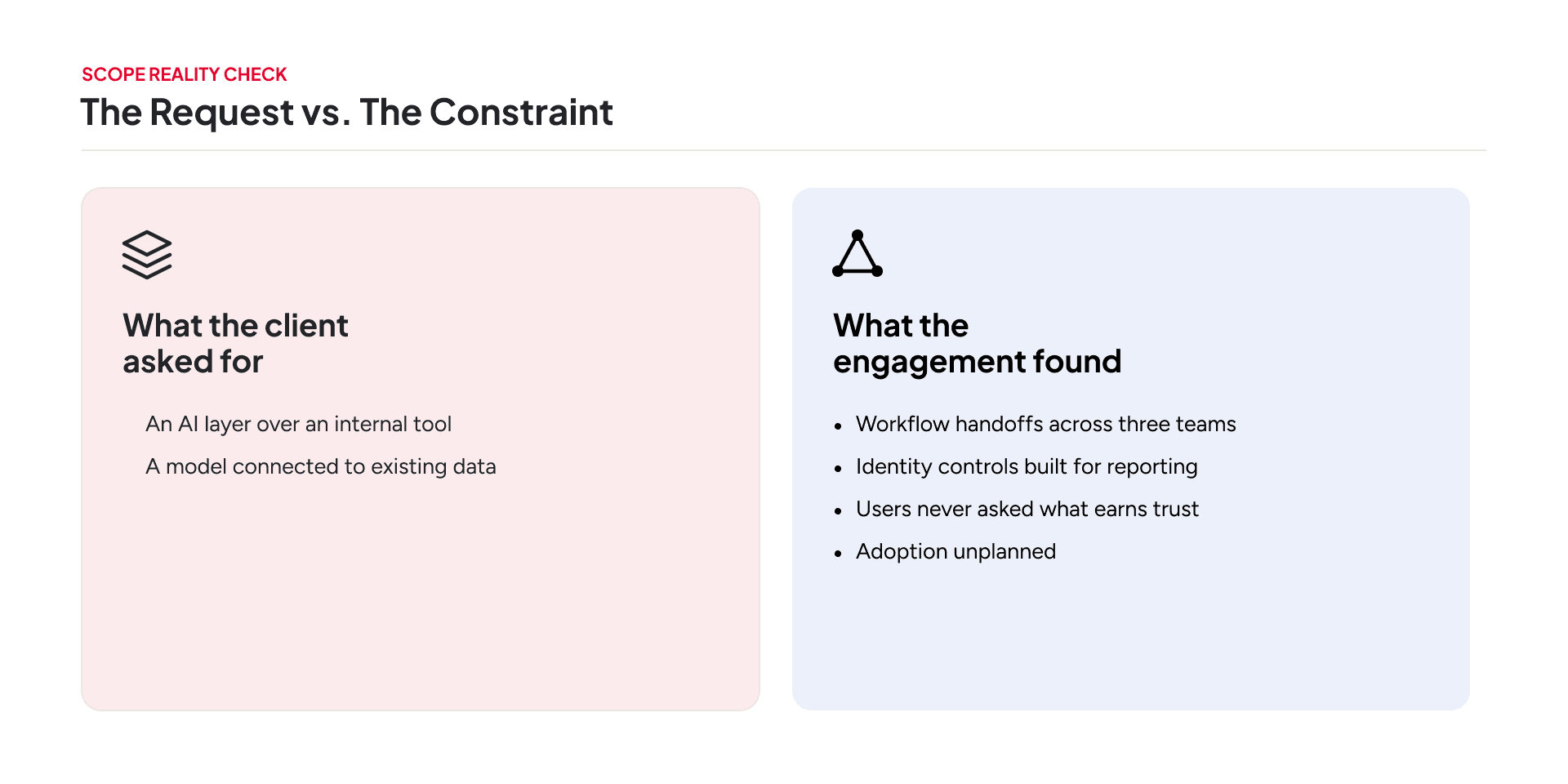
Our CEO spent time in Mumbai this year with two companies, doing the job an FDE actually does. He sat in on handoff meetings. He followed a single request from intake to sign-off and wrote down every place it stopped moving. He asked people what they did when the system said no, then watched them do it.
At the first company, hired to put an AI layer over an internal tool, he traced the workflow back to three teams keeping three private copies of the same spreadsheet. The context that mattered traveled between them by Slack and hallway conversation. The step everyone wanted automated came last, after the interesting decisions had already been made by hand.
At the second, asked to connect a model to data the company already owned, he opened the permissions and found identity controls written for a reporting tool. Read access was broad, and nothing in the design anticipated a system that acts. He also asked the eventual users what would make them trust an answer from a model. Nobody had put that question to them before, which explained a fair amount about the previous pilot.
The pattern scales. McKinsey's 2026 State of AI survey has enterprise scaling at 44% while the share reporting EBIT impact sits at 37%, unchanged from last year.
The request a client brings you is a hypothesis. Most engineers treat it as a specification, build it beautifully, and hand over something nobody uses. A week inside the workflow tells you more than a month of requirement gathering, and it usually tells you something the client did not want to hear.
 Kumar PratikFounder & CEO
So we are teaching our engineers the sequence he used. Count the handoffs, read the permissions, ask the users, and only then argue about architecture.
What Are You Actually Hiring a Forward Deployed Engineer to Fix?
The number one key aspect when hiring a forward deployed engineer is to be clear about what your problem statement really is, and what you need to fix. Write down what you need before you write a job description. Five questions.
- Is a pilot stuck short of production? A model that works in a demo and stalls on the way to real users has a delivery problem, and delivery is what this role exists to solve.
- What is actually blocking you? Technical integration, unclear requirements, and poor adoption look identical from a status report and require completely different people to fix. Name the one that hurts most, then check whether the other two are hiding behind it.
- What does the system have to touch? Count the legacy interfaces, the places your data sits in three formats, the identity controls that decide who can act, and any workflow an auditor cares about. That list is usually longer than the first draft suggests.
- Are you building one thing or a capability? A single workflow needs a team that ships. A repeatable capability needs patterns, documentation, and people you can train.
- Who owns it on the Monday after launch? If the answer is nobody yet, resolve that before you sign anything.
Then compress the answers into one sentence your whole procurement process can be measured against:
Within 90 days, the FDE capability must move claims triage from a manual queue handled by six analysts to an agent that drafts and routes decisions with human approval, while satisfying integration with our policy system and Okta, an audit trail for every action, adoption by all six analysts, and sub-three-second response.
If that sentence is hard to write, the scope is not ready for a provider.
What Does a Forward Deployed Engineer Actually Own in an Enterprise AI Project?
The role is defined by the length of the chain one person stays accountable for. A forward deployed engineer for AI projects opens with business discovery, sitting with the people whose work is about to change and finding out how it really runs.
One engineer carries all seven of these, from the first conversation to the number on the board:
- Discovery, sitting with the people whose work is about to change
- Architecture, then the build itself
- Integration into the enterprise systems already running, where most of the difficulty lives
- Deployment under real load and real permissions
- Adoption, since a system nobody uses has failed whatever its test coverage
- Field observations, carried back to whoever makes the product
- The business number, and whether it moved
Seven stages, one owner. Most organizations split these across separate roles, which is what makes the FDE model different.
How Is This Different From Roles You Already Have?
Role | Answers for |
Software engineer | The system works as specified |
Solutions engineer | The buyer understands what the product can do |
Implementation consultant | The rollout follows the agreed method |
Project manager | The plan, the budget, and the timeline hold |
Forward deployed engineer | The workflow got better, and the code that made it better is theirs |
Each of the first four is doing a legitimate job well. The difference is where accountability stops. A software engineer can ship exactly what the ticket asked for while the business problem sits untouched. An implementation consultant follows a method that assumes the requirements are right.
An FDE has the authority to say the plan is wrong and the skills to write the replacement that afternoon.
Do You Need One Forward Deployed Engineer or an FDE-Led Pod?
Independent research has yet to prove that one staffing model beats another on outcomes, so anyone selling you a rule is guessing. The vendors, however, have voted with their budgets, and the vote was lopsided.
Between May and July 2026, OpenAI put more than $4 billion behind a dedicated deployment business and bought roughly 150 forward deployed engineers along with it. AWS committed $1 billion to an FDE organization staffed by thousands of people, working in embedded pods of about five or six on roughly 45-day cycles.
When Is One Forward Deployed Engineer Enough?
A solo hire works when your organization is already carrying most of the weight. The use case has survived contact with reality and the architecture is settled, which turns discovery into confirmation. One or two integrations sit inside systems your own team documents and controls. Compliance exposure stays low, with no regulated workflow and no auditor waiting downstream. Above all, a mature internal platform team hands over data access, infrastructure, QA, and security review when asked, and a named person inside the company takes the system on at launch.
When Is a Pod the Safer Commitment?
Everything inverts once the deployment crosses organizational boundaries. Google Cloud's 2026 infrastructure research, covering 1,402 IT leaders, found 83% requiring infrastructure upgrades before they can run production-grade autonomous systems, with 43% pointing at legacy APIs and data sources as the hardest gap. Nobody absorbs that alongside stakeholder discovery and model evaluation.
Governance pushes the same way. NIST has made agent identity, authorization, and audit trails into procurement requirements rather than research topics.
Add unresolved requirements, several business units with competing definitions of success, and an expectation that the provider runs the thing after launch, and you have described a program.
A Decision Table for the Scoping Conversation
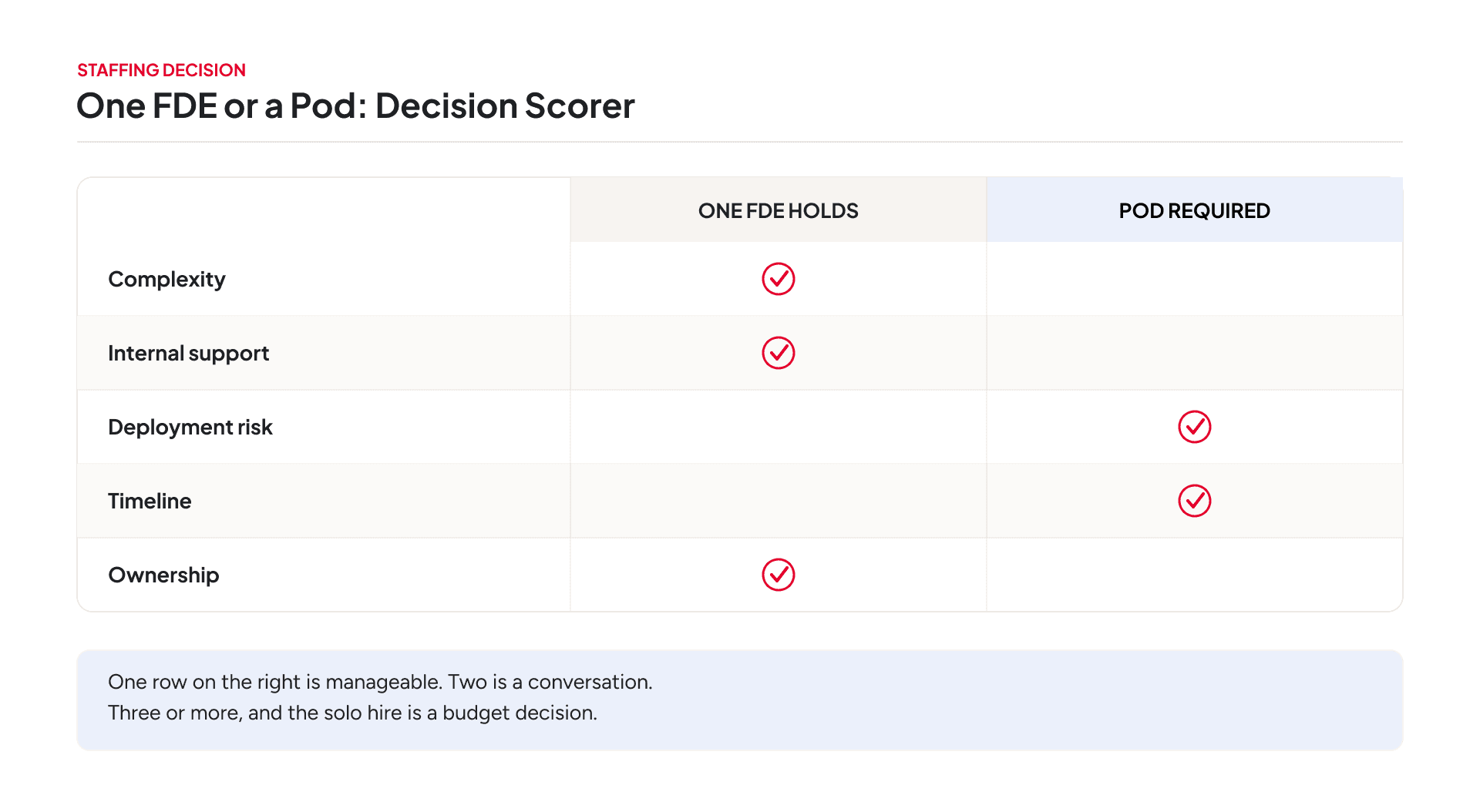
Factor | One FDE holds | Pod required |
Complexity | Defined use case, settled architecture, one or two contained integrations | Discovery still open, several enterprise systems, unresolved data quality or access |
Internal support | Mature platform team supplies data, infra, QA, and security on request | No platform team, or one already at capacity |
Deployment risk | Low compliance exposure, no regulated workflow, reversible failure | Regulated data, agent permissions, audit obligations, customer-facing failure modes |
Timeline | Weeks of ramp are affordable and the date can move | Fixed date with parallel workstreams that cannot queue behind one person |
Ownership | Named internal owner takes the system at launch | Provider runs production, or the capability must repeat beyond the first workflow |
Score it honestly. One row on the right is manageable and two is a conversation. Three or more, and the solo hire is a budget decision dressed up as a staffing decision.
What Are the Different Ways to Hire Forward Deployed Engineering Capability, and Where Should Enterprises Look?
Six buying options exist, and enterprises routinely compare three of them because those are the three their procurement system already has forms for.
Each solves a different problem. Some give you access to people, some give you capacity against a plan you wrote, and some give you a forward deployed engineer for AI projects that owns the result.
Model | Best suited for | Main limitation | Where to look |
Internal full-time FDE | Long-term capability where internal support already exists | Slow to hire; the national talent pool is in the low thousands | Direct recruitment |
Independent or fractional FDE | Discovery, advisory work, or one contained implementation | Thin supporting capacity and real continuity risk | Specialist FDE and AI consulting firms |
Freelance talent platform | Sourcing individual specialists quickly | You coordinate and manage the delivery | Freelancer and specialist platforms |
Staff augmentation company | Filling a defined capability gap | Delivery ownership stays with you | Staff augmentation providers |
Dedicated FDE pod | Complex delivery needing coordinated specialists | Demands clear governance and a named outcome owner | AI product engineering companies |
Managed AI engineering partner | End-to-end production delivery or transformation | Overbuilt if you only need temporary capacity | AI product engineering companies |
Read the table as two categories rather than six options. Platforms and augmentation firms solve talent access, which is a real problem with a known price. Pods and engineering partners solve coordinated delivery, which is a different problem entirely. A platform will find you a person in ten days and will not care whether the deployment reaches production.
AWS made the same argument to its own consulting partners when it extended forward deployed engineering across the channel, on the grounds that enterprise AI has outgrown the advisory model. Advice and capacity are both purchasable. Neither one ships a system.
Whichever door you pick, compare providers against criteria you published before the first call.
What Should an Enterprise FDE Pod Include?
A pod is assembled around your problem. Any provider quoting a fixed team before understanding the workflow is selling inventory. Ten capabilities cover most enterprise AI deployments, and few engagements need all ten at once.
Capability | When it earns a seat |
FDE or lead consultant | Always, from day one to handover |
AI or solution architect | Discovery and architecture, then on call |
Model selection, evaluation, and tuning | |
Every legacy interface you counted | |
Data engineer | Fragmented sources, quality problems, pipelines |
New infrastructure, scaling, cost control | |
QA and AI evaluation engineer | Non-deterministic output, regression risk |
Product manager or business analyst | Competing stakeholders, unclear priorities |
Human review, escalation, and trust in the interface | |
Regulated data, agent permissions, audit obligations |
Part-time is normal and often correct. A security specialist who spends four days on your identity design and returns for the production review costs a fraction of a headcount and prevents the failure everyone remembers.
How Should an Enterprise Evaluate an FDE Company Before Hiring a Forward Deployed Engineer?
Hiring an entire organization is quite different from hiring a vendor or a forward deployed engineer, because the organization is going to own the production outcome. Which means assessing whether they can sustain judgement across delivery, integration and governance for the length of a deployment.
We have designed a scorecard to help as the right questions along with the weightage required.
How to Use This Scorecard
Below are some guidelines to follow so as to be able to use the scorecard efficiently and hire the right forward deployed engineer for your AI projects:
- Set the weights before the first call, and set them with whoever will actually own the outcome internally- not just procurement.
- A CTO weighting integration and governance heavily will end up with a different shortlist than a CRO weighting speed to pilot.
- Score independently- every stakeholder (in engineering, security, the business owner), should fill in the scorecard separately before comparing notes.
- Score from evidence, not from the pitch. A deck can claim discovery capability.
- Treat the scorecard as a live document that gets revised at each stage of the validation process described earlier in this guide.
What Each Evaluation Area Actually Tests
1. Production evidence
Carries the most weight.
Ask for systems currently running against real load, not just demos. Another important question to ask is what broke during the first few instances of deployment and why? This will help you to understand how much knowledge the provider has because most try to get away with just explaining the polished version.
2. Discovery capability
This tests whether the provider treats your request as a hypothesis or a specification.
A strong answer surfaces a scope your RFP didn't mention whereas a weak one would only be able to tell you about your requirements.
3. Enterprise integration
This will help check if the team has actually worked inside legacy APIs, fragmented data platforms, and identity and access systems. Part of why this helps is understanding how the team takes accountability and how they work around something that breaks when a real system meets a real permission structure.
4. Cross-functional capability
Can architecture, data, cloud, QA, UX, and security be genuinely available to be pulled in? Highlighting these answers help you understand how strong the pitch truly is.
5. Governance
Covers how the provider handles privacy, model risk, hallucination rates, access control, and audit trails. These are imperative questions your security and compliance teams will ask regardless of how the sales conversation goes.
6. Knowledge transfer
How does it work in their organization? How do they make sure nothing is missed out? Can our team continue running the extended systems after the engagement ends?
7. Outcome measurement, Team continuity, and Commercial ownership
Does adoption and business results get tracked after launch? Whether the people who led discovery are still on the account months later? and whether the provider is priced against effort or against the result you actually hired them to deliver.
Dimension | Weight | What a strong answer looks like |
Production evidence | 20 | Systems under real load, with the incidents to prove it |
Discovery capability | 15 | Finds the problem behind your request |
Enterprise integration | 15 | Legacy APIs, data platforms, IAM, real workflows |
Consulting judgment | 10 | Has talked a client out of something |
Cross-functional capability | 10 | Architecture, data, cloud, QA, UX, security on tap |
Governance | 10 | Privacy, model risk, access, audit trails |
Knowledge transfer | 8 | Your team can run and extend it |
Outcome measurement | 5 | Adoption and results tracked after launch |
Team continuity | 4 | Discovery leads are still there in month four |
Commercial ownership | 3 | Priced on results rather than effort |
Watch out for this pattern: providers that score high on the pitch and can't produce evidence when asked usually cluster their weakness in the same two or three rows- typically production evidence, discovery capability, and team continuity.
A later section in this guide walks through the fuller set of organizational red flags; if you're seeing gaps concentrated in those three rows during scoring, that's the signal to read that section closely before you move to a pilot.
What Questions Should Buyers Ask Before They Hire Forward Deployed Engineering Capability?
Ten questions separate a consulting mindset from a sales one. Remember, most providers can recite the rest without ever being tested by it.
- Who sits with our stakeholders before scope is frozen, and what are their names?
- Which assumptions in our brief would you test first?
- Which roles join at which stage, and which of them are part-time?
- Tell us about an implementation of yours that broke outside staging.
- How do you evaluate output quality, safety, cost, and latency once live?
- How will you authenticate against our identity provider and respect our permissions?
- Who owns a production incident at 2 a.m. in month seven, and what's the escalation path?
- How do observations from this engagement change what you build for us next, and what you build elsewhere?
- What code, documentation, and evaluation harnesses transfer to us, and on what date?
- If discovery shows the use case shouldn't be built, what happens to your fee?
Taken together, the answers give you a clear picture of how the provider actually operates.

How Can Buyers Validate a Provider Before a Large Commitment?
While a polished proposal seems attractive- you need to see if it can work with your systems, data and stakeholder before you sign.
The fix is to buy in stages, where each one is cheap enough to walk away from and revealing enough that you'd want to.
Stage 1: Capability review
Ask for evidence, not attestations. A better alternative to a case study is always understanding access logs, or named delivery leads who still work at the organization.
- The question that helps create a filter: who on this call led each case study, and are they on your team?
- This stage is crucial to evaluate their portfolio and see if they will fit into your environment.
Stage 2: Paid discovery
Structure it as a fixed-scope, fixed-price engagement with a defined deliverable. Put that in writing- that you own what comes out of it whether or not you proceed to a build.
- Judge the questions the provider asks, not the recommendation that follows.
- Skipping this stage, and discovery happens for the first time inside the production contract, on your clock.
Stage 3: Architecture and delivery plan
Set success criteria specific enough to survive a dispute.
- A missing risk register shows that the provider has not planned for such oversights.
- If the plan can't produce criteria with specifics- that's a red flag.
Stage 4: Bounded pilot
Understand how the demo worked under set conditions and what the workaround is if the same project breaks in different environments.
- Ask what the system got wrong during the pilot, and how the team caught it.
- No failure story means no real evaluation process was running behind the demo.
Stage 5: Scale decision
Expand only once delivery, stakeholder alignment, documentation, and knowledge transfer have all held up.
- Understand production ownership and how it transferred cleanly
- See how long the adoption held up in the first month and how- under what conditions and circumstances. If it failed to do so, then why?
How Should Cost Be Compared Across an Individual FDE, a Pod, and a Partner?
Rate cards are misleading here.
A solo hire shows the lowest price and often the highest cost of reaching production, because the invoice omits most of it. Recruiting takes months against a talent pool in the low thousands.
Supporting roles get pulled in anyway, so declining to buy them moves the work rather than removing it.
Add cloud spend, security reviews, rework from discovery nobody did, production support, and one person holding every decision in their head.
The same proposal that carries the price also carries the warning signs, and those are worth reading just as closely.
Evaluating a FDE Provider? Watch out For these Red Flags
A good practice when you evaluate is to check for the following red flags. These can easily make or break the deal when you aim to hire a forward deployed engineer. This is especially helpful to avoid mishaps after the contract is signed.
Red flag
- Sales cannot name the proposed delivery team
- Discovery means reading your requirements back to you
- Every requested feature gets a yes
- AI experience stops at demos and prototypes
- The proposal skips data, security, QA, or adoption
- A fixed team is quoted before anyone understands the problem
- Success is measured only in milestones shipped
- The senior people vanish after signature
None of these is disqualifying on its own, though each one points to a gap the engagement will eventually run into. Two or three together usually means the provider is selling capacity rather than delivery.
How Should an FDE Pod Be Onboarded and Governed?
A 30-60-90 day plan is built to answer questions about: system accesses, a mapped set of stakeholders, and clarity on who signs off on what.
Phase | Focus | What happens |
Days 1–30: Understand and frame | Mapping the problem before touching production | - Structured stakeholder interviews across the teams whose workflow is changing |
Days 31–60: Build and validate | Proving it against reality before anyone depends on it | - First integration built against live systems and real permissions |
Days 61–90: Operationalize and transfer | Deciding who runs this next | - Production ownership named in writing |
Governance is the part most plans leave implicit, and it's the part that causes friction later. Settle before day one who signs off on architecture changes, who owns agent permissions, who has the authority to pause the system, and who the business owner is once the pod hands ownership back. Shared responsibility without a named owner for each of those tends to become no one's responsibility the first time something goes wrong.

What Did Working Alongside Clients Teach Us About Forward Deployment?
Both Mumbai engagements shipped something other than what was requested, and that gap is the most useful thing we brought home. It taught us that the difference between a good engineering team and a good deployment team is a set of habits, and habits can be institutionalized.
So that is what we are doing.
- Observation now comes before prescription on every engagement, with the first days spent watching how the work actually happens, in handoff meetings and permission structures rather than in requirement documents.
- The brief gets challenged when the evidence demands it, especially when three private copies of one spreadsheet can turn an automation request into a workflow redesign.
- Technical choices get argued in operational terms. Engineers stay close to users after launch to develop trust.
And what they learn in the field travels back into how every other team at GeekyAnts builds, the same loop OpenAI built its Deployment Company around, with one difference we insist on: our loop is designed to end in the client's hands, because the last deliverable of a good engagement is a team that no longer needs us.
Clients stopped buying engineering hours from us. What they want now is certainty that somebody owns the whole problem, including the half of it that turns out to be organizational. That changed what we sell and how we staff it.
 Kunal KumarChief Revenue Officer
Kumar Pratik's Mumbai sequence: where you count the handoffs, read the permissions, ask the users, and only then argue about architecture- is now how our engineers are trained to open an engagement.
Treating engineers as consultants with implementation depth is a longer program than a hiring decision, and we are still building it.

What Should Be Decided Before You Hire?
Nine decisions, and you make each one before a provider makes it for you.
- Internal capabilities — what your own data, infrastructure, QA, and security teams can absorb without renegotiating their roadmap
- Integration complexity — every interface counted, including the legacy one nobody wants to open
- Data readiness — access rights settled, not just quality assessed
- Compliance exposure — which regulations apply, and whose signature closes the review
- Ownership — the named person who runs this after launch, internal or external
- Pilot scope — one real workflow, with the constraints it will run under
- Commercial model — hours, capacity, milestones, or outcomes, decided before the first proposal arrives
- Production support — who answers the page, and how fast
- Ninety-day success measures — the numbers that decide scale, change, or stop
Any line you cannot fill is a line your provider will fill for you.
Hire for the Outcome, Not the Job Title
Deployment is where enterprise AI value now lives, and forward deployed engineering is the market's answer.
No research proves one staffing model wins everywhere.
Define the production outcome, then assemble the smallest capability that can carry the full risk of reaching it.
Sources and Citations
- McKinsey, The State of AI: Global Survey 2026
- Google Cloud, 2026 State of Infrastructure in the Agentic AI Era
- NIST, AI Agent Standards Initiative
- OpenAI, OpenAI launches the Deployment Company, May 2026
- AWS, AWS commits $1 billion to forward deployed AI engineers, June 2026