

Editor’s Note: This article was originally written by Amrit Saluja and published in August, 2025. It was revised and updated by Harrini in July, 2026 to update technology recommendations, security best practices, compliance information, and FAQs to reflect the most recent mobile banking development trends. The technical content was reviewed by Neha Sharma and Kunal Kumar.
Key Takeaways:
- 76%+ of Americans now bank via mobile, making mobile banking apps like Chime the new industry benchmark.
- A feature-rich mobile banking app takes 4–12 months to build, with costs ranging from $20K to $250K+.
- Top compliance needs include KYC, AML, PCI DSS, GDPR, and U.S. regulatory frameworks.
- MVP-first, API-driven, and security-by-design development ensures faster GTM and user trust.
Mobile banking apps have become the primary gateway for customers to interact with digital-first banks. These platforms are changing the way users open accounts, manage finances, make payments, and access financial services. Building a successful mobile banking app however requires much more than a polished interface. It involves defining the right strategy, implementing secure authentication, integrating with banking infrastructure, choosing a scalable technology stack, and meeting regulatory requirements such as KYC and AML.
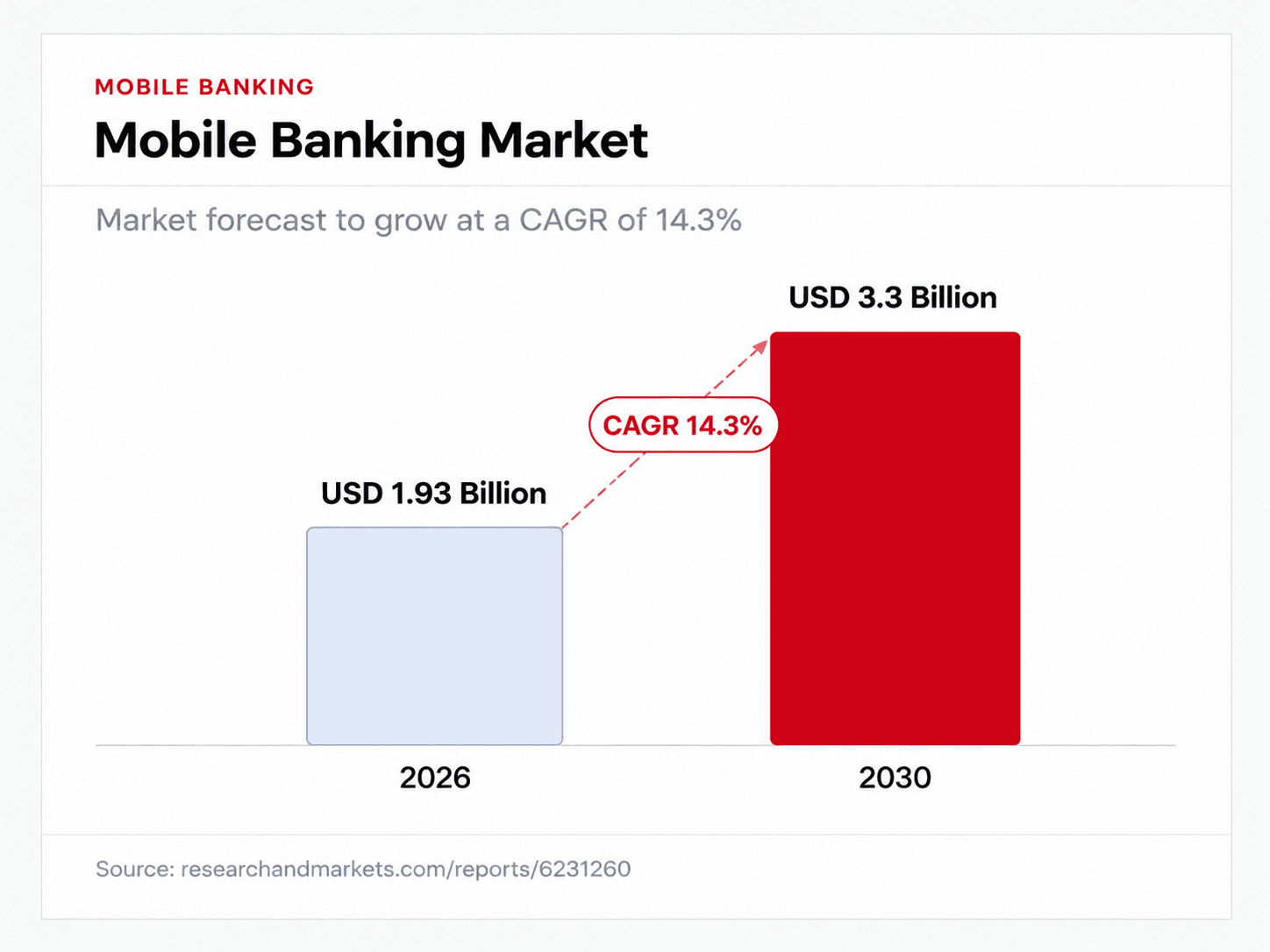
Mobile banking has been considered as one of the preferred banking channel for U.S. consumers, with Statista reporting increasing growth in mobile banking usage through Q3 2025. Source
This widespread adoption has created space for disruption. Digital-only banks like Chime have capitalized on this shift by delivering sleek, real-time, mobile-first banking experiences, free from legacy overhead, physical branches, or outdated product models. Neobanks, a tech-enabled financial platform, appeal to today’s users because they are built for flexibility, transparency, and ease. Younger generations, particularly Gen Z, expect intuitive apps, instant transactions, and financial tools embedded directly into their day-to-day lives.
This blog breaks down how to build a mobile banking app that stands out. From must-have features and UX design to scalable tech stacks and built-in compliance, every step is covered for fintech founders and enterprise leaders alike.
Why Building a Mobile Banking App Is Crucial in Today’s Fintech Market?
It is 8:03 AM, and you are boarding a flight. Just before switching to airplane mode, you pay a bill, check your salary credit, and set a travel spend alert — all in under a minute. No queues. No calls. No desktop.
This is the new baseline in American banking behavior. Mobile has become the primary channel for financial interaction, and the numbers back it up:
- 150+ mobile banking interactions per user per year – McKinsey calls mobile the new banking branch.
- 67M+ app downloads in Q4 2024 alone – the demand isn’t slowing down.
- $600B+ spent annually by banks on tech upgrades – because no one wants to be left behind.
- 65% of adults now complete financial tasks via apps – from tracking credit to sending remittances.
- 92% use digital payments – and over 60% prefer in-app spending.
Traditional institutions are racing to modernize, but digital-first players like Chime are setting a new benchmark. With instant account setup, zero hidden fees, and a user-first design, Chime has redefined what customers expect with fast, intuitive, and mobile-native banking that fits users’ lives.
With an increasing demand in digital-first banking, its success depends on more than launching an app. It requires a product strategy that balances user experience, regulatory compliance, and scalable engineering. GeekyAnts helps fintech startups and financial institutions turn mobile banking ideas into secure, production-ready platforms.
How Does a Mobile Banking App Like Chime Work?
A mobile banking app like Chime operates through a well-orchestrated user journey, blending speed, security, and usability into one seamless financial experience. Here is how the journey unfolds, from the moment users download the app to their everyday banking tasks:
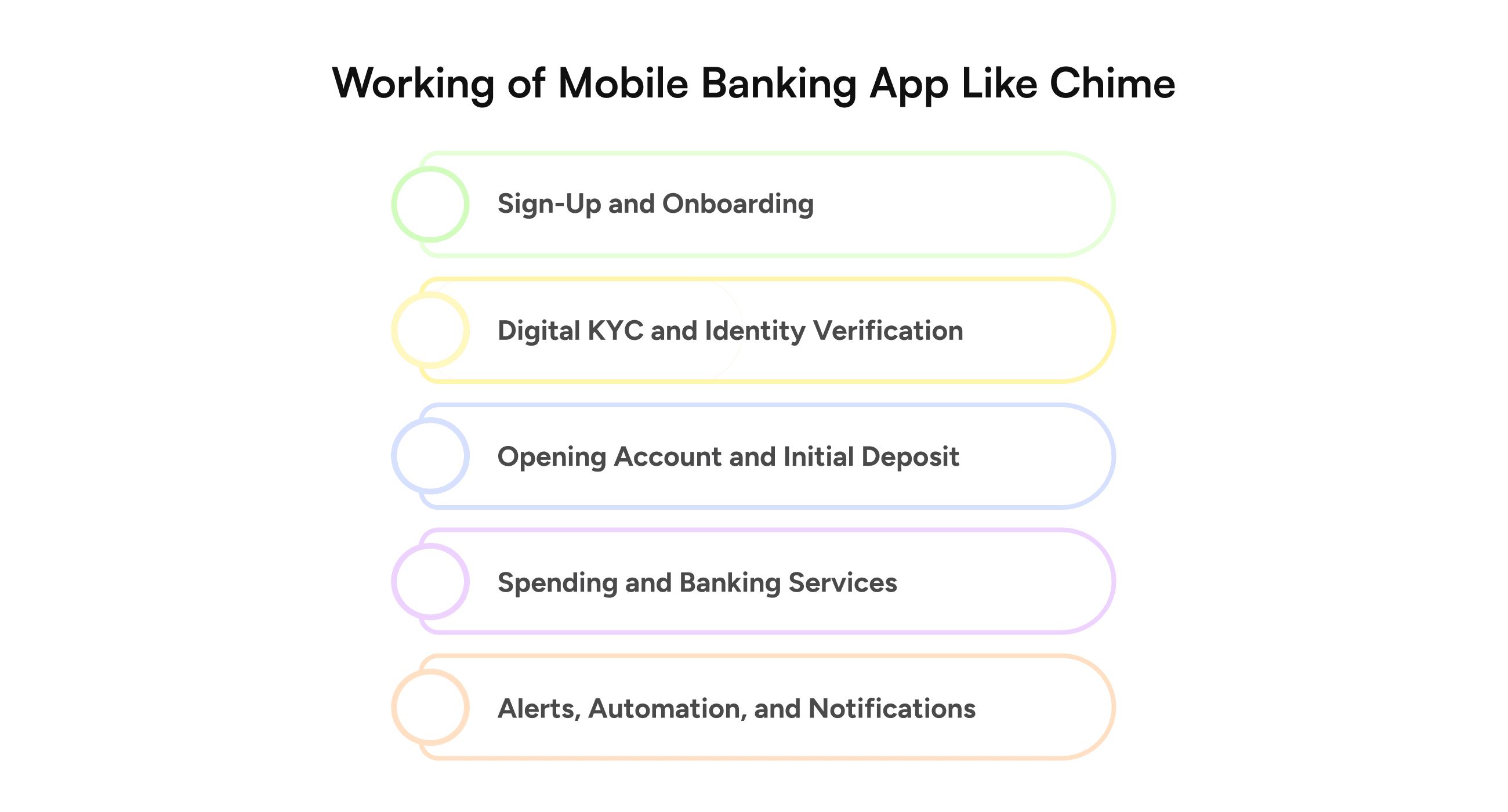
1. Sign-Up and Onboarding
Traditional Banking: Fill out 12 pages of paperwork. Provide three forms of ID. Wait for approval. Schedule another appointment. Hope the system works.
Chime: Download. Type your name and phone number. You're banking.
The onboarding flows like a conversation, not an interrogation. Mobile-first forms that actually fit your phone screen. Tool tips that help instead of confusing. It's banking designed by people who have used other apps in the 21st century.
2. Digital KYC and Identity Verification
After registration, the Know Your Customer (KYC) process that used to take days or weeks now happens in real-time. AI-powered systems handle compliance with AML, GDPR, and banking regulations automatically, turning bureaucratic nightmares into seamless experiences.
Traditional banks kept this process deliberately slow because delays gave them power. Chime made it instant because delays are just obstacles to serving customers.
3. Opening Account and Initial Deposit
Traditional banks treat account opening like they are granting you membership to an exclusive club. Chime treats it like turning on a light switch.
Users can fund their accounts through bank transfers, debit card linking, or direct deposits, all without setting foot in a branch or speaking to a human gatekeeper.
But here is the revolutionary part: Chime allows users to receive their paychecks up to two days early through direct deposit. It's a direct assault on how traditional banking makes money.
4. Spending and Banking Services
Users can now access a full suite of banking tools:
- Real-time balance updates
- Spending insights
- Bill payments
- Peer-to-peer transfers
- Mobile check deposits
- ATM locator for fee-free withdrawals
Chime offers a Visa debit card, fully synced with the app, and allows integration with mobile wallets like Apple Pay or Google Pay for seamless spending.
5. Alerts, Automation, and Notifications
Smart alerts are a major differentiator. Users receive:
- Instant push notifications for every transaction
- Low balance warnings
- Bill due date reminders
- Automated savings triggers (e.g., “Save When You Get Paid”)
This fosters control, transparency, and proactive financial management.
Bonus Capabilities
- Security: Multi-layered, including fingerprint/face ID, OTPs, and auto timeouts.
- Support: In-app live chat, help center, and account management tools.
- Savings Tools: Round-up features, goal setting, and high-yield savings options.
- No Fees: No overdraft or monthly charges, unlike traditional banks.
This linear journey makes banking intuitive and fully mobile. Apps like Chime simplify personal finance through automation, real-time tracking, and smart user experiences. For fintech builders, designing this journey well is the key to user trust and long-term adoption.
Why Consider Building a Mobile Banking App?
In today’s high-stakes fintech landscape, building a mobile banking app is a strategic lever for control, monetization, and defensibility. Here is how forward-thinking founders and financial institutions are gaining the edge:
1. Reduced Long-Term Cost of Ownership
A digital-first platform eliminates the overhead of physical branches and manual back-office workflows. This reduces OPEX while shifting investment toward scalable automation. Institutions that adopt mobile-first operations report 30–40% lower servicing costs per customer compared to branch-led models.
2. End-to-End Control Over Features and Roadmap
Custom apps allow teams to prioritize differentiators such as early direct deposit or AI-driven savings insights. By avoiding vendor lock-ins, companies improve agility while cutting dependency costs. This translates into faster feature delivery cycles and lower per-feature development cost in the long run.
3. Faster GTM Across Fragmented Markets
Mobile-first infrastructure enables quicker compliance rollouts and modular market adaptation. In regulated markets like the U.S., this agility reduces time-to-market by up to 50%, directly lowering CAC since new regions can be entered without heavy infrastructure spend.
4. Monetization Beyond Banking
Modern apps unlock new revenue streams: interchange fees, premium subscriptions, partner APIs, or value-added services such as micro-insurance. Early adopters of these models have achieved 10–15% revenue diversification beyond traditional interest margins, strengthening resilience against rate fluctuations.
5. Deeper Customer Intelligence
Mobile apps provide actionable behavioral data. By analyzing user flows and spending patterns, banks can personalize offers and improve conversion rates. Institutions that leverage predictive insights have reported 20–25% higher LTV per customer, as product adoption deepens over time.
6. Loyalty Through Experience
A frictionless UX becomes a retention moat. Features like proactive budgeting nudges and real-time support build trust and reduce churn. Neobanks that focus on experience-driven retention typically see CAC payback periods shrink by 20–30%, since satisfied users require less re-acquisition spend.
7. Improved Risk and Compliance Posture
Custom builds allow compliance to be embedded at the core rather than bolted on. Automated KYC, AML, and audit-ready workflows reduce regulatory risk and compliance overhead. This often leads to 15–20% lower compliance costs compared to retrofitted legacy platforms.
Building a Mobile Banking App: A Step-by-Step Process
Building a mobile banking app requires a clear strategy, regulatory compliance, secure architecture, and user-focused design. It starts with understanding your market and users, product discovery and architecture planning, and KYC integration and compliance, as every decision impacts scalability and user trust. With expertise in fintech product strategy and engineering, Geekyants helps organizations translate these requirements into building scalable mobile banking apps for long-term growth.
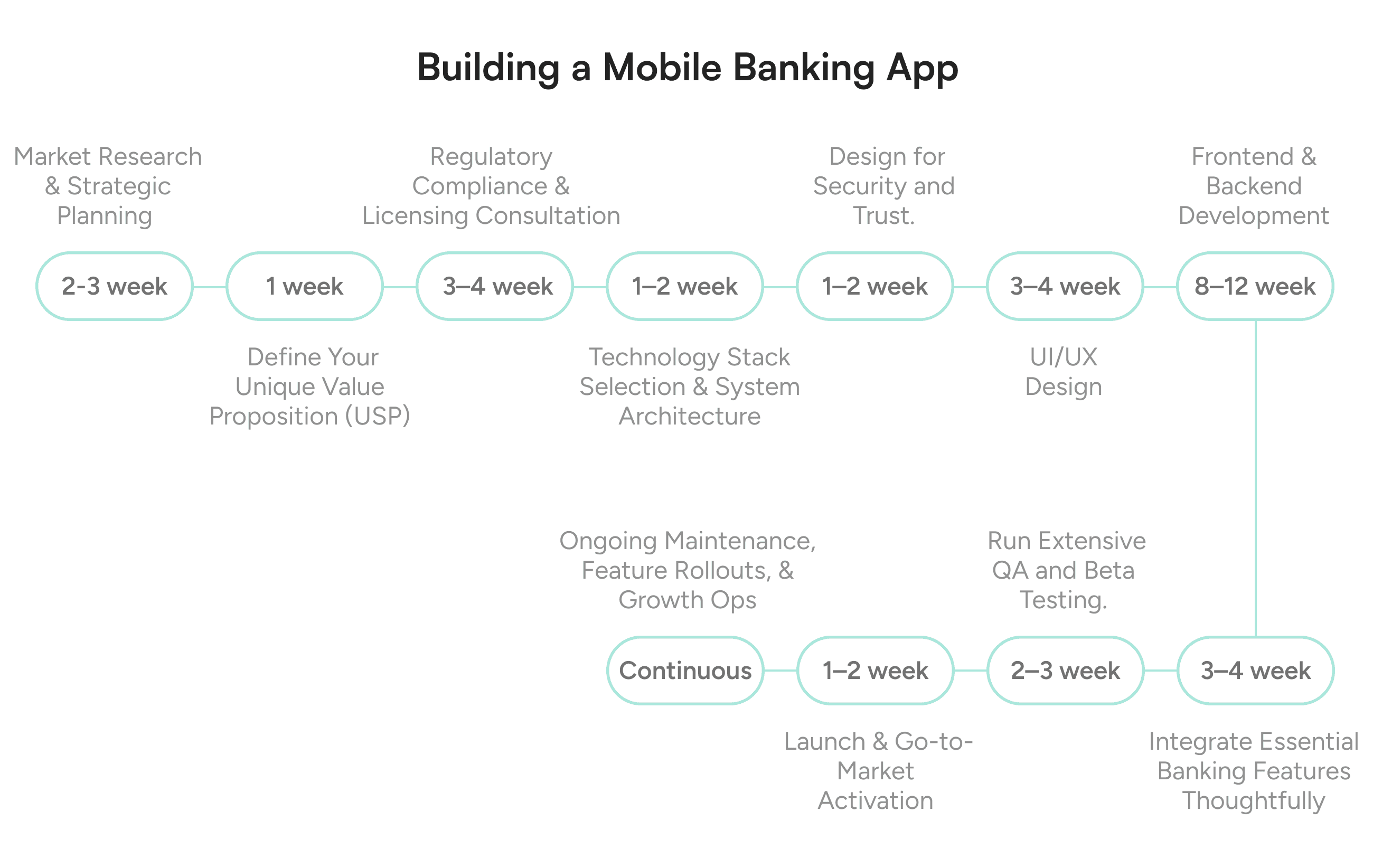
1. Market Research & Strategic Planning
Duration: 2–3 weeks
Analyze user pain points, unmet needs, and competitive gaps. Go beyond
surface-level insights, identify underserved demographics, explore behavioral patterns, and validate hypotheses through interviews and surveys. At this stage, define the app’s vision and build detailed user personas that will anchor both design and product decisions.
2. Define Your Unique Value Proposition (USP)
Duration: 1 week (parallel to research)
In a crowded fintech market, differentiation is key. Whether it is zero-fee accounts, advanced savings automation, or gamified financial literacy, your app must offer something distinct. Your USP should be crystal clear, address a specific user problem, and align with your brand promise.
3. Regulatory Compliance & Licensing Consultation
Duration: 3–4 weeks (initial setup)
From KYC and AML requirements to local/state-specific laws like CCPA and GDPR, regulatory compliance cannot be an afterthought. Work with legal and fintech compliance experts to architect the platform around these obligations. This step is crucial not just for licensing and launch, but also for long-term risk mitigation.
4. Technology Stack Selection & System Architecture
Duration: 1–2 weeks
Your tech stack determines scalability, security, and time to market.
Frontend:
- Swift (iOS), Kotlin (Android), or Flutter / React Native for cross-platform builds
Backend:
Database:
- PostgreSQL or MongoDB (with encrypted fields)
Cloud:
- AWS, GCP, or Azure with containerization (Docker, Kubernetes)
Pro tip: Prioritize data encryption, rate-limiting, and secure API gateways from day one.
5. Design for Security and Trust.
Duration: 1–2 weeks
Security should be woven into the fabric of your application. Implement AES encryption, SSL/TLS protocols, biometric authentication, multi-factor access, and session timeout mechanisms. Build trust with transparency—show users when and why data is accessed or stored.
6. UI/UX Design
Duration: 3–4 weeks
Start with low-fidelity wireframes, progress to interactive prototypes, and finalize high-fidelity mockups for handoff. Focus on mobile-first design, clarity, speed, and ADA compliance. Conduct user testing to validate flows, especially for onboarding, transactions, and account management.
7. Frontend & Backend Development (MVP Build)
Duration: 8–12 weeks
Begin development with a functional MVP covering:
- Onboarding & KYC workflows
- Real-time account access
- Balance & transaction views
- Fund transfers & bill pay
- Card controls & wallet integration
- Push notifications & alerts
The backend must include secure APIs, session handling, admin dashboards, and database design. Third-party integrations (KYC vendors, payment rails, credit scoring APIs) begin here.
8. Integrate Essential Banking Features Thoughtfully
Duration: 3–4 weeks (post-MVP or parallel)
Core functionalities must include real-time account access, peer-to-peer payments, bill pay, and card control. Value-add features like savings automation, in-app chat support, ATM locators, digital wallet integration, and personalized financial insights can be layered in based on user demand and behavioral analytics.
9. Run Extensive QA and Beta Testing
Duration: 2–3 weeks
Conduct usability, security, and load testing before launch. Penetration tests ensure that the app can withstand cyber threats. Launch a private beta with a control group to observe real-world interactions, fix bugs, and refine performance.
10. Launch & Go-to-Market Activation
Duration: 1–2 weeks
Prepare for App Store and Play Store submission. Launch marketing campaigns - SEO, PR, influencer partnerships, fintech media coverage. Incentivize early signups via referrals, waitlist bonuses, or rewards.
11. Ongoing Maintenance, Feature Rollouts, & Growth Ops
Duration: Continuous (Post-launch)
User needs evolve, and so should your app. Monitor engagement metrics, track feature usage, and implement rapid feedback loops. Introduce enhancements based on A/B testing, community feedback, and market trends. Continuously update your security protocols and compliance measures.
Must-Have Features for a Mobile Banking App
Modern banking apps are built for speed, clarity, and control. To stay relevant, every feature from onboarding to alerts must deliver real-time value with zero friction. The list below outlines the essentials that define successful neobanks and digital-first platforms.
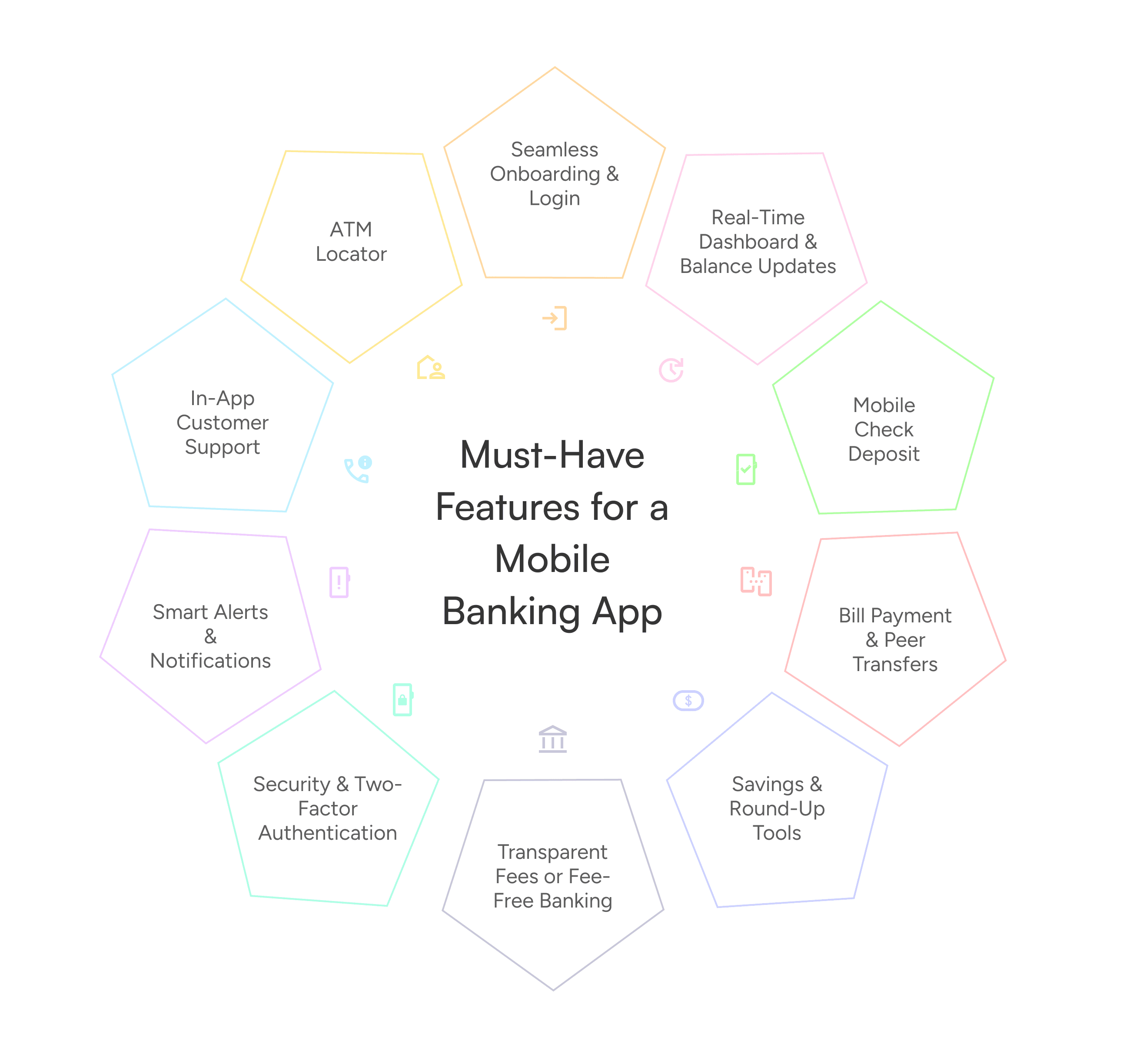
1. Seamless Onboarding & Login
New users should be able to open accounts within minutes using minimal information. The flow should include mobile-first forms, clear progress indicators, and integrated KYC steps. Biometric login (fingerprint or facial recognition), PIN, or password options ensure secure, quick access.
2. Real-Time Dashboard & Balance Updates
The dashboard must present real-time account information clearly and intuitively. Instant balance updates and categorized transaction views give users full visibility into their finances at a glance.
3. Mobile Check Deposit
Allow users to deposit checks by capturing images directly through the app. Fast validation, secure uploads, and clear status notifications for pending and completed deposits build confidence.
4. Bill Payment & Peer Transfers
Enable seamless bill payments and peer-to-peer transfers with support for bank accounts, debit cards, and real-time rails. The interface should let users schedule payments and manage payees with ease.
5. Savings & Round-Up Tools
Integrate automated savings features that round up spare change, enable scheduled transfers, and let users set and track specific goals. These features improve financial discipline and app stickiness.
6. Transparent Fees or Fee-Free Banking
Adopt a transparent fee model—or eliminate hidden charges entirely. Users should be able to view fee policies directly in the app and understand what, if anything, they are paying for.
7. Security & Two-Factor Authentication
Embed strong security protocols, including two-factor authentication, app lock via biometrics, OTPs for sensitive actions, and automatic logouts. All data must be encrypted in transit and at rest.
8. Smart Alerts & Notifications
Offer push notifications for major activities such as salary credits, low balances, spending anomalies, and bill reminders. Users should be able to customize both frequency and type of alerts.
9. In-App Customer Support
Include responsive, built-in support channels such as live chat, contextual help search, and easy service request options. Support should feel embedded into the app journey.
10. ATM Locator
Provide a location-aware ATM finder that helps users locate fee-free ATMs, with filters based on distance, availability, or provider network.
11. Card Management Basics
Users expect direct in-app card control. Freeze or unfreeze cards instantly, reset PINs without calling a service center, and reorder cards—all from within the app.
12. Push-to-Card / Instant Payouts
A must-have for gig workers, freelancers, and contractors. Instant payouts to cards give users immediate access to earnings, positioning the bank as a trusted financial partner for the modern workforce.
Advanced Features
Once core functionality is in place, advanced features allow for deeper engagement and stronger product differentiation.
1. Direct In-App Card Controls
Users expect instant control: freeze or unfreeze cards, set spending limits, reorder cards, or reset PINs directly within the app.
2. Instant Card Replacement Request
A streamlined process for requesting replacement cards reduces friction during card loss or theft, reinforcing trust in the bank’s responsiveness.
3. Virtual Debit and Credit Cards
Instant digital card issuance enables secure online transactions right after account creation. Initially a nice-to-have, it quickly becomes a differentiator for Gen Z and digital-first users.
4. Wallet Integration
Seamless compatibility with Apple Pay, Google Pay, and other wallets ensures smooth, contactless payments.
5. Cashback and Rewards
Dynamic cashback programs and loyalty rewards encourage ongoing engagement and strengthen user loyalty.
6. Multi-Account and Joint Access
Support for multiple linked accounts, including joint viewing, provides flexibility for families and partners.
7. Personalization
Adaptive modules surface relevant insights, savings opportunities, and tailored nudges based on user behavior and intent.
8. UPI or Instant Pay Integration (Region-Specific)
Direct bank-to-bank transfers with minimal fees position the app as a reliable payments hub.
9. Cardless Withdrawals
QR code or one-time PIN withdrawals provide flexibility when physical cards are unavailable.
10. Voice-Activated Commands
Voice-driven balance checks, transfers, and spend reviews enhance convenience and accessibility.
11. Real-Time Fraud Alerts
Instant detection of suspicious activity with immediate alerts empowers users to respond quickly.
12. Crypto Wallet Support
When aligned with business strategy, integrated crypto management, buying, selling, and tracking, expands the app’s appeal.
13. Loan and Credit Line Tools
Users gain better financial control with in-app loan applications, repayment tracking, and credit health insights.
14. Gamified Financial Habits
Savings challenges and rewards transform financial discipline into consistent engagement.
Feature | Category | Differentiator vs Traditional Apps |
|---|---|---|
Seamless Onboarding & Login | Must-Have | Instant KYC, biometric login vs paper-heavy onboarding and branch visits |
Real-Time Dashboard & Balance Updates | Must-Have | Live transaction tracking vs delayed batch updates |
Mobile Check Deposit | Must-Have | Deposit via phone camera vs visiting physical branches |
Bill Payment & Peer Transfers | Must-Have | Real-time peer payments vs manual bank transfers with delays |
Savings & Round-Up Tools | Must-Have | Automated goal-based saving vs manual savings setup |
Transparent Fees or Fee-Free Banking | Must-Have | Clear in-app fee visibility vs hidden charges in statements |
Security & Two-Factor Authentication | Must-Have | Biometrics, OTPs, instant lock vs password-only security |
Smart Alerts & Notifications | Must-Have | Custom push alerts vs SMS/email delays |
In-App Customer Support | Must-Have | Built-in live chat & contextual help vs IVR and long call waits |
ATM Locator | Must-Have | GPS-enabled finder vs static branch/ATM lists |
Card Management Basics (freeze/unfreeze, PIN reset, reissue) | Must-Have | Instant in-app controls vs call center dependency |
Push-to-Card / Instant Payouts | Must-Have | Immediate gig/freelancer payouts vs standard 2–3 day settlements |
Virtual Debit & Credit Cards | Advanced | Instant digital issuance vs waiting for physical card |
Wallet Integration (Apple Pay, Google Pay) | Advanced | Contactless payments vs limited physical card use |
Real-Time Fraud Alerts | Advanced | Instant suspicious activity alerts vs delayed fraud detection |
Voice-Activated Commands | Advanced | Voice-driven financial actions vs manual navigation |
Gamified Financial Habits | Advanced | Engagement-driven savings challenges vs static interest-based saving |
Crypto Wallet Support | Advanced | Buy/sell crypto in-app vs external platforms needed |
Loan & Credit Line Tools | Advanced | Self-serve loan management vs branch-heavy processes |
Cardless Withdrawals | Advanced | QR/OTP withdrawals vs card dependency |
Tech Stack Required to Build a Mobile Banking Application
Creating a secure, scalable, and regulatory-compliant mobile banking app like Chime demands more than just picking tools—it requires a strategic, modular technology architecture that prioritizes performance, user trust, and extensibility. Below is a comprehensive breakdown of the typical tech stack for building such an app, aligned with fintech-grade standards.
Layer | Tools & Frameworks | Purpose / Highlights |
Frontend | React NativeSwift (iOS), Kotlin (Android) | Unified UI, biometric auth, accessibility, native capabilities |
Backend | Node.js + ExpressPython (Django / FastAPI)Go / Java (optional) | Event handling, fraud detection, high-performance services |
Database & Storage | PostgreSQL / MySQLMongoDBRedisS3 / Azure Blob | Secure transaction data, logs, session caching, encrypted KYC storage |
Infrastructure | AWS / Azure / GCPDocker + KubernetesGitHub Actions / Jenkins | Scalable, cloud-native deployments, CI/CD pipelines |
Security | TLS 1.3 / AES-256OAuth 2.0 / OpenID ConnectJWTRASP / ATSCompliance: GDPR, PCI-DSS, CCPA | End-to-end encryption, user auth, runtime protection, regulatory compliance |
Third-Party Integrations | Plaid / YodleeStripe / BraintreeFirebase / Twilio / SendGrid | Banking data, payments, real-time alerts |
Analytics & Monitoring | Mixpanel / Amplitude / FirebasePower BI / LookerELK Stack / Grafana + Loki | User behavior, operations dashboard, diagnostics |
DevOps & Testing | GitHub / BitbucketBrowserStackCloudflare / CloudFront | Version control, cross-device QA, edge CDN & TLS termination |
Choosing the right technology stack is just part of the equation. Building a reliable financial product also requires secure system architecture, third-party integrations, and infrastructure that can scale with user growth. GeekyAnts provides fintech app engineering expertise to deliver banking platforms built for long-term growth.
1. Frontend Development
Your front-end is the first touchpoint for trust. We recommend:
- React Native: Ideal for a unified codebase across iOS/Android. It offers hot reloading, strong community support, and native performance when correctly tuned — great for startups looking to scale fast.
- Swift (iOS) / Kotlin (Android): Choose native when you need low-level OS access (e.g. Face ID, Apple Pay, Secure Enclave) or high-fidelity animations. Better suited for institutions prioritizing performance and precision.
Built-in must-haves:
- Biometric auth (Face ID/fingerprint)
- Real-time balance refresh
- Accessibility-optimized UI components
Use Figma-to-code workflows and design systems to reduce front-end churn across teams.
2. Backend Development
The backend is your bank’s operational brain. It must be auditable, scalable, and built to fail gracefully.
- Node.js + Express: Great for event-driven architectures (alerts, queue processing, P2P workflows). Perfect for rapid iteration.
- Python + Django / FastAPI: Excellent for fraud detection, transaction analytics, and AI-driven user insights.
- Go / Java (optional): Add these when milliseconds matter — e.g., for credit scoring, risk engines, or payment processing microservices.
Best Practices:
- Break into modular services with GraphQL or REST.
- Use circuit breakers and queue-based retries.
- Follow 12-Factor App principles.
3. Database & Storage
- PostgreSQL / MySQL for core banking logic, transaction records, and KYC.
- MongoDB for behavior tracking, in-app settings, and logs.
- Redis as your caching layer — session states, real-time balance previews.
- S3 / Azure Blob for encrypted doc storage (KYC uploads, audit exports).
4. Cloud Infrastructure & Hosting
Your infrastructure needs to be deployment-agnostic but compliance-driven:
- AWS / Azure / GCP: Choose based on data residency, team familiarity, and SLAs.
- Docker + Kubernetes: Decouple services (KYC, alerts, P2P) for isolated scaling.
- CI/CD Pipelines (GitHub Actions / Jenkins): Enforce automated testing, code quality, and audit-friendly deploy workflows.
5. Security Architecture
Trust is the product. You don’t build security later — it’s baked in:
- TLS 1.3 / AES-256 for transport and storage encryption
- OAuth 2.0 + OpenID Connect for authentication flows
- JWTs for stateless access control
- Cloudflare / AWS Shield for WAF and DDoS protection
- Runtime App Self-Protection (RASP) for runtime threat detection
- ATS for iOS and Device Integrity Checks for jailbreak/root detection
Compliance-ready from day zero: GDPR, SOC 2, PCI-DSS, CCPA
6. Third-Party Integrations
- Plaid / Yodlee: Bank account linking + financial data aggregation
- Stripe / Braintree: Card payments and payout workflows
- Firebase / Twilio / SendGrid: Notifications, OTPs, and real-time alerts
Note: Always sandbox integrations and build custom fallback logic. Don’t assume uptime.
7. Analytics & Reporting
- Mixpanel / Amplitude / Firebase: Funnel tracking, churn signals, LTV analytics
- Power BI / Looker / Tableau: Internal ops dashboards
- ELK / Grafana + Loki: Log monitoring, release diagnostics, anomaly tracking.
8. DevOps, Versioning & Device Testing
- GitHub / Bitbucket: PR-based workflows, release approvals, rollback safety
- BrowserStack: Cross-device QA automation
- Cloudflare / CloudFront: Asset caching, edge CDN, TLS termination
Real-World Examples of Successful Mobile Banking Apps
The rise of neobanks like Chime has opened the door for a new generation of mobile banking applications that are redefining how users manage money. These successful examples demonstrate how different platforms cater to distinct user needs through convenience, functionality, and innovation.
1. P2P Payment-Focused Apps
- Venmo
A market leader in peer-to-peer (P2P) payments, Venmo lets users send and receive money instantly with a social twist. Its built-in feed adds a community element to financial interactions. The app also supports crypto investments and offers a Venmo Debit Card for shopping and ATM withdrawals, making it a multifaceted financial tool.
- Zelle
Zelle has become the go-to app for real-time bank-to-bank transfers. It integrates directly with most major U.S. banks and credit unions, enabling seamless and secure money transfers without requiring a separate account. Its widespread adoption across financial institutions ensures convenience and trust.
2. Full-Service Neobanks
- Varo Bank
Varo is one of the first mobile-only banks to receive a national banking charter. It offers users complete control over their finances—from savings and checking accounts to early direct deposits—within a streamlined, user-friendly app. Its minimal fees and intuitive design cater especially well to first-time digital bankers.
- Utoppia
Utoppia focuses on cross-border financial services. It enables international money transfers, global bill payments, and offers interest-bearing wallet balances. The app is ideal for users with global financial needs, combining utility with cost-efficiency and savings incentives.
3. Multi-Utility Finance Apps
- Cash App
Cash App combines the functionality of a neobank, stock brokerage, and crypto wallet. In addition to P2P transfers, users can trade stocks and Bitcoin, receive direct deposits up to two days early, and even file taxes for free. Its all-in-one model appeals to younger users seeking financial empowerment from a single interface.
These platforms thrive by combining seamless digital experiences with specialized features that resonate with target users—whether it’s instant P2P transfers, investing, international payments, or full-scale banking.
How Much Does It Cost to Build a Mobile Banking App Like Chime?
The cost to build a mobile banking app like Chime ranges from $20,000 for a basic MVP to $250,000+ for a full-featured platform. The final cost depends on feature complexity, third-party integrations, compliance needs, design customization, and team location.
Launching with an MVP is a cost-effective way to validate market demand, secure feedback, and accelerate funding rounds. A full-scale release with advanced security, real-time analytics, and multi-gateway integration requires more time and investment.
Mobile Banking App Development Cost by Complexity
Complexity Level | Estimated Cost | Timeline | Key Inclusions |
|---|---|---|---|
Basic MVP | $20,000 – $30,000 | 4–6 weeks | User onboarding, real-time credit check, split payments, push notifications, 1 Payment API, manual KYC, standard encryption |
Mid-Level App | $40,000 – $60,000 | 10–12 weeks | All MVP features + automated KYC/AML, repayment tracking, promo codes, tokenization, scoring engine |
Full-Scale App | $60,000 – $250,000+ | 20–36+ weeks | All above + AI fraud engine, CRM/ERP connectors, multilingual UI, biometric login, PCI DSS/GDPR/ISO compliance, advanced analytics, loyalty wallet |
Most founders budgeting for a compliant and investor-ready release should expect $150,000–$250,000 for design, backend services, integrations, and testing.
Factors That Influence Mobile Banking App Development Costs
Several key factors influence the total cost of developing a mobile banking application:
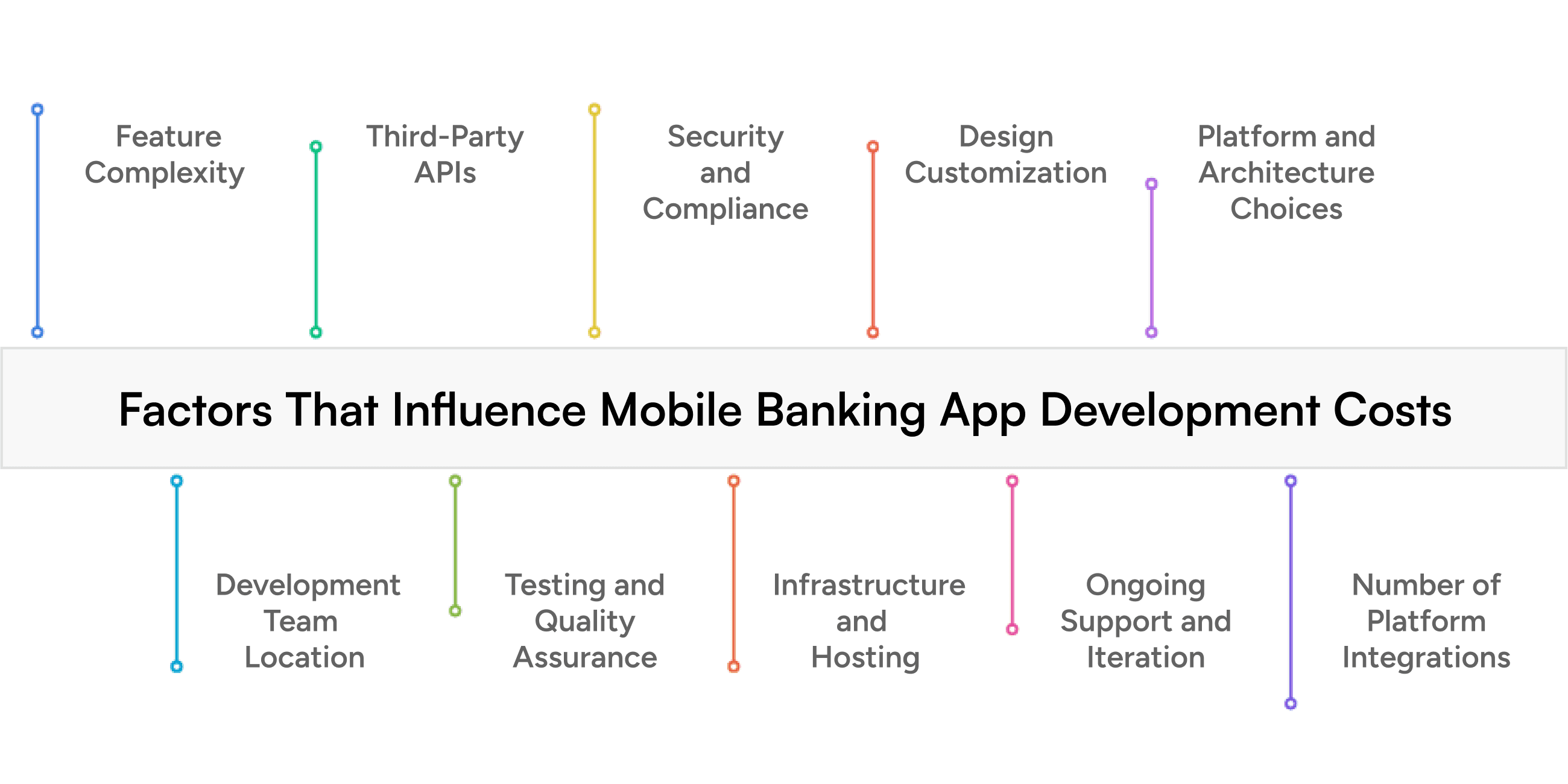
1. Feature Complexity
Core banking tools like transfers and balance checks are inexpensive. AI-powered personal finance tools, gamified savings, or advanced KYC flows (e.g., OCR, selfie + ID match) increase costs significantly.
2. Third-Party APIs
Integrating external services for features like credit score checks or automatic bill payments typically adds to the budget, potentially increasing costs by $5,000 to $15,000, depending on the specific APIs used.
3. Security and Compliance
Banking-grade security, including AES encryption, biometric login, 2FA, real-time fraud detection, and regulatory readiness (PCI DSS, GDPR, CCPA, KYC/AML), adds another $10,000–$20,000.
4. Design Customization
Custom UI/UX built from scratch (rather than templates) typically costs $5,000–$15,000, depending on platform (iOS/Android/cross-platform) and screen count.
5. Platform and Architecture Choices
- Cross-platform tools like Flutter can reduce cost by 30–40%.
- Backend infrastructure, especially if modular and cloud-native (e.g., microservices on AWS/GCP), ensures scalability but adds cost early on.
6. Development Team Location
Average hourly rates:
- Asia: $25–$40/hr
- Eastern Europe: $50–$55/hr
- Western Europe: $80–$90/hr
- US/Canada: $95–$100/hr
7. Testing and Quality Assurance
Expect dedicated time and cost for:
- Functional and security testing,
- Regression testing across devices,
- Load testing,
- Penetration testing,
- Beta feedback implementation.
This phase can account for 15%–20% of the total cost.
8. Infrastructure and Hosting
Cloud infrastructure (AWS, Azure, GCP), CDNs, DevOps, monitoring, and uptime management can cost $10,000–$20,000 monthly post-launch.
9. Ongoing Support and Iteration
Post-launch operations, including maintenance, feature rollouts, bug fixes, and user support, should be budgeted at $25,000/month for a 5-member core team.
10. Number of Platform Integrations
Seamless connections to core banking platforms, payment processors, card issuers, and account data APIs are often required. Each complex integration can add approximately $10,000 to $15,000 to the cost.
It is also important to budget for ongoing costs post-launch, which can be estimated at roughly $25,000 per month for a five-person team to handle maintenance, bug fixes, new releases, customer support, and infrastructure/hosting.
What are the challenges in building a Mobile Banking App, and how to solve them?
Developing a mobile banking app like Chime is as much about navigating regulatory, security, and integration barriers as it is about design and UX. Below are the three biggest challenges and strategic solutions.
1. Regulatory Compliance
Challenge
Fintech apps must adhere to a web of regulatory frameworks—KYC, AML, PCI DSS, GDPR, CCPA, and more. Non-compliance risks include fines, license denials, and reputational loss.
Solution
Embed compliance into the product from Day 1. Use automated KYC/AML engines, encrypted data handling, and real-time audit trails. Maintain alignment with evolving mandates like GDPR, Dodd-Frank, and emerging AI regulations. Appoint a dedicated compliance lead and collaborate with RegTech partners to monitor and adapt to global shifts.
2. Data Security & Fraud Prevention
Challenge
Financial apps are prime targets for breaches, with the average cost of a data breach in financial services exceeding $5.3M. Stolen credentials, phishing, and account takeovers are persistent threats.
Solution
Adopt multi-layered security. Implement AES-256 encryption, TLS protocols, biometric logins, 2FA/MFA, and session timeout features. Build real-time fraud detection using ML-based behavior monitoring. Conduct quarterly pen tests and establish a rapid-response security playbook.
3. BaaS Integration & Legacy Systems
Challenge
Most neobanks depend on BaaS providers or core banking platforms. Legacy systems are not API-native and can delay development, introduce integration errors, or expose new security vulnerabilities.
Solution
Use an API-first middleware layer for abstraction. Build modular microservices that connect to legacy infrastructure without disrupting business logic. Prioritize fintech-friendly BaaS partners with prebuilt KYC, payments, and ledger APIs. Conduct risk audits on third-party dependencies.
Compliances in Mobile Banking App Development
Mobile banking and fintech platforms operate under a dense regulatory framework designed to protect consumers, prevent financial crimes, and ensure systemic integrity. Meeting these standards is foundational to trust and long-term scalability.
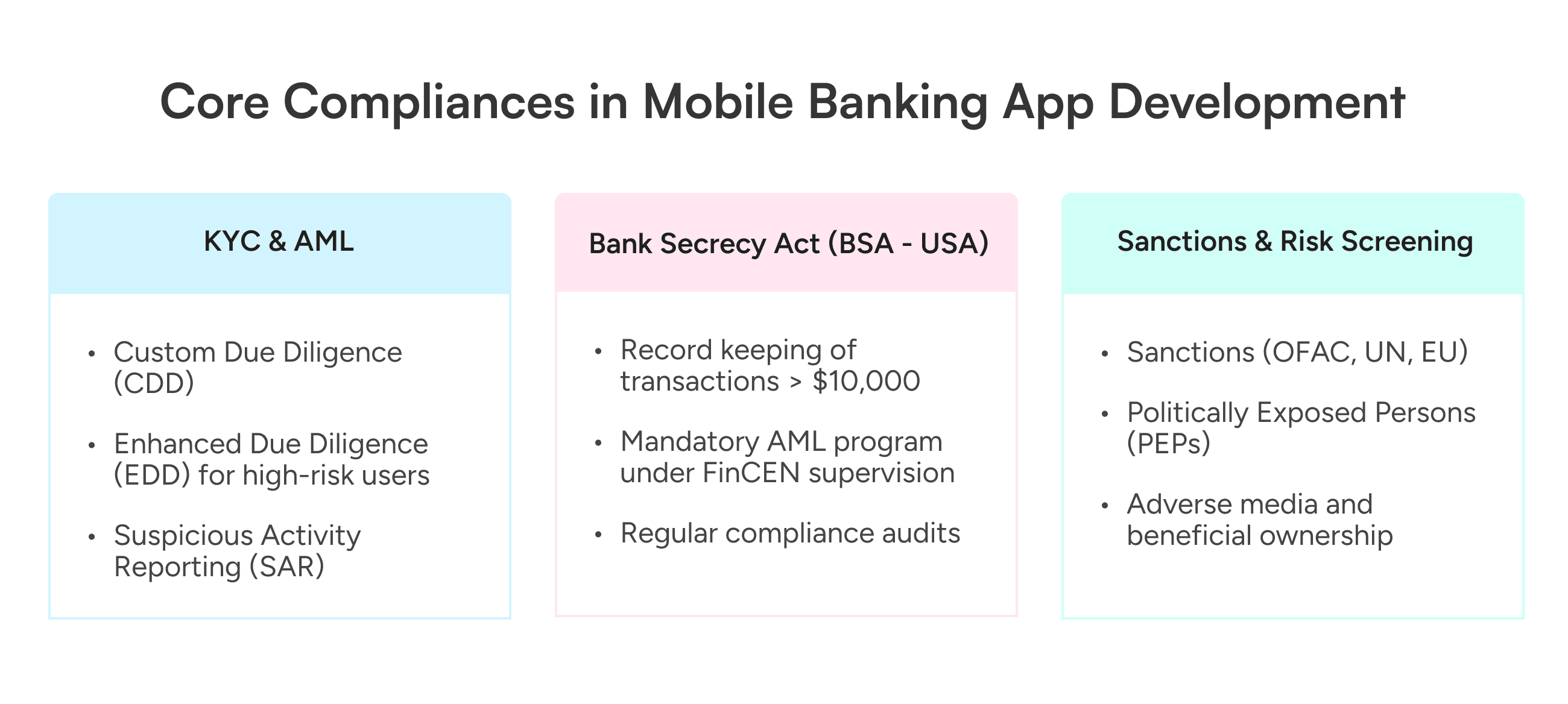
1. KYC & AML
Global financial regulations mandate stringent identity verification (KYC) and transaction monitoring (AML) to combat fraud and illicit finance. Compliance includes:
- Customer Due Diligence (CDD)
- Enhanced Due Diligence (EDD) for High-Risk Users
- Suspicious Activity Reporting (SAR) under FATF and FinCEN (U.S.)
2. Bank Secrecy Act (BSA - USA)
Requires transaction records, reporting of cash purchases over $10,000, and AML adherence under FinCEN oversight.
3. Sanctions & Risk Screening
Ongoing screening for:
- Sanctions (OFAC, UN, EU)
- Politically Exposed Persons (PEPs)
- Adverse Media and Beneficial Ownership (e.g., U.S. Corporate Transparency Act)
4. Data Privacy Compliance
GDPR (EU)
Applies globally to EU users’ data. Enforces consent-based handling, data minimization, breach notification, and Privacy by Design.
CCPA (California)
Mandates transparency, opt-out rights, and data control for California consumers, aligning with GDPR principles.
General Practices
- Encrypted data transmission and storage
- User alerts for sensitive activity
- Clear consent and opt-out mechanisms
5. Payment Security
PCI DSS
Required for any app processing card payments. Key mandates include:
- Data encryption and firewall protection
- Secure system development
- Access restrictions and regular security testing
Licensing & Institutional Regulation
Regional approvals from financial regulators or central banks are essential.
- Dodd-Frank Act (USA): Enforces consumer protections and credit fairness via the CFPB.
Emerging Global Mandates
- AI Regulation: Ensures transparency, explainability, and human oversight of financial AI systems
- MiCA (EU): Regulates crypto assets, custody, and digital wallet providers
- Open Banking & Cross-Border Interoperability: Promotes API standardization and global payment flow
- NIS2 & DORA (EU): Enforce operational resilience and IT risk controls
- ESG Compliance: Increasing focus on ethical finance and sustainability disclosures
Why GeekyAnts for Mobile Banking App Development?
At GeekyAnts, we combine deep fintech expertise with engineering precision and agile execution to deliver mobile banking applications that are secure, scalable, and product-market ready. From building youth banking platforms to empowering global financial transactions and upgrading AI-driven core systems, we help you ship faster, safer, and smarter.
Our team brings full-cycle capability, ideation to deployment, and a track record of transforming complex financial ideas into seamless digital banking products.
Our Strengths in Fintech & Neobank Development
We’ve built successful mobile banking apps across domains, offering:
- Cross-Platform App Development - We build robust apps on iOS and Android using React Native and Flutter. With shared codebases, you get consistent UX, faster go-to-market, and optimized development costs without sacrificing performance.
- MVP-First Agile Approach - We help fintech startups launch investor-ready MVPs in 10–12 weeks. From rapid prototyping to scalable backend foundations, we ensure cost-efficiency with the flexibility to evolve as you grow.
- Security-First Architecture- Our apps are built with AES-256 encryption, OAuth 2.0, JWT, secure APIs, and rigorous audits. Every component is designed to meet KYC, AML, and PCI DSS standards from day one.
- Seamless Integrations - We enable secure connections to payment gateways, KYC providers, third-party APIs, and core banking platforms. Whether it’s real-time UPI, digital wallet sync, or cross-border capabilities- we make it work.
- Custom Dashboards & Wallets - From consumer-facing apps to admin panels, we design modular dashboards and flexible systems. Our interfaces power real-time insights, manage risk, and streamline user support.
- Ongoing Support & AI Innovation - We do not stop at launch. GeekyAnts teams continue to support, optimize, and enhance your banking product. Our AI capabilities (LlamaIndex, GPT, custom chatbots) future-proof your platform with personalization and automation.
Real-World Results of our Fintech Expertise
1. AI-Powered Mobile App Upgrade for Indian Public Sector Bank
We redesigned the mobile banking app to boost performance, security, and flexibility. Key wins included event-driven architecture, voice banking, real-time processing, and dynamic CMS integration using React Native, GoLang, and Spring Boot.
Read Full Case Study
2. Fintech Mobile Web App for Global Payment Processor
For a North American company, we built a cross-border payment platform supporting multi-currency transactions, CRM workflows, and real-time analytics. We used Node.js, PostgreSQL, and AWS ECS to ensure scalability and modularity.
Read Full Case Study
3. Financial Literacy App for Youth
We developed a neobank platform that helps Gen Z manage spending and savings. With intuitive UI, behavioral nudges, and gamified finance education, the app achieved strong retention from early cohorts.
Read Full Case Study
The Future of Banking Is Digital-First
With digital-first platforms like Chime redefining banking, the opportunity for neobank development is massive. However, this space demands more than just tech; it requires regulatory expertise, airtight security, and a relentless focus on user experience. Partnering with a proven fintech development expert ensures faster time-to-market, scalable architecture, and long-term success in a highly competitive, compliance-driven landscape.