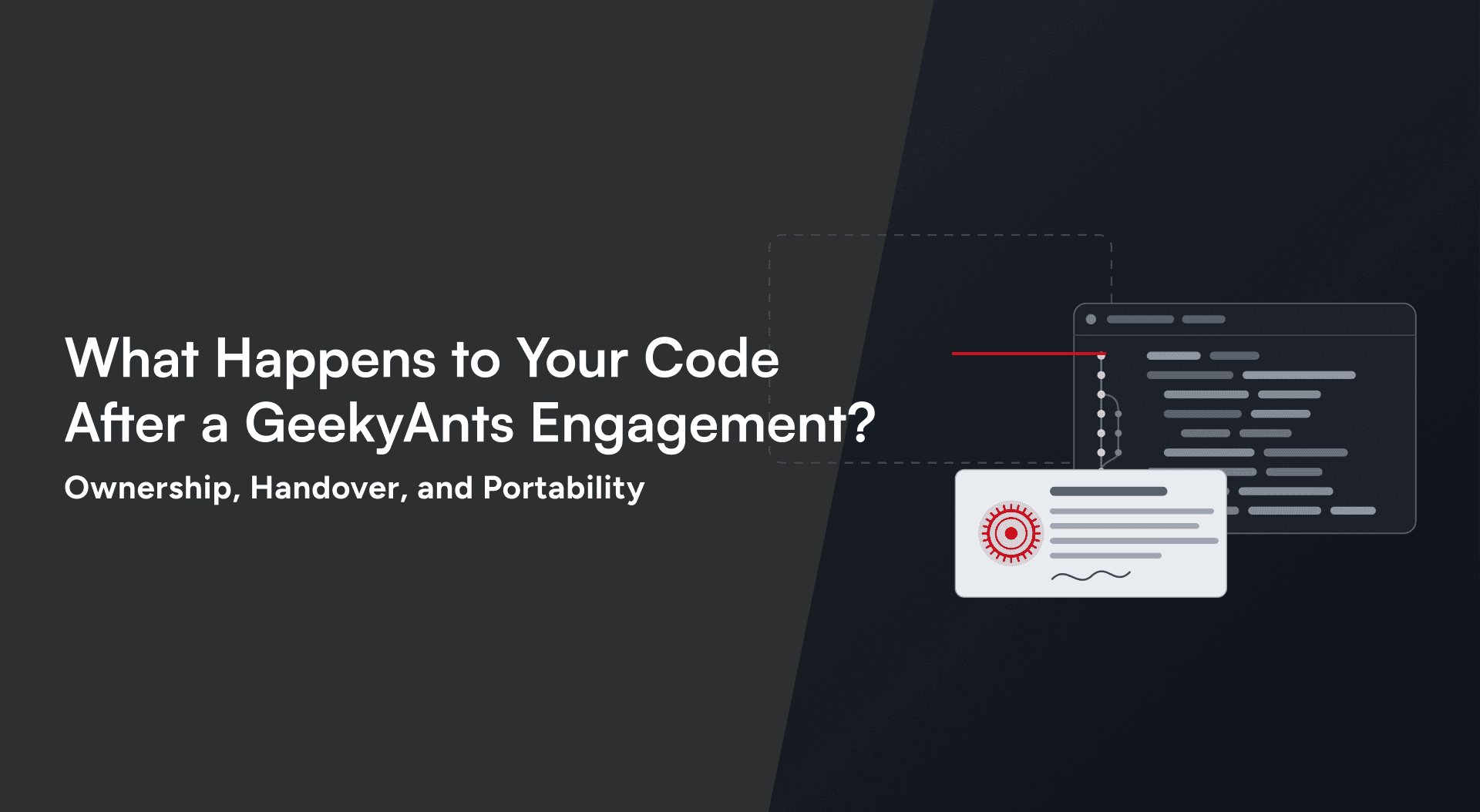


In a GeekyAnts engagement, code and deliverable ownership depends on the agreed engagement terms. Clients receive the source code and relevant project assets as defined in the engagement, while intellectual property, usage rights, reusable components, third-party software, and other ownership conditions are governed by the applicable MSA and SOW.
A software engagement should give clients a clear path to operate, maintain, and transfer the product after delivery. That requires access to the agreed source code, documentation, design assets, credentials, and project knowledge.
Who Owns the Code and Deliverables in a GeekyAnts Engagement?
Legal ownership, code storage, delivery responsibility, and usage rights cover different parts of an engagement. Separating them helps clarify what the client controls during development and after handover.
Legal ownership: The applicable Master Services Agreement (MSA) and Statement of Work (SOW) define intellectual property, ownership rights, and other contractual rights.
Code storage: This refers to where the source code is stored during development. The location of a repository does not determine the legal rights attached to the code.
Delivery responsibility: Within the project team, the Technical Lead takes responsibility for technical deliverables and source code. The Design Lead takes responsibility for design deliverables. These responsibilities concern project delivery rather than legal IP ownership.
Usage rights: The MSA and SOW govern the applicable rights for reusable components, third-party software, open-source dependencies, and other project assets.
The engagement model can affect ownership and responsibility. For Managed engagements, GeekyAnts retains limited ownership where applicable to the engagement. For Unmanaged engagements, ownership and responsibility remain with the client.
Specific usage rights, intellectual property terms, confidentiality, social-media or publication rights, and other engagement-specific contractual matters are governed by the applicable MSA and SOW.
Where Is the Source Code Stored During the Engagement?
The project model determines where the source code is maintained.
For a Fixed-Cost project, GeekyAnts maintains the source code in its GitLab during development. At project completion, the complete source code is transferred to the client.
For Managed T&M and Unmanaged T&M engagements, the source code stays with the client during the engagement.
Code storage and legal ownership remain separate. Keeping a Fixed-Cost codebase in GeekyAnts GitLab during development does not establish the intellectual property rights attached to the deliverables. The applicable MSA and SOW define those rights.
A complete handover covers the agreed materials the client needs to take control of the solution. This can include source code, documentation, design assets, credentials, third-party access, and product knowledge.
What Does the GeekyAnts Handover Include?
The handover process provides the relevant materials required for the client to operate and maintain the solution. The contents depend on the project and agreed scope.
Handover Item | What the Client Receives |
Source code | The complete project source code where transfer applies to the engagement |
Architecture documentation | Documentation covering the architecture of the solution |
Code-level documentation | Technical documentation that supports maintenance of the codebase |
Design files and assets | Relevant design deliverables and associated assets |
Third-party access | Applicable access controls and credentials for third-party systems |
Operational knowledge transfer | Project knowledge required to operate and maintain the solution |
Architecture documentation helps the receiving team understand the system structure and the relationships between its components. Code-level documentation provides context for engineers working with the implementation.
Operational knowledge transfer covers the information required for the client team to take responsibility for the solution. Along with the agreed source code, design assets, documentation, and access, this gives the receiving team the material needed for ongoing operations.
How Does Handover Support Portability and Vendor Independence?
Operational dependency can develop when access, documentation, or product knowledge remains with the original delivery team after an engagement ends.
GeekyAnts addresses this risk through complete documentation and operational knowledge transfer, along with the necessary access and relevant project assets required for ongoing operations. Source-code transfer applies according to the engagement model and agreed terms.
The receiving team can work from the available architecture documentation, code-level documentation, design assets, credentials, source code, and project knowledge without depending on undocumented information held by the delivery team.
Contractual boundaries still apply. Reusable components, third-party software, open-source dependencies, intellectual property, confidentiality, usage rights, and publication rights can carry conditions defined in the MSA or SOW.
Handover expectations should form part of the engagement terms. Both parties should have clarity on where the source code will reside, which assets will transfer, what documentation will be provided, and what the operational knowledge transfer will cover.
Plan Code Ownership and Handover From the Start
Code ownership, intellectual property, code storage, delivery responsibility, and handover address separate parts of a software engagement. Defining these areas at the start gives both parties a clear understanding of their responsibilities and the assets covered by the engagement.
The MSA and SOW establish the contractual terms for intellectual property, ownership, and usage rights. The handover process covers the agreed source code, documentation, design assets, access, credentials, and operational knowledge required by the client.
Organizations considering a development partnership can explore how GeekyAnts works to understand the engagement process from project planning and contracting through development and handover.