
AI is revolutionizing app development and is gaining traction. The range of AI models transforming app development in the UK is vast. With businesses across industries striving to deliver more intelligent, personalized, and efficient digital experiences, integrating AI into mobile applications has become a game-changer. From chatbots and virtual assistants to predictive analytics and computer vision, businesses in the UK have the opportunity to push the boundaries of what's possible in mobile experiences and create cutting-edge apps that adapt, learn, and optimize themselves using AI.
Most commonly adopted AI are used in data management and analysis, natural language processing, and generating computer vision and image processing.
As AI has become increasingly integrated into our lives, it has impacted us in a variety of ways. So let us unpack how companies in the UK are integrating AI in making decisions related to usage of AI and their current usage.
UK Reposts on Adoption to AI— By Statista
- By 2024, the artificial intelligence industry is expected to grow to a size of US$6.03 billion.
- In terms of value, the US market will be the largest worldwide, with US$50.16 billion in 2024.
- It is projected that the market will develop at a rate of 28.30% per year (CAGR 2024–2030) and reach a value of US$26.89 billion by 2030.

Understanding the Role of AI in App Development in the UK
The AI Models Currently in Use
Understanding the fabric of AI localism/globalism requires a working understanding of how AI models use and interpret data.
- Generative AI models utilise existing information and examples to create new, relevant information. An example would be chatbots or virtual assistants that use vast text-based datasets to provide real-time customer support, answer queries, and assist users with tasks.
- Discriminative AI models can classify different objects by identifying patterns in a given data. Mobile apps often use discriminative AI for image recognition tasks, such as identifying objects, people, or scenes in photos. This is commonly found in camera apps, social media platforms, and augmented reality applications.
Interpreting Data
AI understands data by gathering and organising information. It then extracts relevant features and trains models, such as machine learning algorithms or neural networks. These models recognise patterns, enabling predictions or classifications on new data. The interpretative process involves learning from examples, making predictions, and, in some cases, employing reinforcement learning for trial-and-error-based improvement. AI's current capabilities include natural language processing for text, computer vision for images, and speech recognition for auditory data.
Where Does AI Fill in the Gaps?
The scope and capabilities of AI extend to automating or augmenting routine tasks or performing tasks that humans are not capable of doing. Across industries, companies are leveraging this power to reimagine how their business operates.
For example, in healthcare, AI is being used to create customised healthcare plans, while remote health monitoring promotes preventive care and reduced hospitalisations. AI chip and edge computing advancements are fostering more efficient AI processing. Integration of AI with technologies like blockchain and the Internet of Things (IoT) is anticipated to fuel ongoing innovation and growth in the AI industry.
The following table provides a comprehensive breakdown of how different industries are making use of AI models in developing applications.
Industry | Generative AI Applications | Discriminative AI Applications |
|---|---|---|
Strategic Planning | Scenario generation for strategic decision-making | Data analysis and pattern recognition for market trends and competitive intelligence |
R&D | Idea generation and concept creation | Predictive modelling for research outcomes and data analysis |
Product Design | Creativity support in design iterations | Image recognition for identifying design elements and user preferences |
Supply Chain | Predictive demand forecasting and optimisation | Object recognition for inventory management and quality control |
Operations | Dynamic process optimisation and automation | Anomaly detection for operational issues and efficiency improvement |
Finance | Financial modelling and risk analysis | Fraud detection, credit scoring, and anomaly detection in transactions |
HR | Automated resume screening and candidate matching | Sentiment analysis for employee feedback and performance evaluation |
IT | Code generation and automated testing | Anomaly detection for cybersecurity and system monitoring |
Legal | Contract drafting and legal document generation | Legal research assistance and contract review using natural language processing |
Marketing & Sales | Content generation for marketing campaigns | Customer segmentation, sentiment analysis, and lead scoring |
Customer Service | Chatbots for customer support and query resolution | Voice recognition for call center interactions and sentiment analysis |
Unlocking the Impact of AI in App Development in the UK
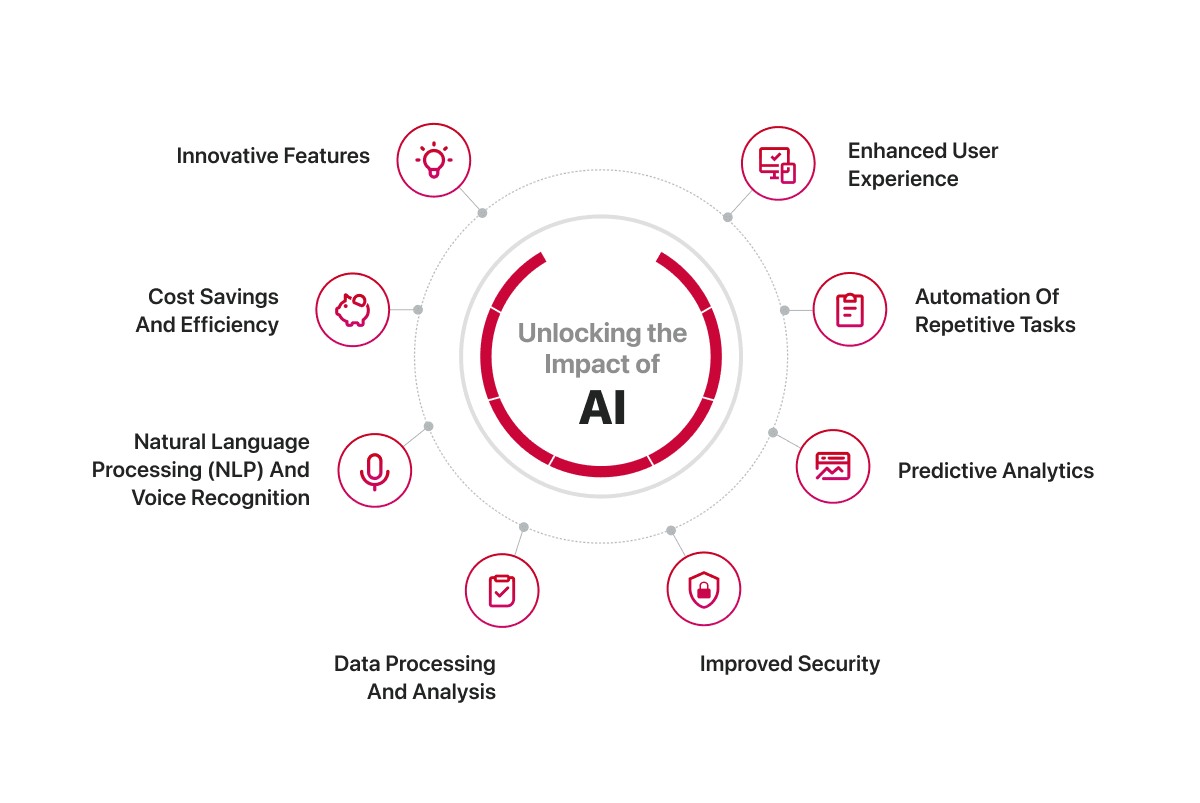
The integration of Artificial Intelligence (AI) in app development has a significant impact on various aspects of the development process as well as the functionality and user experience of the resulting applications.
1. Enhanced User Experience
AI-driven user experiences extend beyond personalisation. Machine learning models can analyse user interactions in real-time, allowing apps to dynamically adjust interfaces, content layouts, and features to optimise user engagement. This adaptability enhances user satisfaction by providing a more fluid and context-aware experience.
2. Automation of Repetitive Tasks
Automation in AI extends to the entire development lifecycle. Beyond code generation and testing, machine learning models can assist in project management, workflow optimisation, and even in the generation of documentation. This comprehensive automation allows developers to focus on higher-level tasks, fostering creativity and innovation.
3. Predictive Analytics
Predictive analytics powered by AI does not only focus on user behaviour but extends to predicting market trends, identifying potential challenges, and suggesting strategies for app improvement. This proactive approach based on data analysis contributes to strategic decision-making and long-term planning.
4. Improved Security
AI enhances security through continuous monitoring and adaptive threat detection. Machine learning algorithms can evolve to recognise new attack patterns and vulnerabilities, providing a more robust defence against emerging cyber threats. Real-time response mechanisms, backed by AI, contribute to a more resilient security posture.
5. Data Processing and Analysis
AI's role in data processing extends to complex data types, such as unstructured data from social media or user-generated content. By employing natural language processing and machine learning algorithms, apps can extract valuable insights from diverse data sources, contributing to a deeper understanding of user sentiment and market dynamics.
6. Natural Language Processing (NLP) and Voice Recognition
Natural language processing goes beyond simple understanding to involve sentiment analysis, context comprehension, and language generation. This sophistication enables the creation of chatbots capable of engaging in more natural and contextually relevant conversations. Additionally, voice recognition technologies are evolving to understand accents, languages, and even emotions, broadening accessibility.
7. Cost Savings and Efficiency
AI's impact on cost savings is not only limited to development processes but extends to resource allocation and infrastructure optimisation. Machine learning algorithms can analyze resource usage patterns, identifying areas for optimisation and cost reduction, leading to more efficient operations.
6. Innovative Features
AI contributes to the development of advanced features like generative models for content creation, recommendation systems that adapt in real-time, and the integration of AI-driven virtual assistants that learn and evolve based on user interactions. These features redefine user expectations and contribute to the overall innovation landscape in app development.
How to Integrate AI and ML in Mobile Applications?
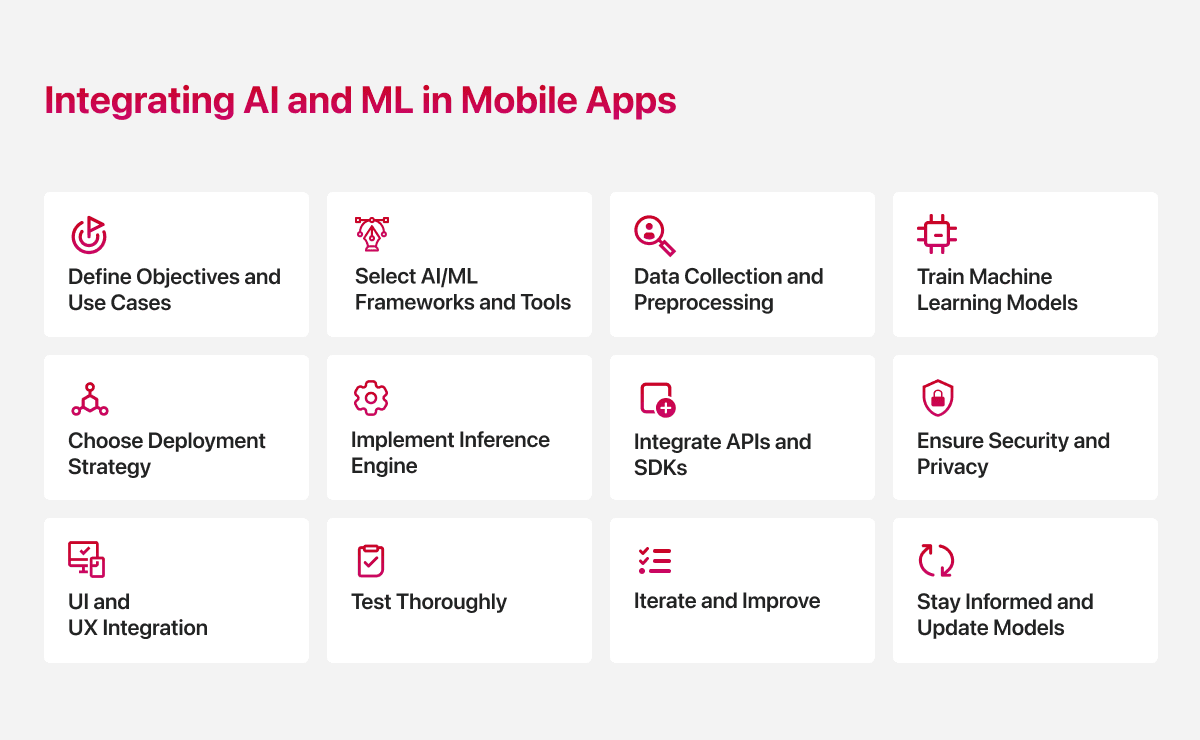
Companies should select between building AI models in-house, fine-tune existing models, or opting for strategic partnerships.
- Building Proprietary Models: Involves creating custom AI models tailored to the specific needs and objectives of the application. This process includes tasks such as defining objectives, selecting frameworks, collecting and preprocessing data, training models, and implementing custom solutions.
- Buying and Fine-Tuning Existing Models: Entails acquiring pre-existing AI models or solutions and fine-tuning them to suit the application's requirements. This approach can save time and resources compared to building models from scratch. Fine-tuning involves adjusting the pre-trained models based on specific data or use cases.
- Strategic Partnerships: Involves collaborating with external AI/ML platforms or service providers through strategic partnerships. This often includes integrating APIs and SDKs from established AI platforms, leveraging their existing models and capabilities. This approach enables applications to benefit from external expertise and resources.
For companies looking to build proprietary models or pursue strategic partnerships, the following is a general guide on how to approach the integration of AI and ML into mobile app development:
1. Define Objectives and Use Cases
This step involves clearly defining the objectives and use cases for integrating AI/ML into the mobile app. Identifying specific problems or areas where AI can enhance user experience, optimise processes, or provide valuable insights is essential.
2. Choose the Right AI/ML Frameworks and Tools
Select suitable AI/ML frameworks and tools based on your project requirements and the expertise of your development team. Popular frameworks include TensorFlow, PyTorch, and scikit-learn for machine learning, and tools like Dialogflow or Wit.ai for natural language processing.
3. Data Collection and Preprocessing
Gather relevant and representative data for training your machine learning models. Ensure that the data is clean, labeled, and appropriately preprocessed. The quality of your data significantly influences the performance of your AI models.
4. Train Machine Learning Models
Use the collected data to train your machine-learning models. Depending on the use case, this might involve supervised learning, unsupervised learning, or reinforcement learning. Regularly evaluate and refine your models to improve accuracy.
5. Choose a Deployment Strategy
Decide whether to deploy your models locally on the mobile device or use a cloud-based approach. On-device deployment is suitable for applications requiring real-time processing, while cloud-based solutions leverage the power of cloud infrastructure.
6. Implement Inference Engine
Develop the inference engine that runs on the mobile device or communicates with the cloud server to make predictions based on the trained models. Optimise the inference process for efficiency, especially in resource-constrained environments.
7. Integrate APIs and SDKs
If you are using pre-trained models or cloud-based services, integrate relevant APIs and SDKs provided by AI/ML platforms. This simplifies the integration process and allows you to leverage existing AI capabilities.
8. Ensure Security and Privacy
Implement security measures to protect sensitive user data, especially if your app deals with personal information. Ensure compliance with privacy regulations and standards. If using cloud services, make sure data transmission is encrypted.
9. User Interface (UI) and User Experience (UX) Integration
Design an intuitive and user-friendly interface that seamlessly integrates AI features. Communicate AI-driven insights or actions clearly to users. Consider how AI enhancements fit within the overall user experience.
10. Test Thoroughly
Conduct comprehensive testing of your AI/ML integration. Test for accuracy, reliability, and performance in different scenarios. Pay attention to edge cases and ensure that the AI features enhance, rather than hinder, the user experience.
11. Iterate and Improve
Monitor the performance of your AI models post-launch. Collect user feedback and use analytics to understand how users interact with the AI features. Iterate and improve your models based on real-world usage.
12. Stay Informed and Update Models
Keep abreast of advancements in AI/ML technology. Periodically update your models to incorporate new data, improve accuracy, and adapt to changing user behaviours or industry trends.
How Much Does it Cost to Develop an AI-powered App in the UK?
AI App Complexity | Development Time (Hours) | Estimated Cost (£) | Examples |
|---|---|---|---|
Basic | 300-500 | £15,000 - £40,000 | Simple chatbots, Basic recommendation engines |
Intermediate | 500-800 | £25,000 - £80,000 | Personalised content recommendation apps, Facial recognition in apps |
Advanced | 800+ | £40,000 - £100,000 or more | Natural language processing-based virtual assistants, Complex healthcare diagnosis apps |
Some Real-world Examples of Apps Using AI Technology
For companies, AI-driven disruptions are no longer an ambiguous concept but a hard reality. In such circumstances, staying ahead of the curve would mean incorporating AI technology into business processes. From developing novelty products to gaining loyal customers, early AI implementation is not without benefits for businesses.
Progressive enterprises are leveraging AI to drive inventive customer products and experiences across various sectors. A notable example is JPMorgan in financial services, where they are crafting an AI model to assist customers in choosing investments customised to their unique circumstances and preferences. Meanwhile, in the realm of sports, the NBA stands out with its array of AI initiatives, introducing innovations like personalised highlight reels that transform the basketball fan experience.
Some other companies making use of AI are listed below.
Netflix
The streaming platform adjusts content recommendations and user interfaces in real-time based on viewing habits and preferences.
Jira by Atlassian
A project management tool that automates task assignment, workflow processes, and offers integrations for comprehensive project automation.
Google Assistant
A virtual assistant that utilizes NLP and voice recognition for natural language understanding and voice-activated commands.
AWS Cost Explorer
An app within Amazon Web Services that uses machine learning to analyze resource usage, identify cost-saving opportunities, and optimize infrastructure efficiency.
Spotify
The music streaming app employs recommendation algorithms that adapt in real-time based on user listening habits and preferences.
How GeekyAnts Can Help in Building AI-enabled Mobile Apps in the UK
With GeekyAnts you can move forward in the ever-changing tech world by leveraging AI in the most efficient and effective way. (Business Standard)
GeekyAnts is leveraging AI technologies to provide futuristic solutions for a range of business requirements. We are set to play a pivotal role in revolutionizing your company’s AI powered digital transformation with a wide range of AI app development techniques and solutions.
- Enhancing Customer Service: We offer AI-powered chatbots and support solutions that offer real-time, round-the-clock customer care, enhancing the quality and responsiveness of the services.
- Supercharging Product Growth and Evolution: Assisting the implementation of AI for product development using predictive analysis, we provide user-focused solutions that improve functionality and increase market relevance.
- Accelerating Development Processes: We offer AI that simplifies every stage of the development process, from conception to delivery, resulting in a quicker, more effective project completion while providing an outstanding value to clients.
- Automating Routine Processes: With the expertise to assist you with AI that increases productivity, we help you automate repetitive work freeing up human resources for strategic and creative projects.
- Enhanced Decision Making: We provide AI-driven data analysis with actionable insights, enabling more informed, strategic business decisions.
- Optimizing Operational Efficiency: Our AI solutions find and fix operational inefficiencies, which dramatically lowers expenses and improves output.
- AI-Driven Enterprise Modernization: Our AI-powered automation shortens development times by accelerating design to development processes and improving productivity and product quality.
- AI-Driven Design Optimization: By using AI to transform design processes and produce data-driven, user-centric interfaces, we guarantee engaging, simple-to-use user experiences that are in line with current market trends.
Checkout Some Cool AI Experiments by Our Geeks at GeekyAnts ⬇️
🔍A working AI IVR Bot demo:
🔍Our VisionOS experiment:
🔍Use your hand as a virtual mouse, like Tony Stark:
Summing Up
The creation and use of mobile apps are being revolutionised by the incorporation of AI. With the use of powerful AI models, such as discriminative AI for pattern recognition and generative AI for content creation, businesses can create highly customised, intelligent apps that instantly adapt to the preferences and user behaviour. AI enhances each step of the app development process, from delivering predictive insights to automating tedious operations and helping with strategic decision-making. We may anticipate even more cutting-edge app features and improved user experiences in the future as AI capabilities continue to advance.
For companies looking to harness the transformative potential of AI, partnering with experienced AI development teams like GeekyAnts can be invaluable. We have the proficiency in developing AI-enabled mobile applications, putting advanced AI solutions into practice, and using the newest AI frameworks and technologies may quicken your digital transformation process. You may obtain a competitive edge, increase operational efficiency, and provide outstanding client experiences by incorporating AI into your goods and operations with ease.