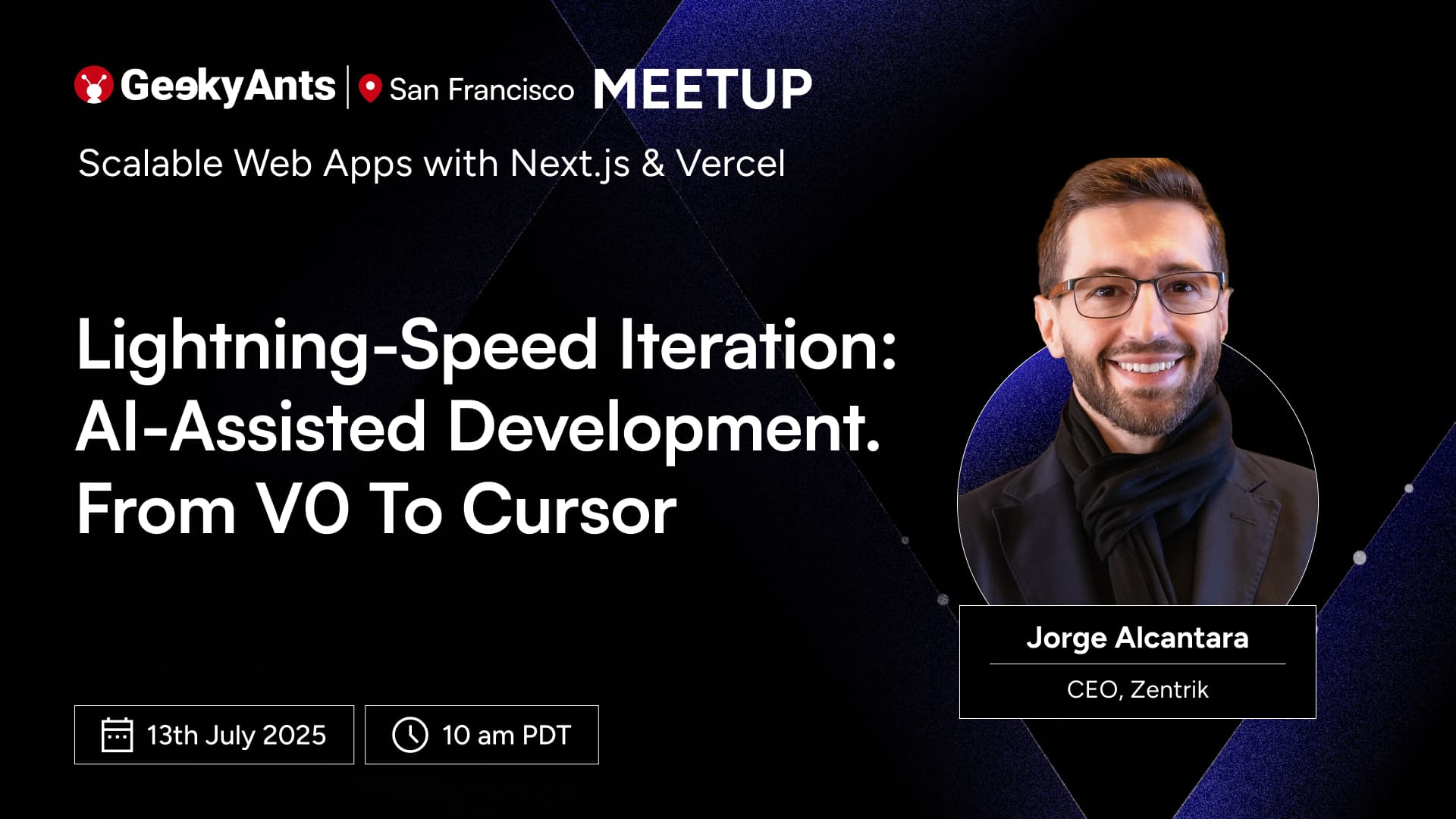

Editor’s Note: This blog is adapted from a talk by George Alcantara at the Next.js US Meetup. As the founder of Zentrik and an AI solutions expert, George explored how natural language is emerging as the new programming paradigm. His session unpacked how tools like Centric, V0, and Cursor can transform workflows—bridging planning, prototyping, and deployment—and why this shift signals a new era of collaboration between developers, designers, and product teams.
Hi, I am George Alcantara, Founder and CEO of Zentrik, where we help software teams deliver products that truly make an impact. For over eleven years, I have been building enterprise AI solutions across the globe from Silicon Valley, focusing on making development smarter, faster, and more collaborative. Before Zentrik, I worked deeply in semantic search systems, and today, alongside running the company, I also teach at universities because I believe education is the bridge to the next era of technology.
This moment we are living through is unlike anything I have seen before. I want to share why I believe that—and more importantly, what I have learned about AI-assisted development, the tools I use every day, and why I think this changes everything for builders.
The Future of Development Is AI-Assisted
We have experienced many technological shifts—desktop to mobile, on-premise to the cloud—but this one feels bigger. Why? Because for the first time in history, the main programming language is not JavaScript, Python, or Go. It is a natural language. If you can describe what you want, you can build it. And that changes everything.
When programming becomes conversational, the old silos break down. Developers, designers, and product managers are no longer on separate islands. They can now collaborate in ways we never imagined. If you are an engineer, this is your opportunity to bring people into the process instead of gatekeeping. If you are a designer or a product manager, you can go beyond static mockups—you can create working prototypes yourself. And if you are a non-technical founder, the barriers to validating an idea have never been lower.
This is not about replacing developers. It is about freeing them from repetitive tasks, so they can focus on architecture, quality, and innovation. It is about making product cycles faster and making collaboration richer. That is the reason I am passionate about AI-assisted development.
The Collaboration Revolution
Before we dive into the tools, let us acknowledge what is happening: roles are shifting. Developers are no longer the sole gatekeepers of what gets built. Designers can now move past wireframes and turn concepts into functional UI. Product managers can take initiative without waiting for full development cycles. This is not just a technical revolution—it is cultural. Teams that learn to embrace this new dynamic will outpace those that do not.
And to my fellow engineers, I say this: do not resist this change. Embrace it. Pull others in early. Use AI to give yourself leverage. The most valuable engineers of tomorrow will not be the ones who write the most code; they will be the ones who orchestrate the smartest workflows.
The AI Tool Landscape
Now, let us talk tools, because this is where things get exciting. Over the past year, I have tried almost everything out there, and I like to group the ecosystem into three categories:
First, there are web-based builders like V0, Lovable, and Bolt. These are perfect for getting started quickly. You type a prompt, and within minutes, you have a working interface running on Next.js with a serverless backend. They are incredible for rapid prototypes. Do they have limitations? Absolutely—especially around backend integrations—but as a starting point, nothing comes close.
Second, we have AI-native IDEs like Cursor and Windsurf. These bring AI directly into your coding experience. This is where the real magic happens because you stay in control while still benefiting from intelligent suggestions, auto-generated code, and natural language commands.
Finally, there are CLI-based tools like Claude Code. These are for advanced users who want raw power and maximum flexibility. They come with a steep learning curve, but they can automate entire workflows if you know how to use them.
Every category has strengths and weaknesses. The secret is not picking one—it is learning how to combine them into a seamless workflow.
My Workflow: From Centric to Cursor
When I start a new build, I begin with clarity. AI cannot rescue you from poor planning. Context matters. That is why I use Centric, our AI-powered planning tool, to break ideas into structured user stories, initiatives, and engineering tasks. This keeps everyone aligned and gives AI the context it needs to generate meaningful results.
Once the plan is solid, I move to V0. This is where things get fun. In minutes, I can generate a functional prototype and deploy it on Vercel—no server configuration, no DevOps headaches. V0 even integrates with GitHub and pulls from Figma, which is a huge win for designers and developers working together.
After the prototype is ready, I sync it to GitHub and pull it into Cursor. This step is critical because V0 alone will not get you to production. Cursor gives me the best of both worlds: a fast, AI-assisted start plus full control over the code. Here, I refine the architecture, add custom logic, and handle complex backend integrations that web builders cannot. I can ask Cursor to write tests, refactor functions, or explain an implementation—all in natural language.
Finally, I deploy on Vercel, which makes the entire process seamless. Preview URLs for every branch mean stakeholders can review updates instantly. Feedback cycles that used to take a week now happen in a day. That is the speed competitive teams need.
One of my favourite examples of this in action is ByCodex, an open-source project where I share guides and workflows for AI-assisted development. Everything in ByCodex started the same way: Centric for planning, V0 for rapid prototyping, and Cursor for refinement. If you want to see what this looks like in practice, ByCodex is a great place to start.
What I Learned Along the Way
AI-assisted development is powerful, but it is not magic. You still need good habits. There are real limitations:
Web-based builders often lack deep backend integrations. Two-way sync between design and code is still not seamless. Branch management becomes messy if you mix AI-driven and manual edits without discipline.
But these challenges are solvable. Here is what works for me: keep your project context organised. Break large problems into smaller, testable steps. Review every line of AI-generated code before merging it. And most importantly, embrace what I call BI Collaboration—Build and Iterate. Treat AI like a teammate, not an oracle. Pair program with it. Guide it. Learn from it.
The Future: Why This Changes Everything
This is bigger than shipping features faster. It is about reducing the distance between an idea and its impact. With tools like Centric, V0, and Cursor, I have seen projects go from concept to production in hours instead of weeks. That is not hype—it is reality.
But this is not just about tools. It is about mindset. Organisations that adopt this approach will unlock speed and creativity that traditional workflows cannot match. Those who cling to old ways will fall behind.
If you take one thing from this, let it be this: AI is not coming for your job. It is coming for your friction. Use it to build better, collaborate smarter, and move faster.
If you want to dive deeper or share your experience, feel free to connect. The future of software is AI-assisted, and it is happening right now. The question is: will you lead the change, or follow it?