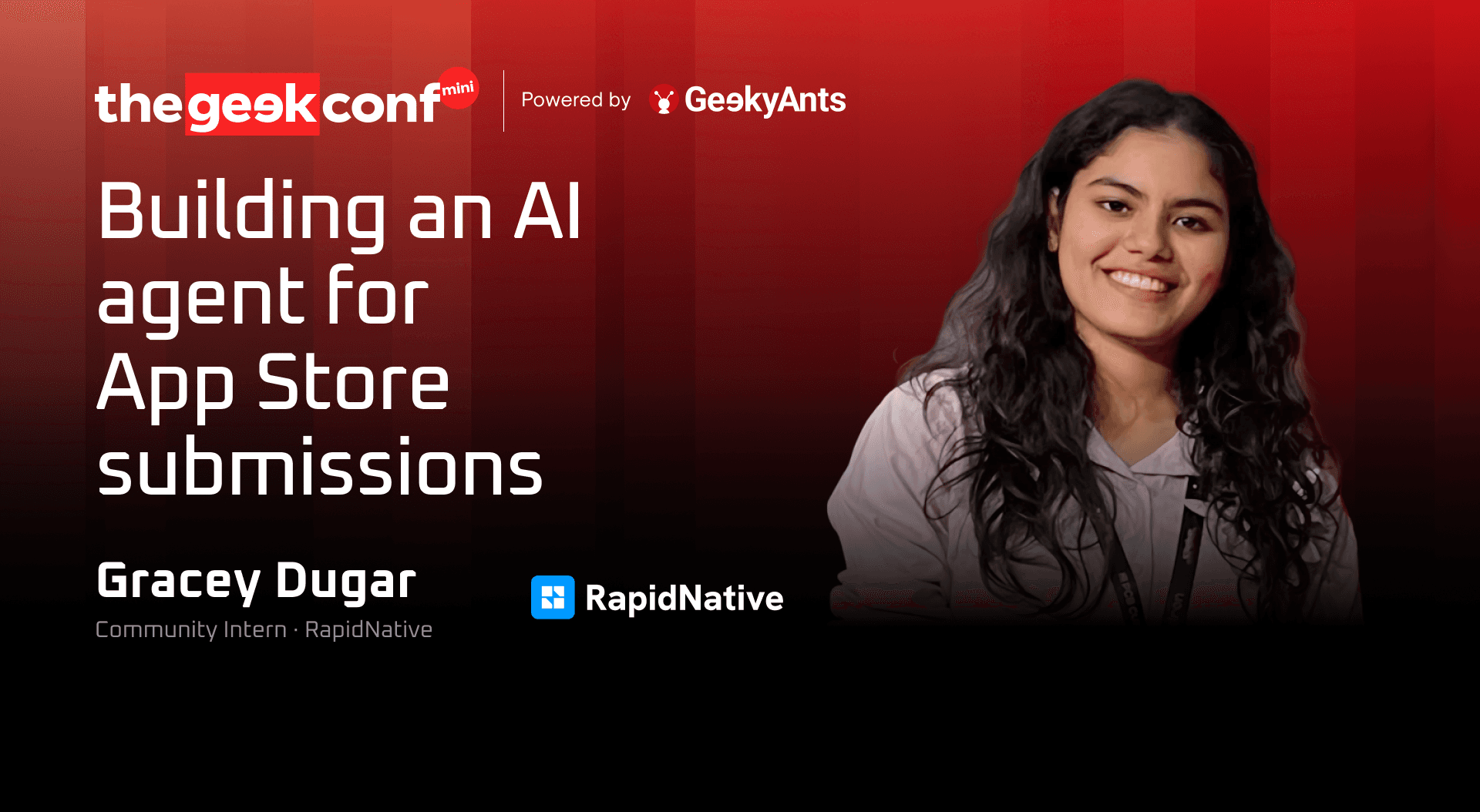

Editor's Note: This blog post is adapted from Building an AI Agent for App Store Submissions, a talk delivered at thegeekconf mini 2026 by Gracey Dugar, Robotics and Strategist at RapidNative. Working on mobile deployment tooling, Gracey walks through why the last step of shipping — build logs, certificates, metadata, and store review — is where most AI agent workflows get stuck, and demonstrates an end-to-end path from a single prompt to a live app store submission.
AI has made it dramatically easier to build digital products, from websites and landing pages to complete applications. But getting something built is not the same as getting it into the hands of real users.
At thegeekconf mini 2026, Gracey Dugar of RapidNative explored this gap through the lens of mobile app deployment. The session focused on why app store submission remains a difficult final step for AI agents, what an agent needs to navigate builds, credentials, metadata, errors, and store requirements, and how an end-to-end workflow can take an application from a single prompt all the way to submission.
Everyone Builds. Almost Nobody Ships.
When most people say "AI agent," they picture the model writing code. Debugging it. Refactoring it. However, a gap that's becoming increasingly difficult to close is understanding where the project finishes and if a stranger can use said app and provide feedback.
Most AI- assisted projects are not able to cross over to deployment and reach the intended users.
Watch the full talk here, straight from thegeekconf mini 2026
Why the Last Mile Is Hard
Mobile is where this shows up most sharply, because publishing consists of a sequence of small, procedural, unforgiving steps:
- Build logs that have to be read and understood when something fails
- Metadata that has to match what the store expects, field by field
- Bundle IDs that have to be correct and consistent
- Certificates and signing credentials that have to be valid, current, and correctly associated
- Store review, which can reject the submission after all of the above is done correctly
Store reviews are what make or break the agent workflows. Everything before it is deterministic. Review is a gate controlled by someone else, applying criteria the agent cannot reason its way around.
This work is also structurally unlike what coding agents are good at. It happens in external systems, across multiple sessions, with credentials the agent has to be trusted to handle. So the common outcome is an agent that produces a working application and then stops, leaving the developer to debug submission errors manually - which is precisely the work they were trying to avoid.
What an Agent Needs to Finish the Job
Getting from generated code to a live store listing asks four things of an agent, and they are worth holding onto independently of any particular tool.
What it means | |
Plan | Work out the sequence from what it has been given, rather than executing one instruction at a time |
Retain context | Hold the whole submission - the app, the credentials, the store requirements, not just the current step |
Use tools appropriately | The work happens in external systems, so the agent has to call the right one at the right point |
Handle errors | Rejection and failure are expected states in this pipeline, not exceptions to escalate |
An agent that assumes everything will go right will stop at the first rejected build making it a routine concept rather than an exception.
Prompt to Store Listing, End to End
The talk demonstrated this end to end, twice.
The first run started with an application built in Lovable and exported as a zip. Uploaded to RapidNative, it was acknowledged by email, reviewed, and converted into a native mobile application — screens intact, features carried over from the original prompt.
From there, submission was a form: developer account credentials, an access token, a choice between Google Play and the Apple App Store, a JSON file for the Play Store path, and an editable privacy policy.
Then submit.
The second run skipped the intermediate build entirely. A single line of prompt that created an e-commerce platform for FMCG goods and produced a full set of screens in about five minutes, with the database visible and the project exportable for other people on the team to edit.
The specific tooling matters less than what the sequence demonstrates: the generated application did not stop at the point where code exists. It continued through the submission steps that normally require a developer to sit down with a store console and work through the requirements by hand.
Can You Deploy It?
Anyone can build a substantially well working application using AI Agents now.
The interesting question at this stage is: can you deploy it? Can you put it in front of people who did not build it? Does it hold up when it meets a use case nobody anticipated?
A project sitting in a GitHub repository is not finished. The work is done when the idea is live and accessible to your target audience.