MongoDB for Scalable Apps
We build MongoDB architectures around access patterns — so the database performs at scale rather than just at launch.
Your database should grow with you











Scaling a product should not mean fighting your database. Most teams struggle because they treat MongoDB like a relational store, leading to slow queries and inefficient storage. We take full ownership of your MongoDB infrastructure to ensure your data stays fast as you scale to terabytes.
We solve this by modeling data based on how your app actually uses it—utilizing Embedding and Bucketing for peak read speeds instead of forcing data into rigid, old-fashioned tables. To keep your backend lean, we leverage the Aggregation Framework and Atlas Search to handle complex data analysis and rich discovery features directly within the database engine.
Client Results and Success

400M+ global payments processed annually
The system provides the scalability required to handle millions of transactions while maintaining data integrity and administrative control.
- Active Users in the UK, Canada, Europe, and Australia
- 120k+
- Global Payments Processed Annually
- 400M+
- Downloads Across iOS and Android
- 350k+

3x faster AI feature iteration
The modular backend architecture allowed the team to deploy new AI capabilities and personalized features significantly faster than industry benchmarks.
- Reduction in meal decision time
- 40%
- Increase in daily active usage during pilot
- 2x
- Faster iteration on new AI-driven features
- 3x
$57,000+ Annual Savings
The project achieved a 60% reduction in monthly cloud costs (from $8,100 to $3,300) without any loss in transaction speed or system security.
- Reduction in monthly cloud costs
- 60%
- Saved per month
- $4800
- Annual savings
- $57,000+
50% reduction in manual validation cycles
The integration of automated benchmarking frameworks and AI-driven process automation also resulted in 30% faster internal testing workflows.
- faster internal testing
- 30%
- reduction in manual validation
- 50%
Our MongoDB Product Architecture Capabilities
Infrastructure risk should not be something your team quietly absorbs. Our services close the gaps that come from ad-hoc account creation, permission creep, and setups that look stable until something breaks.
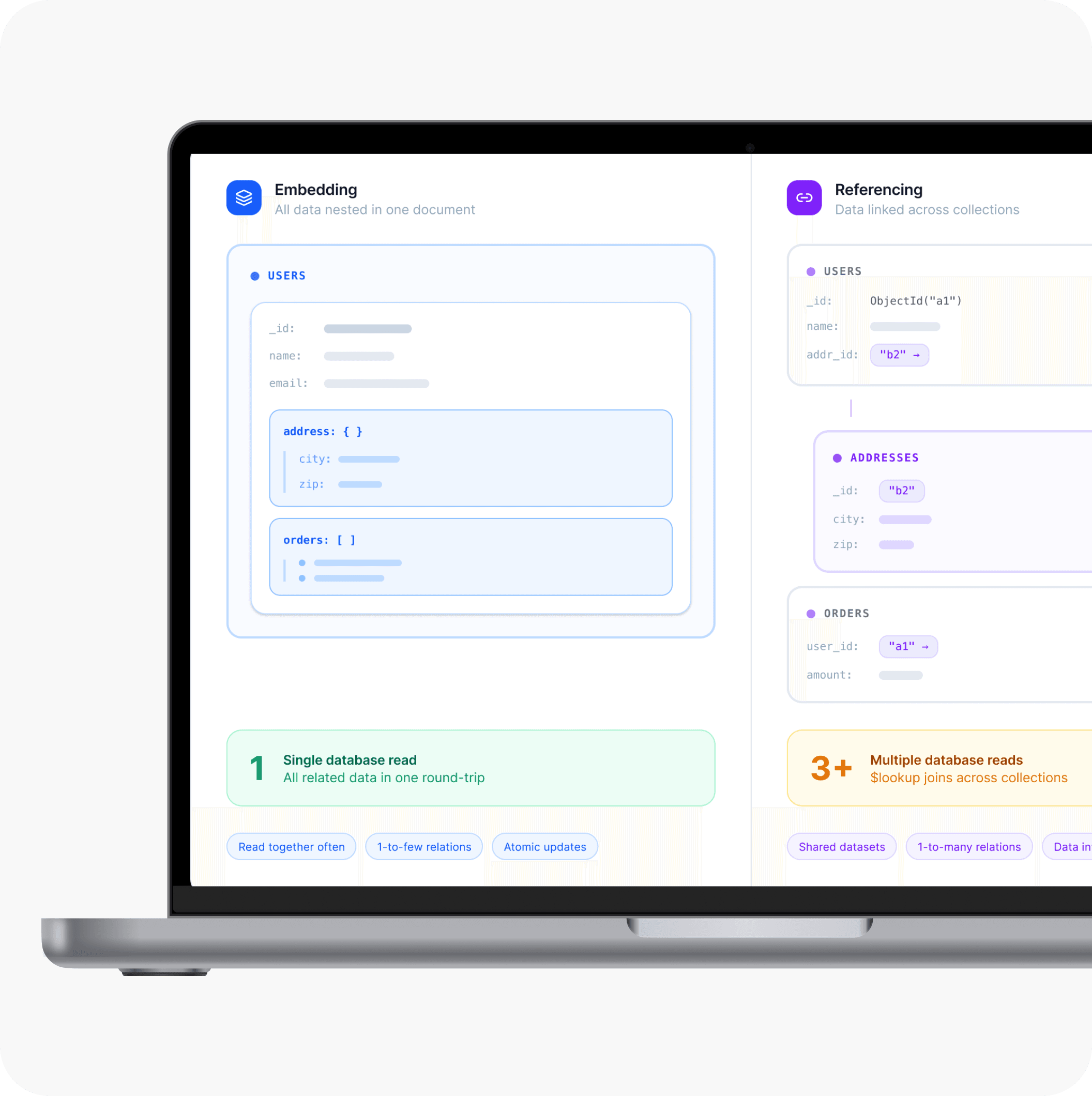
We move away from rigid normalization. By choosing between Embedding vs. Referencing based on your specific use case, we reduce the need for expensive joins and ensure your data is ready for the screen the moment it is queried.
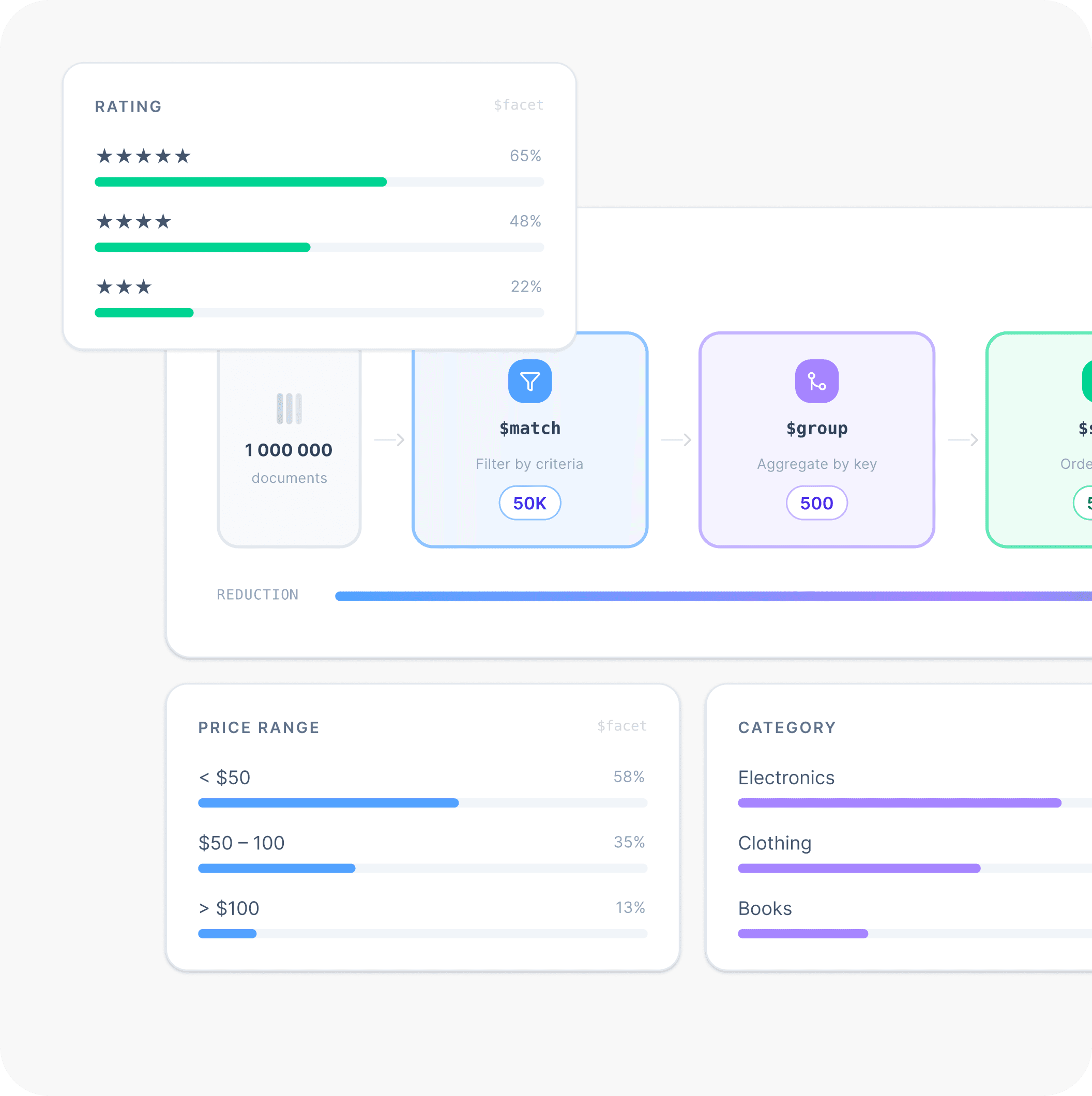
We leverage the Aggregation Pipeline to perform heavy lifting inside the database. Using Multi-stage Pipelines and Facet Search, we build complex dashboards and filtering systems that remain fast even as your dataset grows.
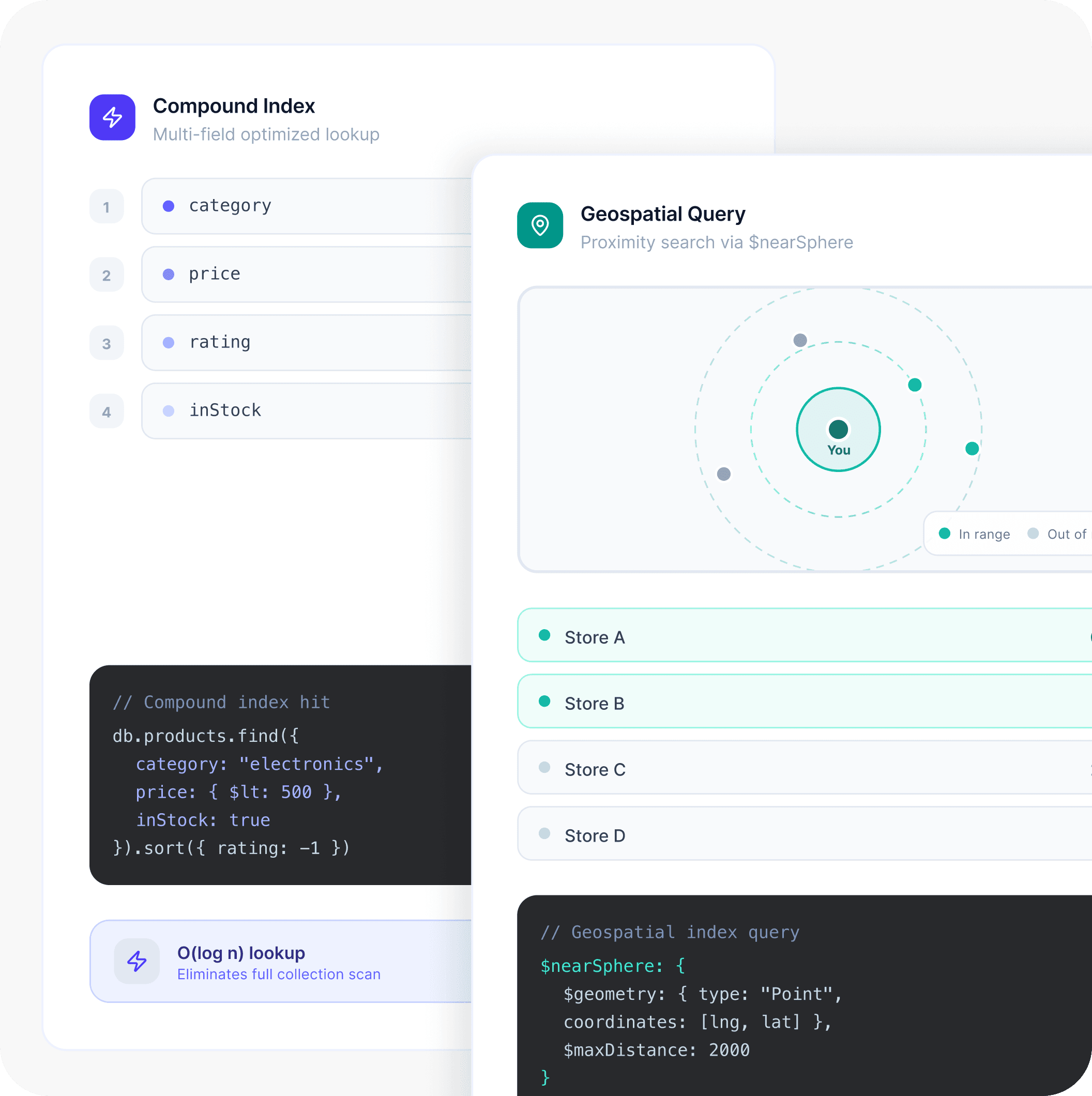
We go beyond simple lookups. We implement Compound Indexes for multi-criteria filtering and use Geospatial Queries for location-based apps, ensuring your search features are both powerful and efficient.
Complete Backend Engineering Services for Enterprises and Companies
Industries-Based MongoDB Services
MongoDB document design requirements shift by product type. A content management system with variable content structures has different schema requirements than an IoT ingestion pipeline optimizing for write throughput. We design MongoDB architectures around the data model and access patterns that the product actually has.
MongoDB for Scalable Apps by Engineers Who Have Delivered 1000+ Projects
We have worked on databases where inventory race conditions were accepted as normal, where reporting queries were timing out because nobody had added a materialized view, and where JSONB had been added without indexing because the flexibility was needed, but the performance implications were not considered.
The senior engineers who plan your architecture are the same ones who write the code.
We work with NestJS, Express, GraphQL, and more. We choose the technology that fits your team, not just what is trendy.
We provide clear documentation and Architecture Decision Records. When we finish, your team will have everything they need to run and grow the system without us.
Our Latest Thinking
FAQs About MongoDB Services for Scalable Apps
We cover document schema design, embedding versus referencing decisions, index strategy, aggregation pipeline optimization, Atlas Search setup, geospatial indexing, and sharding where the scale requires it. The end state is a MongoDB architecture designed for the access patterns and write volumes the product generates — not the default structure that accumulated during development.
Most engagements complete within three to five weeks. Duration depends on the size of the existing collection set, whether sharding needs to be implemented from scratch, and how much aggregation pipeline optimisation the current query patterns require.
Both. For new products, we design the document schema before data accumulates in a structure that is hard to migrate. For existing databases, we assess the current schema, identify the highest-impact access pattern mismatches, and restructure incrementally where collection size makes full migration impractical.
Yes. Every engagement delivers schema decision documentation, index strategy records, and aggregation pipeline notes — so your team can add collections and documents following the same design patterns without guidance from us.
Having MongoDB running and having a well-designed MongoDB schema are different things. Most collections that grew organically embed data that should be referenced, carry indexes that do not match the queries being run, and have aggregation pipelines that scan more documents than necessary. Those problems are invisible until query latency or write throughput makes them visible.
Redesigned document schema where needed, index strategy implemented and validated against actual query patterns, aggregation pipelines reviewed and optimized, Atlas Search configured where in scope, sharding implemented if required, and full documentation covering design decisions and pipeline logic.
We work across MongoDB Atlas, the aggregation framework, Atlas Search, geospatial indexes, compound indexes, the bucket and polymorphic patterns, sharding, replica sets, and explain output analysis for query performance. Feature selection is based on the product's data model and scale requirements.
Yes. Field-level encryption, audit logging, role-based access control, and data residency configuration via Atlas are part of how we build MongoDB architectures for products operating under GDPR, HIPAA, SOC 2, or PCI-DSS requirements.
Index and aggregation pipeline improvements are visible within the first week. Schema restructuring and sharding implementation are complete within two to four weeks, depending on collection size. Full documentation and handover are typically completed within four to five weeks.
An internal hire needs ramp time before safely restructuring production collections. Our engineers arrive with that experience in place, deliver a documented and tested architecture on a fixed schedule, and carry none of the overhead of recruiting or onboarding.