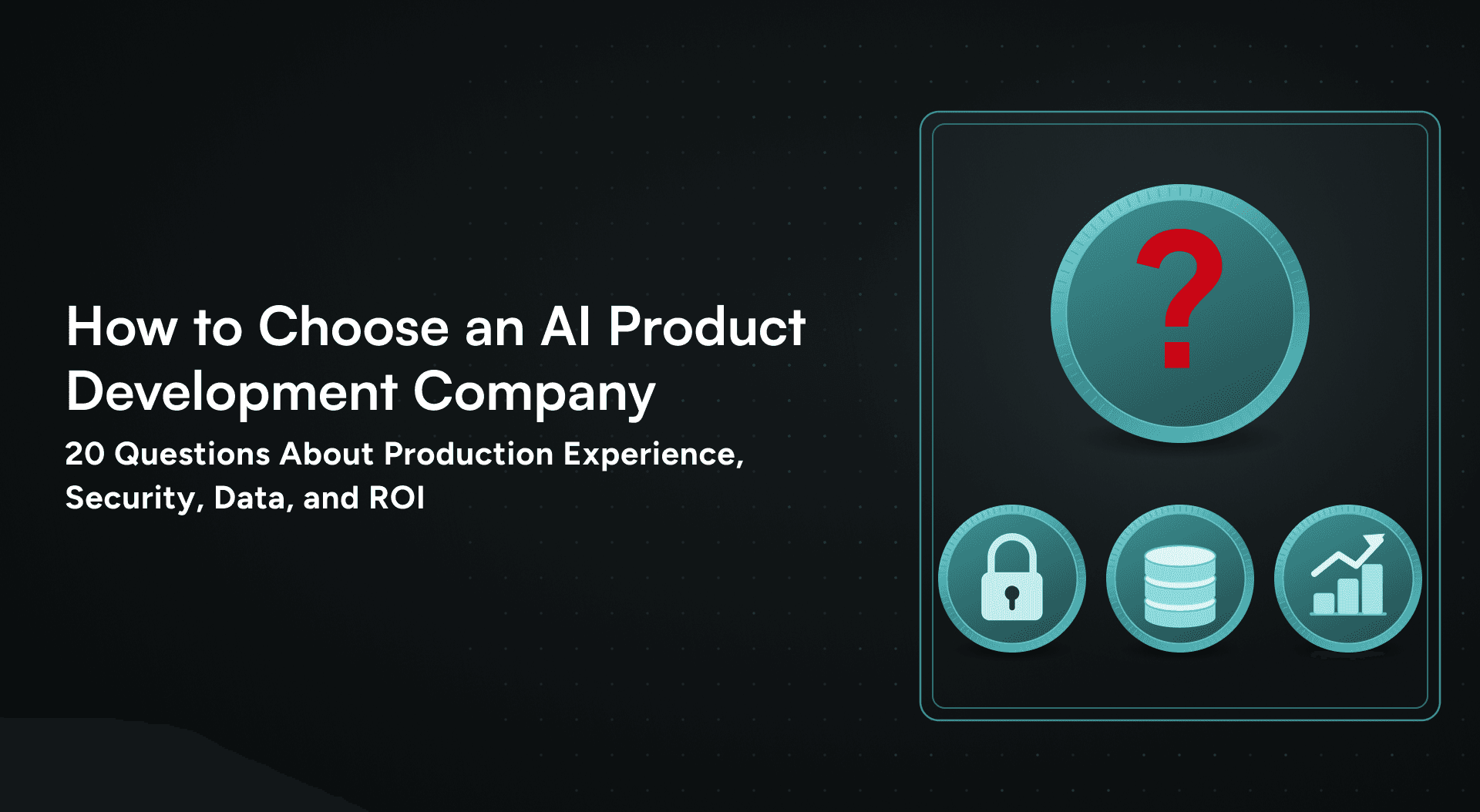


Key Takeaways
- Judge an AI product development company on production evidence, not demo polish or certifications.
- Ask each vendor for the artifact behind every answer, then score what they can prove.
- Treat security as an action problem once the system can call tools and reach internal data.
- Read total cost as build plus run plus change, since inference and support decide whether a product survives.
- Confirm you can own the prompts, evaluation sets, embeddings, and runbooks, not only the code.
What Should Buyers Check Before Choosing an AI Product Development Company?
Most enterprises can build an AI prototype in a few weeks. The harder work comes later, when that prototype has to run reliably for real users, stay within budget, and hold up under security review.
Gartner reported that at least half of generative AI projects were abandoned after proof of concept by the end of 2025, citing poor data quality, weak risk controls, rising costs, and unclear business value. Adoption is not the constraint: Stanford's 2026 AI Index records organizational AI adoption at 88 percent, with agent deployment still in single digits. The distance between using AI and operating it dependably is where selection now matters.
That distance changes how you evaluate an AI Product Development Company. A demo and a list of framework logos say little about whether a partner can build, secure, integrate, operate, measure, and transfer a product under production conditions. The 20 questions below surface that evidence early.
Buyers who compare AI companies on demo quality find the real cost after launch. The teams worth shortlisting show a system that has run for months and explain what it took to keep it running.
 Kunal KumarChief Revenue Officer
What Should You Evaluate Before Choosing an AI Product Development Company?
A production-ready AI product development company has to clear six areas, and a strong record in one does not cover a gap in another.
Each maps to a group of questions below, with a concrete thing to look for rather than a claim to accept.
Evaluation area | What good evidence looks like |
Production experience | Systems that have run live, not pilots that stopped at a demo |
Technical and architecture depth | A design that fits your existing systems and avoids provider lock-in |
Data and security | Where data travels, who can reach it, and what the system can act on |
Delivery team and process | Named people who build it and stay accountable after launch |
Economics and ROI | The full cost of a reliable production outcome, not the build price alone |
Ownership and long-term operations | Proof the product stays yours to run, extend, or move |
What 20 Questions Should You Ask an AI Product Development Company?
The questions run across the lifecycle of an AI product, grouped so you can move through a vendor conversation in order.
Read them as a due-diligence sequence for any AI software development company, noting for each why it matters, the evidence to request, and the answer that should lower the score.
A prototype tells you a team can make a model respond. Production tells you they can keep it correct, safe, and affordable while real users push on it. Ask for the artifact behind the answer.
 Konakanchi Venkata Suresh BabuPrincipal Technical Consultant.
Production Experience and Track Record
Production experience is the clearest signal that a partner can take an AI product past the demo stage.
A firm that has operated live systems answers these questions from memory, while one that has mostly run pilots starts to hedge. Ask them first, and weigh each answer on the evidence offered rather than the confidence.
Question to ask | What a strong answer shows | Red flag |
1. How many AI products have you taken from proof of concept to production? | A specific count and domains, with named or redacted deployments, go-live dates, and what changed from pilot to live | A portfolio that is mostly pilots and internal demos |
2. Can you show an AI product running at enterprise scale for six to twelve months or more? | A live system with usage volume, uptime, and a reference who confirms the timeline | Every example is recent or still in beta |
3. What went wrong in your last AI production deployment, and how did you fix it? | A concrete incident with detection, root cause, and the fix, shown in a postmortem | An assurance that nothing has ever gone wrong |
4. Can we speak with clients running comparable AI products in production? | Direct reference calls with clients matched to your use case and scale | References are unavailable or limited to design-stage work |
Architecture, Models, and Technical Depth
An AI product has to fit the systems, identity, and data you already run, and it should not tie you to one model provider. These questions test the partner's architectural thinking and its evaluation discipline.
On that last point, NIST's AI Risk Management Framework gives a primary-source basis for how model performance and failure should be measured before launch.
Question to ask | What a strong answer shows | Red flag |
5. How would you design the AI architecture around our existing enterprise systems? | A reference architecture that starts from your data sources, access model, and latency needs | A generic stack offered before any question about your environment |
6. How do you choose between models, providers, and architectures? | A written comparison weighing task fit, cost per request, latency, and data terms | One provider recommended by default, with no trade-offs |
7. How difficult would it be to replace the underlying AI model later? | An abstraction layer that isolates prompts, routing, and evaluation from any provider | Provider-specific logic wired through the whole application |
8. How do you evaluate model performance, hallucinations, and failure cases before production? | A redacted evaluation report with dataset provenance, metrics, a release threshold, and regression checks when prompts, models, or tools change | Manual spot-checking until responses look acceptable |
Data, Security, and Enterprise Compliance
Security questions widen once the system can act on your data. A chat product exposes prompts, outputs, and access; an agentic product may also read repositories, call APIs, update records, and trigger workflows.
OWASP's GenAI Security Project released its 2026 LLM Top 10 and an Agent Control Standard in September 2026 for exactly this shift, covering identity, permissions, and runtime control of systems that take actions.
Question to ask | What a strong answer shows | Red flag |
9. Where does our data go, and which third parties can access it? | A data-flow map naming each processor and subprocessor | Uncertainty about where prompts and outputs go |
10. Will our prompts, data, or outputs be used to train any models? | Contract terms that disable training use and set retention limits | A verbal assurance with no written term |
11. How do you handle PII, sensitive enterprise data, embeddings, and logs? | Redaction, encryption, access scoping, and retention rules that cover derived data | Controls that stop at the database and ignore embeddings and logs |
12. Can the solution run inside our cloud environment or private infrastructure? | A prior deployment in your cloud account, private, or on-prem | A single hosted option with no isolation path |
13. How do you handle access control, prompt injection, tool permissions, data leakage, and auditability? | Least-privilege access, human approval for high-risk actions, full logging, and a fast way to stop an agent | Broad tool access with no approval step and no shutdown |
For the last question, the checks below turn a general security reassurance into specific artifacts you can request.
Data Readiness, Evaluation, and Production Operations
This group decides whether the product stays good after it ships. It runs from data readiness through the launch evaluation to how quality, cost, and failure are handled in production.
Google's People and AI Guidebook is a useful reference for the last question, since it centers on user control, calibrated trust, and helping people recover when the system is wrong.
Question to ask | What a strong answer shows | Red flag |
14. How will you assess our data quality and readiness before development? | A readiness assessment covering coverage, labeling, freshness, and known gaps | Development that starts before any data review |
15. What evaluation dataset and benchmarks will you use before launch? | An evaluation plan with a held-out set from your workflows, rubrics, and pass thresholds | Benchmarks limited to public leaderboards |
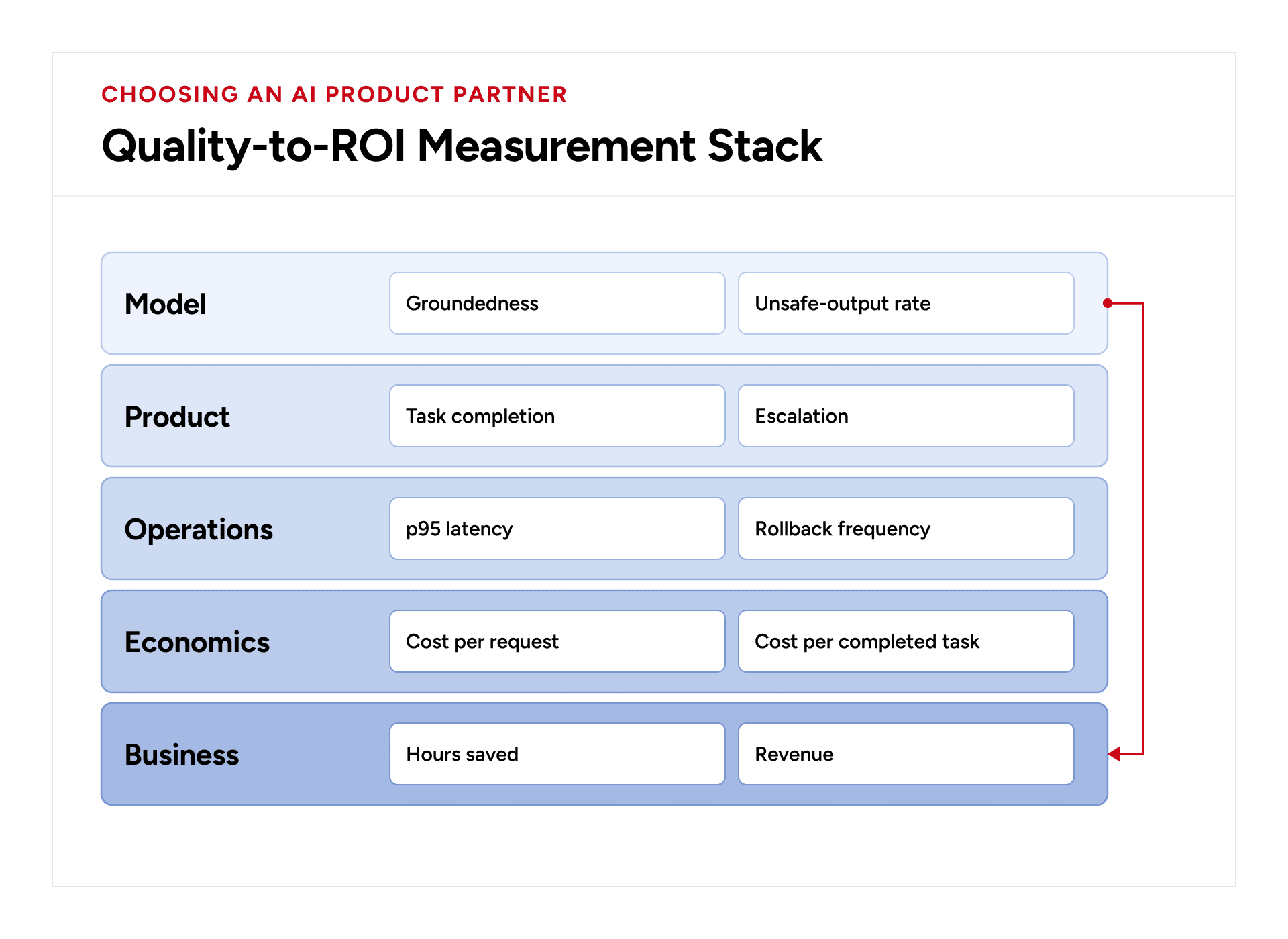
16. How will you monitor model quality, cost, latency, and failures after launch? | Dashboards tracking model, product, operational, and cost metrics together | Monitoring limited to uptime |
17. What happens when the model gives a wrong or unsafe answer in production? | Confidence checks, escalation, safe fallbacks, and a path to correct or reverse an action | The only plan is to improve the prompt |
Team, Delivery, and Commercial Model
The last group covers who does the work, what it costs to run, and what you keep.
Operating cost belongs here as much as build price: McKinsey's May 2026 Enterprise AI FinOps survey found 93 percent of enterprises had exceeded their AI budgets, which makes the run cost a selection criterion rather than a post-launch surprise.
Question to ask | What a strong answer shows | Red flag |
18. Who exactly will build and operate our AI product, and who stays accountable after launch? | Named team members with seniority and a support model that continues after go-live | Senior experts sell the work while a junior team builds it |
19. What are the full build, infrastructure, inference, monitoring, and maintenance costs? | A build-run-change cost model with volume scenarios and cost per completed task | A single build quote with no operating estimate |
20. What do we own, and how can we take over the product if the engagement ends? | A handover schedule listing every asset, where it lives, and how it transfers at termination | Ownership limited to source code |
How Should You Score an AI Development Partner’s Answers?
This is the step most buyers skip, and where a shortlist gets decided, because twenty good questions can still produce twenty polished sales answers. A "yes, we can do that" is a claim; documentation is evidence; a live example with a measurable result and a reference is production-verified.
Score each answer from 0 to 3 to expose where one vendor supplied proof and another supplied reassurance.
Score | Meaning | What you received |
0 | Evasive or absent | No usable answer |
1 | Claim | Verbal reassurance |
2 | Documented | An architecture, process, security, evaluation, or commercial artifact |
3 | Production-verified | A live example, a measurable result, and a reference |
Sum the scores, but weight the pattern over the total. A vendor averaging 2 across most areas with a 0 or 1 on security or ownership should drop on your shortlist regardless of total score, since those gaps surface after signing.
Before you move forward, confirm:
- No score below 2 on production, security, or ownership
- At least a few 3s, each backed by a live reference you can call
A low score on security, data ownership, or operations should trigger follow-up even when the total looks strong.
What Are the Red Flags When Evaluating an AI Product Development Company?
The tables above name the red flag for each answer. The ones that matter most, though, show up across the whole conversation, in how a vendor behaves when you keep asking for proof. Watch for these patterns rather than any single weak answer.
- Confidence rises as specifics are requested. The assurances get stronger while the artifacts get vaguer.
- Every answer is a capability claim, and none is backed by a document, a metric, or a name you can call.
- Weak answers cluster in one area, such as several soft responses on security or on ownership, rather than one isolated gap.
- Scope only ever grows. The vendor never proposes a smaller first step or names anything it would decline to build with AI.
- Cost and timeline arrive as single numbers, never as ranges tied to volume or data readiness.
- Ownership, exit, and support terms are discussed warmly but never offered in writing.
A single instance can be a bad day. Two or more of these, or a cluster in a critical area, is a reason to slow down, ask for the missing artifacts, or run a small paid trial before committing.
What Six Proofs Should an AI Product Development Partner Provide?
This is the part to remember if you remember nothing else. The 20 questions roll up into six kinds of proof, and each one has a single artifact that settles it more reliably than any answer. The value of naming the artifact is that it is hard to fake: a partner either has the deployment, the diagram, or the postmortem, or it does not.
A production-ready company can put most of these in front of you without a long delay, and it names the gaps it still has rather than talking around them.
Proof | The one artifact that settles it | Why it is hard to fake |
Production proof | A live deployment you can reference, with usage volume and duration | It needs a real client and real uptime, not a rebuilt demo |
Technical proof | An architecture or integration diagram from prior work | It exposes whether the design has ever met real systems |
Security proof | A data-flow and controls summary with a subprocessor list | It shows the security model exists on paper, not just in conversation |
Economic proof | A build-run-change cost model with a cost-per-outcome figure | It forces the operating cost into the open |
Operational proof | A monitoring dashboard alongside a real incident postmortem | It proves the system has run and been kept running |
Ownership proof | A handover schedule naming every asset and how it transfers | It commits the vendor to your independence in writing |
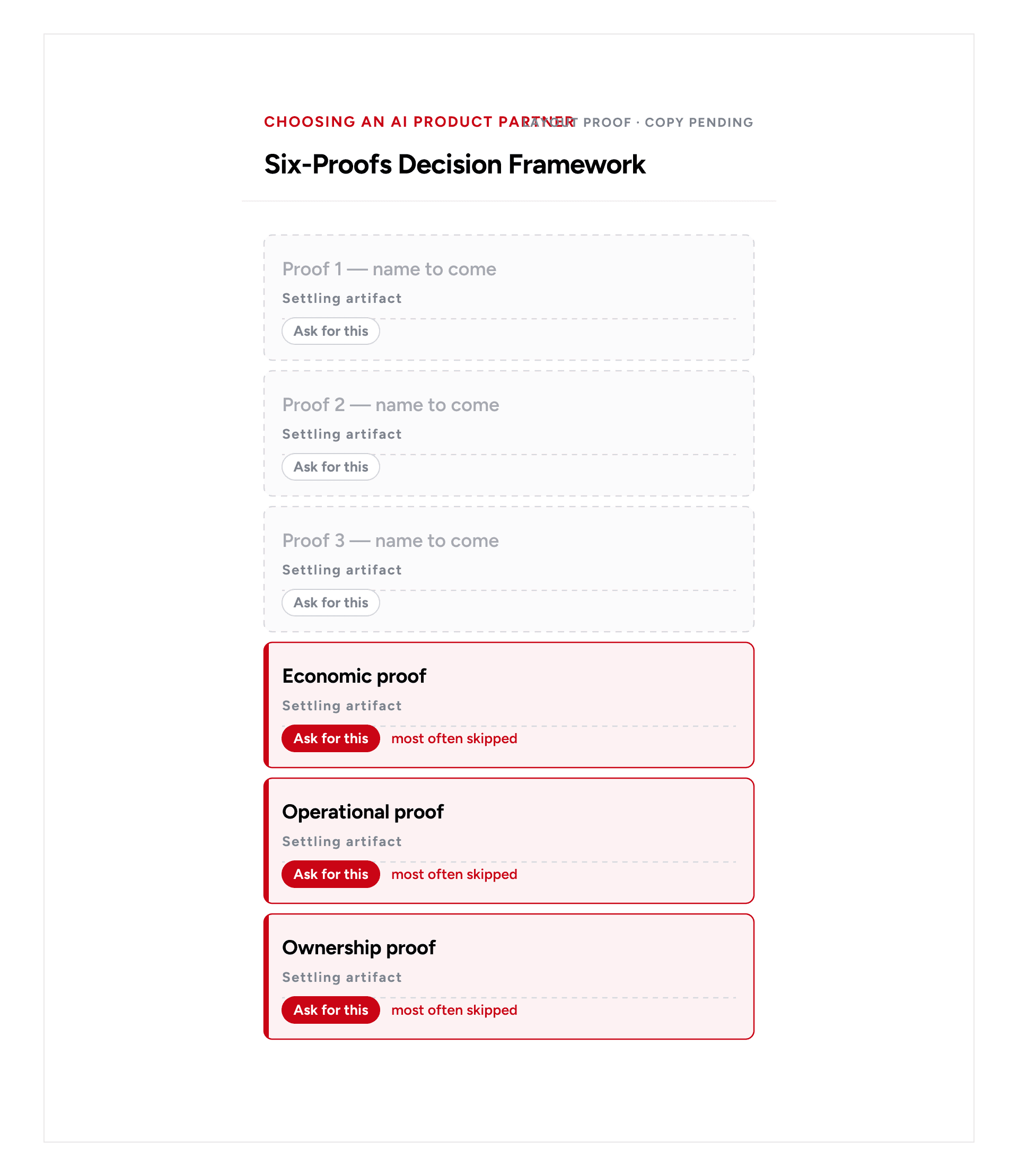
A company that produces five or six of these on request is describing work it has done. One or two, with the rest promised for later, is describing work it hopes to do.
This is also where GeekyAnts frames the decision differently from a rate-card comparison: the useful measure is the total cost of reaching a reliable production outcome, which is exactly what these six artifacts make visible.
What Production Evidence Does GeekyAnts Bring as an AI Development Company?
The same standard applies to GeekyAnts. A buyer should examine how the team approaches discovery, architecture, evaluation, data control, production, and handover, rather than read a capability list.
GeekyAnts works as an AI Development Company that treats total cost as the cost of reaching a reliable production outcome, so the engineers who sit close to production also shape the commercial conversation.
The teams that get value from AI treat the run cost and the handover as part of the deal, not an afterthought. We price the work against a reliable production outcome, because that is the number that decides whether a product survives its second quarter, and it is the number a rate card hides.
Kunal KumarChief Revenue OfficerTwo examples from GeekyAnts' published enterprise-grade delivery guide show the standard in practice. The first is a property-inspection assistant that routes low-confidence queries to human agents instead of guessing, which is the failure-recovery design Question 17 asks for.
The second is an automated candidate-interview system, built over a three-to-four-month engagement from separate components for interview planning, question generation, voice processing, and reporting, which shows the modular architecture that keeps an AI product maintainable and its models replaceable.
Against each proof a buyer scores, GeekyAnts brings a concrete artifact rather than a claim.
Your evaluation criterion | GeekyAnts proof to supply |
Production proof | A live deployment you can reference, with duration and usage. Example: the RBI-mandated domain migration for India's largest private bank, run with zero downtime across 100+ integrations during a festive code freeze. |
Technical proof | An architecture or integration diagram from the work above. Example: Property AI, a production-grade RAG system built on FastAPI, GPT-4, and pgvector for real-time property Q&A. |
Security proof | A data-flow, controls, and compliance summary. Example: a casino platform built for KYC, payments, and geo-compliance. For evidence tied to your specific case, ask what can be shared during evaluation or under NDA. |
Economic proof | A cost-per-outcome figure, not an hourly rate. Example: DollarDash cut AWS cloud costs by 60%, saving over $57K annually. |
Operational proof | The monitoring, evaluation, and incident approach. Example: for Nexus, AI agents and BPM automation cut manual validation by 50% and sped up testing by 30%. |
Ownership proof | The repository, documentation, and handover plan. Ask GeekyAnts for a reference client willing to confirm handover terms, since repo access itself is typically confidential to the client. |
The point is not that GeekyAnts is the best choice. It is that the six artifacts you would ask any vendor for are the ones GeekyAnts is set up to put on the table.
How Do You Compare Two AI Product Development Companies Before You Sign?
Selection becomes more reliable when every shortlisted company is asked for the same evidence and assessed against the same criteria. Work through the checklist below after your initial conversations, and confirm each item with evidence you have received or reviewed.
Before you sign, confirm you have |
☐ Seen a live deployment that has run six months or more, with a reference who confirmed the timeline |
☐ Spoken directly to a client in your sector, rather than read a written testimonial |
☐ Reviewed a reference architecture built around your systems instead of a generic stack |
☐ Read a real evaluation report with a held-out test set and a stated launch threshold |
☐ Received a data-flow map that names every processor and subprocessor in the path |
☐ Confirmed where the workload runs and which controls cover embeddings and logs, not only the database |
☐ Priced the run cost as well as the build, with a figure for cost per completed task |
☐ Agreed who operates, monitors, and supports the product after go-live |
☐ Listed every asset you own, including prompts, evaluation sets, and embeddings, not only the code |
☐ Put exit, handover, and portability terms into the contract, not a verbal promise |
Use the checklist above to compare vendors side by side, assessing the evidence each company provides before making your decision.
How Can Buyers Make the Final AI Partner Decision?
A good AI product development company can be identified before the contract is signed, if you ask for evidence and score what comes back.
Move through the 20 questions, grade each answer from claim to production-verified, and confirm what you will own. The right partner welcomes the scrutiny.