

Key Takeaways
- A successful AI demo is not the same as a production-ready wealth management product. The real test is whether it works with real data, users, systems, and controls.
- Production readiness depends on more than model accuracy. Business value, data quality, architecture, governance, reliability, security, and user adoption all need to meet defined standards.
- Before going live, wealth firms should set clear release gates for accuracy, traceability, latency, availability, cost, human oversight, and failure handling.
- Start with a focused use case, measure its business impact, and scale only when the evidence supports it. If a major gap remains, fix it before expanding the rollout.
Why AI Adoption Has Outpaced Business Impact in Wealth Management
A wealth management firm presents an AI assistant in front of their leadership team. A portfolio manager enters a question about the client’s holdings. And within seconds, the tool brings together all the account information, summarizes the portfolio, and suggests what the review task should the adviser take up next.
Everyone in the presentation is impressed.
And then someone asks a question, “How do you even know if the answer is right?”
This brings a sudden pivot in the conversation.
A demo can work because everything around it is controlled. The data is prepared. The questions are predictable. Someone is watching the screen. A production wealth management platform has none of those guarantees. Client information changes, market data moves throughout the day, permissions differ between users, and an adviser may need to explain where an answer came from long after it was generated.
That is where the industry is heading now, from experimentation to actually scaling products. EY’s 2025 research across 100 wealth and asset managers found that 95% had scaled GenAI across multiple use cases, while 78% were exploring agentic AI. Yet only slightly more than one-quarter of executives reported substantial business impact from GenAI. EY also found that 86% of firms were surprised by regulatory and compliance complexity, with 77% raising concerns about data privacy, accuracy, and the use of external data.
Why Production Readiness Matters for Wealth Management AI
The adoption numbers are strong. The production results tell a different story.
Consider a portfolio-summary assistant. Suppose the model uses a market feed that is several hours old, the answer may read perfectly and still give the adviser the wrong picture of a particular client’s position. Without a freshness check, source tracking, access controls, and a review path, it becomes easy to miss the problem since everything looks flawless on the screen.
Wealth and asset firms need to move beyond proofs of concept and build AI capabilities advisers can use in their daily work while meeting compliance requirements. Salesforce also highlights adviser productivity, personalization, trusted data, and governance as important considerations as firms bring AI into wealth workflows.
This guide brings to light where promising AI demos tend to break, then examines business value, data, architecture, governance, reliability, cost, and adoption. The goal is to turn those concerns into clear release gates and a controlled path from pilot to production.
Why AI Wealth Management Demos Fail in Production
A wealth management AI demo usually has one thing going for it, everyone knows what is supposed to happen.
The data is ready, the question is clear, the system has access to the right information. A portfolio summary appears on screen, an investment insight sounds sensible, and the adviser can see how the feature might save time.
Then the feature has to function in an actual workflow process.
A client’s market data is two hours old. The CRM stores a different risk profile from the portfolio system. An adviser asks why the AI made a recommendation and there is no record of the source behind it. A compliance reviewer wants to see what the system knew when the response was generated. Suddenly, the demo has become a product problem.
The table below provides demo assumptions, product obligations, and possible errors that could arise in business fit, data integrations, governance, reliability, and user adoption.
Area | Demo Assumption | Production Obligation | What Can Go Wrong? |
Business Fit | A clean dataset is enough | Data needs freshness, lineage, permissions, and consistent definitions | An adviser receives an outdated portfolio view |
Data | One successful API call proves integration | CRM, portfolio, custody, market-data, identity, and compliance systems need reliable connections | A recommendation uses incomplete client information |
Integrations | A convincing answer means the model works | Outputs need evaluation, source tracking, and defined review rules | An unsuitable recommendation reaches an adviser |
Governance | Logging the application is enough | Decisions, inputs, outputs, approvals, and changes need an audit trail | Compliance cannot reconstruct what happened |
Reliability | A fast response means good performance | The complete workflow needs predictable latency and availability | Advisers stop using the feature during busy periods |
User Adoption | Users will adopt it because it saves time | The workflow must fit existing adviser habits and support human review | Advisers ignore or manually verify every response |
The cost shows up later. A launch gets pushed because an integration was never tested against production data and then the compliance asks for evidence that was not captured. Advisers lose confidence after seeing an answer they cannot verify and product owners then discover that fixing the problem means rebuilding parts of the data layer, integration architecture, or approval workflow.
That is why production readiness should be checked before a prototype becomes a roadmap commitment.
A Production-Readiness Scorecard for Wealth Management AI Tool Prototype
Businesses can refer to this quick red-amber-green check:
Area | 🟢 Green | 🟠 Amber | 🔴 Red |
Business Fit | Clear owner and measurable outcome | Value is assumed | No defined workflow or owner |
Data | Fresh, traceable, permissioned | Known quality gaps | Unknown sources or stale data |
Integrations | Tested with live-system conditions | Partial integration | Demo or mock connections |
Governance | Review rules and audit trail exist | Controls are being defined | No approval or traceability |
Reliability | Tested for failure, latency, and availability | Limited testing | Works only in controlled demos |
Adoption | Advisers use and trust the workflow | Manual verification remains high | Users reject the output |
If several areas are red, adding more model capability will not solve the underlying problem. The product needs stronger foundations first.
A controlled demo can hide gaps in data, integrations, auditability, and adviser workflows because each part is designed to work for the demonstration. In fintech product work, those gaps tend to surface when the feature meets real users, real systems, and real controls.
 Jani Hardik SanjayProduct Owner I
The pattern is straightforward: unresolved production gaps rarely disappear after launch. They usually become delayed releases, compliance rework, adviser distrust, or expensive platform changes. McKinsey’s research on scaling GenAI in financial services similarly points to the need for stronger data foundations, workflow integration, governance, and operating models as organizations move beyond early experiments.
A wealth management AI prototype needs a proper view of what is missing before anyone treats the demo as a product.
What Does It Take to Turn an AI Wealth Management Demo Into a Production-Ready Product?
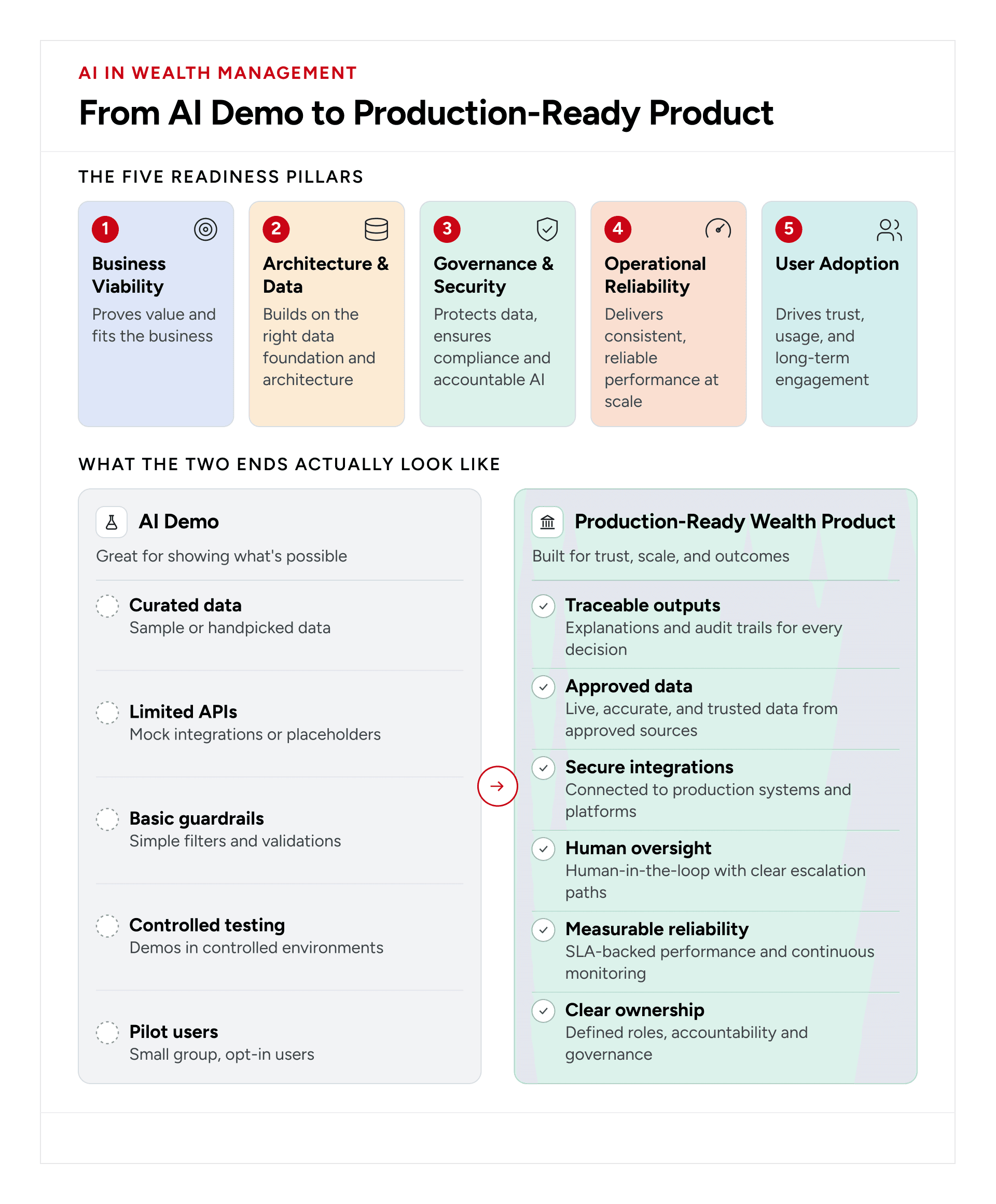
A demo can make an AI wealth management product look ready before it has faced the actual demanding conditions in a live environment.
It may answer a client question in seconds, summarize a portfolio, generate an investment brief, or help an adviser prepare for a meeting, but a product has to work with client data, connect to existing systems, follow firm policies, explain its outputs, handle failures, and remain useful when hundreds or thousands of advisers and clients depend on it.
That gap is where most of the AI initiatives end up stalling.
Scaling generative AI in financial services points to the need for reusable technology and data foundations, proper governance, focused use cases, and strong executive ownership.
The Five Pillars of Production Readiness
A production-ready AI wealth management product should meet five crucial conditions.
Pillar | What Needs to be True |
1. Business Viability | The product solves a defined client or adviser problem, has a clear owner, and produces measurable business value. |
2. Architecture and Data | It can access the right portfolio, market, client, and knowledge data with the freshness, quality, and permissions the use case requires. |
3. Governance and Security | Every important action has appropriate controls for privacy, model risk, suitability, access, explainability, and auditability. |
4. Operational Reliability | The product performs consistently, meets agreed latency and availability targets, and has a clear response when something goes wrong. |
5. User Adoption | Advisers and clients understand where the AI helps, where human judgment remains necessary, and why they should use it. |
These pillars are connected. An AI model can be accurate but still fail production if its data is stale. A secure system can still fail if advisers do not trust its recommendations. A useful adviser copilot can still create risk if nobody owns its outputs.
What Changes Take Place in Demo vs. Production?
Area | AI demo | Production |
Data | Sample or curated data | Approved, permissioned, current client and business data |
Integrations | Mock APIs or limited connections | Portfolio, CRM, market-data, document, identity, and workflow systems |
Controls | Basic prompts and guardrails | Access controls, policy checks, monitoring, audit trails, and human oversight |
Reliability | Works for a controlled demonstration | Meets defined availability, latency, recovery, and failure-handling targets |
Users | Product team or pilot group | Advisers, operations teams, clients, or other approved users |
Ownership | Project team | Named business, technology, risk, and compliance owners |
Cost | Prototype budget | Known cost per user, interaction, workflow, or portfolio |
Accountability | “The model produced this” | Someone can trace what happened, why it happened, and who approved the outcome |
Production changes the standard of proof.
For instance, an AI assistant that summarizes a portfolio from five sample accounts may look impressive in a demo. In the production stage, the same assistant needs to distinguish between current holdings and historical positions, respect account permissions, identify the source of its information, handle missing data, and make the right decision when the adviser needs to review the result.
What Metrics Should Businesses Measure Before Going Live With AI in Wealth Management?
The product should be considered ‘ready’ only when production readiness is demonstrated against measurable thresholds. At minimum, decision-makers should be able to ensure:
- Accuracy: The system should be able to produce an acceptable answer or recommendation for the intended use case.
- Traceability: An adviser or reviewer should be able to identify the data, model, rules, and actions behind an output.
- Latency: The product must respond within the time users expect for the workflow.
- Availability: Users can depend on the product during business-critical periods.
- Human oversight: Decisions must be taken up by an adviser, compliance, or involve other human approvals.
- Cost: Each interaction, client, workflow, or portfolio to be evaluated to identify the cost of operations.
- Data quality: The system shouldn't encounter stale, incomplete, conflicting, or unauthorized data.
- Failure handling: The model, data source, API, or downstream system should be able to handle possible failures.
- User adoption: Advisers and clients are using the product correctly and consistently.
- Business impact: Demonstrated improvement in metrics such as adviser preparation time, client response time, engagement, revenue, or operating cost.
The thresholds will vary by use case. An AI tool drafting an internal meeting summary does not face the same bar as a system influencing an investment recommendation. Production readiness should therefore be tied to the risk and consequence of the task, in addition to the sophistication of the model.
A 50-Point Production-Readiness Checklist for AI in Wealth Management Product
Use this checklist to find the gaps before the product reaches advisers or clients.
Area | Key Questions | Points |
Business Viability | Is the use case tied to a measurable business outcome? Is there a defined target user? Is there a business owner? Are success metrics agreed? | 10 |
Architecture & Data | Are required data sources available and permissioned? Is data current? Are integrations production-grade? Can the architecture support expected demand? | 10 |
Governance & Security | Are access controls, privacy protections, model-risk checks, audit trails, explainability, and human approval requirements defined? | 10 |
Operational Reliability | Are latency and availability targets defined? Is monitoring in place? Are failures, outages, rollbacks, and model changes covered? | 10 |
User Adoption & Accountability | Do users know when to trust, review, or reject an output? Are responsibilities clear? Has the product demonstrated adoption and business value? | 10 |
Total | 50 points | 50 |
A high score does not automatically make an AI wealth product safe to launch. It shows that the major production questions have answers. A low score tells leadership where the product could break first.
The goal is not to turn every AI experiment into a large technology program. It is to know which gaps can stop a product from being trusted, scaled, or defended once real money and real clients are involved.
How to Select and Validate an AI in Wealth Management Use Case for Production
1. Start with the Use Case
A promising AI use case is not automatically a production-ready one. Start with the workflow, not the model. Look at how often the task happens, who handles it today, what data it depends on, and what happens when the output is wrong. A tool that prepares client meeting notes has a different risk profile from one that recommends a portfolio change. The decision consequence, regulatory exposure, and need for adviser review should shape the path to production.
Data readiness matters just as much. If client information exists across disconnected systems or contains gaps, the model will inherit those problems. Check whether the required data is available, reliable, accessible, and permitted for the intended use before investing in the build.
2. Add Metrics for Measurability
The business case should also have numbers attached to it. Track ROI, total cost of ownership, cost per completed workflow, adviser time saved, escalation rate, response latency, and client or adviser adoption. Model accuracy is useful, but it does not tell you whether advisers are using the tool or whether the workflow costs less to complete.
Set these measures before the pilot starts. Then compare the results against a baseline. If preparing a financial plan takes an adviser 90 minutes today and the AI-assisted workflow brings that down to 45 minutes without increasing review time or errors, you have something concrete to take into a production discussion.
3. Know When to Scale, and When to Stop Scaling
The decision can also look different depending on the firm. A funded startup may move forward when a use case shows adoption, revenue potential, and manageable operating costs. A mid-sized firm may need stronger integration and governance evidence before expanding. An enterprise may need to prove that the workflow works across teams, meets internal controls, and can be supported with the right talent.
A prototype may serve as a strong starting point, but what is more important to note is if it can actually be utilized by users, create a measurable impact, and if the cost spent is justified after the deployment phase.
AI investment should be tied to an operating outcome from the start. Without a workflow owner, adoption target, time-to-value measure, and evidence from releases, a technically impressive use case can consume funding without proving its commercial value.
 Kunal KumarChief Revenue Officer
What Architecture and Data Foundation Does an AI in Wealth Management Product Need?
A wealth management AI product starts with the systems that feed, control, and record every action around the model. A production setup should typically connect the following layers:
- User channels: Adviser portals, client apps, and internal tools.
- Adviser workflows: Client reviews, portfolio analysis, research, service requests, and approvals.
- Orchestration: Routes requests between AI services, business systems, and human reviewers.
- Rules and guardrails: Enforces suitability rules, permissions, escalation thresholds, and compliance checks.
- Models and retrieval: Combines models with approved internal knowledge, portfolio data, market information, and documents.
- Data services: Manage client, account, transaction, market, and reference data.
- Audit logging: Records prompts and inputs, retrieved information, decisions, approvals, and system actions.
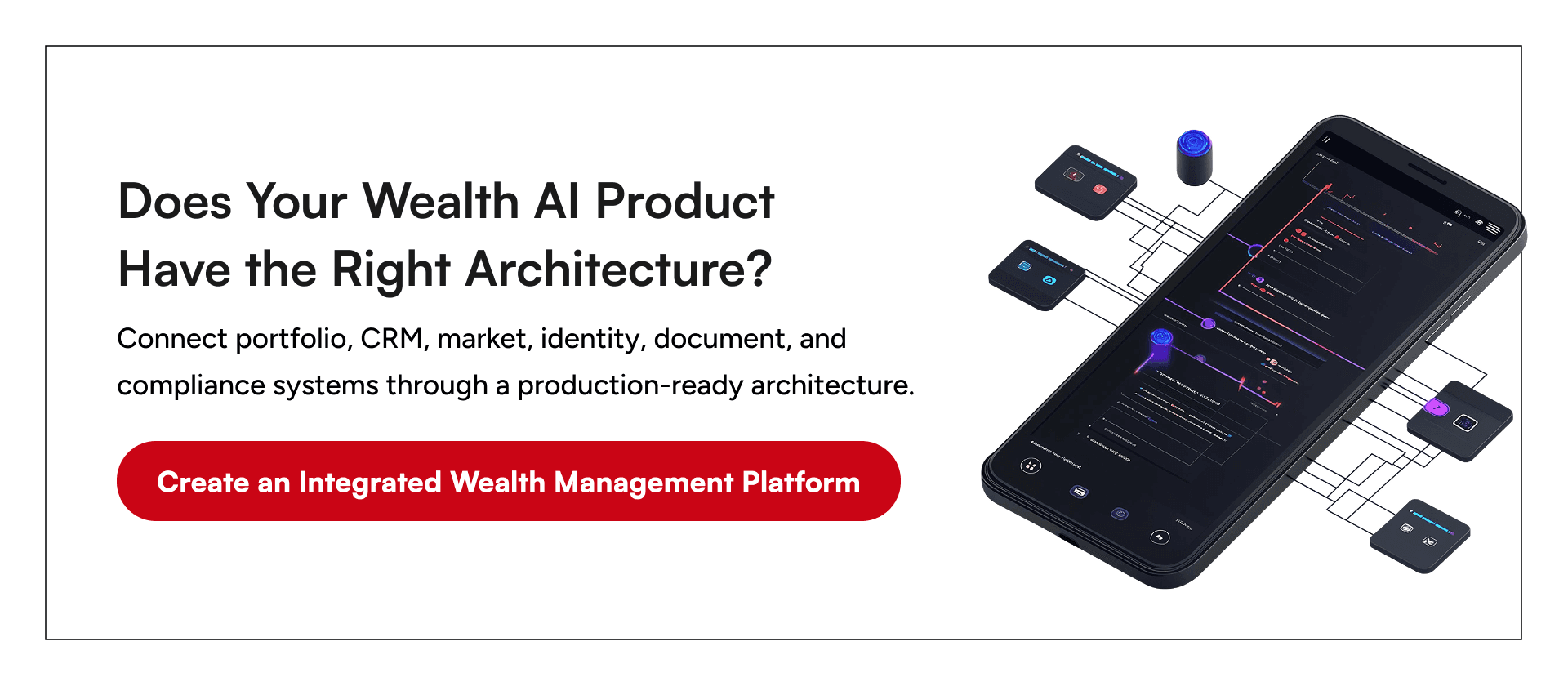
The architecture also needs connections to the systems advisers already use, which include CRM, portfolio management platforms, custodians, market-data feeds, KYC/AML services, identity providers, document repositories, and compliance workflows.
Data quality is also one of the crucial production concerns. Firms need to know where the data had come from, when it was updated, who can access it, where it is stored, and which client or account it belongs to. Market prices may require real-time pipelines, while reports and historical records may move through scheduled batches. Client-level isolation should prevent one household's information from appearing in another client's workflow.
Analyze the Architecture Approach That Fits the Wealth Management Product
Approach | Speed | Differentiation | Data Control | Vendor Dependency | Compliance | Cost |
Build | Slow | High | High | Low | Custom controls | High upfront |
Buy | Fast | Limited | Lower | High | Vendor-dependent | Lower upfront |
Modernize | Medium | Medium-High | High | Medium | Stronger over time | Medium |
Hybrid | Medium | High | High | Medium | Flexible | Medium-High |
The right choice depends on what the firm needs to own. Buying a commodity capability can shorten delivery, while building around proprietary workflows, client data, or adviser experiences can create differentiation. A hybrid model often makes sense when firms want to modernize existing platforms without replacing systems that already handle core financial operations.
Once a wealth product is live, the model stops being the expensive part. Data pipelines, integrations, and the people reviewing edge cases every day are what actually run up the bill. Teams that budget for the model and treat everything around it as an afterthought are usually the ones surprised by their own operating costs six months in.
Jani Hardik SanjayProduct Owner IMid-sized firms often need reusable data and integration foundations more than a large enterprise architecture. In our experience, the practical path is to build shared services that support several AI workflows without creating layers of infrastructure the business does not yet need.
How Should AI Governance and Human Oversight Work in Wealth Management?
AI governance works best when it is built directly into the workflow. It avoids the hassle of adding the features after the model is built. A client-facing assistant that drafts a meeting summary does not need the same controls as a system that proposes a portfolio change. The second can affect a client’s investments, suitability assessment, and regulatory obligations, so it needs a different level of review, access, and evidence.
One of the practical starting point is to classify the AI use case across five different questions:
- How much autonomy does it have? Does it suggest, prepare, or execute?
- Who sees the output? Is it for an internal employee, an adviser, or a client?
- What data does it touch? Public information carries a different risk from client financial records.
- What happens if it is wrong? Can someone correct the output before it causes harm?
- Can the action be reversed? A mistaken draft can be deleted. An executed transaction may not be so easy to undo.
FINRA makes a similar distinction in securities settings, pointing firms toward model risk management, data governance, customer privacy, cybersecurity, vendor management, and supervisory controls when adopting AI. It also notes that AI used for investment advice or portfolio rebalancing can raise suitability and best-interest considerations.
Match Human Review Triggers with Consequence of the Decision
Human oversight doesn't necessarily involve assigning every person with every type of AI output. That could end up creating a queue of people solving a problem instead of creating the product.
Instead, define review triggers. An adviser might approve a recommendation when the AI changes an asset allocation, encounters incomplete client information, detects a suitability conflict, or falls outside an approved confidence or policy threshold. Lower-risk tasks, such as summarizing a client call, can move through with lighter review.
The person reviewing the output also needs enough information to challenge it. Show the source data, relevant documents, assumptions, model or system version, and reason for the recommendation where possible. Give the adviser a clear accept, edit, reject, or escalate path.
Salesforce uses similar product controls, including human checkpoints for high-stakes workflows, role-based access controls, explainability, and audit trails.
This is important because ‘human-in-the-loop’ is meaningless if the human cannot understand what the system did or stop it from acting. The EU AI Act, for instance, needs proper human oversight for high-risk AI systems and specifies that authorized people should be able to interpret, override, or stop the system wherever necessary.
Governance Requires An Owner And a Paper Trail
An AI system in production should have a named owner for the workflow. Before approval of the workflow, the table below suggests what needs to be considered that teams should be able to answer:
Evidence | What Should It Show? |
Evaluation results | Accuracy, failure cases, bias checks, robustness, and performance against agreed thresholds |
Data lineage | Where inputs came from, how they were transformed, and what version was used |
Access controls | Which users, agents, vendors, and services can access client or market data |
Model/system card | Intended use, limitations, dependencies, known risks, and approved use cases |
Human-review rules | When review, override, rejection, or escalation is required |
Incident procedure | What happens when the system produces harmful, incorrect, or unexpected output |
Vendor assessment | Data handling, security, model changes, service dependencies, and contractual controls |
Change logs | What changed, who approved it, which version went live, and when |
FINRA's guidance highlights the importance of appropriately designed supervision, testing, monitoring, documentation, recordkeeping, and controls when firms deploy AI. (FINRA)
The Rules Change By Market
The underlying principles are similar across regions, but the regulatory route is not identical.
Region | What firms should pay attention to |
North America | Focus on existing securities, suitability, supervision, privacy, recordkeeping, and consumer-protection obligations. In the US, FINRA says its rules remain applicable when firms use GenAI and highlights supervision, accuracy, reliability, documentation, and monitoring. |
UK | AI use exists within the existing financial-services framework, with emphasis on accountability, governance, safety, security, robustness, and consumer outcomes. The FCA has also stressed maintaining human judgement and accountability where AI supports regulatory decisions. |
EU | The EU AI Act introduces risk-based requirements, including human oversight, logging, documentation, data quality, cybersecurity, and transparency for applicable high-risk systems. Financial institutions also need to consider how existing financial-services governance requirements interact with the Act. (Digital Strategy) |
Middle East | Requirements vary by jurisdiction and financial centre. UAE regulators have issued guidance covering AI and other enabling technologies, with attention to governance, risk management, security, and controls when financial institutions adopt them. (ADGM) |
APAC | Requirements differ across markets. For example, Singapore's technology-risk requirements apply to licensed financial institutions, while Australia's ASIC is examining how financial-services licensees govern and manage AI risk. (Monetary Authority of Singapore) |
The goal is to establish a core operations control framework, then map the product and market to the rules that apply.
This approach provides wealth management firms something more useful than AI policy that exists in the compliance folder; this is the product where every important action includes an established boundary, an accountable person, and solid evidence showing why the system had taken that particular step.
How Do Wealth Firms Monitor AI Accuracy, Reliability, Risk, and Cost?
An AI model can perform well in testing and still fail once live inputs, users, integrations, and operating conditions change. The inputs change, documents go missing, prompts get updated, retrieval fails, and users find cases the original evaluation never covered.
1. Test the Workflow Along With the Model
Start with separate checks for different failure points. Model evaluation can measure whether an answer is correct. Workflow testing checks whether the system retrieves the right client record, calls the right tool, applies the right rule, and hands the case to an adviser when it should. Security testing looks for unauthorized access or data leakage. Adversarial testing probes cases designed to break the system. Compliance testing checks whether the workflow follows the firm's policies and required controls. Production monitoring needs to answer what is currently happening in the present situation.
2. Track AI Performance and Data Quality After Launch
Keep a track of the groundedness, retrieval quality, tool-call errors, data freshness, latency, availability, escalation rates, and user feedback.
For instance, for a portfolio-review assistant, a useful check should verify that the figures came from approved sources, the data was current, and the system did not skip a required adviser review.
EY's 2025 wealth and asset management research found that regulatory and privacy issues remain major concerns, with firms also reporting challenges around accuracy, hallucinations, model bias, and back-end data.
3. Add Necessary Control Around Possible Changes
AI systems change even when the user-facing feature does not. A model provider can release a new version, an engineer can change a prompt, a retrieval source can be updated, costs can increase as users will start sending longer documents.
Keep the version records for models, prompts, retrieval configurations, and workflow rules. If the new version doesn’t perform as per the standards, the team must identify what change took place and what rollback must be implemented to rebuild the entire feature.
It is important to ensure that we don’t make the model the only path that must follow through a critical workflow process. Deterministic rules can handle fixed checks, a pre-approved fallback model can provide continuity during an outage, provided it has been evaluated for the same workflow and risk level. Meanwhile, a kill switch should be available when an incident crosses a predefined threshold.
4. Make Cost a Part of the Monitoring Dashboard
It is necessary to track costs involved in completing the entire workflow, in addition to the model’s token price. A feature that saves an adviser 20 minutes but costs several dollars per client interaction may not work at scale.
Set the token budget, usage caps, and cost alerts. Route simple requests to smaller models and reserve larger models for cases that actually require them. Cache repeated results where the underlying data has not changed. Monitor sudden increases in usage, latency, or cost before they become a monthly budget problem.
Accuracy demands the same principle, but it doesn't necessarily assure ‘zero hallucinations’. Define what level of error is acceptable for each workflow, what evidence the system must provide, and when should a human take over. A client-meeting summarizer and a tool that recommends a portfolio action should not have the same threshold. This gives wealth management firms something they can monitor after launching the product.
What Does a Pilot-to-Production AI Roadmap Look Like for Wealth Firms?
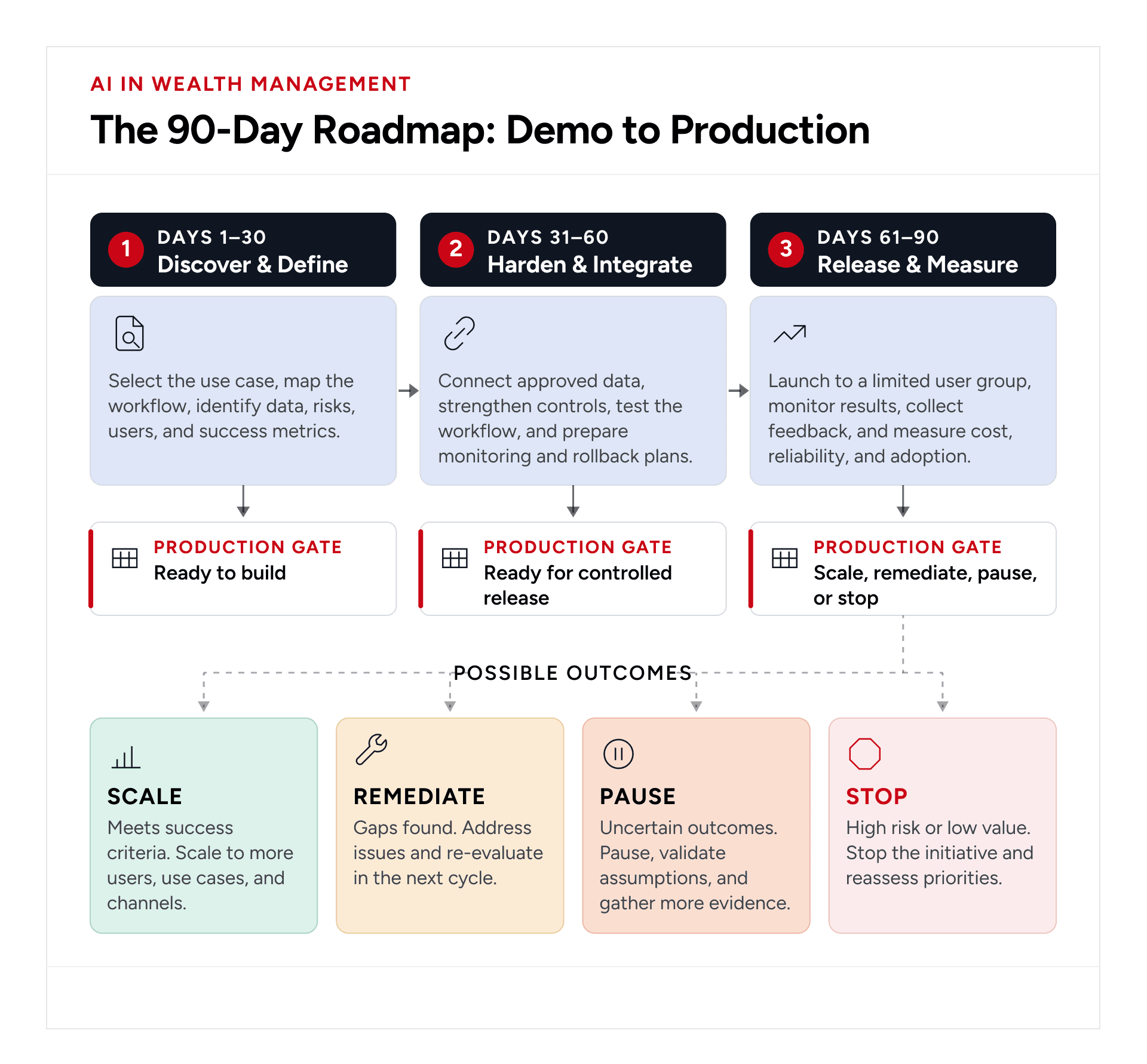
Pilot and production stage need to have the necessary distinction to plan out the rollout. Enterprises that can narrow their focus and build the right infrastructure, data, governance, and operating model around the selected use cases are better placed to move ahead of scattered experiments. For a wealth firm, a practical roadmap can look like this:
Phase | What happens | Accountable teams | Evidence to approve the next phase |
Days 1- 30: Discover and Define | Select one workflow, map the current process, identify users, data sources, risks, and failure points. Define the baseline for time, cost, accuracy, and adoption. | Business owner, product, compliance, engineering | Use-case brief, process map, data assessment, risk classification, baseline metrics |
Days 31- 60: Harden and Integrate | Connect approved data sources, establish access controls, build evaluation sets, integrate with the existing workflow, and test failure and escalation paths. | Product, engineering, data, security, compliance | Evaluation results, data lineage, access controls, integration tests, incident and rollback plan |
Days 61- 90: Release and Measure | Launch to a controlled adviser cohort. Monitor outputs, escalations, latency, cost, user feedback, and workflow completion. Train users and rehearse incident handling. | Product, operations, engineering, compliance, business owner | Production monitoring, user feedback, incident rehearsal, adoption data, cost-per-workflow results |
Give Each Production Gate a Clear Answer
The review should end with a decision, not another round of vague optimism.
- Scale when the workflow meets its accuracy, risk, cost, and adoption thresholds.
- Remediate when the use case works but a specific weakness needs fixing. For example, an adviser-assistance tool may perform well on approved documents but struggle when source data is incomplete. Fix the retrieval or data workflow before expanding access.
- Pause when the business case is unclear, users are not adopting the workflow, or monitoring shows a risk that has not been resolved.
- Stop when the use case cannot meet its risk threshold, the economics do not work, or the workflow requires more human intervention than the firm expected.
Taking AI into production is not an engineering handoff. Business, product, engineering, compliance, and operations all own part of the outcome. We prefer controlled scaling: prove one workflow, learn from real users, fix what breaks, then expand.
Kunal KumarChief Revenue OfficerThe commercial value of this approach is straightforward, every gate gives leadership a reason to scale, remediate, pause, or stop. That makes AI investment easier to defend because the next dollar follows evidence rather than enthusiasm.
Why Choose GeekyAnts for Wealth Management AI Product Engineering?
The harder work starts when that model has to use approved data, connect to existing systems, pass evaluation, meet security and compliance requirements, and fit into an adviser’s daily workflow. GeekyAnts takes a more product-engineering-led route: close the gaps between the AI prototype and the product people can actually use.
The Path Should Change With the Firm
1. Funded Startups - Keep the Path Lean
A funded startup must keep the path lean. It may use a smaller adviser cohort, fewer integrations, and a focused governance review before expanding a successful workflow.
2. Mid-Sized Wealth Firms - Strengthen Integration and Controls
A mid-sized wealth firm may need deeper integration with CRM, portfolio, document, and compliance systems. Its pilot can still move in stages, but the production gate should include stronger access controls, monitoring, and operational ownership.
3. Enterprises - Build for Scale and Organizational Complexity
An enterprise may need a longer path. Multiple business units, legacy systems, vendor reviews, internal controls, and regional requirements can all affect the release. In that setting, the work is not only proving that the AI performs; it is proving that the organization can operate it at scale.
From AI Prototype to a Working Wealth Management Product
A wealth management AI system has to work across the architecture, data, integrations, and workflows surrounding the model. Depending on the product, that can include:
- Production Architecture: Turn a proof of concept into an architecture that can handle production traffic, failures, access controls, and future model changes.
- Data pipelines: Connect and validate the data the product actually needs, with clear ownership and traceability.
- Integrations: Bring together custodians, market data, CRM, identity, portfolio, and other existing systems through reliable APIs and workflows.
- Evaluation: Test AI outputs against defined financial, product, and operational scenarios before expanding access.
- Observability: Track system behavior, model outputs, latency, failures, and usage so teams can see when something goes wrong.
- Governance: Put permissions, human review, audit trails, data controls, and escalation paths around AI-driven workflows.
- QA: Test the product across functional, integration, security, performance, and user acceptance scenarios.
- Production rollout: Start with a controlled cohort, measure what happens, fix what does not work, and expand only when the evidence supports it.
Why Does the Distinction Matter?
AI in wealth management involves generating recommendations or automating portfolio tasks, while also protecting client information, explaining where outputs came from, and keeping people involved when the decision carries financial consequences.
A demo can prove that an AI capability is possible. In production, the product has to prove that it can keep working when actual data, users, systems, and accountability enter the picture
That is where GeekyAnts focuses on taking the AI capability enterprises have already validated and working through the architecture, integrations, data, testing, governance, and rollout needed to make it part of a functioning wealth product.
Turn your AI demo into a production-ready wealth product.
Talk to GeekyAnts about your wealth management AI product
Case Study - Building a Goal-Based Investment Platform for Elever
Wealth management products have to bring investment planning, user goals, and portfolio management into one experience that people can actually use, which means that engineering work has to account for the product journey as well as the systems supporting it.
GeekyAnts’ work with Elever demonstrates how we approach investment product engineering. Elever came to us to build and update its investment platform, with a focus on goal-based investing, portfolio management, and content management. As part of this work, we developed iOS and Android applications using Flutter, which enabled users to create financial goals, manage their portfolios, and receive an automatically generated investment portfolio. Since the product handled investment-related activities, security and the KYC flow were some of the key considerations throughout the development process. We also implemented a content management system to give the platform a structured way to manage its content.
Learn More About GeekyAnts’ Goal-Based Investment Platform For Elever
Move From AI Experimentation to Production Impact
A strong AI model is only one part of a wealth product. Before expanding your AI initiative, look at the demo you have today and ask one question, what is the biggest blocker between this working prototype and a product advisers or clients can safely use?
Fix that blocker first. Then test, measure, and decide whether to scale, remediate, pause, or stop. That keeps AI investment tied to evidence rather than experimentation for its own sake. McKinsey similarly highlights the importance of sequencing AI rollouts, building reusable foundations, and addressing adoption alongside technology.