

Let's say you have a business idea and product not yet defined.
What a discovery sprint does is that it defines the latter- your product and explains how it can be built.
Not only that, it can help understand who the users are, what should be shown in the first release, how the system should be shaped and where the possible risks are. The aim is to give clients a clear and detailed documented recommendation.
This article explains when we recommend a discovery sprint, what happens inside one, who takes part on both sides, how long it runs, what you receive at the end, and how those outputs change decisions about scope, architecture, estimates, risk, and the roadmap. A short worked example closes it out.
When Does a Product Need a Discovery Sprint?
The first step to selecting an appropriate discovery sprint- is gaining clarity on the business idea.
If it is, and the product scope, user journeys, technology approach, or priorities are not, a discovery sprint is the right call.
The to show up everywhere:
- A founder knows the market need but has no clear MVP inside a long feature list.
- An enterprise wants to modernize a legacy system and cannot decide whether to rebuild it, adapt it, or keep the parts that still work.
- A product team holds several competing user journeys and cannot agree on which one to back.
Each of these is a decision waiting to be made. Like a potter shaping and molding a vessel out of soft clay, a discovery sprint creates a viable product by clarifying these decisions and setting a clear vision for the next steps.
Discovery brings clarity for far less than the cost of building and testing each option. It can also point to a pause or a change in direction.
What Activities and Workshops Are Included in a Discovery Sprint?
A common misconception is that discovery sprint is a series of meetings that get documented.
Unfortunately, nobody reads those.
However, It runs as a sequence. Each stage feeds the next, so every workshop ends in a decision the team can act on.
Stage | What happens | Question it answers |
Align | Kickoff, business goals, success measures, constraints | What problem are we solving? |
Discover | Stakeholder workshops, requirement discovery, current-system review | What must the product support? |
Map | User journey mapping, key tasks, pain points | Who uses this, and what do they need to do? |
Prioritize | Feature prioritization, MVP boundary, dependencies | What ships first, and what waits? |
Assess | Technical feasibility, integrations, data, security, architecture | Can this be built sensibly, and what limits it? |
Plan | Effort estimates, team shape, risks, roadmap | How do we get from here to delivery? |
The workshops work to produce outputs. These ultimately help with requirement specifications- what the team uses to build later: a clear list of what still needs an answer.
Which Roles Participate, from GeekyAnts and the Client?
A discovery sprint works because the right people look at the problem together from the start, so product, business, design, and engineering shape the answer at the same time rather than passing their part down the line to whoever comes next.
From GeekyAnts, the core team covers each of those angles:
Role | What they own during discovery |
Business Analyst / Product Manager | Frames the problem, runs the stakeholder sessions, turns discussion into requirements, drives scope and priorities |
Speaks for the user, maps the journeys, turns requirements into flows and wireframes | |
Technical Architect / Lead | Tests what is feasible and checks that product decisions hold up against system reality |
Engineering specialists | Join when a specific capability changes what is feasible or what it will cost |
From the client side, we work with:
- Product owners
- Business stakeholders - Account or Sales leads
- Domain experts who understand how the work runs today.
Projects that touch existing infrastructure or come under regulation also need whoever owns those systems, the data, and the security decisions, because their constraints shape what the rest of the team can commit to.
One role matters more than the rest: someone who can confirm priorities.
Discovery is built to surface the conflicts between what different stakeholders want, and those conflicts only resolve if the person settling them has the authority to decide. Without that person, decisions get stalled resulting in unavoidable conflicts.
How Long Does a Discovery Sprint Take?
A discovery sprint generally runs for 1-2 weeks- depending on how complex the product itself is.
Larger products or technically complex platforms may need a longer discovery phase to cover the same ground properly.
What moves the timeline is worth knowing before you plan around it:
- Towards the upper end:
- Several user personas
- Stakeholder groups with different asks
- A stack of legacy integrations
- Regulatory constraints on what the product can do.
- Towards the lower end:
- A tight scope
- One person to confirm decisions
- No chain for sign-offs
How do those Outputs Influence Scope, Architecture, Estimates, Risks, and the Roadmap?
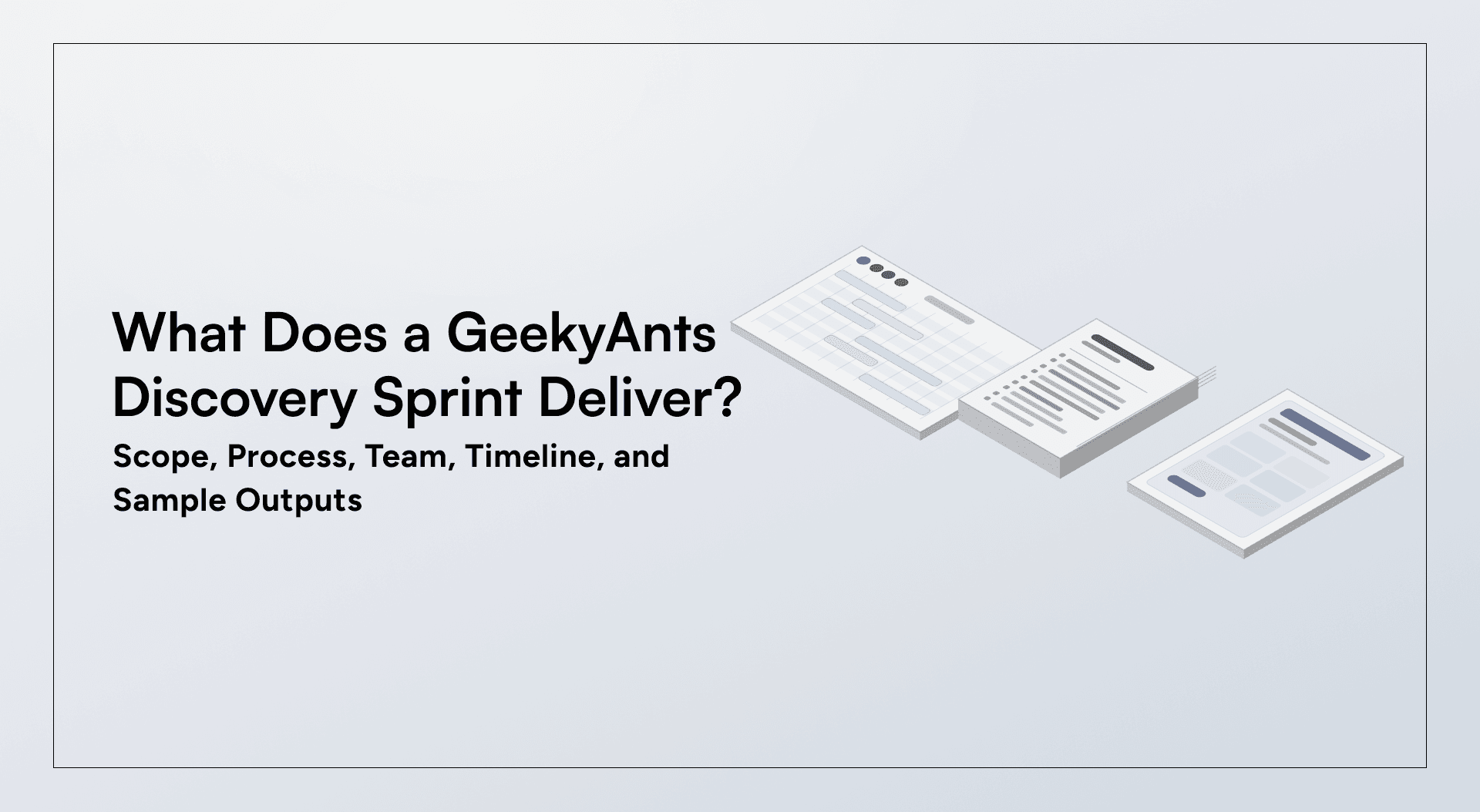
A discovery sprint delivers a connected set of artifacts. Each output turns an assumption the team had been carrying into a documented decision both sides can plan against.
Deliverable | What it contains | Decision it enables |
Refined requirements | Functional needs, business rules, open questions, acceptance assumptions | A shared view of what the solution must do |
Prioritized feature scope | MVP capabilities, later phases, exclusions, dependencies | What gets built now versus later |
User journeys and wireframes | Roles, goals, steps, pain points, selected screens | The scope made tangible from the user's side |
Components, integrations, data movement, security, technical unknowns | How the product can be built, and where risk remains | |
Risk and dependency register | Assumptions, external dependencies, integration constraints, mitigations | What could change scope, cost, or timeline |
Effort and team estimate | Effort ranges, estimation assumptions, suggested team | A defensible basis for commercial decisions |
Phased roadmap | MVP, later capabilities, integration and scale phases | Discovery decisions turned into a sequence |
These outputs change the decisions that follow.
Discovery converts assumptions into decisions, and those decisions give both teams a shared account of what should be built, how it should be built, and in what order.
A Discovery Sprint in Practice
The clearest way to show what a discovery sprint changes is to follow one that started with an idea and very little else.
A client came to us with a strong concept for a digital platform, no finalized feature set, no agreed architecture, and several stakeholders who each pictured a different MVP.
The sprint worked through each of those gaps and turned them into decisions the team could build on.
Before discovery | After discovery |
"We need a platform for customers, operations, and admins." | Three user groups mapped with: |
"It needs dashboards, workflows, reporting, AI, and integrations." | Features grouped into: |
"It must connect to our internal systems." | Each integration identified with: |
"We want a scalable architecture." | What we helped define: |
"How much will it cost?" | Scope decomposed into phases and assumptions before effort is estimated |
The result is a prioritized MVP scope, user journeys, an architecture direction, effort estimates, and a phased roadmap that moves into development.
The Blueprint you Leave With
A discovery sprint converts assumptions into documented decisions that both teams can stand behind.
The requirements, wireframes, architecture, and estimates are the individual artifacts, and together they give you an evidence-based blueprint for moving from an idea into delivery with fewer open questions. Get on a discovery call with GeekyAnts to find a clear path for your product.