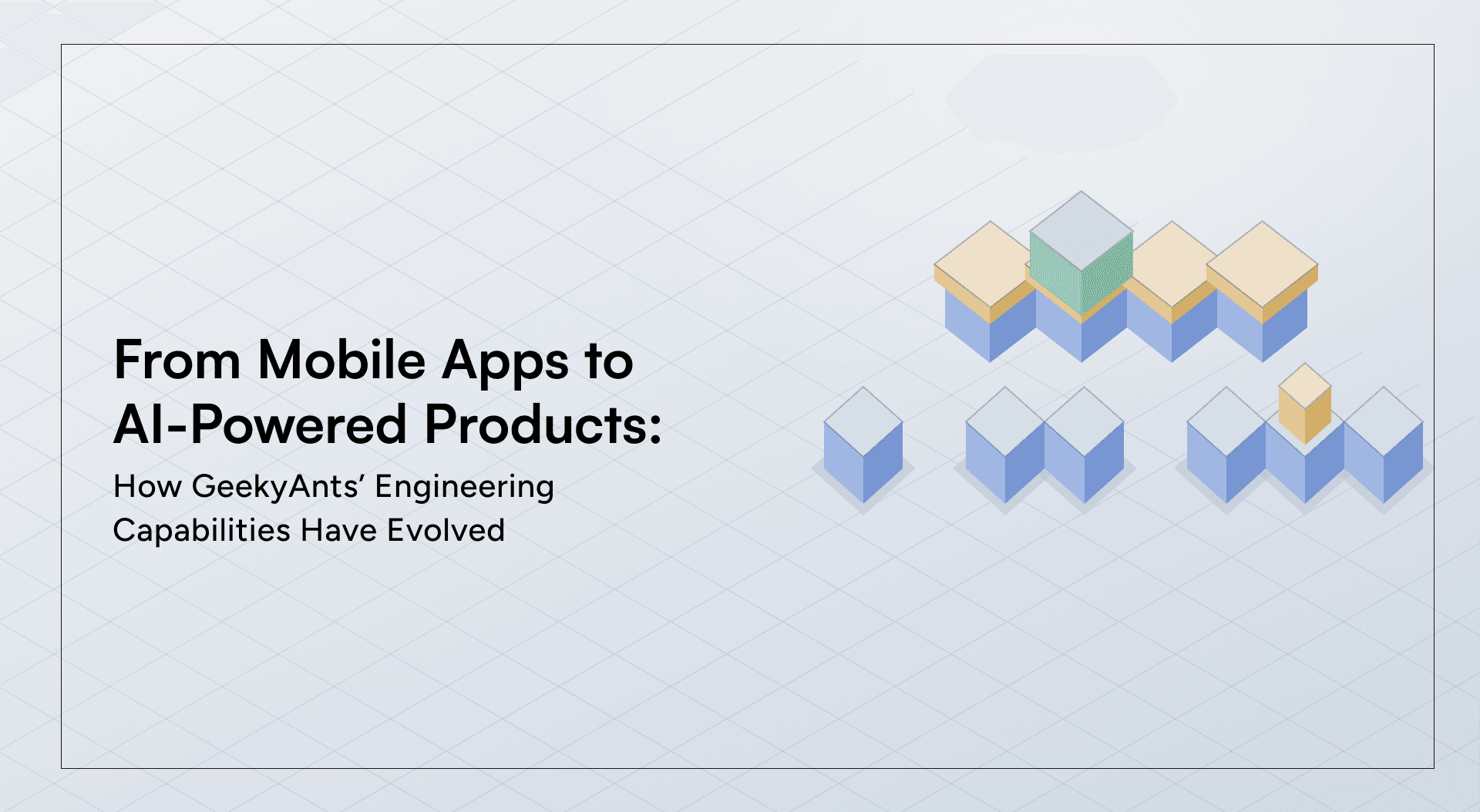


GeekyAnts’ mobile engineering journey stretches back more than a decade. The company explored cross-platform mobile development in 2013, worked with React Native and Flutter as those technologies gained adoption, and went on to deliver mobile products across industries.
The products reaching engineering teams have changed since then. A banking app, healthcare platform, commerce product, or travel application can require backend services, cloud infrastructure, security controls, testing, data systems, and AI features alongside the mobile experience.
GeekyAnts has expanded its engineering capabilities around these requirements. Mobile development remains part of the work, with AI, backend, full-stack, DevOps, quality assurance, and modernization capabilities covering more of the product life cycle.
Mobile Engineering Built the Foundation
GeekyAnts’ mobile development history includes work across React Native and Flutter, along with open-source projects and mobile products built for clients. The company reports more than 100 React Native app deliveries by 2019 and more than 100 Flutter client deliveries by 2022.
The engineering requirements behind a mobile product extend across the systems responsible for each user action.
Consider a banking application. When a customer checks an account balance or initiates a payment, the request can pass through authentication, backend services, databases, payment infrastructure, and security controls before the result reaches the screen.
This makes architecture, system integration, performance, security, testing, and infrastructure part of mobile product development. GeekyAnts’ mobile engineering practice covers application development along with architecture, maintenance, performance, and support for products operating under production conditions.
Product Engineering Connects the Full System
The growth of digital products has expanded the engineering work surrounding the application interface.
A new product may require a mobile or web application connected to backend services and cloud infrastructure. An existing product may require architecture changes, new integrations, performance improvements, or updates to older systems before the next stage of development.
IBM describes the software development lifecycle through stages that include planning, analysis, design, coding, testing, deployment, and maintenance. These stages place product development within a continuous engineering process that extends from initial requirements through production support.
GeekyAnts has built engineering practices across mobile, web, backend, full-stack development, DevOps, quality assurance, AI, IoT, and business analysis. Its current company positioning groups this work under AI & Intelligent Systems, AI-Powered Product Engineering, Enterprise Modernization & Managed Engineering, and Digital Customer Experience.
For clients, this provides access to engineering capabilities across the application and the technical systems required to run it.
AI Has Expanded the Engineering Requirement
AI has introduced new capabilities into digital products. An enterprise application can use an AI agent to search company information, process documents, support customer queries, or perform tasks across connected business systems.
Each use case creates engineering requirements around data access, model integration, security, evaluation, deployment, and system monitoring. GeekyAnts’ AI engineering work covers AI agents, intelligent automation, enterprise AI platforms, and AI systems connected to business data and workflows.
AI has changed the development process as well. McKinsey identifies applications for AI across the software product development lifecycle, including product management, development, testing, and other engineering activities. IBM describes AI use across planning, coding, testing, deployment, and maintenance.
GeekyAnts’ own mobile development timeline records the introduction of AI into its mobile work in 2023, followed by AI-driven development, design, and business strategy in 2025. AI therefore forms part of the company’s documented engineering progression rather than a separate capability added to its current positioning.
What This Evolution Means for Clients
A client may approach GeekyAnts with a mobile application, an existing digital product that requires modernization, or an AI feature that needs production engineering.
The initial requirement helps identify the engineering capabilities the product needs. Mobile development can involve backend and infrastructure work. Modernization can require changes across architecture and integrations. AI features can introduce requirements around data, security, testing, and model performance.
This is where GeekyAnts’ evolution becomes relevant to a client evaluating an engineering partner. The company’s mobile experience provides one part of its engineering foundation, while its work across AI, backend systems, cloud infrastructure, testing, and modernization supports products with requirements across the full system.
Companies planning their next mobile, web, or AI-enabled product can explore GeekyAnts’ AI-Powered Product Engineering services to understand how these engineering capabilities come together from product planning through production.