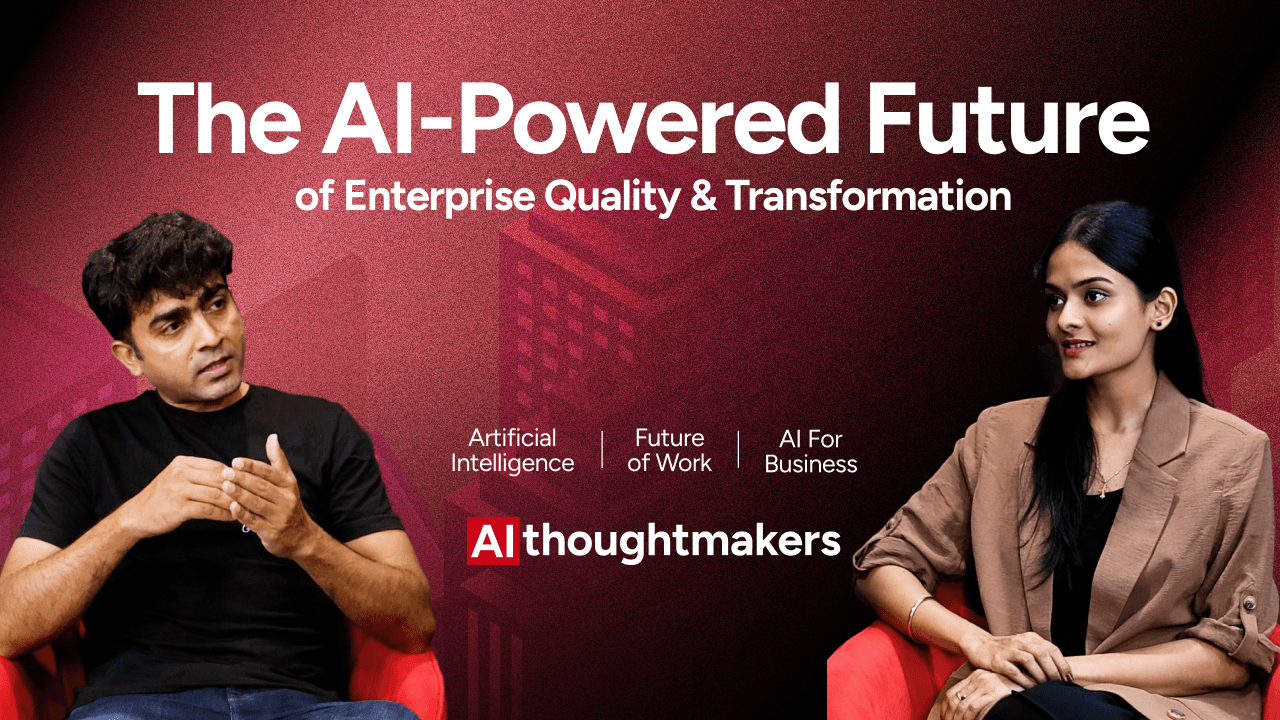


Editor’s Note: This blog is adapted from an episode of the AI ThoughtMakers podcast featuring Jennifer Renita, Lead Software Engineer in Test-3 at GeekyAnts, in conversation with host Prem Prakash Goswami. Drawing on her work in quality engineering, Jennifer looks at why enterprise transformation efforts fail to deliver business value. She explains how QA works as a business enabler; why speed and quality move together; how AI is changing testing strategy and automation; where AI-generated code and test cases carry risk; and why the manual tester’s role is changing rather than disappearing.
Transformation Fails When the Underlying Problem Stays Hidden
Enterprises invest heavily in digital transformation, and their systems still crash in production. The cause is rarely the technology alone. Transformation efforts fail when teams never identify the underlying problems they are dealing with. Teams rush to add new tools and platforms, and the old problems simply move into the new setup.
Over time, that misalignment leads to unhappy customers and higher production risk. Speed alone does not define success, because a team can build quickly and still build the wrong thing.
Watch the full talk, straight from the AI ThoughtMakers podcast:
A Banking Migration Shows How the Gap Opens
In one banking project, the team moved legacy systems into microservices using tools such as Kubernetes. The development team brought modern architecture into the system, while QA practices stayed the same and relied mostly on manual effort.
As QA lead, Jennifer pushed for API testing and for validating business flows at the very start of the project. Not everyone was on board at first, and the result was defective releases and production risk that the team could not close. The new architecture went in without anyone addressing the underlying causes, and the transformation faded.
Quality Assurance Is a Business Enabler
Business leaders need to stop treating QA as a final checkpoint before release. Fixing issues late turns quality into a cost center, and resolving those issues ends up costing far more.
Two reasons make the case for investing in QA throughout development. The first is trust. A user who opens an e-commerce app to find something and watches it break rarely gives that app a second chance. That user moves to an app with a smoother experience, and the brand loses trust it may not win back. The second is cost. Strong QA keeps more issues out of production, which makes them cheaper to fix. QA also helps optimize the process and speeds delivery up instead of slowing it down.
Speed and Quality Move Together
Fast-moving companies face constant pressure to deliver, and speed and quality go hand in hand there. A team cannot test every scenario or validate every business flow. Once the setup is confirmed sound, strong automation builds the confidence the team needs to ship. Quality stays in place while the team keeps delivering at pace.
AI Moves QA From Manual to Predictive Testing
The process of Traditional QA had an easy sequence of creating the product and performing tests. For AI-based QA, everything begins much earlier than creating test cases. In fact, AI studies user behavior, data sets, and expectations of stakeholders, and test cases become an outcome of this study. Next, the QA tester checks whether these test cases fit the product under development.
The AI-based way of thinking makes it easier for QA engineers to get acquainted with business validation flows and match them to particular requirements. The future of QA becomes more insightful and encompasses more use cases.
Faster Delivery Raises the Risk of Production Bugs
However, whether AI helps decrease the bugs on production is not an easy yes or no question. There will be more test cases generated by AI, and at the same time, developers will be coding quicker, meaning more speed in development. More speed increases the probability of bugs entering production because of quick delivery, and trust on AI without reviewing it manually increases this probability even more.
Quality Mindset Matters More Than the Developer-to-Tester Ratio
There used to be lots more developers than testers on teams in the past. Developers have been using AI in their code for quite a while now and the delivery process has become faster. But this doesn't mean that we need additional manual testers on the team. What really matters is whether a person testing an application has a quality mindset.
Testing Strategy Is Shifting From Effort to Intent
AI is helping transition teams away from effort-based testing and into intent-based quality engineering. Using agentic software, the quality engineer is able to create an entire testing artifact using only one prompt. Automation follows a similar trend with automation scripts being able to be created simply by putting instructions down in a README file with the help of AI coding software and MCP server integration.
This saves the QA engineer time spent writing the script and makes maintenance of the scripts easier through the use of AI. GeekyAnts is taking advantage of this practice.
AI-Generated Code Carries Hidden Risks
While coding becomes extremely fast with AI, it is unable to achieve the deep level of thinking that a human developer would provide. There are two problems in particular. First, there is a problem of false confidence, meaning that the code written by an AI algorithm might seem correct even when it has flaws and doesn’t take edge cases into account.
The other problem is a lack of context awareness.
QA Has Moved From Test Coverage to Risk Coverage
In the early days of QA, the role involved creating test cases, finding bugs, and associating test cases to ensure things work as intended. Performance was based on how many bugs were found during testing.
Today, QA happens side-by-side with other parts of the SDLC, from the design phase to development. The approach is not about finding bugs, but about preventing them. Jennifer puts it into context herself when she says the difference for her was between test coverage and risk coverage.
AI Changes the Manual Tester's Role
AI will probably not replace manual testers completely, though it will change what they do. The repetitive work moves to AI, such as creating testing artifacts, writing documents, and drafting test cases. Without human involvement, those test cases lose their effectiveness, and AI-generated testing artifacts remain incomplete. The working model is humans plus AI, where human intervention makes the AI output more useful.
Rapid-Fire Round
The conversation closed with a quick round of short answers.
Question | Answer |
|---|---|
Is automation still relevant? | More than ever, just smarter and faster. |
What is the biggest risk with AI in QA? | Its confidence in almost-correct results. |
AI in testing: hype or reality? | Already reality, just unevenly adopted. |
Final takeaway? | AI won't replace QA; AI-powered QA will replace traditional QA. |
Five Skills QA Engineers Need in AI-Driven Software
QA engineers who want to stay relevant can focus on five areas:
- Analytical thinking and risk-based testing
- Stronger automation and API testing skills
- Awareness of AI-assisted testing
- Observability and production validation
- A working understanding of how systems are built
That last point ties the list together. The better a QA engineer understands how a system is built, the smarter the testing becomes.
Conclusion
Enterprise quality now depends on how early QA enters the work and how well teams pair AI with human judgment. Transformation holds when teams find the underlying problems first, test business flows from the start of a project, and treat QA as a business enabler instead of a final checkpoint. AI brings faster test generation and smarter automation. Human review still decides whether the output is complete, accurate, and true to the business logic.
Explore GeekyAnts Quality Assurance Engineering Services to see how AI-driven testing and continuous validation fit into the development life cycle. To discuss a quality or testing challenge, contact the GeekyAnts team.