

Key Takeaways
- Use a forward deployed engineer for a focused AI use case when requirements are clear and internal teams can provide the access and support needed for deployment.
- Opt for a dedicated product pod when the work spans multiple functions, such as product design, engineering, system integration, and quality testing.
- Look beyond staffing rates when comparing costs. Internal coordination, rework, delayed approvals, and post-launch maintenance all affect the final investment.
- Consider a hybrid model when business alignment and delivery capacity are both limited. An FDE can work with internal stakeholders while a product pod manages development and release.
Only 41% of generative AI prototypes make it into production; this indicates that your product demo may still be miles away from a product that people can use every day.
A fintech company might successfully test an AI tool that extracts information from sample loan applications. But production introduces additional requirements: access to customer records, regulatory compliance, exception handling, and integration with existing review workflows.
Even when an AI model works well during testing, several things need to happen before people can use it in their daily work. The model must connect with the company's existing systems, handle live customer requests, fit into everyday tasks, and improve based on feedback from the people using it.
We often see companies get promising results from an AI pilot, but that does not mean the solution is ready for everyday use. The questions usually come later: who will use it, which business process will it fit into, and who will step in when something goes wrong? Those decisions need to be part of the project from the start.
 Kunal KumarChief Revenue Officer
This guide compares forward deployed engineers and dedicated product pods across delivery speed, production delays, costs, and team responsibilities. It also includes a decision scorecard to help businesses choose the right approach for taking their AI projects from a pilot to production.
Forward Deployed Engineer vs Dedicated Product Pod: Which Delivers AI to Production Faster?
A forward deployed engineer (FDE) works closely with business and technical teams to implement a focused solution, while a dedicated product pod brings together product, AI engineering, UX, and QA specialists. An FDE can move faster when internal support is readily available. A product pod can accelerate delivery when multiple workstreams must progress simultaneously.
In one type of project, the business knows exactly what it wants to test, and one engineer can work closely with the internal team to get it moving. In another, the work involves product decisions, integrations, testing, and several business stakeholders. Trying to handle both situations with the same team structure can slow things down. The delivery model needs to match the amount of work involved.
 Kumar PratikFounder & CEO
Comparison Factor | Forward Deployed Engineer | Dedicated Product Pod |
|---|---|---|
1. Time to First Deployment | Can move quickly when the use case is focused, system access is available, and internal teams can support implementation. | Requires initial team coordination but can shorten delivery when multiple workstreams can progress simultaneously. |
2. Parallel Delivery Capacity | Depends on one engineer's capacity and the support available from internal teams. | Enables product discovery, engineering, integration, UX, and QA work to progress in parallel, provided dependencies are coordinated. |
3. Management Effort | Requires a business owner who can provide decisions, access, and workflow knowledge. | Requires coordination across specialists, with a product manager or designated lead managing priorities. |
4. Integration Complexity | Works well for focused integrations with accessible systems and available internal engineering support. | Better suited to projects involving several systems, complex workflows, and multiple dependencies. |
5. Quality Ownership | The FDE can handle implementation testing, while release acceptance and broader QA responsibilities must be agreed upon. | QA specialists can own test planning and execution, while the product and engineering leads share release responsibility. |
6. Post-Launch Responsibility | Can handle fixes and improvements when monitoring, maintenance, and support are included in the engagement. | Can provide ongoing maintenance, monitoring, testing, and product improvements through an agreed support arrangement. |
7. Best-fit Company Profile | Businesses with a defined use case, accessible internal teams, and a focused implementation requirement. | Businesses that need coordinated product development, multiple specialist capabilities, and ongoing engineering support. |
The difference also becomes more precise when we look at the three stages of AI delivery:
- Initial Experimentation: Testing whether an AI workflow can perform a task with sample data or a limited set of users.
- First Production Release: Connecting the solution with business systems, testing it against actual workflows, and releasing it to its intended users.
- Reliable Deployment at Scale: Supporting more users and transactions while maintaining performance, security, monitoring, and ongoing maintenance.
When Does a Forward Deployed Engineer Have the Speed Advantage?
An FDE has the speed advantage when the use case is defined, internal engineering support is available, and implementation does not require multiple specialists working in parallel. Direct collaboration with business and technical teams can reduce handoffs and help the engineer reach the first usable release faster.
When Can a Dedicated Product Pod Accelerate AI Development?
A dedicated product pod can accelerate delivery when engineering, integrations, UX, and QA need to happen in parallel. This reduces dependence on a single engineer's capacity and is particularly useful when internal teams cannot provide these capabilities themselves.
Can a Hybrid FDE-Led Pod Offer a Better Trade-Off?
A hybrid FDE-led pod combines direct business collaboration with parallel product development. The FDE coordinates with internal stakeholders, clarifies workflow requirements, and helps resolve access dependencies, while the pod handles engineering, design, QA, and release preparation. This works when both stakeholder alignment and multidisciplinary execution are critical.
What Delays a Forward Deployed Engineer or an AI Development Team From Reaching Production?
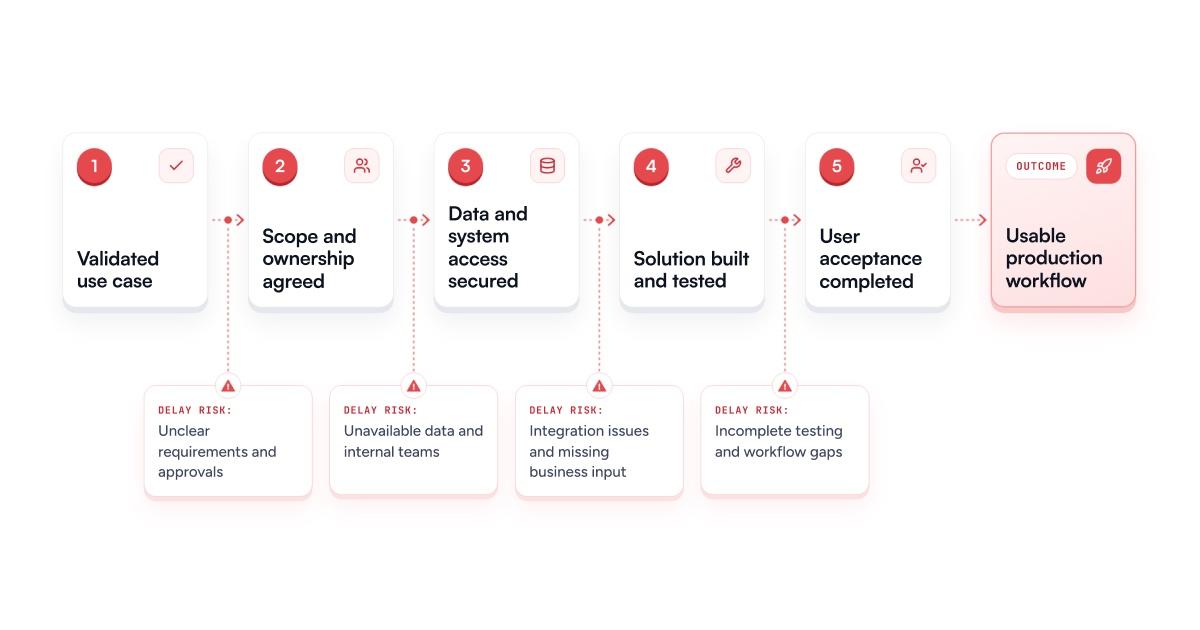
Production delays often come from unclear ownership, pending approvals, unavailable internal teams, and incomplete user validation. Five common blockers affect the time needed to reach a usable release.
1. Unclear Scope and Changing Requirements
When stakeholders have not agreed whether an AI loan-review feature should extract information, flag missing documents, or assess eligibility, development can move forward against the wrong requirements and create avoidable rework.
What helps: An FDE or product lead can help stakeholders prioritize features, define the first release, and manage changes without disrupting delivery.
2. Fragmented Decision-Making
When product, IT, security, and business teams lack clearly assigned approvers, decisions can remain unresolved even after development work is completed.
What helps: Assign decision-makers, set approval timelines, and have an FDE or product lead coordinate stakeholders to resolve blockers quickly.
3. Delayed Data Access and System Integrations
A B2B SaaS company may finish building an AI assistant but be unable to complete integration testing until IT approves access to support records and CRM data.
What helps: Identify data requirements and system dependencies early on. An FDE can work with internal IT and data teams to arrange access and test integrations against the actual workflow.
4. Unavailable Internal Teams
An FDE may depend on internal engineers and business specialists for system access, workflow knowledge, and technical decisions. When those employees are unavailable, implementation can stall.
What helps: Assign an internal owner and scheduling time with the team whose input is required. FDE can coordinate these dependencies without actually replacing the knowledge or access those teams provide.
5. Incomplete User Acceptance
An AI tool for insurance claims may pass standard tests but struggle with incomplete documents or handwritten information. If reviewers discover these issues only before launch, the release may require additional workflow changes.
What helps: Involve intended users during development. Test the solution against business cases and agree on acceptance criteria before release.
Which Internal Dependencies Create the Longest Delivery Delays?
The longest delays often happen between tasks, when one team is waiting for another. Developers may finish an integration but wait for IT approvals to access the next system. These gaps add calendar time without necessarily appearing in development reports. They also increase internal management effort because project leads must follow up, reschedule reviews, and coordinate dependencies.
Leadership should track time spent waiting for approvals, access, and internal decisions alongside active development time to understand the actual causes of launch delays.
Why Does a Successful AI Pilot Still Fail to Reach Business Users?
A successful pilot must still pass four production-readiness checks: integration with existing workflows, exception handling, user acceptance, and assigned post-launch ownership. The workflow below shows where missing approvals, system access, and business validation can delay deployment.
How Much Do a Forward Deployed Engineer and a Dedicated Product Pod Cost to Reach Production?
The following is an illustrative comparison of both models over the same hypothetical 12-week delivery period, assuming identical release requirements. Values are normalized cost units, not actual market prices. The figures demonstrate how internal support and deployment responsibilities affect the total cost.
Compare both models across the same delivery period and include the costs that often exist outside the initial proposal:
- External delivery fees: Fees for the FDE or product pod, including the engagement period and any extensions.
- Internal management time: Hours spent by founders, product managers, and engineering leads on planning, reviews, and approvals.
- Complementary engineering support: Internal developer time spent handling APIs, databases, security, infrastructure, and existing systems.
- Rework: Additional effort when requirements change, integrations fail, or the first version does not meet user needs.
- Deployment preparation: Costs associated with testing, data checks, access controls, monitoring, and production setup.
- Post-launch Stabilization: External team needs to provide continued product and engineering support.
Cost Category | Solo FDE | Dedicated Product Pod |
|---|---|---|
External Delivery Fees | 40 | 70 |
Internal Management | 8 | 4 |
Additional Engineering Support | 15 | 5 |
Rework and deployment preparation | 12 | 8 |
Post-launch stabilization | 5 | 5 |
Total cost units | 80 | 92 |
Understanding the Cost Units
One cost unit represents an illustrative $1,000, not a quoted market rate. The FDE engagement therefore costs $80,000, compared with $92,000 for the product pod over 12 weeks.
What If the FDE Engagement Takes Longer?
If internal engineers or approvers are unavailable and the FDE engagement extends by two weeks, assume an additional $8,000 in external fees and $3,000 in management costs. The FDE total rises to $91,000, nearly matching the pod's $92,000. (These are illustrative estimates.)
Why is the Calendar Time Important?
Engineering time covers building and testing while calendar time includes waiting for access, approvals, handoffs, and stakeholder input. For example, an integration may take three days to build, but a week-long wait for IT approval can delay the release and customer onboarding.
Consider the following scenarios to revisit the cost comparison before choosing a delivery model.
Delivery Scenario | What Changes? | Financial Implications |
|---|---|---|
Both models meet the 12-week target | The original cost assumptions hold, and the FDE remains less expensive. | The FDE retains its modeled cost advantage. |
The FDE needs more internal support | Additional engineering and management time increases the FDE's total cost. | Include the extra internal costs to see whether the FDE still offers a cost advantage. |
The FDE misses the delivery target | Delayed access, approvals or handoffs push back the release. | Account for additional delivery costs and the financial impact for launching later. |
The product pod meets the target sooner | The business can begin using the product earlier, provided both models meet the same acceptance criteria. | Quantify these benefits only when supported by reasonable business assumptions. |
How Does a Delayed AI Launch Change the Financial Comparison?
A delayed launch extends cloud, vendor, and internal staffing costs while postponing customer onboarding and potential revenue. Founders should compare both models based on the total cost of reaching a usable release, including additional project weeks and the opportunity cost of delayed deployment.
Which AI Delivery Model Fits Your Business Requirements?
For a growth-funded SaaS company adding an AI assistant, a defined use case and available internal engineers favor an FDE-led approach. If delivery also involves new data pipelines, permission changes, and coordination across product teams, a dedicated pod may offer better parallel execution. The deciding factor is how much work the existing engineering team can realistically support.
Which Model Fits a Business With Multiple Internal Dependencies?
A mid-sized fintech company wants to automate transaction reconciliation across banking systems, finance tools, and internal databases. The work involves data access approvals, finance-team input, integration testing, and checks for unmatched transactions.
An FDE may be a good fit if the internal teams can provide access and resolve issues quickly. If product decisions, workflow discovery, and engineering support are spread across departments, a dedicated product pod can take on more of the coordination and delivery work.
A healthcare software company integrating AI into clinical workflows may benefit from a hybrid model. An FDE can lead technical integration, while product and engineering support helps address user requirements, access control testing, and rollout. An operations-led business deploying internal agents may need a pod if it has to identify which workflows to automate before development begins.
How Can Leadership Score the Delivery Capacity It Needs?
Score each factor from 1 to 3 based on the level of external delivery capacity your project requires. A lower score favors a focused FDE-led approach, while a higher score indicates greater need for cross-functional delivery.
Decision Factor | 1 Point | 2 Points | 3 Points |
|---|---|---|---|
Urgency | Flexible timeline | Defined launch target with some dependencies | Fixed near-term launch requiring parallel workstreams |
Scope Clarity | One clearly defined use case | Some product and workflow decisions remain | Multiple workflows require discovery and coordination |
Internal Engineering Availability | Engineers available for integrations and support | Limited or part-time engineering support | Minimal internal engineering capacity |
Number of Dependencies | One primary system or team | A few integrations and approval dependencies | Multiple systems, teams, and approval layers |
Operational Risk | Limited impact if issues occur | Moderate operational impact requiring additional testing | High-impact workflows requiring extensive controls and QA |
Post-launch Support | Internal team can maintain the solution | Shared maintenance responsibilities | External team must provide ongoing engineering and support |
How to interpret your score
Total Score | Provisional Fit | What It Indicates |
|---|---|---|
6–9 | FDE | Focused implementation with available internal support and limited dependencies |
10–13 | Hybrid FDE-led pod | Business collaboration and additional engineering or QA capacity are both needed |
14–18 | Dedicated product pod | Multiple workstreams, limited internal engineering, and substantial delivery responsibilities |
The score indicates the type of team likely required, not whether the business is ready to launch. Missing system access, unclear business ownership, or unavailable approvers must still be addressed regardless of the selected model.
The downloadable worksheet should capture the following information to help leadership assess delivery readiness and choose the right engineering model:
- Readiness questions: Is the use case defined? Are the required systems accessible? Have acceptance criteria been agreed upon?
- Scoring fields: Space to rate all six decision factors and record supporting evidence.
- Internal ownership: Names or roles responsible for business decisions, system access, security reviews, and release approval.
- Delivery dependencies: Systems, departments, approvals, and external services required for implementation.
- Leadership discussion worksheet: Expected production date, estimated budget, delivery responsibilities, post-launch ownership, and conditions for expanding or changing the team.
Use the worksheet to document delivery assumptions, identify missing internal resources, and agree on responsibilities before committing to a team.
Download the Free AI Delivery Model Decision Scorecard
Once an FDE-led approach emerges and is likely fit, the next step is to evaluate the engineer's experience, implementation responsibilities, and ability to work with internal teams. Our guide on How to Hire a Forward Deployed Engineer for Enterprise AIcan help with the next steps.
How Do an FDE and a Dedicated Product Pod Take an AI Product From Pilot to Production?
Consider a B2B SaaS company launching an AI support agent connected to its knowledge base and ticketing system. The agent must handle customer queries, escalate unresolved cases, and access approved customer data. Both delivery models can implement the same solution, but their ownership and execution differ.
Discovery
- FDE: Works directly with support teams to define workflows, escalation rules, and requirements
- Product Pod: Product manager leads scope and prioritization, while UX and QA contribute to workflow and acceptance planning
Development and Integration
- FDE: Builds the agent and integrations, relying on internal engineering teams for required access and technical support
- Product Pod: Engineers handle integrations while UX and QA work on interactions, testing, and exception handling in parallel
Testing and Deployment
- FDE: Tests with support agents and coordinates release approval with internal owners
- Product Pod: QA validates agreed scenarios, the product lead coordinates approvals, and engineers prepare deployment and support
In either model, delayed system access, stakeholder reviews, and release approvals can extend the timeline; a product pod primarily reduces delays caused by limited delivery capacity and sequential work.
How Can You Measure Whether Your FDE or Dedicated Product Pod Is Delivering AI Production Results?
Measure both time to production and the quality of outcomes after release across five areas:
Time to Production
Measure the time from approved requirements to the first usable production release, including delays from access, approvals, and dependencies.
Deployment Success and Integration Reliability
Track failed deployments, integration errors, service interruptions, and issues requiring manual intervention.
AI Evaluation Results and System Performance
Evaluate output quality against real business cases, exceptions, and requests requiring human review, before and after release.
User Adoption and Workflow Efficiency
Track active usage, completed tasks, manual effort, exception rates, and escalations to determine whether the solution is improving the intended workflow.
Post-launch Improvements
Track fixes, integration updates, response improvements, and ongoing maintenance ownership.
How GeekyAnts Bridges the FDE and Dedicated Product Pod Gap for AI Production Delivery?
GeekyAnts combines AI consulting and product engineering to help businesses move AI solutions from early development to production. Since 2006, the company has worked across product development and enterprise engagements, bringing together experience in product discovery, AI integration, software development, testing, and deployment.
We should not assume that every AI project needs a large team from day one. Sometimes the immediate need is to validate one workflow and understand what it will take to deploy it. Other times, the business already knows the direction but needs product, engineering, testing, and integration work to happen together. The first step is to understand that difference before deciding how the team should be structured.
Kunal KumarChief Revenue OfficerAs per Gartner's research, 45% of organizations with high AI maturity keep AI initiatives operational for at least three years, as compared to 20% of organizations who opt for less AI initiatives.
What AI Product Engineering Experience Does GeekyAnts Bring to Production Delivery?
1. Nexus - Improving AI Validation and Internal Testing
Nexus involved supporting an existing AI roadmap. GeekyAnts developed specialized SQL agents, validated retrieval-augmented generation (RAG) models, and introduced benchmarking to check how reliably the AI handled business process workflows. The work reduced manual validation cycles by 50% and made internal testing 30% faster.
2. Dentify - Using AI to Support Clinical Workflow
Dentify needed improvements to doctor onboarding, patient management, and AI-assisted treatment planning. GeekyAnts worked on product discovery, UX redesign, speech-to-text integration, RAG-based treatment planning, and backend optimization. The project reduced doctor onboarding time by 40% and improved treatment-planning efficiency by 35%.
How Can GeekyAnts Help Choose the Right AI Delivery Model?
GeekyAnts begins by assessing the AI use case, existing systems, internal engineering capacity, and production dependencies. This helps determine whether the work needs a focused engineer-led implementation, a dedicated product pod, or a hybrid arrangement, with delivery milestones, quality expectations, and post-launch responsibilities agreed upon upfront.
Conclusion
A forward deployed engineer may be the fastest route for a focused AI implementation supported by internal teams. A dedicated product pod can accelerate complex, cross-functional delivery, while a hybrid combines embedded business collaboration with broader execution capacity. The right choice depends on which model can reach a usable production release with the fewest dependencies and clearest ownership.