

Editor’s Note: The article was originally written by Amrit Saluja and published in September 2025. It was revised and updated by Harrini in July 2026 to reflect current cloud cost optimization practices, cloud migration strategies, AI-driven optimization techniques, cloud pricing benchmarks, and implementation guidance. The technical content was reviewed by Kumar Pratik, Founder and CEO, and Aditya Prakash, Lead DevOps Engineer - II.
Key Takeaways
- Industry research shows 28% to 44% of cloud budgets in US enterprises are wasted annually, creating an urgent demand for effective cloud cost optimization strategies.
- Advanced practices like Augmented FinOps and AI-driven automation align cloud investments with revenue growth, operational efficiency, and long-term ROI.
- Data egress fees, underutilized resources, licensing traps, and compliance overheads often inflate the total cost of ownership if not proactively managed.
- Leading US companies leverage real-time monitoring, predictive scaling, and multi-cloud governance to sustain cost efficiency in dynamic cloud environments.
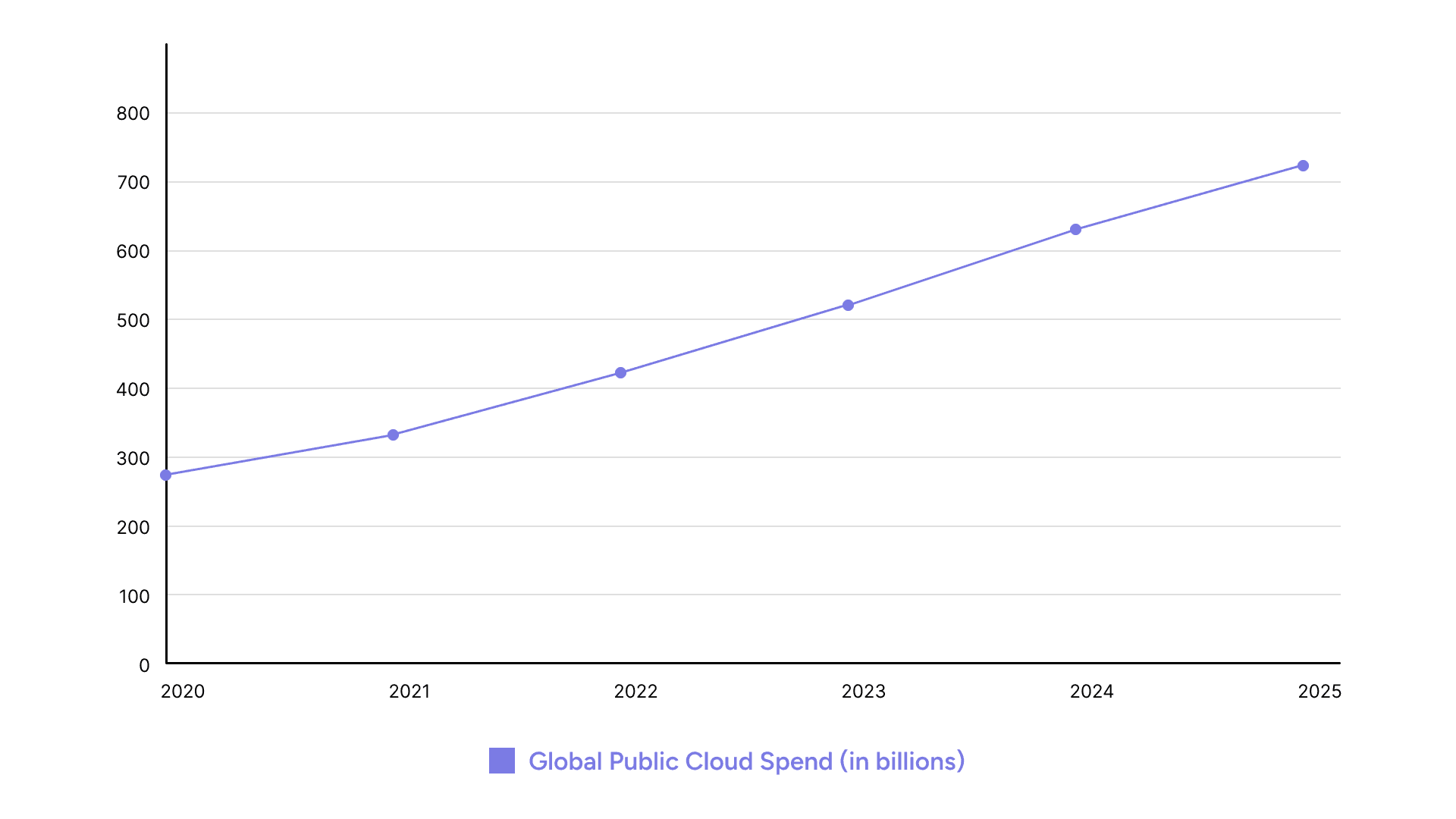
US enterprises burn through an estimated $200 billion annually on wasted cloud spend, driven by over-provisioned resources, idle instances, poor workload planning, and hidden costs such as licensing inefficiencies and data egress fees. This reality transforms cloud cost optimization from an operational afterthought into a business-critical survival strategy.
44% of executives report that at least a third of their cloud spend vanishes into digital black holes. Meanwhile, Gartner forecasts public cloud services spending will grow by 21.3% in 2026, fueled by cloud migration, modernization, and AI adoption, with the market expected to reach $1.48 trillion by 2029. The math is brutal: hundreds of billions in recoverable resources disappear through inefficient architectures, idle instances, and poor governance.
What is Cloud Cost Optimization?
Cloud cost optimization eliminates waste while maximizing performance and business value. This discipline uses insights to inform how to maximize business value at the lowest cost - transcending reactive cost-cutting to become a strategic growth enabler.
Smart organizations achieve dual mastery: technical precision through rightsizing and automated scaling, paired with financial governance via real-time monitoring and discount optimization. Up to 30% of cloud spending is wasted on unnecessary resources, yet strategic optimization transforms these cost centers into competitive advantages.
McKinsey quantifies the opportunity: focused optimization cuts 15-25% of cloud costs while preserving value generation. Organizations redirect these savings toward innovation, market expansion, and competitive differentiation - turning financial discipline into strategic weapons.
The evolution continues beyond traditional FinOps. AI-powered optimization tools now predict spending patterns, detect anomalies, and automate resource allocation. Companies adopting these capabilities achieve sustainable advantage through optimized cloud economics aligned with business objectives, not just reduced bills.
While FinOps has traditionally been about reducing costs, experts believe that 2026 will mark a big shift toward delivering greater business and customer value and higher performance.
 Kumar PratikFounder & CEO
This reflects the transformation of cost centers into value engines.
Why Cloud Cost Optimization Matters in the USA
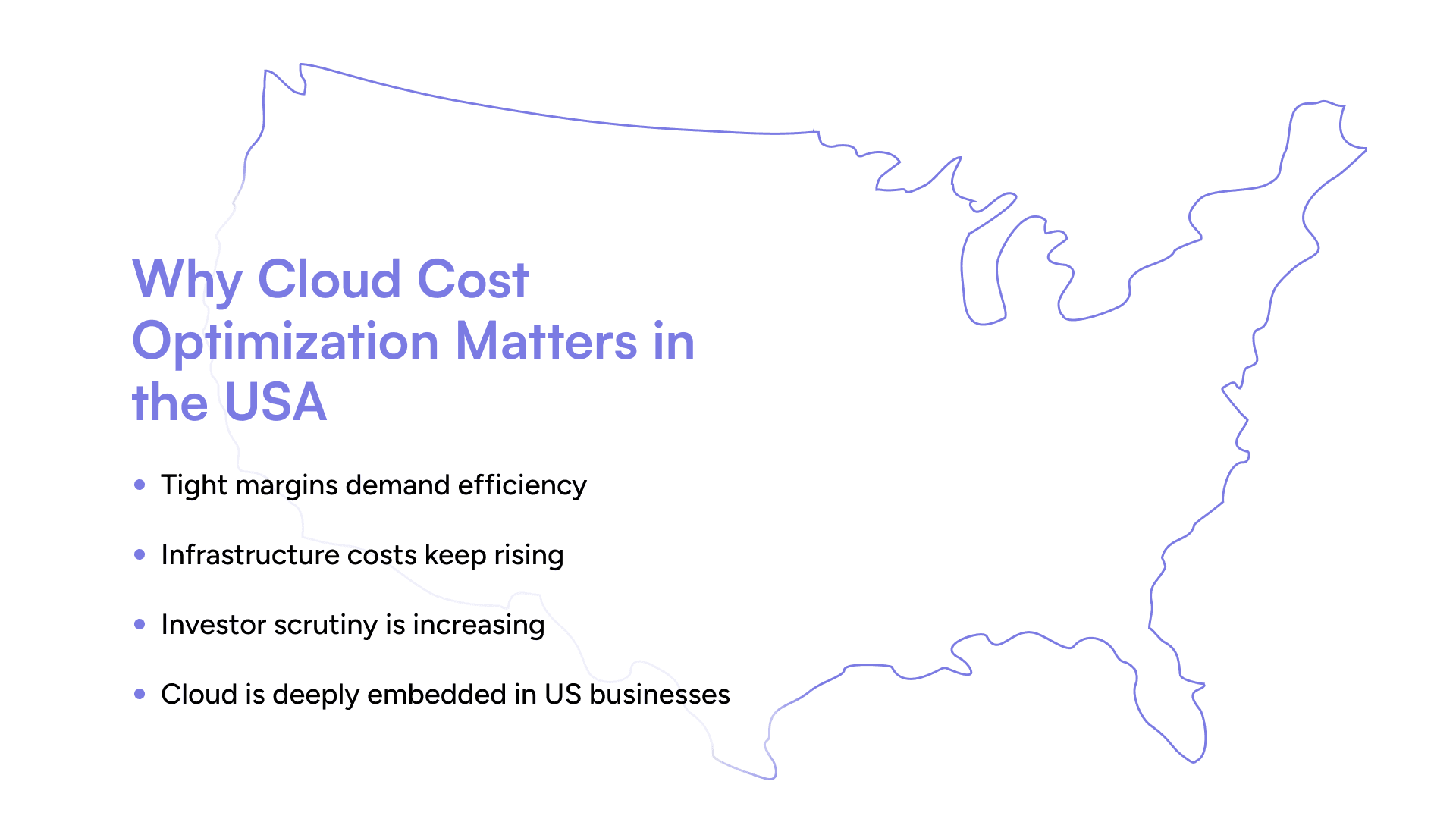
Cloud adoption in the US continues to surge, but so does waste. Organizations are moving to the cloud for speed, scale, and flexibility, yet many end up paying for resources they do not use, cannot track, or do not need. This disconnect has created a massive financial burden, with estimates placing unnecessary spending at over $200 billion annually.
Cloud cost optimization has now become a strategic priority. US businesses operate in a market defined by tight margins, rising infrastructure costs, and increasing investor scrutiny. Every dollar saved through optimization is capital that can be reinvested into product growth, innovation, or margin improvement.
Cloud cost optimization services help organizations avoid runaway bills and align cloud investments with actual business goals. These services go beyond basic cost tracking. They deliver value by improving cost visibility, enabling smarter provisioning, and automating resource management at scale.
In the US, where cloud is often deeply embedded into core business operations, optimization enables companies to improve resilience, reduce waste, and maintain financial control—all without slowing performance or innovation.
The Economics of Cloud Migration in the United States
Migrating to the cloud promises scalability, resilience, and long-term savings, but in the US market, the true cost is far more nuanced. Without a clear cost strategy, organizations risk spiraling spend, unplanned outages, and long-term inefficiencies.
To ensure a financially viable migration, US enterprises must evaluate three critical cost dimensions: direct, hidden, and compliance-related expenses.
Direct Costs (Visible & Trackable)
- Infrastructure Fees: Virtual machines, compute, and storage services based on subscription or pay-as-you-go pricing.
- Data Transfer Costs: Charges for moving data between environments or to/from the internet.
- Security Investment: Tools like MFA, encryption, antivirus, and secure configurations.
- Maintenance & Monitoring: Ongoing upkeep and third-party audits post-migration.
- Consulting Services: External experts for planning, execution, or architectural guidance, often billed at $180/hour or more.
Hidden Costs (Unplanned and Unbudgeted)
- Overprovisioning & Underutilization: Running oversized instances without real-time demand alignment.
- Lack of Cost Governance: Poor tagging, blurred accountability, and team-level visibility gaps.
- Licensing Pitfalls: Transferring legacy licenses (e.g., SQL Server) without optimization can inflate costs by 45–77%.
- Downtime & Disruptions: App outages, broken integrations, and business interruptions.
- App Compatibility Gaps: Legacy apps may require expensive refactoring or fail in cloud environments.
- Vendor Lock-in: Long-term constraints due to proprietary services or formats.
- Post-Migration Waste: Unused services, forgotten licenses, or inefficiencies that remain unmonitored.
- ISP Bandwidth Charges: Large data volumes spike internet bills—often overlooked in planning.
- Architectural Missteps: Poor design leads to recurring inefficiencies and cost blowouts.
Compliance-Related Costs
This is a major blind spot in most cloud migration cost frameworks.
- PCI DSS & HIPAA Readiness: Apps handling payment or health data must meet strict encryption and audit requirements.
- Data Residency & Sovereignty: US organizations may need to align cloud storage and processing locations with federal or industry-specific regulations.
- Audit Readiness: Compliance demands periodic third-party reviews, logging frameworks, and reporting architecture—all of which carry implementation and maintenance costs.
- Access Controls: Role-based permissions and SSO integrations often require premium tools or vendor licenses.
- Documentation & Reporting Overhead: Maintaining compliance documentation and real-time dashboards adds labor cost.
A cloud migration is a moment of truth for your financial strategy. Without a plan for both the visible and hidden costs, you’re transferring risk from CapEx to unpredictable OpEx.
Kumar PratikFounder & CEOThis perspective highlights a common oversight among enterprises: treating migration purely as a technical project. Successful leaders approach it as a financial transformation, mapping direct costs, hidden overhead, and compliance obligations before the first workload shifts. Organizations that skip this groundwork often face wasted resources, inflated operational bills, and costly regulatory fixes within the first year, erasing potential ROI before it compounds.
Core Key Strategies for Cloud Cost Optimization
Implementing effective cloud cost optimization strategies requires a systematic approach that addresses both immediate cost reduction opportunities and long-term financial governance. US organizations can achieve significant savings by adopting proven strategies that eliminate waste while maintaining performance and compliance standards.
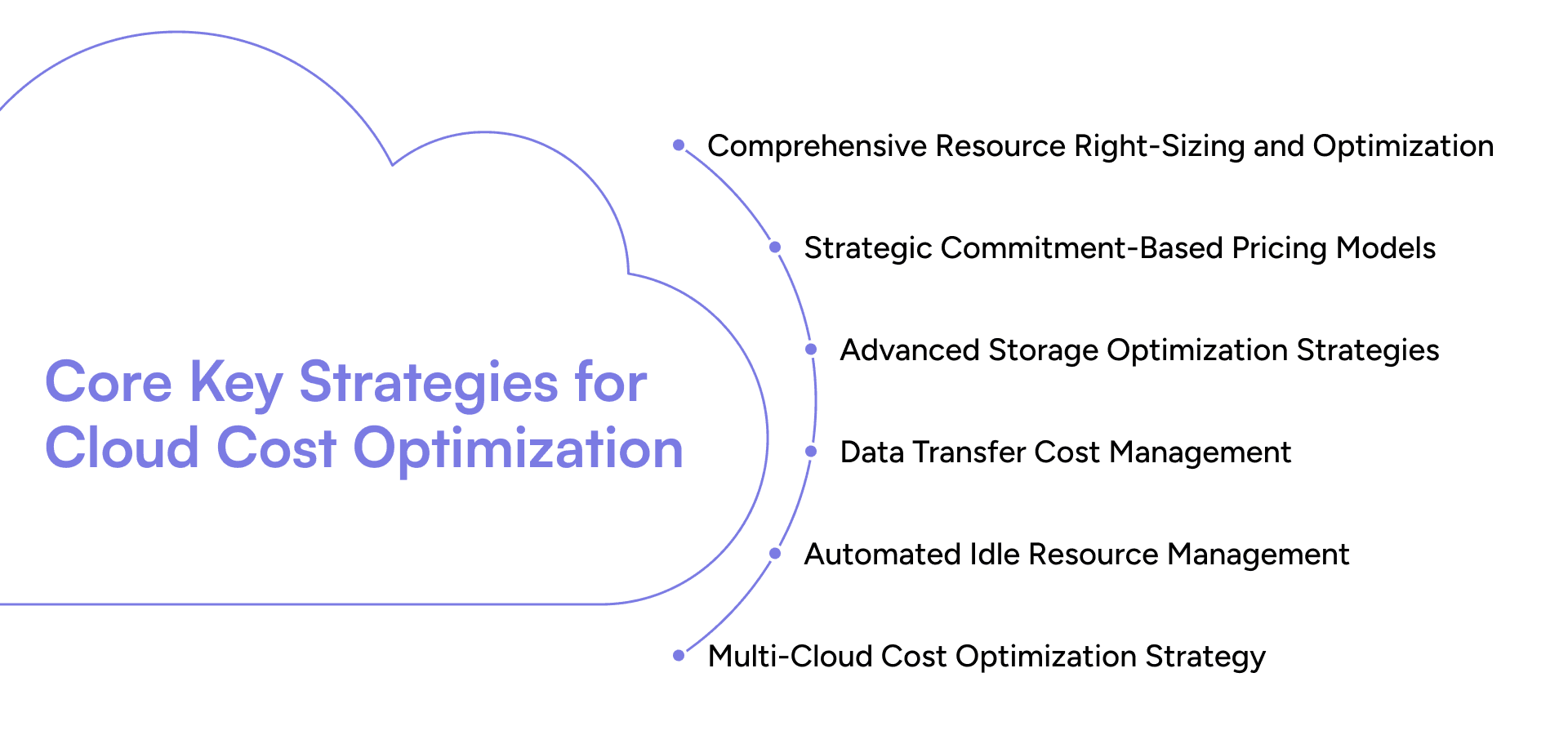
1. Comprehensive Resource Right-Sizing and Optimization
Right-sizing represents the foundational strategy for cloud cost optimization. Organizations must analyze real-time CPU, memory, and storage metrics to match resource configurations with actual workload demands. Over-provisioned resources inflate costs without delivering performance benefits, while under-provisioned resources create bottlenecks that impact business operations.
US Market Application: AWS t3.nano instances cost $0.0052 per hour versus m5.large at $0.096 per hour - proper sizing can reduce compute costs by up to 94% for appropriate workloads.
Implementation Framework:
- Monitor utilization patterns across 30-day periods, minimum
- Identify instances running below 20% average utilization
- Implement automated scaling based on demand patterns
- Review and adjust configurations quarterly
2. Strategic Commitment-Based Pricing Models
Reserved Instances and Savings Plans offer substantial discounts for predictable workloads. US organizations can achieve 38-72% savings compared to on-demand pricing by committing to 1-3 year terms across major cloud providers
Provider Comparison for US Regions:
- AWS Reserved Instances: 38% (1-year) to 57% (3-year) savings on m5.large instances
- Azure Reserved VM Instances: 40% (1-year) to 61% (3-year) savings on D2s_v3 instances
- GCP Committed Use Discounts: 37% (1-year) to 54% (3-year) savings on n2-standard-2 instances
- Oracle Cloud: Competitive rates with VM.Standard.E4.Flex instances starting at $0.038/hour
Strategic Considerations:
- Analyze workload stability and growth projections
- Balance commitment levels with business flexibility needs
- Combine Reserved Instances with Spot Instances for optimal cost structure
3. Advanced Storage Optimization Strategies
Storage costs accumulate rapidly without proper tier management and lifecycle policies. Organizations must implement automated data lifecycle management to transition data between storage classes based on access patterns.
US Pricing Benchmarks:
- AWS S3 Standard: $0.023/GB-month vs S3 Glacier Deep Archive at $0.00099/GB-month
- Azure Blob Storage: Hot tier at $0.018/GB-month vs Archive tier for long-term retention
- GCP Standard Storage: $0.020-$0.023/GB-month with automatic lifecycle transitions
- Backblaze B2: Competitive at $6/TB-month with free egress up to 3x stored data
4. Data Transfer Cost Management
Data egress charges represent significant hidden costs, especially for multi-cloud architectures and data-intensive applications. Strategic placement and transfer optimization can reduce these expenses substantially.
Provider Egress Comparison:
- AWS: $0.09/GB for the first 10TB/month internet egress
- Azure: First 100GB free, then $0.08/GB for next 10TB
- GCP: 0-200GiB free, then $0.085/GB for 200GiB-10TiB
- Oracle Cloud: $0.0085/GB for data over 10TB/month from North America
- Backblaze: Free egress up to 3x average monthly stored data
5. Automated Idle Resource Management
Idle resources drain budgets without delivering value. Automated detection and cleanup policies prevent resource sprawl and eliminate unnecessary expenses.
Key Implementation Areas:
- Schedule non-production environments to shut down outside business hours
- Implement automatic cleanup of unattached storage volumes
- Deploy cost anomaly detection with automated alerts
- Configure lifecycle policies for development and testing resources
6. Multi-Cloud Cost Optimization Strategy
No single provider offers optimal pricing across all services. Strategic multi-cloud adoption leverages competitive advantages while maintaining cost efficiency.
Provider Strengths by Service Category:
- Compute: Oracle Cloud is often the most cost-effective for standard workloads
- Storage: Backblaze B2 is competitive for backup and archival
- Egress: Oracle Cloud is superior for high-volume data transfer
- Specialized Services: AWS, Azure, and GCP each excel in different areas
How to Calculate Cloud Migration Cost
Cloud migration introduces a financial inflection point, not just a technical milestone. To protect long-term margins and business continuity, organizations must break down cost structures across four vectors: baseline infrastructure, migration execution, post-move operational shifts, and hidden liabilities. Below is a precise cost modeling framework that aligns with US market realities and compliance overheads.
1. Establish Your Baseline: Current IT Infrastructure TCO
Before moving workloads, quantify what you already own.
- Hardware: Servers, storage units, networking gear, power, cooling, and rack space. Include refresh cycles.
- Software: Licensing costs across operating systems, databases, monitoring, and security tools.
- Operations: IT staff salaries, vendor support contracts, facility overhead, compliance reporting.
- Utilization: Track per-server CPU/memory/storage usage and flag underused resources.
Insight: “The cost of staying on-prem isn’t just hardware. It’s the compounded inefficiency of sunk capital, underutilization, and compliance drag. You must translate this into a per-app cost basis to make a defensible cloud case.”
Goal: Determine per-month TCO across applications and environments—development, QA, production. This sets your benchmark for cost-efficiency in the cloud.
2. Forecast Future-State Cloud Infrastructure
Use your current workload profile to model cloud-side consumption.
Inputs to Calculate Cloud Spend:
- Instance type: e.g., AWS m5.large vs Azure D2s_v3 vs GCP n2-standard-2
- Virtual machine count and vCPU/core allocation
- Memory (RAM), OS, database engines
- Primary and archival storage tiers
- IOPS requirements
- % of data accessed frequently vs rarely
- Network bandwidth and expected egress volume
US Market Snapshot:
Provider | Compute (On-Demand) | 1-Year Reserved Savings | Egress (First 10TB) |
|---|---|---|---|
AWS | $0.096/hr (m5.large) | 38–57% | $0.09/GB |
Azure | $0.096/hr (D2s_v3) | 40–61% | $0.08/GB |
GCP | $0.104/hr (n2-std-2) | 37–54% | $0.085/GB |
Oracle | $0.104/hr (n2-std-2) | Comparable savings | $0.0085/GB |
SME Tip: “Always model with regional pricing and apply sustained-use discounts where applicable. A 20% overcommit in the wrong region is harder to fix than an upfront rearchitecture.”
3. Model Migration Execution Costs
This phase includes all lift-and-shift, replatforming, and validation activities.
Breakdown:
- Consultants & Architects: Typically billed at $180–$300/hr
- Migration Tools: AWS Migration Hub, Azure Migrate, CloudEndure, etc.
- Dual Run Infrastructure: Temporary systems run in parallel to production for validation
- Data Transfer: Terabyte-scale migration may trigger ISP bandwidth upgrades or physical transfer devices
- Testing: Sandbox environments, rollback buffers, and staging validations
Insight: For every 10 TB of data moved without tiering or compression, add a 10–15% cost buffer.
4. Quantify Post-Migration Operating Model
Cloud costs are recurring. Budgeting stops being CapEx-driven and shifts to variable OpEx tied to consumption.
Recurring Costs:
- Compute: Auto-scaling vs reserved instances vs spot workloads
- Storage: Active, infrequent access, archival tiers
- Monitoring & Security: Real-time analytics, compliance logging, threat detection
- Governance: Role-based access, FinOps tools, usage dashboards
Cost vs Compliance Trade-Offs:
Regulation | Impact on Cloud Cost (US) | Drivers |
|---|---|---|
HIPAA | +15–25% | Encryption, audit logs, isolated VPCs |
SOX | +10–20% | Access logging, change controls |
GDPR | +12–18% | Data residency, anonymization layers |
5. Account for Hidden Liabilities
These are the traps that derail migration ROI.
- Legacy Licensing: Non-portable licenses (e.g., SQL Server) may require costly upgrades or audits.
- Overprovisioning: Bringing fixed infra habits to elastic platforms results in waste.
- Tagging Gaps: If you cannot attribute cost to owners or apps, you cannot govern it.
- Compatibility Overhead: App refactoring or dependencies not discovered during planning.
Insight- "Tag early. Govern continuously. Costs spiral when environments scale without ownership and accountability."
Total Cost Formula
Total Cloud Migration Cost =
(Current Infra TCO × Complexity Factor)
- (Migration Services + Data Transfer + Temporary Infra)
- (Post-Migration Monthly Costs × 12 Months)
- Hidden Cost Buffer (15–25%)
Takeaway
A successful cloud migration strategy requires financial engineering and architectural rigor. Budgeting is not just about finding the cheapest compute—it is about aligning technical choices with long-term business goals, compliance posture, and margin resilience.
Importance of Cloud Cost Reviews After Migration
Cloud migration introduces a new operational reality. It shifts the business from static infrastructure to a dynamic environment where ongoing cost management becomes essential. Without a clear review process in place, many companies witness their cloud expenses rising well beyond initial projections. This often undermines the return on investment that migration was expected to deliver.
The key reasons for continuous cost reviews after cloud migration include:
1. Preventing financial surprises
Cloud platforms operate on a flexible, usage-based pricing model. This model, while beneficial, can create unexpected expenses when left unchecked. Regular reviews allow businesses to identify and address cost escalations before they become budgetary problems.
2. Eliminating over-provisioned resources
Many organizations lift and shift existing workloads to the cloud without modification. These workloads frequently contain oversized virtual machines or underutilized storage. A structured cost review identifies these inefficiencies and enables right-sizing.
3. Cleaning up unused services
Cloud environments often accumulate resources that serve no current purpose. These include idle virtual machines, unattached volumes, and dormant databases. Continuous oversight ensures the timely decommissioning of these elements, which reduces unnecessary spending.
4. Maintaining regulatory alignment
Industries such as healthcare and finance must meet strict compliance standards. Ongoing reviews help ensure cloud configurations remain within acceptable guidelines for data security and risk management.
5. Improving return on investment
Cost reviews help teams shift toward pricing models that deliver better value, such as reserved instances or usage-based scaling. This discipline ensures the cloud continues to serve as a growth enabler rather than a cost center.
How to Reduce Cloud Migration Costs Without Sacrificing Value
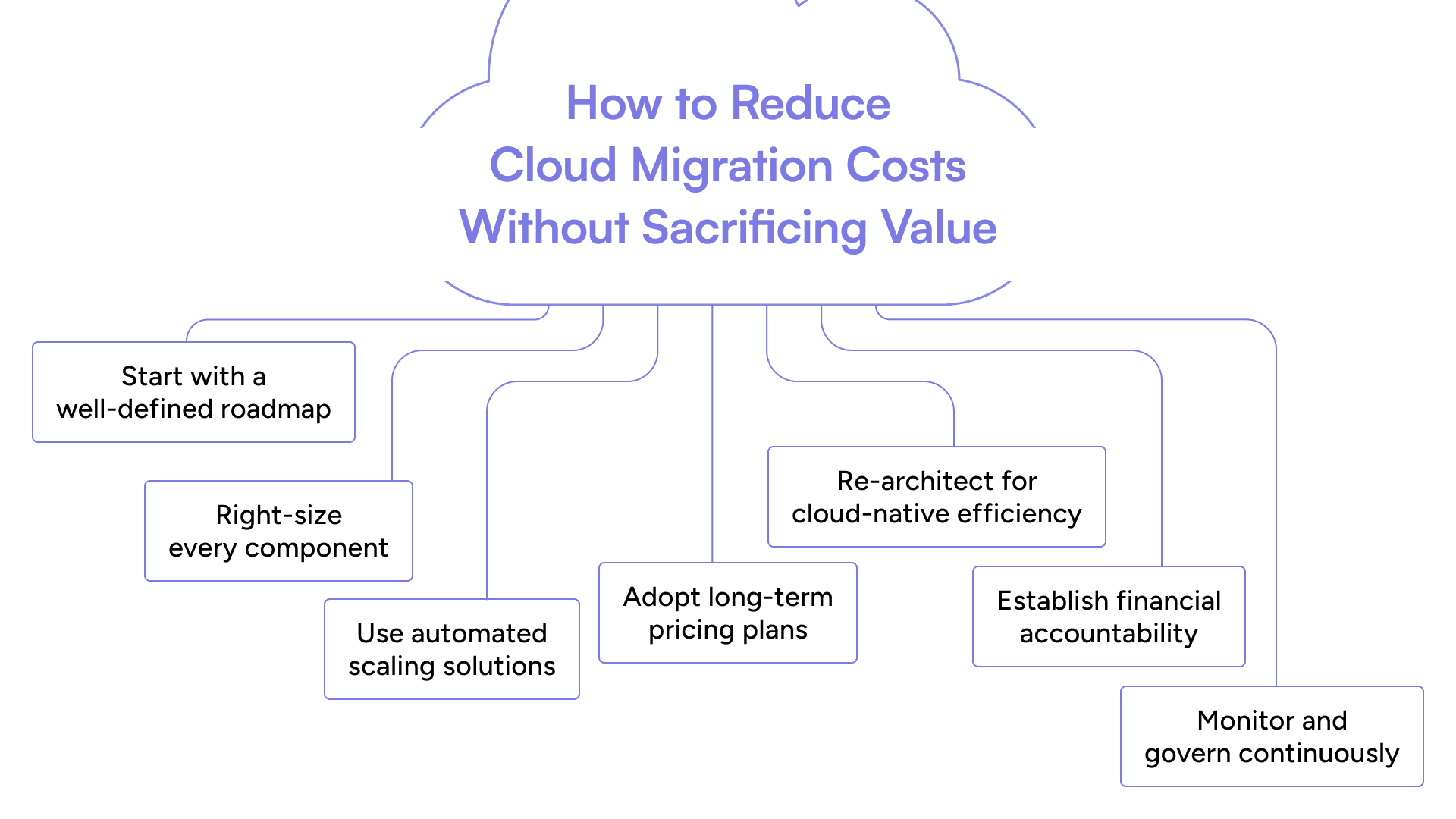
Reducing the total cost of cloud migration involves more than price negotiation. It requires strategic planning during the migration and disciplined operations afterward. The following practices support both goals:
1. Start with a well-defined roadmap
Before migration, assess all on-premises workloads. Determine which applications should move to the cloud, and identify their actual usage patterns. This analysis provides the foundation for efficient resource allocation.
2. Right-size every component
Allocate compute and storage resources based on verified performance needs. Many cloud providers offer sizing tools to support this process. Right-sizing reduces waste and improves system performance.
3. Use automated scaling solutions
Implement autoscaling configurations to match demand fluctuations. These tools ensure that systems use resources only when needed, without manual intervention.
4. Adopt long-term pricing plans
When workload patterns remain stable, purchase reserved capacity or savings plans from the cloud provider. These agreements reduce unit costs over time, especially for compute and storage-intensive applications.
5. Re-architect for cloud-native efficiency
Modernize applications to make use of microservices, serverless functions, and container orchestration. These tools improve scalability and reduce operating costs through better resource utilization.
6. Establish financial accountability
Empower each team with visibility into its cloud usage and budget impact. Set clear performance and cost goals for engineering leaders, and track progress through regular reviews.
7. Monitor and govern continuously
Deploy cost visibility tools that offer real-time insights and trend analysis. Set budget thresholds, define anomaly alerts, and automate non-critical resource shutdowns during off-hours.
Must-Have Cloud Cost Optimization Tools for U.S. Businesses
A wide range of tools helps organizations lower cloud costs and improve cost governance. From built-in cloud provider tools to cross-platform FinOps solutions, these technologies support unified visibility, real-time optimization, and precise resource control across cloud environments.
Native Cloud Provider Tools
Cloud-native tools offer foundational cost tracking and optimization features within each provider’s ecosystem. They work best for organizations operating on a single cloud platform.
Amazon Web Services (AWS)
- Cost Explorer: Visualizes spend by service, account, and region. Includes spend forecasting.
- Budgets: Sets cost thresholds and sends alerts based on limits.
- Compute Optimizer: Recommends instance rightsizing based on usage patterns.
- Cost and Usage Reports (CUR): Offers detailed billing data for cost analysis.
- Cost Anomaly Detection: Identifies unusual spikes in charges.
- Trusted Advisor: Reviews resources for cost, security, and performance.
- CloudWatch: Monitors resource metrics and triggers auto-scaling.
Microsoft Azure
- Cost Management + Billing: Tracks real-time spend with forecasting and AI recommendations.
- Policy: Enforces compliance and cost governance.
- Advisor: Recommends ways to reduce costs and improve reliability.
- Monitor: Provides observability for workload performance and costs.
Google Cloud Platform (GCP)
- Cloud Console: Tracks spend, builds custom budgets, and reports across projects.
- Billing Reports: Offers real-time analytics and visualization via Looker Studio.
- Recommender: Suggests cost-saving actions across services.
- Pricing Calculator: Estimates cloud resource costs.
Native tools give granular visibility into spending within their cloud. They do not provide unified control across multiple clouds, which creates blind spots for hybrid and multi-cloud operations.
Top Third-Party FinOps and CCO Platforms
Third-party tools deliver cross-cloud visibility, policy enforcement, and granular optimization. Many platforms use AI to automate discounting, detect waste, and allocate costs by workload or team.
Cloud Cost Optimization Tools (U.S. Availability)
Tool | Core Features | Ideal Use Case | Supported Clouds | Pricing Model | Notable Outcome |
|---|---|---|---|---|---|
nOps | AI-based automation, AWS MAP management, commitment tracking | Automated AWS optimization | AWS | Percentage of savings | Up to 60% cost reduction |
Apptio Cloudability | Budgeting, forecasting, rightsizing, FinOps compliance | Large enterprise cloud governance | AWS, Azure, GCP | Not listed | Faster decision cycles |
Spot by NetApp | Workload automation, scaling insights | Multi-cloud scaling control | AWS, Azure, GCP | Not listed | Continuous savings recommendations |
Densify | Kubernetes/VM rightsizing, hybrid resource optimization | Kubernetes, hybrid ops | Multi-cloud, VMs | Trial + fixed fee | Resource-level cost precision |
ProsperOps | Autonomous RI/SP savings plans | Hands-off discount management | AWS, Azure, GCP | Fee per savings | 100% RI utilization |
CloudZero | Unit cost tracking, cost per feature/customer/team | Engineering and finance alignment | AWS, Azure, GCP, Kubernetes | Tiered | 33% efficiency gain |
Harness | Root cost analysis, policy automation | Teams needing strict cost enforcement | AWS, Azure, GCP | 2.25–2.5% of spend | Enforced spend controls |
Pump | AI optimization, group buying | Startups with monthly spend | AWS, Azure, GCP | Free | Saves ~60% without upfront fee |
Azilen | Cost audits, FinOps automation for ML workloads | AI/SaaS with high compute usage | AWS | Not listed | 50% cost cut, improved security posture |
Intellias | Proprietary rightsizing, cloud spend analysis | Engineering-led cost optimization | Not listed | Not listed | Built-in tooling for custom ops |
Persistent | TCO review, FinOps training | Legacy systems moving to the cloud | Not listed | Not listed | Elastic architectures and modernization |
Rackspace | Multi-cloud governance, COaaS strategy | Mid-market cloud operations | AWS, Azure, GCP | Not listed | Architecture-led savings |
Zluri | SaaS cost tracking, Shadow IT detection | IT finance teams managing contracts | AWS, Azure, GCP, Kubernetes | Not listed | Eliminates unused licenses and SaaS sprawl |
Flexera One | Licensing visibility, hybrid cloud tracking | Software-heavy environments | AWS, Azure, IBM | Not listed | Full TCO management |
CloudBolt | Augmented FinOps, real-time simulation | Hybrid/multi-cloud firms | Multi-cloud | Not listed | AI-enhanced scenario modeling |
Cast.ai | Kubernetes resource rightsizing | K8s-focused product teams | Not listed | Not listed | Optimized container resource spend |
Shift in Pricing Models
Performance-based pricing has gained traction in this space. nOps and ProsperOps charge based on savings delivered. Pump provides optimization for free by using group discounts powered by AI. These models reduce entry barriers while aligning outcomes with customer goals.
This pricing strategy appeals to startups and mid-sized firms with limited budgets. It also encourages long-term partnerships based on continuous performance, rather than software licenses.
The Role of AI and Automation in Cloud Cost Optimization
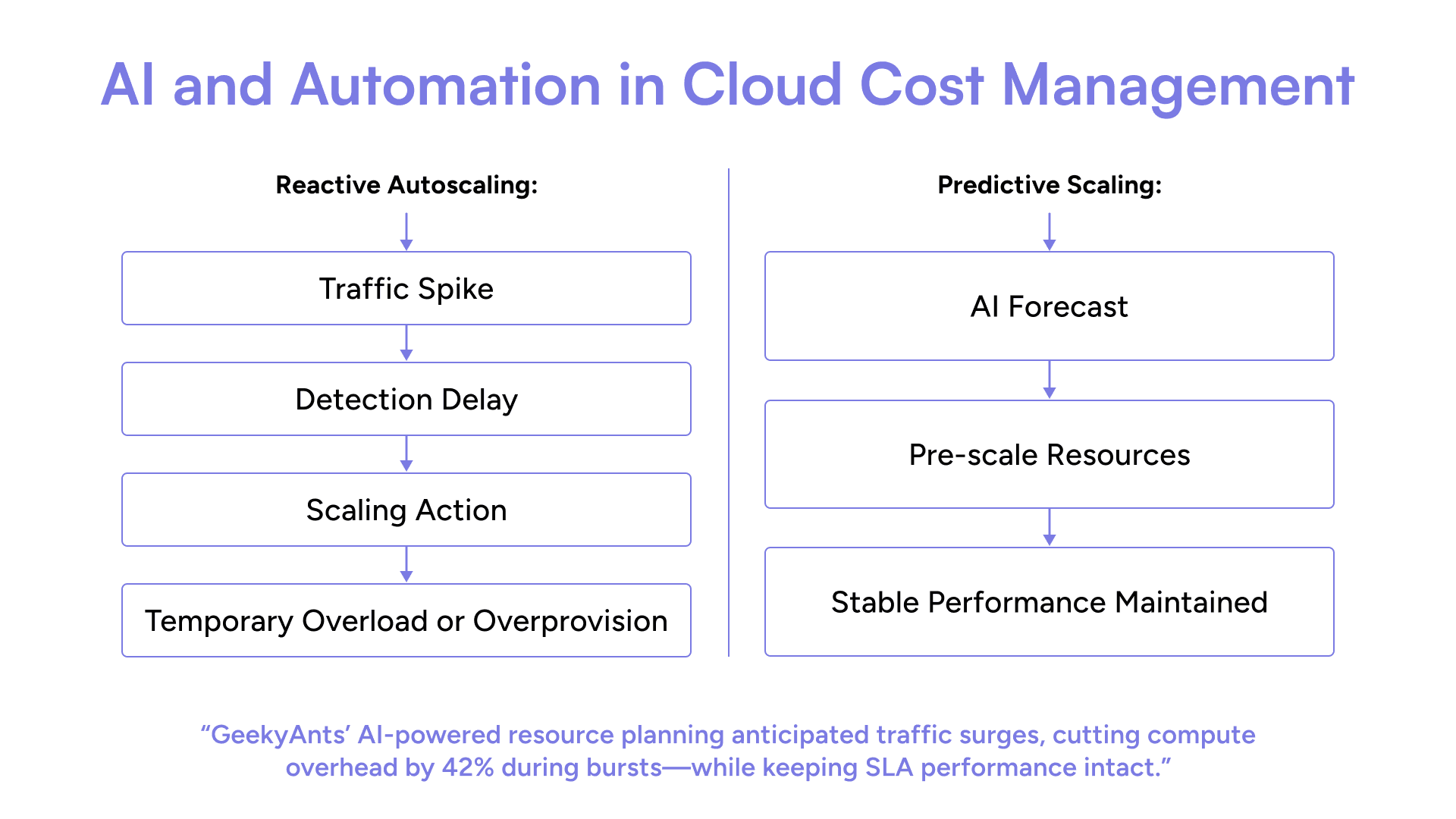
AI and machine learning are reshaping cloud cost management from static budgeting to dynamic, precision-based optimization. As cloud environments grow in complexity, manual methods fall short. Intelligent automation enables real-time insights, proactive scaling, and actionable cost control strategies.
The foundation of effective AI-driven cost optimization lies in predictive scaling. Unlike reactive autoscaling, AI anticipates future demand by analyzing historical usage data. This allows infrastructure to scale ahead of traffic surges, preventing both over-provisioning and outages. In a recent logistics intelligence platform modernization, GeekyAnts implemented predictive resource planning to reduce compute overhead by 42% during traffic bursts without compromising SLA performance.
Uncontrolled cloud spending often stems from a delayed response to anomalies. AI systems detect cost spikes instantly—triggered by configuration drift, excessive API calls, or unscheduled data transfers. Automated alerts allow early intervention before financial impact escalates. GeekyAnts deployed an AI-driven anomaly detection module for a retail analytics provider, reducing their cost variance by 27% within the first quarter.
Automation also transforms infrastructure governance. AI continuously rightsizes underutilized resources, shuts down idle environments, and scales workloads to match real-time usage. In one healthcare platform built on Kubernetes, GeekyAnts integrated a self-optimizing autoscaler that achieved a 35% drop in monthly cloud spend while maintaining 99.9% uptime across patient-facing services.
Another critical challenge in cloud cost management is financial visibility. AI enables granular cost allocation by tagging resources to individual teams, projects, and features. This precision allows business units to correlate spend with value delivery. During a multi-region financial services audit, GeekyAnts uncovered 18% of cloud spend attributed to underutilized legacy modules. The insights enabled a successful refactor and reallocation of resources to growth-driving services.
Discount management often lacks precision when handled manually. AI addresses this by tracking usage trends and automatically applying the most efficient pricing models, such as Reserved Instances and Savings Plans. This reduces lock-in risk and improves long-term savings.
The true advantage of AI lies in converting raw billing and telemetry data into strategic intelligence. It highlights root cost drivers, forecasts future expenditure, and guides investments toward higher cost-performance ratios. Through its AI and automation services, GeekyAnts has equipped product teams with FinOps dashboards that align cloud spend with business goals, improving cost-to-value clarity across hybrid and multi-cloud architectures.
However, the accuracy of AI insights depends on data quality. Poor tagging, incomplete logs, or inconsistent usage metrics compromise optimization outcomes. GeekyAnts begins every cost optimization initiative with strict data governance protocols. This ensures clean, well-structured data flows into automation pipelines, unlocking the full potential of AI-driven cost control.
AI and automation are critical enablers of financial discipline in cloud-first operations. For organizations scaling with generative AI, ML workloads, or hybrid infrastructure, working with cost optimization companies that specialize in automation—such as GeekyAnts—ensures both control and innovation remain sustainable.
US Cloud Cost Benchmarks and Optimization Metrics for Businesses
To manage and optimize cloud costs effectively, organizations in the US market must measure against realistic industry benchmarks. This means tracking both wasted spend averages and current service rates for leading cloud providers to establish accurate baselines for optimization efforts.
Industry Benchmarks for Cloud Spend and Optimization
Wasted cloud spending remains a significant issue in the US market. Organizations estimate that approximately 29% of their public cloud spend is wasted, as per recent industry reports. A separate study cited by CloudZero via AmericanChase indicated that over one-third of spending is inefficient, with some executives reporting waste levels above 44%. Even mature cloud programs show measurable waste, underscoring the potential for savings across industries.
McKinsey Digital estimates that targeted cloud cost optimization can reduce program expenses by 15% to 25% while maintaining operational value.
2026 US Cloud Pricing Benchmarks
Current US pricing averages for key cloud services provide a reference point for evaluating and negotiating contracts. Rates vary slightly by provider, region, and usage volume, but the following table summarizes standard on-demand costs for major services as of Q3 2026:
Cloud Provider | Region (US) | Avg Storage (per GB/month) | Avg Compute (per vCPU/hour) | Data Egress (First 10TB/month) |
|---|---|---|---|---|
AWS | US East (N. Virginia) | $0.023 | $0.0464 | $0.09/GB |
Microsoft Azure | US Central | $0.018 | $0.0500 | $0.087/GB |
Google Cloud | US West (Oregon) | $0.010 | $0.0450 | $0.085/GB |
These benchmarks highlight that even small inefficiencies—such as unused storage or unoptimized compute allocations—can create substantial cost leakage over time. For organizations running multi-cloud or high-volume workloads, differences of fractions of a cent per unit can scale to millions in annual spend.
Moving Beyond Cost Reduction to Value-Based Metrics
Leading cost optimization programs now track business value unit economics to align investment with measurable outcomes. Key metrics include:
- Cost per transaction – Cloud spend attributed to each customer transaction.
- Cost per customer served – Expenditure per active customer supported.
- Cost per deployment or feature – Engineering cost impact at a granular level.
- Gross margin impact – The relationship between cloud costs and revenue generation.
This value-based approach enables you to justify cloud investments based on revenue growth, customer retention, and operational efficiency rather than cost minimization alone.
Benefits of Cloud Cost Management
For organizations operating at scale, cloud cost management is not a tactical expense-reduction exercise but a strategic enabler of operational and financial performance. The most significant cloud cost optimization benefits extend across cost control, business agility, and governance.
1. Reduction of Wasted Spend at Scale
In large cloud environments, idle compute instances, unattached storage volumes, and over-provisioned workloads accumulate quickly. Advanced cost management frameworks, often supported by AI-driven monitoring, identify these inefficiencies in real time and automate corrective actions. This drives direct cost savings while improving utilization rates across multi-cloud deployments.
2. Financial Visibility and Forecasting Accuracy
Granular cost attribution—down to the transaction, feature, or customer level—enables precise forecasting and budget alignment. Leaders can tie cloud expenditure to revenue streams and operational KPIs, making cloud investments defensible to boards and shareholders. This visibility also improves the accuracy of long-term capacity planning and vendor negotiation strategies.
3. Performance-Driven Resource Allocation
By aligning capacity with workload demand profiles, organizations maintain optimal performance without overspending. Continuous monitoring and right-sizing ensure that critical workloads receive priority, while non-critical environments are scaled back during off-peak periods. This balance supports both high availability and financial discipline.
4. Business Agility and Competitive Responsiveness
Cloud cost efficiency frees capital for innovation—whether in R&D, market expansion, or customer acquisition. It enables faster experimentation with new services or geographies without the constraint of runaway infrastructure costs, supporting rapid pivoting in competitive markets.
5. Governance, Compliance, and Risk Mitigation
Structured cost management incorporates compliance controls to meet regulatory frameworks such as HIPAA, FedRAMP, and SOC 2. This reduces the financial and reputational risk of non-compliance, while ensuring that cost optimization strategies do not undermine security or data governance standards.
When executed with disciplined processes and modern tooling, cloud cost management becomes a strategic function that supports profitability, scalability, and resilience—transforming the cloud from a fluctuating expense into a controllable, value-generating asset.
Migration Cost Savings and Cloud Cost Optimization Success Stories
Cloud cost optimization delivers measurable results across industries. From migration-driven savings to ongoing efficiency gains, these case studies show how strategic execution reduces costs while improving scalability and performance.
DollarDash - Cloud Cost Optimization for a Cross-Border Payments Platform
DollarDash, an overseas fund transfer platform, partnered with GeekyAnts to optimize its inherited AWS infrastructure after cloud costs had grown significantly over time. The team audited infrastructure usage, removed unused and legacy resources, right-sized compute and database workloads using real usage data, and restructured non-production environments to run on demand.
Within a single quarter, monthly AWS costs dropped from $8,100 to $3,300, a 60% reduction that generated over $57,000 in annual savings. The optimization was completed without removing any features, impacting SLAs, or causing production downtime, while establishing governance processes to prevent future cost drift.
Other Notable Examples
- CloudKeeper: Delivered over $100M in cloud cost savings, averaging 20% reduction per customer.
- MobiKwik: Reduced AWS costs by 27% with CloudKeeper EDP+.
- Damstra: Cut cloud spend by 22% through FinOps adoption.
- Condé Nast: Migrated 300+ servers to AWS, cutting costs by nearly 40% and improving performance by 30–40%.
- Unilever: Streamlined supply chain operations with real-time analytics, reducing operational costs.
Across industries, these examples confirm that cloud cost optimization and migration strategies can yield 20–50% savings, alongside operational agility and improved service delivery.
Cloud Migration Mistakes That Drive Up Costs and How to Avoid Them
Even with clear business cases for cloud adoption, U.S. companies often encounter predictable mistakes that inflate migration costs, delay timelines, and dilute ROI. Addressing these issues early is essential for ensuring that cloud investments deliver measurable value.
Strategic and Planning Gaps
Many budget overruns originate in the planning phase. A 2024 survey found that 59% of organizations experienced migration delays due to insufficient pre-migration planning. As per industry reports, 54% of organizations view understanding application dependencies as one of the biggest cloud migration challenges. Without a thorough assessment of application relationships and workloads before migration, organizations risk project delays, unexpected costs, and operational disruptions.
Common errors include:
- Skipping detailed assessments of workloads, performance requirements, and security needs before provider selection.
- Choosing the wrong migration approach, such as lift-and-shift without optimization, replicates costly inefficiencies from on-premises systems.
- Migrating all workloads at once rather than adopting a phased approach to control risk and costs.
- Overlooking application suitability, where some workloads require re-engineering or are better retained on-premises.
- Underestimating or overestimating budgets creates either funding gaps or wasted allocations.
Mitigation: Conduct structured readiness assessments, evaluate workloads individually, and align finance, IT, and business teams before migration.
Technical and Operational Missteps
Post-migration cost spikes are often tied to technical inefficiencies:
- Over-provisioning and underutilization create “zombie resources” that drain budgets without delivering value.
- Weak tagging and governance obscure cost attribution, making optimization difficult.
- Inefficient architectures that ignore cloud-native services result in higher operational expenses.
- Complex billing models that are not easily understood by engineering or finance teams.
- Insufficient testing leads to unexpected resource consumption after go-live.
Mitigation: Automate resource monitoring and rightsizing, enforce consistent tagging, leverage reserved or spot instances, and simplify reporting for transparency.
Organizational and Cultural Barriers
Cloud cost optimization is as much an organizational challenge as it is a technical one:
- Siloed teams between IT, finance, and business units slow decision-making and cause inefficiencies.
- Skill gaps leave teams unable to leverage optimization features or manage evolving architectures.
- Resistance to change undermines process adoption and accountability.
- Vendor lock-in limits long-term cost flexibility and strategic leverage.
Mitigation: Embed FinOps practices, invest in continuous training, promote shared cost accountability, and plan architectures to avoid provider dependency.
Cloud migration success hinges on disciplined planning, engineering precision, and cross-functional accountability. At GeekyAnts, our migration strategy blends technical optimization with business-aligned cost governance, ensuring that clients gain efficiency without sacrificing performance or scalability.
Kumar PratikFounder & CEOBy recognizing and mitigating these pitfalls, enterprises can avoid cost inflation, accelerate time-to-value, and align cloud adoption directly with strategic growth objectives.
The Role of a Cloud Migration Company: Why GeekyAnts Fits
A cloud migration partner acts strategically, guiding businesses through every phase of moving infrastructure, applications, and data to the cloud while aligning migration strategies with business goals. The role covers in-depth assessment of existing IT environments, creation of precise roadmaps, execution of the right migration approach, and post-migration optimization to improve performance, security, and cost efficiency.
GeekyAnts delivers this end-to-end expertise with a focus on building secure, scalable cloud-native architectures, modernizing legacy systems, and reducing technical debt. Our cloud cost optimization strategies remove waste, right-size resources, and leverage provider discounts to maximize ROI, while FinOps consulting integrates financial accountability into cloud operations for real-time cost visibility and smarter spending decisions. With delivery of large-scale projects across the USA and global markets, we ensure a seamless, future-ready transition to the cloud.
Conclusion
Cloud adoption in the US offers agility and innovation but demands rigorous cost control. With 28% to 44% of cloud spend wasted, often due to legacy practices, over-provisioning, and hidden fees, cost optimization is essential. Compliance with HIPAA and FedRAMP further impacts total ownership costs.
Optimization is a continuous process requiring constant monitoring, FinOps-driven collaboration, and a shift to unit economics that ties spending to business value. AI and ML now enable proactive optimization through predictive scaling, anomaly detection, and intelligent resource management, reducing waste and allowing teams to focus on strategic outcomes while maximizing cloud ROI.