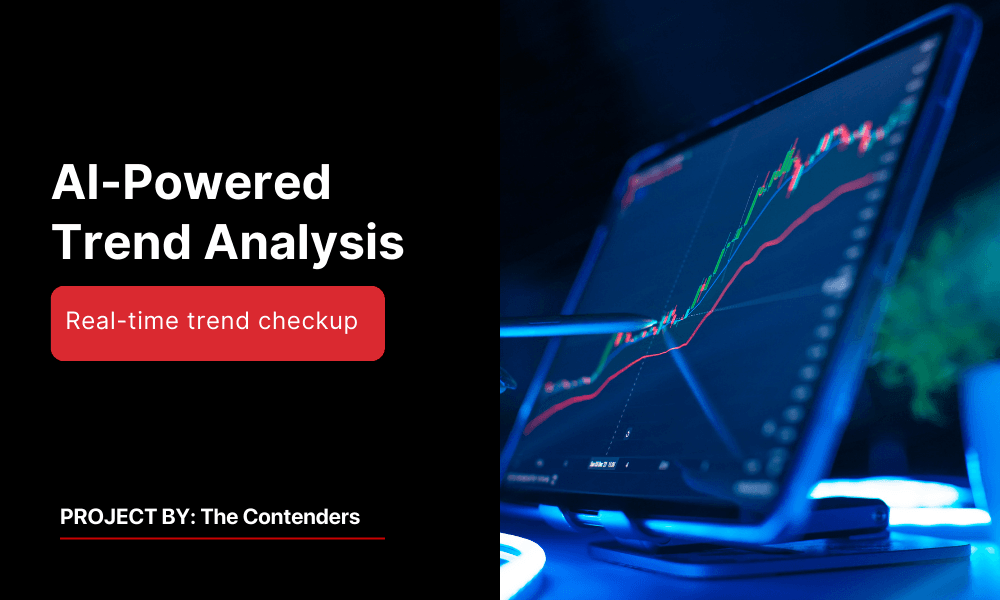

Editor's Note: Hackathons bring out the best in innovation, and Team The Contenders proved it with Trendalyzer—an AI-powered trend analysis tool designed to track emerging topics and market developments. In this blog, team member Vishvendra Tomar walks us through the journey of building Trendalyzer at the GeekyAnts Hackathon, highlighting the problem statement, solution, technical approach, and future scope.
Team composition: Ashwini Bodavula, Vansh Gupta, Vishvendra Tomar, Pratyush Raj
Hey, everyone. My name is Vishvendra Tomar. I am from the team, The Contenders. This will be a presentation of the project we built during the hackathon.
Problem Statement
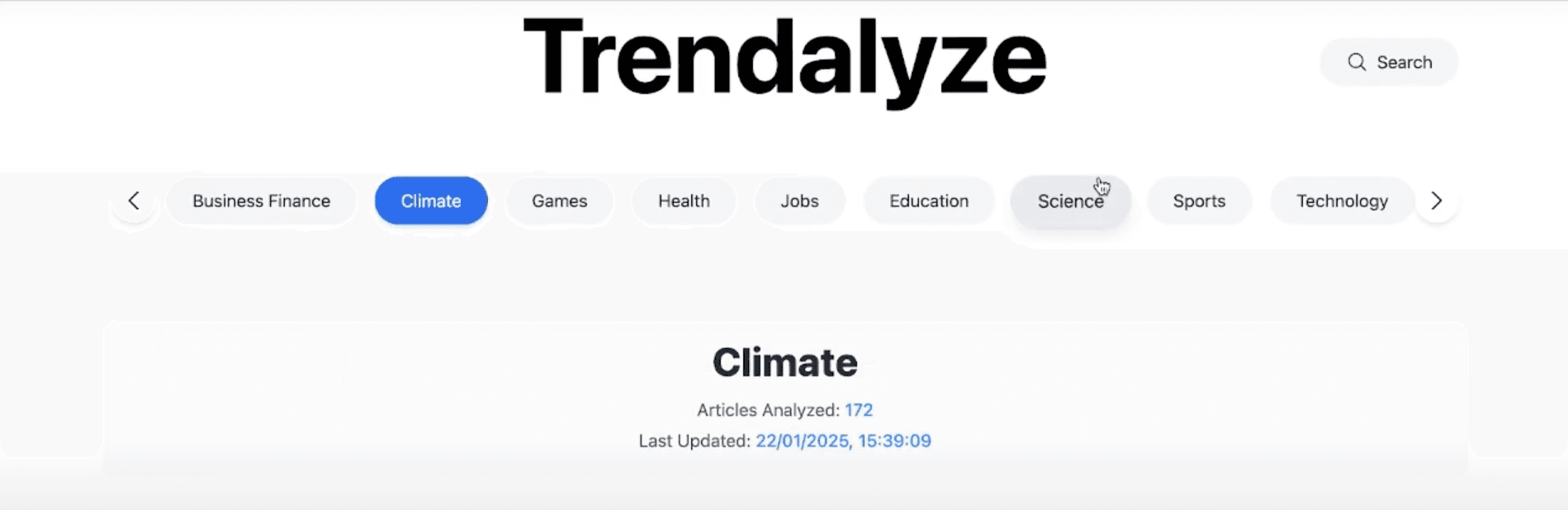
The problem statement that we picked is an AI-powered trend analyzer tool. The objective was to collect data from multiple sources to identify trending topics and emerging market developments over the past 30 days.
Our Solution: Trendalyzer
How Trendalyzer works
Data Collection
We are collecting data based on sectors. We have divided it into multiple sectors that we think are useful. Based on the sectors, the tool collects information from multiple news portals and websites. It searches through articles, blogs, and other necessary sources.
Once the data is collected and divided into sectors, the analysis process begins.
Trend Analysis and Scoring
Each article is analyzed and given a certain score. The scoring is based on multiple parameters.
One key parameter is repetition. If an article is repeated multiple times across various websites, it indicates that the topic is trending. When we see those articles in multiple sources, we increase the score for that article or topic.
Topics are also analyzed similarly.
Another important parameter is engagement. If an article has a higher level of engagement from the audience, we assign it a higher score. Based on these scores, we pick around 20 to 25 articles from each sector.
These articles are then used to generate more precise information.
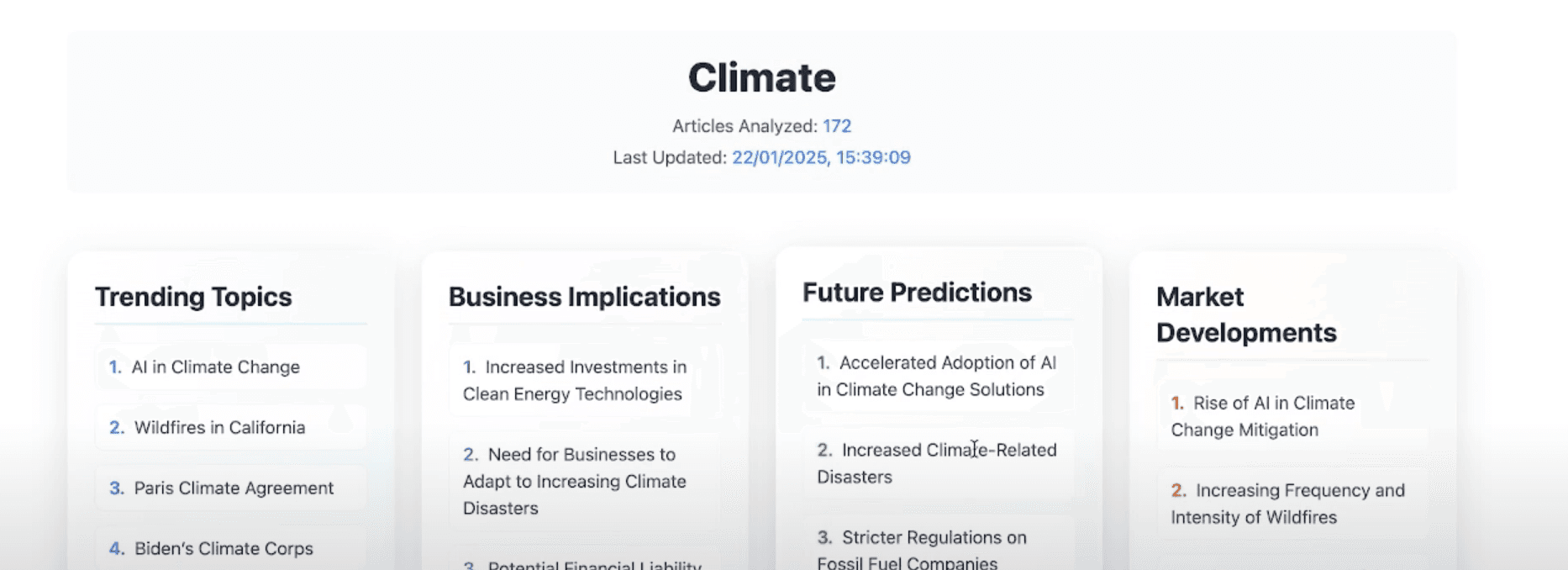
Once we have our selected articles—let's say 25 in total—we analyze them further to create insights into business implications, future predictions, and market developments.
Trending topics are graded from highest to lowest scores. For example, if an article from January 10 has a higher score compared to one from January 21, it is placed at the top.
Real-Time Updates with Cron Job Scheduler
Since news and trends keep updating, we have implemented a cron job scheduler to ensure real-time updates.
The scheduler updates articles and their analysis every 24 hours. The latest update is reflected on the platform, and after 24 hours, the articles and analysis are refreshed again. The data is stored in a database, from where we fetch and display the latest information.
Sector-Based and Topic-Based Analysis
Let’s say we want to gather more information about a specific topic within a sector.
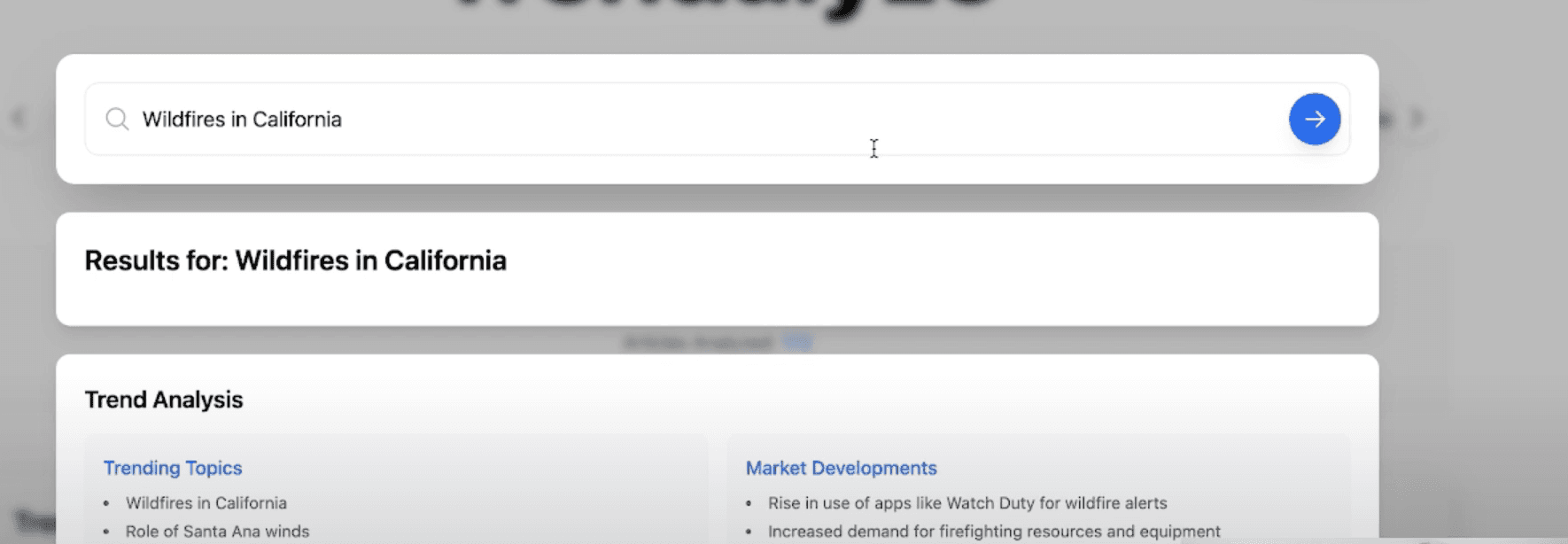
For example, if we want to know more about wildfires in California, we can use the search option to input this topic.
The system will then repeat the same process it does for sectors—analyzing articles, assigning scores, and ranking them.
It then generates insights such as market developments, business implications, and future predictions.
For example, in the case of wildfires in California:
- Market development: Potential increase in insurance claims due to property damage.
- Future prediction: More frequent wildfires due to climate change.
These insights are derived from the selected top 20 articles related to the topic.
The same process can be applied to any topic. For example, if we search for weather control technology, Trendalyzer will scan multiple sources, analyze the articles, score them based on various parameters, and present insights.
It is not limited to a particular sector or topic; we can search for anything—be it artificial intelligence, electric vehicles, or financial markets.
If we search for next-gen AI advancements, Trendalyzer will analyze the topic in the same way, scanning relevant websites, scoring articles, and ranking the top 20 based on engagement and repetition.
Challenges We Faced and How We Solved Them
One of the biggest challenges was ensuring data accuracy and filtering out irrelevant information. To tackle this, we refined our algorithm to prioritize high-quality sources and engagement metrics.
Another challenge was real-time data processing. Implementing a cron job scheduler allowed us to automatically refresh data every 24 hours, keeping the analysis up-to-date without manual intervention.
Lastly, ensuring accurate trend scoring was crucial. We fine-tuned our scoring system to consider multiple parameters such as repetition across sources, sentiment analysis, and audience engagement to produce meaningful trend insights.
Future Enhancements
We built Trendalyzer in just 1.5 days, but there is still a lot of room for improvement. Some potential enhancements include:
- Expanding data sources: Integrating social media data to capture trends beyond news articles.
- Improved trend scoring: Using advanced NLP models to provide deeper insights.
- Custom reports: Allowing users to generate reports for specific industries or time frames.
Reflections and Acknowledgments
This was an incredible experience, and building Trendalyzer in such a short period was both challenging and rewarding.
I want to give a huge shoutout to Pratik and Sanket for providing this platform and to my team for their dedication and collaboration.
What’s Next?
We are excited to refine and enhance Trendalyzer further. Stay tuned for future updates as we continue improving the AI-powered trend analysis tool.
Project GitHub link: https://git.geekyants.com/vishvendra/hackathon-the-contenders#