

Most enterprises run on a mix of systems—some modern, some monolithic. Core applications like ERP, payroll, or inventory work well individually, but they weren't built for today's connected world. They lack modern APIs, use outdated data formats, and operate in isolation. Critical information gets trapped. Teams can't synchronize workflows. Decision-making slows down.
Everyone knows integration is essential for agility and innovation. But traditional approaches are slow and complex—custom middleware, manual API development, months of engineering work. This introduces delays, raises costs, and increases risk.
Generative AI offers a different path. Instead of handcrafted code and rigid frameworks, it automates the heavy lifting: code scaffolding, schema mapping, connector generation. It reduces technical friction, minimizes manual effort, and enables faster alignment between legacy systems and modern platforms.
The numbers back this up: 86% of IT leaders expect generative AI to reshape their tech strategy, and 67% already have implementation plans for the next 18 months.
The result? Intelligent automation that connects legacy infrastructure with modern platforms—quickly, securely, and at scale.
This article explains how generative AI resolves integration challenges, enhances system performance, and enables leaders to modernize legacy infrastructure with minimal disruption.
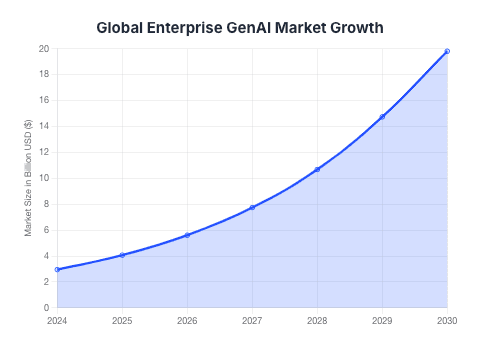
Current Challenges in Enterprise Systems Integration
Enterprise systems today are more distributed and diverse than ever. From on-premise ERPs to cloud-native CRMs, and from legacy mainframes to microservices, the modern enterprise operates in a complex web of technologies. While these systems serve critical business functions, getting them to work together efficiently remains one of the most persistent and costly challenges in digital transformation.
1. Fragmented Technology Ecosystems
Most large enterprises run a mix of legacy systems and modern applications that were never designed to communicate with each other. According to MuleSoft’s 2024 Connectivity Benchmark Report, 80% of IT leaders say their organizations struggle with data silos, while 72% report it is slowing down digital initiatives. This fragmentation creates redundant processes, inconsistent data, and disconnected user experiences.
2. Manual, Code-Heavy Integration Processes
Traditional system integration still relies heavily on custom code, middleware, and manual configurations. This not only increases time to value but also creates long-term maintenance burdens. As reported by Gartner, by 2026, 65% of large organizations will still be dependent on at least four integration tools, complicating governance and slowing agility. Each additional point of integration becomes a potential point of failure or performance bottleneck.
3. Talent Gaps Are Slowing Integration Delivery
As enterprise IT environments grow in complexity, the demand for skilled integration specialists is outpacing supply. Businesses face delays not because they lack ambition, but because they lack the bandwidth to execute. The shortage of experienced engineers who understand both legacy systems and modern integration frameworks is creating a serious delivery bottleneck.
4. Custom Code and Middleware Create Long-Term Drag
Most integration efforts still rely on manual coding, point-to-point connectors, and middleware-heavy architectures. While these methods work, they come with high maintenance costs and limited scalability. Every additional integration point introduces friction—slowing time to market, complicating governance, and increasing the risk of failure.
5. Limited Real-Time Capabilities
Even as companies aim for real-time analytics and automation, many enterprise integrations remain batch-based or asynchronous. This leads to delayed insights, missed opportunities, and operational inefficiencies. In a 2024 Deloitte survey, over 60% of enterprises cited “lack of real-time integration” as a key blocker to digital transformation.
The Role of Generative AI in Enterprise Integration
Enterprise integration has long been the unsolved puzzle of digital transformation. Systems speak different languages, data lives in silos, and developers bear the weight of building bridges—one brittle connector at a time. Generative AI changes this equation.
Generative AI, powered by large language models and neural networks, brings intelligence to every node in the integration chain. And in the context of integration, it acts as a co-engineer.
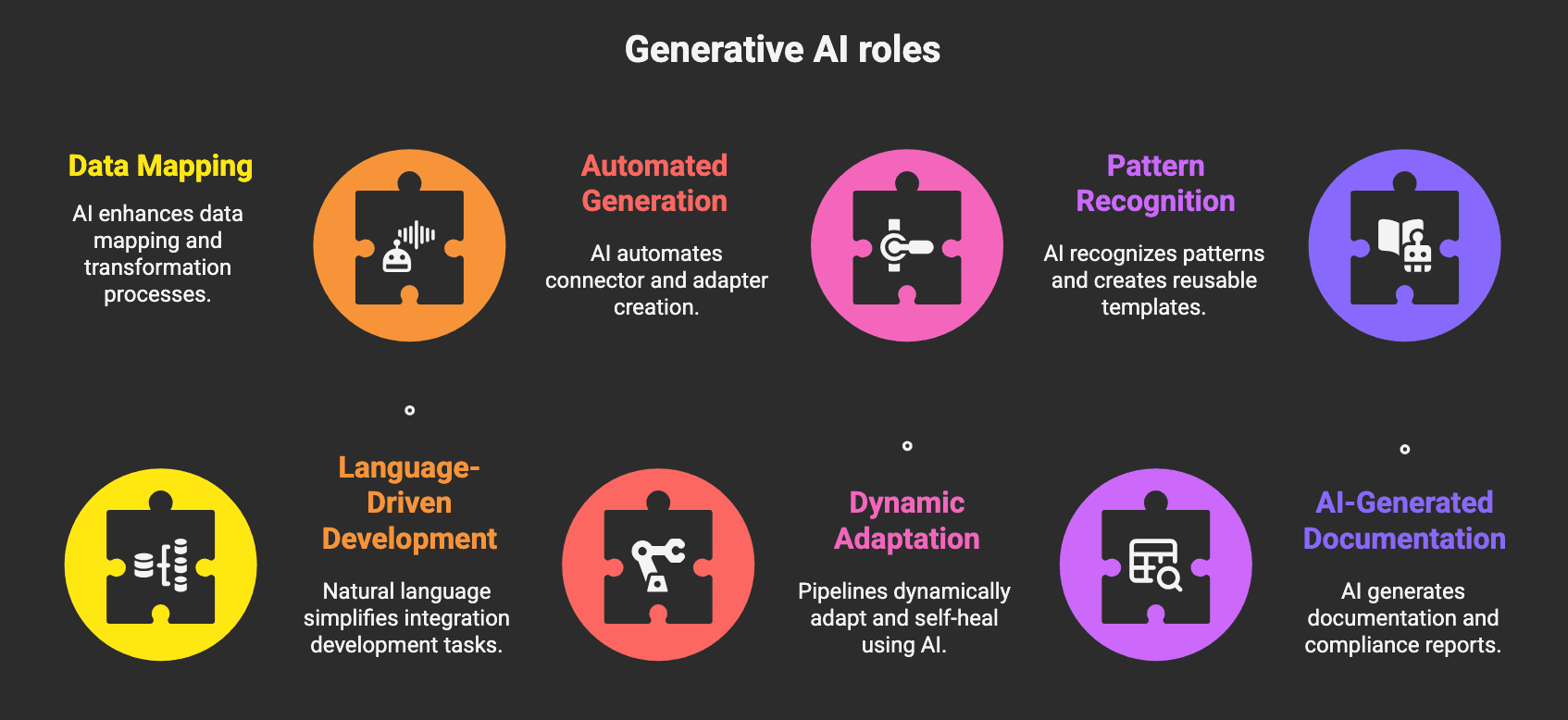
1. Intelligent Data Mapping and Transformation
Data mapping is a bottleneck that can stall entire integration initiatives. Engineers manually correlate fields across systems and transform data formats—tasks that consume hours and introduce risk.
Generative AI solves this by recognizing structural patterns across schemas. It can infer how a “Customer Address” field in Salesforce aligns with nested fields in SAP. It learns from historical mappings, applies contextual logic, and recommends transformations in seconds. Date reformatting, currency conversions, unit standardizations—it handles all of it on the fly.
Benefit: Mapping time drops from hours to minutes.
Risk: Misalignments can occur without validation loops.
Solution: Human-in-the-loop review with confidence scoring ensures safety.
2. Natural Language-Driven Integration Development
Integration no longer needs to begin with code. Generative AI makes it possible to describe logic in plain language:
“Sync new sales orders from Shopify to Oracle ERP every night.”
The AI translates this into API calls, transformation rules, and scheduling logic. What once required a backend engineer can now be initiated by a business analyst.
This approach enables “citizen integrators” to build prototypes, test workflows, and iterate faster. It does not replace developers—it elevates them to focus on complex exceptions, not boilerplate logic.
Advantage: Integration becomes accessible to product teams.
Limitation: Complexity boundaries still require engineering oversight.
Outcome: Democratization of integration accelerates delivery cycles.
3. Automated Connector and Adapter Generation
Every new system requires a connector. In legacy processes, developers must read documentation, handle authentication, and write custom adapters.
Generative AI can write this code. It understands REST, SOAP, and GraphQL. It can auto-generate authentication flows, data parsers, and even retry logic. Tools like SnapLogic’s SnapGPT already enable this.
Enterprises integrating with niche SaaS platforms now see development timelines shrink by 70%.
Upside: Reduces custom coding effort.
Downside: Generated code must be audited for compliance and efficiency.
Resolution: Combine GenAI outputs with static analysis and CI/CD enforcement.
4. Dynamic Adaptation and Self-Healing Pipelines
Integrations fail silently. Fields disappear, APIs version out, and formats mutate. Most teams learn about breakages from the downstream impact.
Generative AI introduces real-time awareness. It monitors integration flows, detects anomalies, and recommends (or applies) fixes. Does a field get renamed in a CRM? The AI highlights the mismatch, suggests the update, and revalidates the pipeline.
This transforms integrations from static connections into living systems—ones that evolve with the environment.
Pro: Improves resilience across system updates.
Con: Can overcorrect without version control.
Strategy: Apply governance rules that prioritize suitability before patching.
5. Pattern Recognition and Reusable Templates
Every enterprise builds the same integrations over and over. New HR systems still push employee records into the same internal databases. Every commerce platform still syncs with the same ERPs.
Generative AI learns from these repetitions. It creates reusable blueprints—starting points for common flows. For example, it might suggest a templated pipeline for syncing Stripe payment data into an accounting tool, already configured with best practices and validations.
This turns tribal knowledge into scalable knowledge.
Value: Speeds up the onboarding of new systems.
Tradeoff: Initial templates may not cover edge cases.
Approach: Use templates as scaffolds, not endpoints.
6. AI-Generated Documentation and Compliance Reporting
Integration documentation is often an afterthought. Yet, in regulated industries, missing documentation can halt audits or trigger fines.
Generative AI can reverse-engineer integration pipelines and produce human-readable documentation, complete with data flows, dependencies, and logic descriptions. It can visualize mappings, create changelogs, and maintain version histories.
This shifts compliance from a burden to a baseline.
Gain: Maintains documentation hygiene automatically.
Risk: Requires checks for outdated auto-generated sections.
Best Practice: Tie documentation refreshes to deployment triggers.
7. The Emerging Stack: GenAI-Driven Integration Platforms
Major players are embedding generative AI into integration platforms:
- SnapLogic SnapGPT enables chat-based pipeline creation.
- Boomi AI suggests mappings and creates connectors with minimal input.
- Google Vertex AI enhances integration with predictive transformation models.
These platforms redefine what integration teams look like. Where once a team needed domain experts, middleware engineers, and QA specialists, now a smaller group can orchestrate and scale with AI assistance.
Gen AI understands APIs, writes code, tracks anomalies, suggests corrections, drafts documentation, and builds reusable knowledge. This makes it uniquely suited for the chaos of enterprise integration.
Key Benefits of Generative AI for Enterprise Integration
Traditional integration is a pain point. Teams spend weeks mapping fields, writing custom code, and debugging connections between systems. Every new platform means another development cycle. Every schema change triggers rework. And the result is slow deployments, high costs, and frustrated stakeholders.
Generative AI changes this equation entirely. Instead of manual coding and rigid frameworks, it automates the heavy lifting—from code generation to data mapping to testing. This isn't just about working faster; it's about working smarter.
Here's how GenAI transforms each critical aspect of enterprise integration:
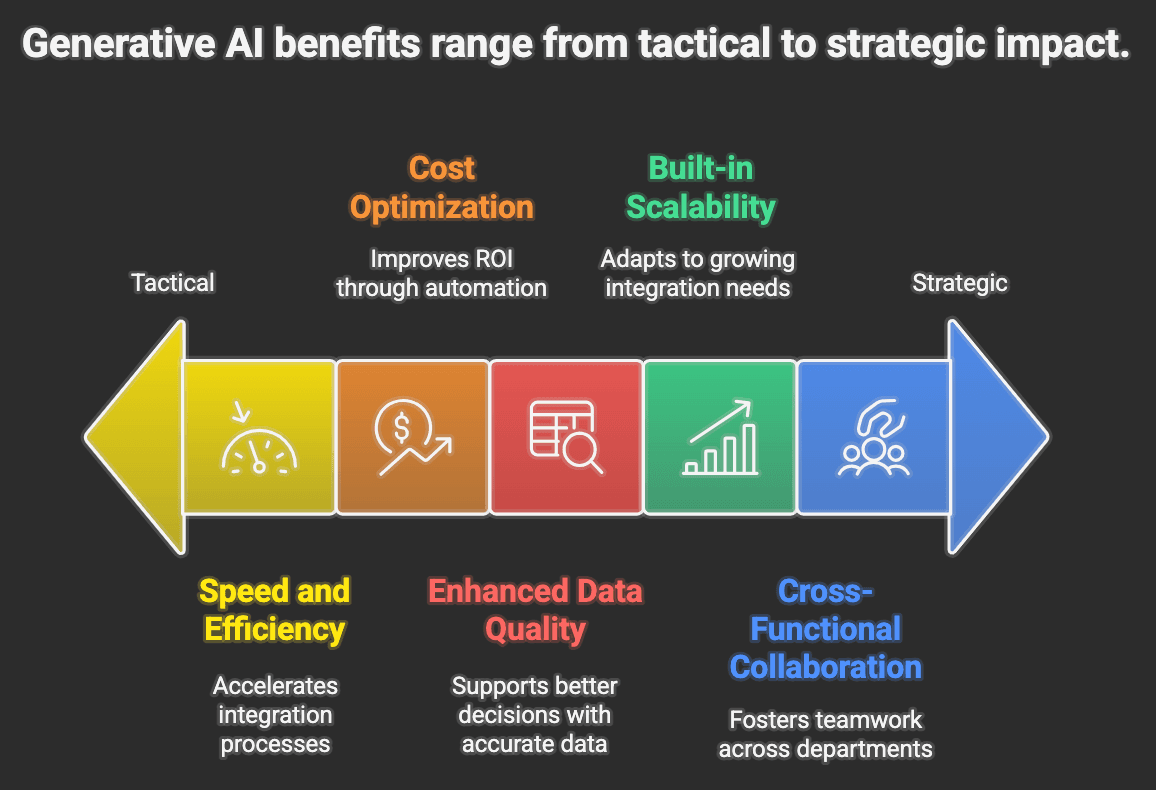
1. Speed and Efficiency
Integration timelines traditionally stretch for weeks. Teams burn hours mapping fields, writing adapters, and debugging payloads. Generative AI cuts through this inertia by generating integration code, automating data mappings, and creating test data automatically.
SnapLogic reports that pipelines that took weeks now complete in days. This acceleration unlocks business agility—a new SaaS platform or data source can join the ecosystem without a six-week development cycle. AI eliminates repetitive effort while reducing logic errors, ensuring smoother deployments.
2. Enhanced Data Quality and Decision-Making
Integrated data powers decisions, but incomplete or inconsistent data leaves leaders steering blind. Generative AI enhances consistency across sources by detecting duplicates, aligning schemas, and cleansing formats automatically.
The outcome? Executives gain access to unified, real-time views. Dashboards become more accurate. Forecasts become more reliable. According to IT Convergence, enterprises using AI-assisted integration report improved analytics accuracy and fewer reporting discrepancies.
3. Cost Optimization and Better ROI
Integration is expensive. Development hours pile up. Bugs trigger costly rework. Expert hires drive budgets higher. Generative AI shifts this balance by handling code generation, mapping, and testing, slashing development cycles and reducing downtime.
Progress.com notes that organizations using AI for integration cut both build costs and long-term maintenance expenses. Smaller teams achieve more, and specialists can focus on architecture rather than boilerplate code. This translates to fewer post-launch issues and higher first-pass success rates.
4. Built-in Scalability
Integration doesn't stop at go-live. Enterprises evolve. Systems grow. APIs change. Business logic adapts. Generative AI ensures the integration layer grows with these changes by building connectors for new platforms, re-mapping fields as schemas shift, and auto-adjusting logic when endpoints change.
PreludeSys reports that companies using GenAI see fewer system integration failures during platform changes. The infrastructure becomes self-adapting rather than brittle.
5. Cross-Functional Collaboration
Integration used to be a black box—engineers built it, business waited,and visibility remained limited. Generative AI changes this dynamic. Non-technical users can describe workflows in plain language, and AI converts them into functioning pipelines. This allows business and IT to co-create solutions.
Natural language tooling improves clarity across teams. AI-generated documentation ensures that data flow diagrams, transformation rules, and interface details remain current. SnapLogic reports higher satisfaction among business users when natural language integration is adopted.
The Transformation
Generative AI transforms integration by accelerating delivery, improving data quality, reducing costs, scaling effortlessly, and enabling cross-functional collaboration. It replaces manual effort with intelligent systems that adapt and execute with precision.
The faster enterprise connects first. The smarter one scales farther.
Integrating Generative AI Into Enterprise Systems: A Step-by-Step Guide
Integrating systems has always been the bottleneck in enterprise agility. Generative AI clears that path—but only for those who implement it with discipline and precision. This is not a one-click revolution. It is a structured evolution.
Below is a practical playbook for embedding generative AI into your integration strategy—without disruption, without risk fatigue, and without misalignment. Each step is grounded in business reality and designed to guide outcomes.
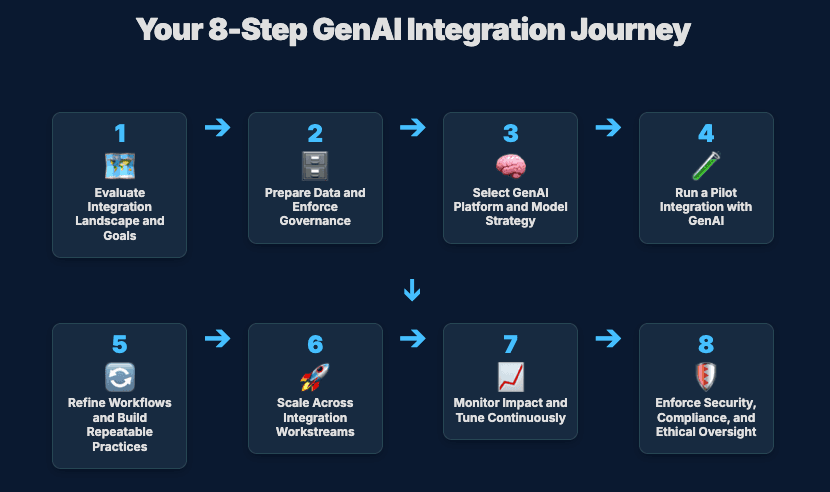
Step 1: Evaluate Your Integration Landscape and Goals
Timeline: 2- 3 Weeks
Start by assessing where integration hurts the most. Audit existing systems, APIs, workflows, and failure points. List every manual touchpoint. Define measurable goals for AI: faster pipeline development, lower integration errors, real-time data sync, or automated API conversion.
Set clear use cases.
Step 2: Prepare Data and Enforce Governance
Timeline: 3-4 Weeks
Generative AI amplifies what it sees. Feed it noisy data, and it produces unreliable logic. Clean your house first. Consolidate essential datasets. Normalize schemas. Define a canonical model for business entities like Customer, Order, and Product.
Bring legal, security, and compliance teams to the table. Determine what data AI can access. Secure Personally Identifiable Information (PII). Apply role-based access and logging.
Step 3: Select the Right GenAI Platform and Model Strategy
Timeline: 2-3 Weeks
Choose the platform that fits your stack. Options include:
- iPaaS tools with embedded GenAI (SnapLogic AI, MuleSoft + Einstein)
- APIs from foundation model providers (e.g., OpenAI, Cohere)
- Fine-tuned in-house models for domain-specific use cases
Evaluate platforms for:
- API coverage and format flexibility
- On-prem and hybrid support
- Audit logs, rate limits, and encryption
Run a proof of concept before full deployment.
Step 4: Run a Pilot Integration with GenAI
Timeline: 4-6 Weeks
Begin with a targeted pilot. Choose a moderately complex integration, such as AI-generated ERP mappings or CRM documentation. Build, deploy, and monitor using your GenAI platform. Measure key outcomes: development time saved, first-pass code accuracy, and team feedback. A well-chosen pilot builds internal trust and demonstrates value quickly. Poor selection risks overfitting or eroding confidence.
Step 5: Refine Workflows and Build Repeatable Practices
Timeline: 2-4 Weeks
Translate pilot insights into a structured playbook. Define rules for human-AI collaboration—code reviews, validation checkpoints, and rollback protocols. Standardize prompt design, output checks, and error handling. Build feedback loops to improve model reliability. This phase turns isolated success into a scalable system.
Step 6: Scale Across Integration Workstreams
Timeline: Ongoing (Begin in 2 Weeks)
Extend GenAI adoption in phases. Start with data pipelines, then move to API logic and layer in testing and self-healing workflows. Use a centralized Center of Excellence to oversee deployments, enforce standards, and circulate learning. Align with evolving governance and business goals.
Step 7: Monitor Impact and Tune Continuously
Timeline: Every 4-6 Weeks (Ongoing)
Define KPIs to assess Gen AI impact—track development time, sync accuracy, and post-launch issues. Benchmark against traditional methods. Monitor AI output for drift, hallucinations, and accuracy. Refine prompts, retrain models, or update tooling as needed.
Step 8: Enforce Security, Compliance, and Ethical Oversight
Timeline: Embedded Throughout All Phases
Review every AI-generated asset for security. Check for exposed credentials, improper access, or noncompliant logic. Avoid external data transfers without encryption. Prefer private or on-prem models for sensitive flows. Build explainability into decision points and train teams on ethical use.
Generative AI for Enterprise Integration: Success Stories
These real-world cases reveal how generative AI drives measurable impact across integration workflows.
1. Cleverbridge: Smarter Marketing Automation
Focus: Retention, ML integration, content automation
Cleverbridge used GenAI to predict churn and generate personalized retention emails based on usage data. The integration automated high-churn segment outreach, freeing teams from manual campaign tasks.
Impact:
- Faster campaign execution
- Higher CLTV through tailored offers
- Leaner marketing ops
Caution: Required human checks on content tone and compliance.
2. Global Review Platform: Scalable Content Summarization
Focus: Review data integration, text summarization
A SaaS review platform uses GenAI to summarize user reviews for 50+ products. AI-generated summaries improved SEO, eliminated third-party content costs, and updated product pages in near real-time.
Impact:
- Lower content ops cost
- Faster publishing cycles
- Stronger search visibility
Caution: Needed domain-aware prompt tuning for accuracy.
Measuring Success: KPIs and ROI of AI-Driven Integration
AI-driven integration is about speed and measurable impact. As enterprises adopt generative AI to streamline data workflows and automate interfaces, success hinges on clear KPIs and defensible ROI. Without benchmarks, efficiency becomes anecdotal. With the right metrics, AI investments gain strategic weight.
What to Measure and Why It Matters
To evaluate AI’s contribution, metrics must reflect operational value, quality, scalability, and financial return. Together, they tell a story of performance before and after AI adoption.
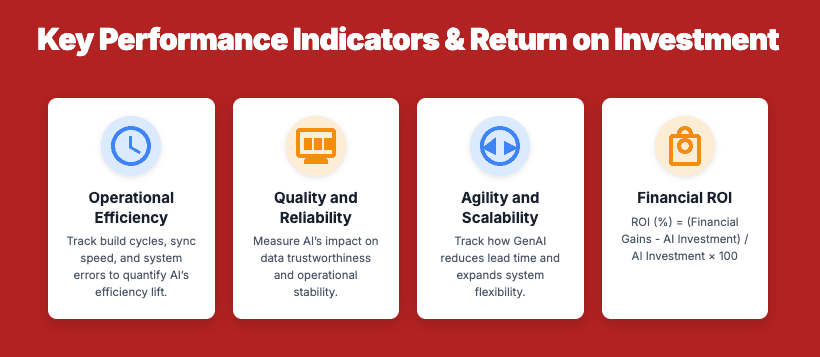
1. Operational Efficiency
Track build time per integration, data sync frequency, error rates, and overall throughput. If development drops from five days to one or systems update in real-time, the lift is measurable.
2. Quality and Reliability
Monitor data accuracy across systems, time to resolve integration issues, and drop in support tickets. Better uptime and cleaner handoffs are leading indicators of AI maturity.
3. Agility and Scalability
Track integrations deployed per quarter, lead time for new connections, and speed of change request handling. These metrics reflect how quickly AI lets your teams respond to evolving demands.
4. Financial ROI
Compare AI investment to cost savings (reduced labor, fewer errors, lower support burden) and new revenue (faster channel activation, improved retention). Use the formula:
ROI(%)=(Gains−Cost)Cost×100ROI (\%) = \frac{(Gains - Cost)}{Cost} \times 100ROI(%)=Cost(Gains−Cost)×100
ROI(%)=AI/ Investment(FinancialGains−AIInvestment)×100
Monitor. Refine. Scale.
Tracking success is not a one-time exercise. Review KPIs monthly or quarterly. If AI-generated mappings introduce new errors, retrain models or introduce validation layers. If ROI stalls, double down on high-performing workflows. Align data, tooling, and talent based on what the numbers reveal.
Expand the Lens
Consider broader metrics like:
- Innovation velocity: Number of new services launched due to faster integrations.
- Talent impact: Hours of manual work are replaced by AI, allowing teams to focus on design, strategy, and innovation.
Future Trends in Enterprise Integration with Generative AI
Generative AI is reshaping enterprise integration—not as an enhancement, but as the new foundation. What began as AI-assisted mapping is now evolving toward self-driven design, contextual logic, and autonomous maintenance. Here’s where we are headed:
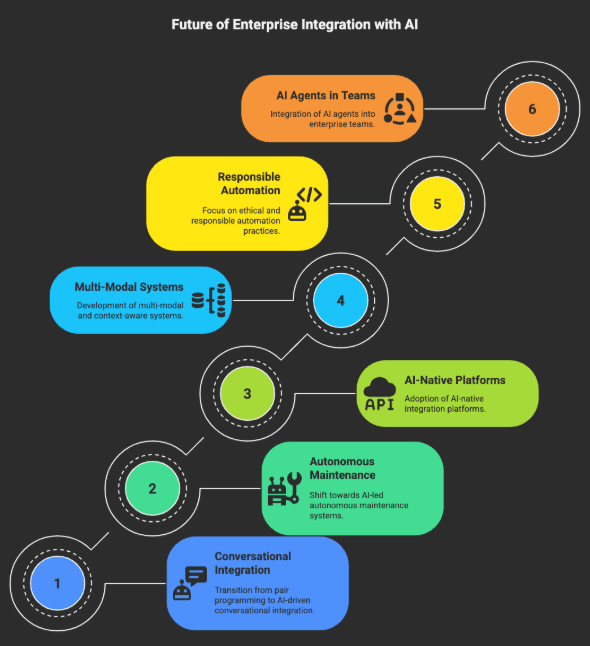
1. From Pair Programming to Conversational Integration
Today, AI supports developers. Soon, it will lead to the build. Specialized models will generate APIs, transformation logic, and test cases from a single business prompt. Integration as conversation will become the standard—describe the outcome, and AI assembles the connections. This shift will collapse IT backlogs and empower business users to self-serve safely under IT’s watch.
2. Autonomous Maintenance Becomes the Norm
AI will not just create workflows—it will run and repair them. Self-healing integrations will detect failed APIs, adjust data flows, and optimize for throughput in real time. As systems evolve, the AI will adapt without manual intervention. This marks a move from managed services to autonomous operations.
3. AI-Native Integration Platforms Take Over
Legacy iPaaS tools are becoming AI-first. Integration platforms will soon include embedded models trained on thousands of enterprise use cases. Architecture suggestions, best practices, and pre-built flows will surface as AI-native features. Vendors like Salesforce and Microsoft are already infusing their stacks with generative AI, and buyers will treat AI capability as a core decision factor, on par with reliability or security.
4. Multi-Modal and Context-Aware Systems
Future AI models will understand diagrams, screenshots, and voice inputs, enabling integrations to be designed through visuals or even conversation. More critically, AI will operate with full business context, respecting enterprise semantics, data rules, and compliance constraints by default. This will cut down rework and errors from poorly scoped logic.
5. Responsible Automation Takes Center Stage
As AI automates decisions, governance becomes essential. Expect integration frameworks to require audit trails, explainability, and secure environments. Companies will run models in VPCs or on-premises, track AI-generated code, and validate outputs for bias. Watermarking, provenance, and AI reviews will become compliance standards.
6. AI Agents Join the Integration Team
The next evolution: AI agents acting as autonomous integration engineers. They will attend meetings, track objectives, and handle end-to-end implementation—deploying, testing, and maintaining workflows with minimal human oversight. While early, this shift is already visible in co-pilot experiences across the enterprise stack.
The future of integration will be AI-led with human guidance. As capabilities scale, so does the need for alignment—technical, operational, and ethical. Enterprises that evolve now will not just move faster—they will integrate at the speed of business.
Why GeekyAnts for Enterprise Systems Modernization?
At GeekyAnts, we help enterprises modernize legacy systems using the power of generative AI and advanced integration strategies. From code refactoring to intelligent data migration, our team delivers modernization that is secure, scalable, and built for speed.
Our goal is to ensure it translates to business value.
Our Strengths in Generative AI and System Integration
We build future-ready systems by combining deep AI knowledge with real-world enterprise integration experience:
- Proven GenAI & Integration Expertise —
We help enterprises automate documentation, enhance interfaces, refactor legacy code, and streamline data pipelines. Our team knows how to apply the right AI tools—LLMs, predictive models, or automation frameworks—to the right use case.
- Custom Modernization Roadmaps —
Every enterprise is unique. We begin with discovery, assess your current systems, then deliver a phased modernization plan focused on ROI. From cloud-native refactors to GenAI-powered integrations—we build what your enterprise needs, not a one-size-fits-all solution.
- AI-Driven Architecture —
Our solutions use microservices, containers, and message queues alongside on-prem or cloud-based AI models. We integrate GenAI into your existing stack securely—supporting both hybrid and cloud-first environments.
- Security and Compliance Built In —
AI does not replace rigor. We bake in enterprise-grade security and regulatory compliance from day one. Our systems meet the highest governance standards, whether you operate in finance, healthcare, or retail.
- People-Centric Delivery —
We partner with your internal teams, enable smooth change management, and ensure long-term adoption. We provide training, risk mitigation, and internal buy-in through pilot-first delivery. Our goal: reduce friction, not introduce it.
- Ongoing Partnership & Optimization —
Modernization is a journey. Post-deployment, we stay on to monitor, iterate, and optimize. As your enterprise grows, your systems should evolve—our team ensures they do.
Seize the Modernization Advantage
Legacy systems can no longer carry the weight of digital-first business. Manual processes slow growth. Fragmented stacks limit innovation.
But modernization is not about shiny tools. It is about building intelligent infrastructure that adapts, scales, and performs.
At GeekyAnts, we help you shift from reactive workflows to proactive intelligence. Our integration-first, AI-enhanced approach enables agility, improves data flow, and empowers every business function to move faster with less effort.
The future belongs to systems that learn, respond, and evolve. We are here to build them with you.
Conclusion
GenAI powers faster development, fewer data errors, and higher system responsiveness. It transforms brittle, code-heavy processes into agile, scalable ones—without requiring full rip-and-replace upgrades. Enterprises leveraging GenAI for integration are gaining real-time data flow, lower costs, and future-ready infrastructure. The result: greater speed, smarter insights, and continuous innovation.
FAQs
1. What are the best generative AI tools for system integration?
Choose tools based on your stack, use case, and governance needs. Look for platforms that offer pre-trained models, AI-assisted data mapping, and secure deployment options (like on-prem or VPC). Pilot real-world integrations to compare tool efficiency and usability before scaling.
2. What risks come with using GenAI in integrations?
Risks include data leaks, inaccurate AI outputs, legacy system instability, and regulatory non-compliance. These are avoidable with strong governance: validate AI-generated code, keep humans in the loop, encrypt sensitive data, and train teams on safe AI usage.
3. How do I calculate ROI on GenAI integration?
Measure time saved, reduced rework, and new revenue enabled by faster integrations. Combine this with cost savings on developer hours and maintenance. Many firms report 100–150% ROI within a year. Use before/after dashboards to track performance.
4. How does data security factor into GenAI for integration?
It is foundational. Use encryption, access control, and private model hosting. Implement auditing tools to trace AI-generated outputs and ensure compliance with GDPR, HIPAA, or other standards. Treat GenAI components like any mission-critical infrastructure.
5. When can I expect to see results?
Many organizations see measurable outcomes in weeks. Pilot one integration use case, validate speed or error-rate improvements, and expand from there. Full ROI is often realized in 3–6 months, with compound gains as AI is scaled across more systems.