

Key Takeaways
- Dedicated teams offer up to 40% faster time-to-market and 60% lower operational overhead compared to in-house hiring—ideal for startups needing speed without sacrificing quality.
- You get a handpicked, full-time team that works exclusively on your product, like in-house, minus the hiring, HR, and infrastructure burden.
- Unlike freelancers (inconsistent) or staff aug (limited ownership), dedicated teams bring deep product knowledge, long-term continuity, and built-in leadership.
Access top 1% global developers with 2–4 hour US time zone overlap, ISO-certified security, and proven delivery in AI, SaaS, Fintech, and more.
What is the recipe for app development success? Is it the idea? Is it the technology? Or is it the lack of a team that can turn the vision into reality before the window of opportunity closes?
For founders, CTOs, and product owners in the US, the challenge has become sharper than ever— how to build capable product teams quickly and cost-effectively in the face of rising hiring costs and an intensifying developer talent shortage. The cost of hiring in-house talent continues to rise. The pool of skilled developers continues to shrink. By 2030, the global technology sector is projected to face a shortfall of eighty-five million workers.
This is where the dedicated development team model provides a clear and effective solution. It enables founders, CTOs, and product leaders to secure skilled professionals who can take a product from idea to execution, without the delays, high costs, or talent gaps that slow traditional hiring.
This guide will explain what sets the dedicated development team model apart, how it compares with other engagement models, and what steps will help you build and lead a team that delivers real results. The focus will remain on businesses in the United States, where the need for speed, precision, and cost efficiency continues to grow.
What Is a Dedicated Development Team Model?
A dedicated development team is a strategic extension of your company—a full-time, high-caliber team that works exclusively on your product. Handpicked to match your exact needs, the team aligns with your goals, integrates into your workflows, and fits your culture.
Unlike traditional outsourcing, this model builds long-term value. You shape the team—developers, designers, QA, PMs—and they report directly to your stakeholders, driving the product forward with deep domain knowledge and continuity.
When you hire a dedicated development team (in-house or outsourced), you get the agility of in-house development without the overhead of hiring. Scale the team as your product evolves. Set clear expectations, communicate directly, and align on the result, is a team that delivers as if it were in-house.
This model is ideal for companies seeking a true partner to build and scale with precision.
— Saurabh Sahu, Chief Technology Officer
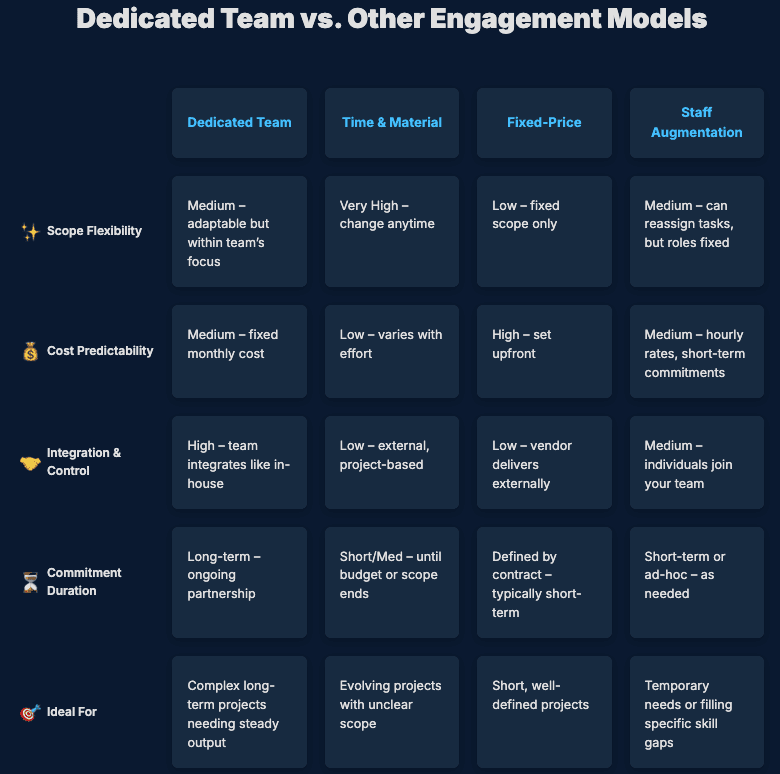
Dedicated Team vs. Other Engagement Models
No two products follow the same path. The right engagement model shapes how fast you move, how well you adapt, and how much value you create. This is where understanding the difference between a Dedicated Development Team, Time and Material, Fixed-Price, and IT Staff Augmentation becomes essential— to achieve the best balance of speed, flexibility, cost-efficiency, and technical alignment for your product’s unique goals and growth stage.
Let us break it down.
Dedicated Team vs. Time and Material
Time and materials mean you pay for the hours and resources used. This gives flexibility when your project scope changes. You can shift priorities without red tape. But flexibility comes at a cost. Budgets stay unpredictable. Costs rise if the scope expands. Oversight becomes critical to prevent overruns.
Dedicated Team gives you a stable, full-time team at a fixed monthly rate. You shape the team to match your needs—front-end, back-end, design, QA, management. You gain deeper project knowledge and stronger cultural alignment. Costs stay steady, but you commit to a fixed capacity each month. This model requires effort upfront to align the team with your vision.
Model | Pros | Cons |
Time and Material | High flexibility for changing scope. | A budget can spiral without strict management It requires constant oversight |
Dedicated Team | Predictable cost with full-time focus, Strong alignment with your processes and culture | Fixed monthly cost, even during low-demand phases. |
Dedicated Team vs. Fixed-Price
Fixed-price locks cost and scope at the start. The budget stays clear. Oversight stays light. But this model fits only when requirements never change. Scope shifts demand new contracts or change orders. Innovation slows. Vendors focus on delivery, not on value, which risks shortcuts.
A dedicated Team brings flexibility. You control priorities, adapt features, and respond to feedback without contract changes. The team grows with your product. Total cost may exceed a single fixed bid, but you gain continuous delivery and rapid response.
Model | Pros | Cons |
Fixed-Price | Clear cost from day one, Minimal management if the scope stays stable | No flexibility once the scope is set |
Dedicated Team | Flexibility to refine scope over time, Ongoing delivery, and faster feedback response | Higher long-term cost compared to one-time bids |
Dedicated Team vs. IT Staff Augmentation
IT Staff Augmentation adds temporary specialists to your team. You fill gaps fast. You access niche skills on demand. But cohesion suffers. Cultural alignment stays weak. You carry full management responsibility. Focus and loyalty may vary.
A dedicated Team provides a long-term unit that integrates with your operations. The team works only on your product, with built-in management and accountability. You gain consistency, deeper alignment, and stronger delivery across the product life cycle.
Model | Pros | Cons |
Staff Augmentation | A quick way to fill skill gaps, easy to scale headcount | Limited alignment with your culture. You manage the added staff directly |
Dedicated Team | Full alignment with your vision and processes. Committed, self-managed team focused on long-term success | Higher cost due to full-team commitment. Needs integration into your broader operation |
The Dedicated Development Team Model fits when you want more than delivery. It fits when you want a true partner—one that moves with you, adapts with you, and shares your vision for the product. The model brings stability, flexibility, and long-term value, where short-term models fall short.
To summarize the differences, here’s a comparison of key factors across these four engagement models.
When Should You Hire a Dedicated Development Team?
When the stakes are high and success depends on speed, precision, and expertise, the right team makes the difference. Below are clear situations where hiring a dedicated development team offers the strongest advantage.
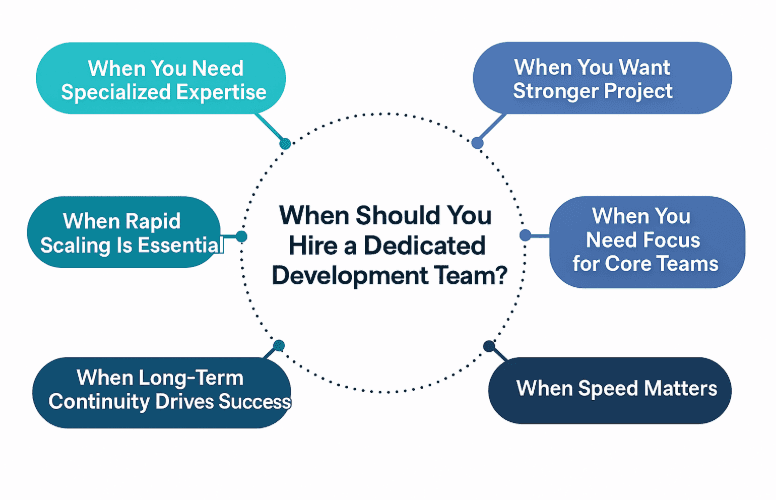
When You Need Specialized Expertise
Your in-house team may not cover every skill. Building an AI-driven platform, a blockchain solution, or an IoT product requires niche expertise. A dedicated team provides that expertise fast. You skip long recruitment cycles and access the skills that local markets often lack. In the US, this is critical. AI and ML engineers remain scarce and expensive. A dedicated team fills these gaps cost-effectively.
When Rapid Scaling Is Essential
Markets move fast. Startups and growing businesses often face deadlines where time-to-market decides who wins. A dedicated team lets you add capacity without the delay or risk of hiring full-time staff. You scale up or down as needed. You respond to demand without the constraints of U.S. labor laws or the burden of permanent hires.
When Long-Term Continuity Drives Success
Complex products need stable teams. Dedicated teams bring knowledge continuity that freelancers and rotating contractors cannot match. The team grows with your product. The team understands your domain. The result is higher quality work, fewer disruptions, and a partner that treats your success as its own.
When Speed Matters
The market rewards those who ship first. A dedicated team focuses only on your product. There are no distractions, no context switching. Development moves faster. Launch deadlines are met. Opportunities are captured before competitors react.
When You Need Focus for Core Teams
Your internal teams should drive vision and strategy. A dedicated team handles the heavy lifting. The core team focuses on priorities—legacy systems, business strategy, and customer needs—while the dedicated team builds and ships the product that supports growth.
When You Want Stronger Project Management
Dedicated teams bring structure. You gain project managers and QA specialists who work with your processes. You get consistency in reporting, testing, and delivery. The team stays accountable. Quality improves because the team’s success aligns directly with your product’s success.
Key Considerations Before Hiring a Dedicated Team
— Saurabh Sahu, Chief Technology Officer
Consider the recent high-profile case: IBM was ordered to pay £80 million ($105 million) to Co-Op Insurance after a failed £50 million IT transformation project that began in 2015. This wasn't about technical incompetence—it was about inadequate partnership preparation.
These failures follow a predictable pattern. Companies that succeed with dedicated teams follow six critical considerations—most founders ignore every single one.
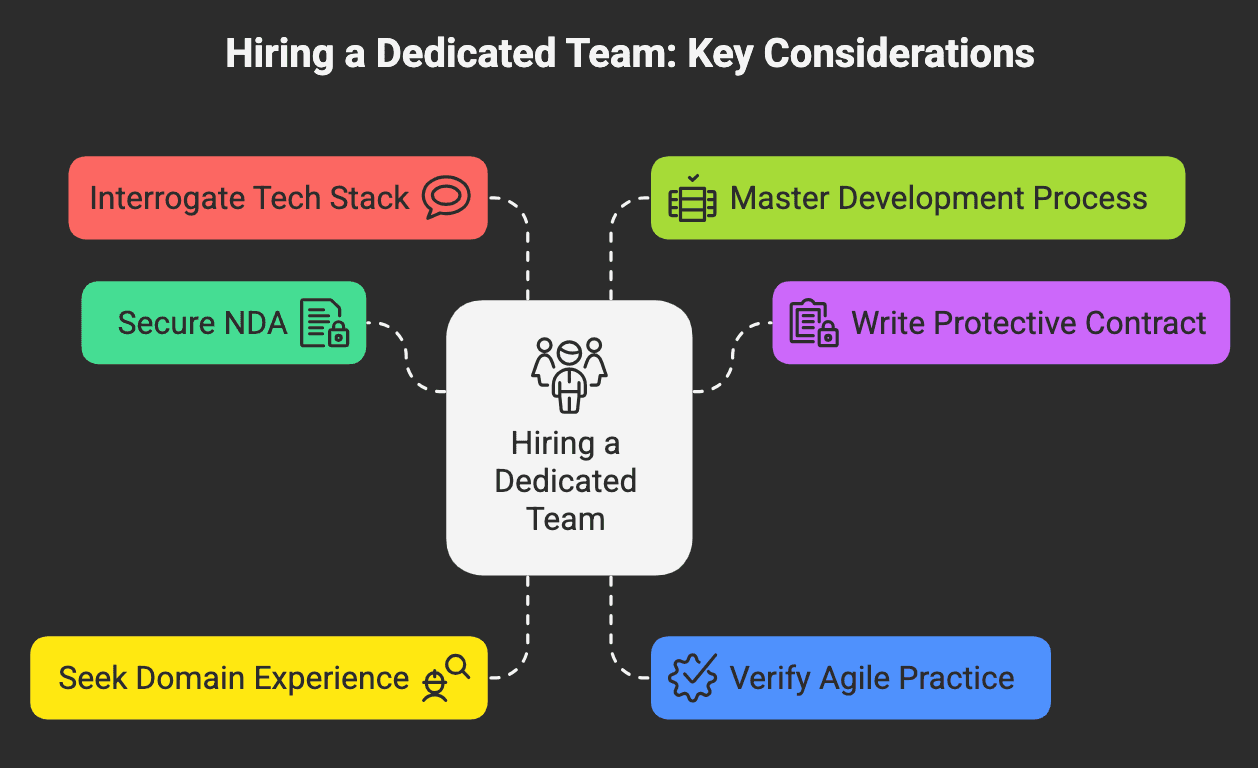
1. Master the Development Process Before You Need It
Most founders approach development partnerships like hiring a contractor to renovate their kitchen. They think they can hand over requirements and check back in a few weeks. This thinking destroys projects.
You need to understand every aspect of how your development team will work before they write a single line of code. Consider these essential questions:
- What happens when your team encounters a blocker at 2 AM their time?
- How do you handle scope creep when your biggest client demands a new feature?
- Who owns the decision when your designer disagrees with the developer?
Action Step: Demand a detailed process document. If the vendor cannot provide one, walk away. Great teams have systems; mediocre teams have good intentions.
2. Become a Tech Stack Interrogator
A founder once approved a software development team that wanted to build his AI-powered platform using jQuery and PHP. When questioned why he agreed, he said, "The tech knowledge wasn't there to argue." This attitude costs millions.
You don't need to code, but you need to understand why your team chooses specific technologies. Modern development moves fast, and teams using outdated tools deliver outdated products.
Action Step: Ask these questions in every vendor conversation:
- Why did you choose this specific tech stack for our project?
- What alternatives did you consider, and why did you reject them?
- How do you stay current with emerging technologies?
3. Demand Agile, Then Verify They Practice It
Every development team claims to be "Agile." Most are not. Real Agile methodology means you see working software every two weeks. It means daily standups, sprint planning, and retrospectives.
Too many founders nod along when vendors mention "Agile" without understanding what that means for their project. Six months later, they stare at a half-built product with no clear delivery timeline.
Action Step: Ask for their sprint schedule during the sales process. If they cannot show you a sample two-week sprint plan, they're not doing Agile—they're doing "Agile-ish."
4. Hunt for Domain Experience Like Your Business Depends on It
Generic development teams build generic products. If you're developing healthcare, you need developers who understand HIPAA. If you're building fintech, you need a team that has navigated regulatory requirements before.
One startup hired brilliant developers who had never worked in their industry. They built beautiful code that failed every compliance check. Four months of rebuilding followed what should have worked from day one.
Action Step: Don't just ask about domain experience—demand proof. Request similar projects they've completed, references from companies in your space, and specific examples of industry challenges they've solved.
5. Treat Your NDA Like Your Company's Life Insurance
Your idea is everything. Your data is everything. Your competitive advantage is everything.
Founders who treat NDAs like bureaucratic paperwork, you need to rush through risk their entire market position when proprietary information leaks to competitors.
Action Step: Use your own NDA, not theirs. Require individual team members to sign, not just the company. If they push back, that's not a red flag—it's a deal-breaker.
6. Write a Contract That Protects Your Future Self
Your contract is your insurance policy against the unknown. Include specific deliverables, payment tied to milestones, and clear procedures for scaling the team up or down.
Action Step: Do not sign anything until your lawyer reviews it. Yes, it costs money upfront. Compare that to the $2.3 million lost because this step was skipped.
The Uncomfortable Truth About Dedicated Teams
Most founders hire dedicated development teams because they want to move fast. The irony? Rushing the preparation phase guarantees you'll move slower than if you'd built in-house.
Companies that succeed with dedicated teams spend more time preparing than they do managing. They understand that a great partnership isn't found—it's built, brick by brick, decision by decision.
How to Hire a Dedicated Development Team?
Companies using dedicated teams report 40% faster time-to-market compared to traditional hiring models while reducing operational overhead by 60%. The reason? Dedicated teams eliminate the friction of constant onboarding, context switching, and project handoffs.
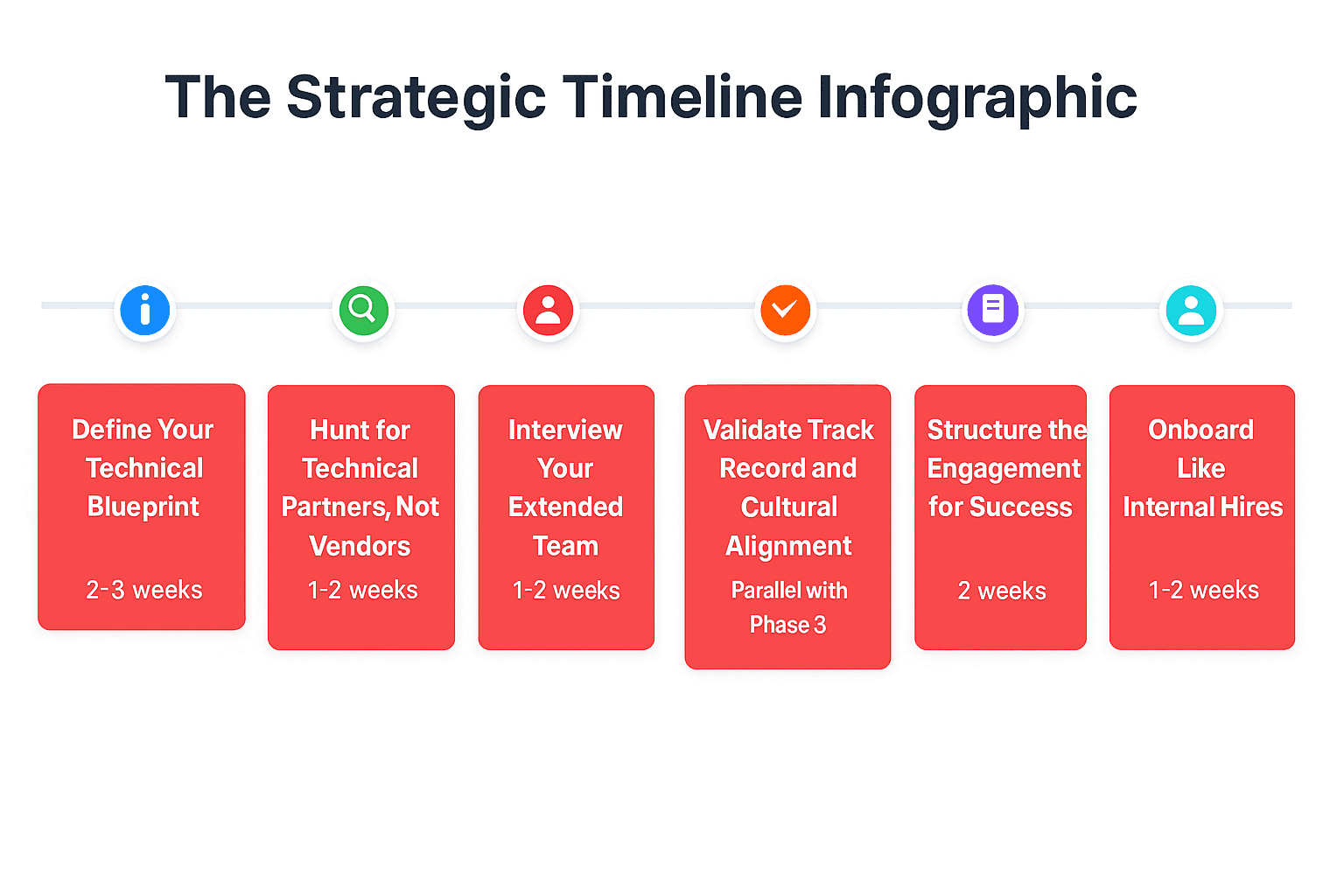
Step 1: Define Your Technical Blueprint
Timeline- 2-3 weeks
Most founders begin with vague requirements. "We need a mobile app" or "Build us a dashboard" creates confusion, not clarity.
Instead, document your project with surgical precision:
- Scope boundaries: What features make version 1.0 versus future releases
- Technical architecture: React frontend, Node.js backend, PostgreSQL database
- Success metrics: User acquisition targets, performance benchmarks, revenue goals
- Timeline constraints: Market windows, funding milestones, competitive pressures
Create a one-page technical brief that any developer can understand within minutes. This document becomes your north star throughout the hiring process.
Pro tip: Include user stories with acceptance criteria. "As a user, I want to login via Google OAuth so I can access my dashboard within 2 seconds" provides more direction than "implement user authentication."
Step 2: Hunt for Technical Partners, Not Vendors
Timeline- 1-2 weeks
The difference between a vendor and a partner determines your project's success. Vendors execute tasks; partners solve problems.
Start your search in regions known for technical excellence:
- India: Cost-effective with deep technical talent pools
- Eastern Europe: Strong in fintech and enterprise software
- Latin America: Favorable time zones for US-based companies
Use platforms like Clutch, GoodFirms, and TopDevelopers to identify candidates. However, ratings alone mislead. Dig deeper into case studies that mirror your industry and technical requirements.
Step 3: Interview Your Extended Team
Timeline- 1-2 weeks
Here comes the crucial moment: meeting the people who will build your vision.
Treat each interview like hiring a senior engineer for your core team. Technical skills matter, but communication and problem-solving abilities determine long-term success.
Ask these revealing questions:
- Technical depth: "Walk me through how you would architect a system handling 10,000 concurrent users."
- Problem-solving approach: "Describe a complex bug you encountered and how you solved it."
- Communication style: "How do you handle disagreements about technical decisions?"
- Business understanding: "What questions would you ask to understand our user's pain points?"
The best candidates think beyond code. They understand your business context and suggest solutions that align with your strategic goals.
Step 4: Validate Track Record and Cultural Alignment
Timeline- Parallel with Phase 3
Technical skills get you in the door. Cultural fit determines whether teams thrive or struggle. Request detailed case studies from similar projects. Look for patterns:
- Did they deliver on time and within budget?
- How did they handle scope changes or technical challenges?
- Do their clients continue working with them after project completion?
Cultural alignment matters more than many founders realize. A team that shares your work ethic, communication style, and quality standards integrates seamlessly. Misaligned teams create friction that slows progress and increases costs.
Test cultural fit through small paid projects. A two-week proof-of-concept reveals more about working dynamics than months of interviews.
Step 5: Structure the Engagement for Success
Timeline- 2 weeks
This step separates amateur engagements from professional partnerships.
- Define the working model: Agile sprints work well for iterative development, while waterfall suits projects with fixed requirements.
- Establish communication rhythms: Daily standups, weekly demos, monthly strategic reviews
- Set clear boundaries: IP ownership, confidentiality agreements, and termination clauses.
- Plan for time zones: Ensure 3-4 hours of overlap for real-time collaboration.
- Create payment structures: Fixed monthly rates provide predictability; milestone-based payments align with delivery goals.
Document everything in a formal agreement. Ambiguity in contracts leads to disputes that damage relationships and delay projects.
Step 6: Onboard Like Internal Hires
Timeline 1-2 weeks
Your dedicated software development team succeeds when they feel like employees, not contractors.
Provide comprehensive onboarding:
- Full access to development tools and documentation
- Introduction to key stakeholders and decision-makers
- Clear escalation paths for technical and business questions
- Regular feedback loops for continuous improvement
Set up robust communication channels. Use Slack for daily coordination, Jira for task management, and GitHub for code collaboration. The goal: eliminate friction that slows development velocity.
Your next unicorn idea deserves a team that matches its potential. Start with clarity, hunt for partners, and build relationships that outlast individual projects.
Dedicated Teams vs Freelancers vs In-House: The Strategic Choice That Determines Your Success
Three paths diverge in the technical talent woods. Your choice shapes everything—product quality, team velocity, budget efficiency, and market timing. Choose wrong, and competitors sprint past while you wrestle with coordination chaos or drain capital on overhead.
The breakdown of Dedicated Teams, Freelancers, and In-House Teams has been presented in the form of a clear table for easy comparison and decision-making.
Aspect | Dedicated Teams | Freelancers | In-House Teams |
Role | Full remote extension of your tech division. Vendor supplies pre-integrated team (PM, developers, designers, QA). | Independent specialists for specific tasks. | Full-time employees are dedicated to your technical vision. |
Strategic Advantage | Global talent, long-term focus, deep institutional knowledge. | Immediate niche skills, no long-term obligation. | Maximum control, cultural alignment, and technical ownership. |
Best For | Medium-large projects, sustained velocity, complex integrations, platform evolution. | One-off tasks, experiments, niche consulting. | Core platforms, long-term strategic initiatives, and critical technical IP. |
Coordination Complexity | Low — pre-integrated team, vendor handles coordination. | High — multiple independents, you manage integration. | Low — single organization, direct internal oversight. |
Quality Consistency | High shared standards, peer reviews, and unified processes. | Variable — individual standards and practices differ. | High internal processes and ownership align quality. |
Project Continuity | Strong — full-time commitment, deep project knowledge. | Weak — availability fluctuates, risk of disruption. | Strong, stable employment ensures continuity. |
Cost Profile | Higher upfront, better long-term value. 35% lower total cost vs freelancers (same scope). | Low hourly, hidden costs from integration and delays. | High salaries plus 30-40% overhead costs. |
Talent Access Speed | 2-4 weeks via vendor’s pre-vetted pool. | Immediate for task-based roles. | 3-6 months per hire in competitive markets. |
Scalability | Fast — vendor scales capacity as needed. | Limited availability is dependent on individuals. | Slow hiring or layoffs lag behind business needs. |
Geographic Flexibility | Global talent pools, no location limits. | Global or local, depending on hire. | Limited to local or relocatable candidates. |
Cost Benchmark | 50-70% lower than Silicon Valley in-house equivalents. | Seems low per hour, but total cost rises with delays. | $150k-$200k per senior dev + 30-40% overhead. |
Managing a Remote Dedicated Team: Ensuring US Time Zone Overlap with Precision
The promise of a dedicated remote development team is compelling. Around-the-clock productivity. Cost efficiency. Access to global talent. However, the moment the distance spans continents and time zones stretches to extremes, the equation shifts. Founders, product owners, and tech leaders must master a precise balancing act. Let us explore how to lead remote dedicated teams across US and offshore time zones, not as a challenge, but as an opportunity to outpace competitors.
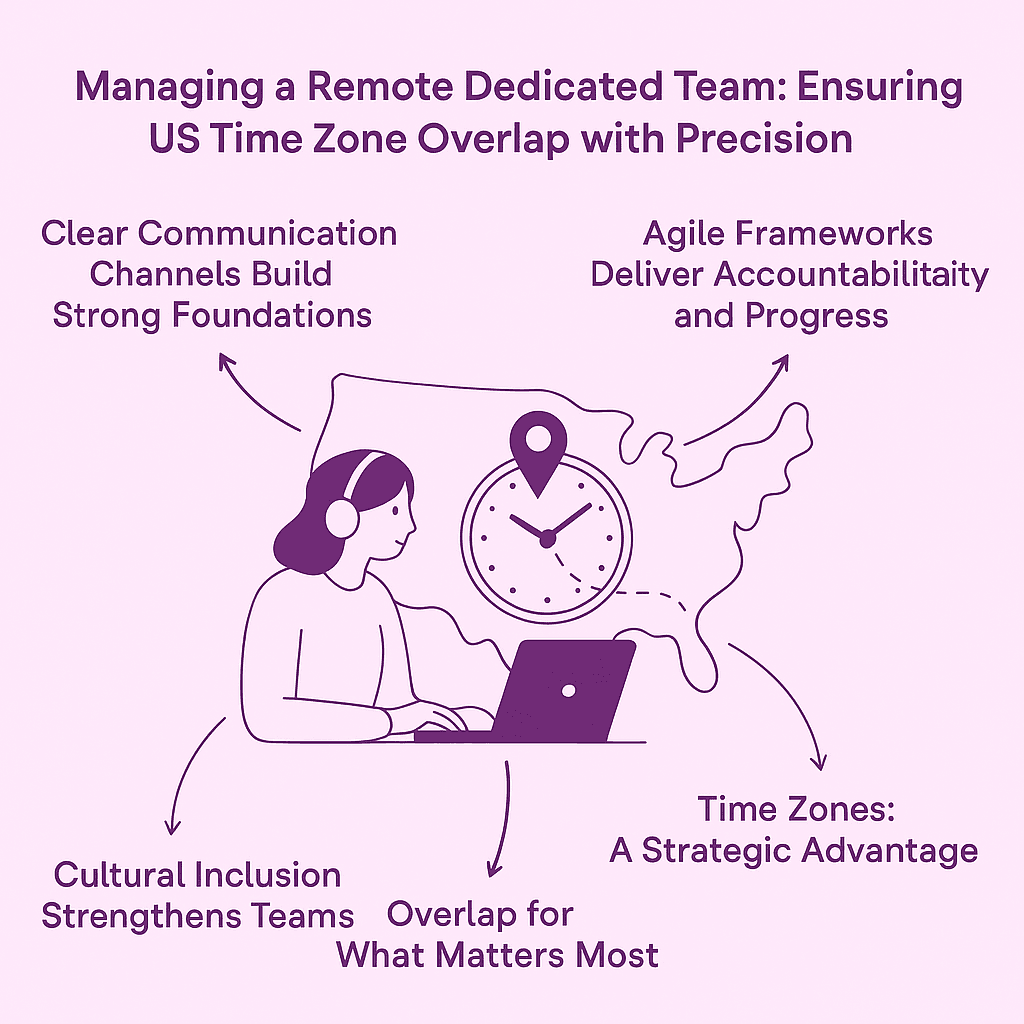
1. Clear Communication Channels Build Strong Foundations
Strong teams start with strong communication. Use synchronous tools like Zoom or Microsoft Teams for planned meetings. Pair these with asynchronous tools like Slack or email for daily updates. Create a detailed communication plan with check-ins and escalation paths.
For teams across a ten to twelve-hour gap, secure two to four hours of overlap. Schedule stand-ups or live sessions during this window. Outside these hours, insist on written updates. Clear documentation ensures workflows run seamlessly between time zones.
2. Agile Frameworks Deliver Accountability and Progress
Agile frameworks are non-negotiable. Use tools like Jira, Asana, or Trello as a single source of truth. Track progress. Assign clear owners. Set deadlines. Hold sprint planning and retrospectives during overlap hours. Structure transforms time zone differences into a non-issue.
3. Time Zones: A Strategic Advantage
Leverage time zones to extend the workday. Handoff tasks at the close of the US day. Receive progress updates by the next morning. Follow-the-sun models can accelerate delivery. Balance this with sustainable schedules. Have offshore teams shift hours a few days per week. Ask US teams to flex occasionally. Mutual flexibility builds trust.
4. Cultural Inclusion Strengthens Teams
Culture matters. Take time to understand the holidays and customs of your offshore team. Share your own. Acknowledge festivals. Schedule around national holidays. These gestures demonstrate respect.
Host introductory calls for new team members and encourage personal connections beyond work. Utilize informal channels for casual conversations. When feasible, organize face-to-face meetings or virtual team-building sessions. Inclusion fosters trust, which in turn fuels performance.
5. Overlap for What Matters Most
Prioritize overlap hours for design reviews, planning, and architectural discussions. For lower-priority updates, use recorded demos or detailed notes. Plan meetings well in advance. Choose times that strike a fair balance. A standing Wednesday meeting at 9 AM ET and 6:30 PM IST ensures predictability. Predictability lets teams plan their lives and deliver their best work.
Trust Empowers Performance
Micromanagement destroys morale. Instead, lead by setting clear goals and measuring outcomes. Resist the urge to monitor every move because you cannot see the team at work. If you have established visibility through communication tools and project tracking, trust your team. Review work. Provide feedback. Maintain timelines. But focus on results, not hours logged. Empowerment leads to accountability.
Aspect | Pros (Data-Driven Insight) | Cons (Cautionary Note) |
Time Zone Leverage | Enables 16-24 hours of development coverage through a follow-the-sun model (up to 30% faster sprint velocity based on distributed team studies). | Requires rigorous handoff processes; risk of misalignment if documentation is weak. |
Cost Efficiency | Offshore teams can reduce operational costs by up to 40-60% without quality compromise. | Savings can erode if poor coordination causes rework or delays. |
Talent Access | Access to a wider, often highly skilled, talent pool across regions. | Time zone gaps can limit real-time collaboration for complex problem-solving. |
Productivity | Structured overlap hours combined with asynchronous progress drive consistent output. | Without clear scheduling, team members risk working irregular hours, causing fatigue. |
Cultural Diversity | Diverse teams bring fresh perspectives, improving innovation by up to 20% in well-integrated groups (source: McKinsey). | Misunderstandings can arise if cultural differences are not proactively addressed. |
The true opportunity lies in transforming distance into a strategic advantage. When led well, your dedicated team will deliver with speed, quality, and cohesion that makes geography irrelevant.
What are the key Benefits of hiring a Dedicated development team?
Investing in a dedicated development team can feel like a huge leap. But what if that leap could land you squarely in a space of innovation, efficiency, and significant growth? It is not just about offloading work; it is about strategically expanding your capabilities. Tapping into a specialized team offers distinct advantages that can redefine your project's trajectory and your business's future.
- Modern Expertise: You gain a team proficient in modern, relevant technologies and industry best practices, leading to efficient delivery and a future-proof product.
- Agile Delivery: By favoring Agile methodologies, you benefit from regular checkpoints, frequent deliverables, and the ability to adapt to changes, ensuring continuous improvement.
- Domain Insights: A team with relevant domain experience can ramp up faster and bring valuable insights, enriching your project.
- Resource Efficiency: Understanding the full range of a team's skills allows you to utilize their capabilities effectively, with the potential to leverage the same team for future projects.
- Legal Clarity: A detailed contract and Non-Disclosure Agreements (NDAs) ensure aligned expectations, protect your intellectual property, and provide clear recourse if issues arise.
Ultimately, a dedicated development team is a strategic asset that accelerates your vision into reality.
Cost of Hiring a Dedicated Development Team
One of the most common questions is: “How much will a dedicated development team cost?” The answer depends on location, expertise, project complexity, and added services. Understand these, and you control your budget.
Location matters most. Hiring in the United States or Western Europe costs $80 to $150 per hour. Eastern Europe ranges $35 to $70 per hour. Asia offers $20 to $50 per hour.
Expertise pushes costs higher. Senior or niche-skilled developers charge 30 to 50 percent more. Complex builds with integrations or compliance add time and budget. Design, QA, DevOps, and project management add 20 to 40 percent.
Region (Location of Team) | Typical Hourly Rate (USD) |
United States | $80 – $150 per hour |
Western Europe (e.g. UK, Germany) | $60 – $100 per hour |
Eastern Europe (e.g. Poland, Ukraine) | $40 – $70 per hour |
India & Southeast Asia | $25 – $50 per hour |
Latin America | $30 – $60 per hour (varies by country) |
Rates vary by role and region. Senior developers in the USA, especially in cities like San Francisco or New York, often exceed $150 per hour. In contrast, skilled developers in India cost far less, though remote work adds coordination overhead.
Dedicated teams usually work on a monthly rate. A $ 50-per-hour developer costs about $8,000 per month based on 160 hours. Vendors often bundle project management or support into the price.
Cost Scenarios with Examples from our 500+ client projects
To provide a clearer understanding of the costing range, here are some typical scenarios:
- Small Team for Startups/MVP (Minimum Viable Product):
Team: 2–3 developers + 1 designer + part-time PM
Timeline: 3–4 months
Real Example: IoT Hydration App for Footballers & Clinical Tool for Amputees
Cost: $40,000 – $50,000/month
- Medium-Sized Team for Growing Businesses:
Team: 4–5 developers + 1–2 designers + QA + full-time PM
Timeline: 3.5 months (2 phases of 7 weeks each)
Real Example: Asset Management System for a Global Railway Giant
Cost: $60,000 – $90,000/month
Overcoming the Top Concerns of Hiring Dedicated Development Teams
Every leader considering a dedicated team faces hard questions. Will the team deliver? Can you trust them with your code? Will communication break down? Each concern has a solution. Here is how to address them with precision.
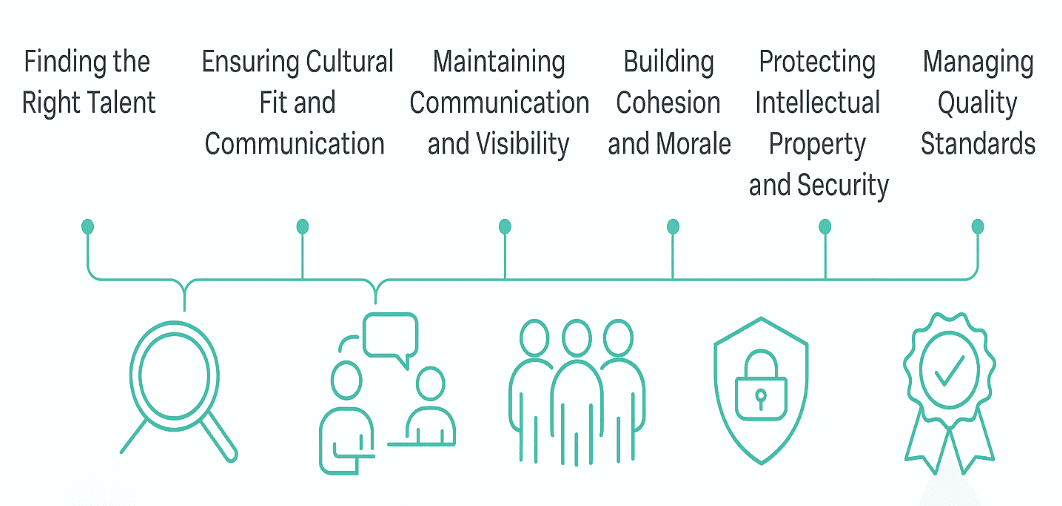
1. Finding the Right Talent
The fear of ending up with second-rate developers is common. The solution is simple. Choose a vendor with a strong hiring process. Top firms keep a bench of skilled engineers and can recruit niche talent quickly. Review CVs. Run technical interviews. Start with a trial sprint. Global hiring expands access to talent far beyond local limits.
2. Ensuring Cultural Fit and Communication
Work styles differ across countries. Misalignment can hurt progress. Address this during hiring. Test communication skills and work style in interviews. Once onboarded, integrate the team. Share your mission. Include them in meetings. Set clear expectations on hours, feedback, and decision-making.
3. Maintaining Communication and Visibility
Remote teams succeed with structure. Use tools to keep work visible. Hold daily check-ins. Share dashboards. Run weekly demos. Set protocols. Slack for urgent issues. Email for daily wrap-ups. Reports for weekly updates. Define response times. Discipline in these practices gives you full insight, as with an in-house team.
4. Building Cohesion and Morale
Dedicated teams stay engaged when they feel part of the mission. Share user feedback. Celebrate wins together. Include them in retrospectives. Encourage informal chats. Plan virtual team-building. Arrange occasional meetups when possible. Treat them as equals. A united team produces stronger results.
5. Protecting Intellectual Property and Security
Safeguard IP through legal and technical measures. Sign NDAs at the individual and company levels. Ensure contracts give you code ownership. Store code in your repositories. Apply access controls. Choose vendors with ISO or similar certifications. Discuss security openly. The right setup protects your business.
6. Managing Quality Standards
Set clear standards from day one. Use your review processes and CI pipeline. Apply automated code checks. Give early and direct feedback. Hold teams to the same benchmarks as your own. Strong vendors meet these expectations and often raise the bar.
Final Thought: Dedicated teams bring challenges. But with clear steps, each challenge becomes manageable. A well-managed team delivers value as an extension of your business. That is how you scale with confidence.
Why Choose GeekyAnts as Your Dedicated Development Partner
At GeekyAnts, we combine product engineering excellence with deep domain knowledge. Our dedicated teams help businesses launch, scale, and modernize products with precision. We bring more than developers — we bring solutions that move fast and deliver value.
Our Advantage in Dedicated Development
We provide dedicated teams that work as true extensions of your business. Each team is hand-picked, battle-tested, and aligned with your goals.
- Proven Domain Expertise – Over a decade of delivering products in healthcare, finance, e-commerce, SaaS, and more. From retail and dining leaders like Olive Garden and Darden to financial powerhouses like HDFC and ICICI, our teams solve real-world challenges with confidence.
- Top 1% Engineering Talent – Access elite developers, open-source contributors, and experts in React, Node.js, Flutter, DevOps, and cloud. Every team is selected to fit your tech stack.
- US & UK Time Zone Alignment – With offices in Bangalore, London, and San Francisco, we ensure overlapping hours for seamless communication. Our teams understand US and UK business culture and communication styles.
- Transparent Agile Process – Sprints with clear goals. Daily updates. Regular demos. Full visibility through tools you already use (Jira, Slack, Teams). No surprises — only clarity.
- Built-in Quality and Security – ISO 27001 and ISO 9001 certified. Dedicated QA in every team. Strong peer review and secure code practices. Your IP stays protected.
- Flexible Engagement – Scale up or down fast. Start small, grow as your product succeeds. Long-term support ensures continuity and deep domain knowledge retention.
Proven Expertise. Trusted Partnerships.
We have powered startups to acquisition and helped enterprises launch bold new platforms. Clients rate us 5 stars on Clutch. Our teams earn praise for technical strength, commitment, and delivery excellence. With GeekyAnts, you gain a partner invested in your success.
Let’s innovate, collaborate, and build amazing products together!
Conclusion: Dedicated Teams as a Growth Engine
With the right team, you gain an extension of your company — skilled, aligned, and committed to your vision.
For founders, CTOs, and product owners, this model provides a proven path to faster launches, stronger products, and smarter scaling. The key is to choose a partner who matches your standards, aligns with your culture, and builds with precision.
When you address the risks and apply the right practices, the benefits are clear. Dedicated teams deliver outcomes that move your business forward.