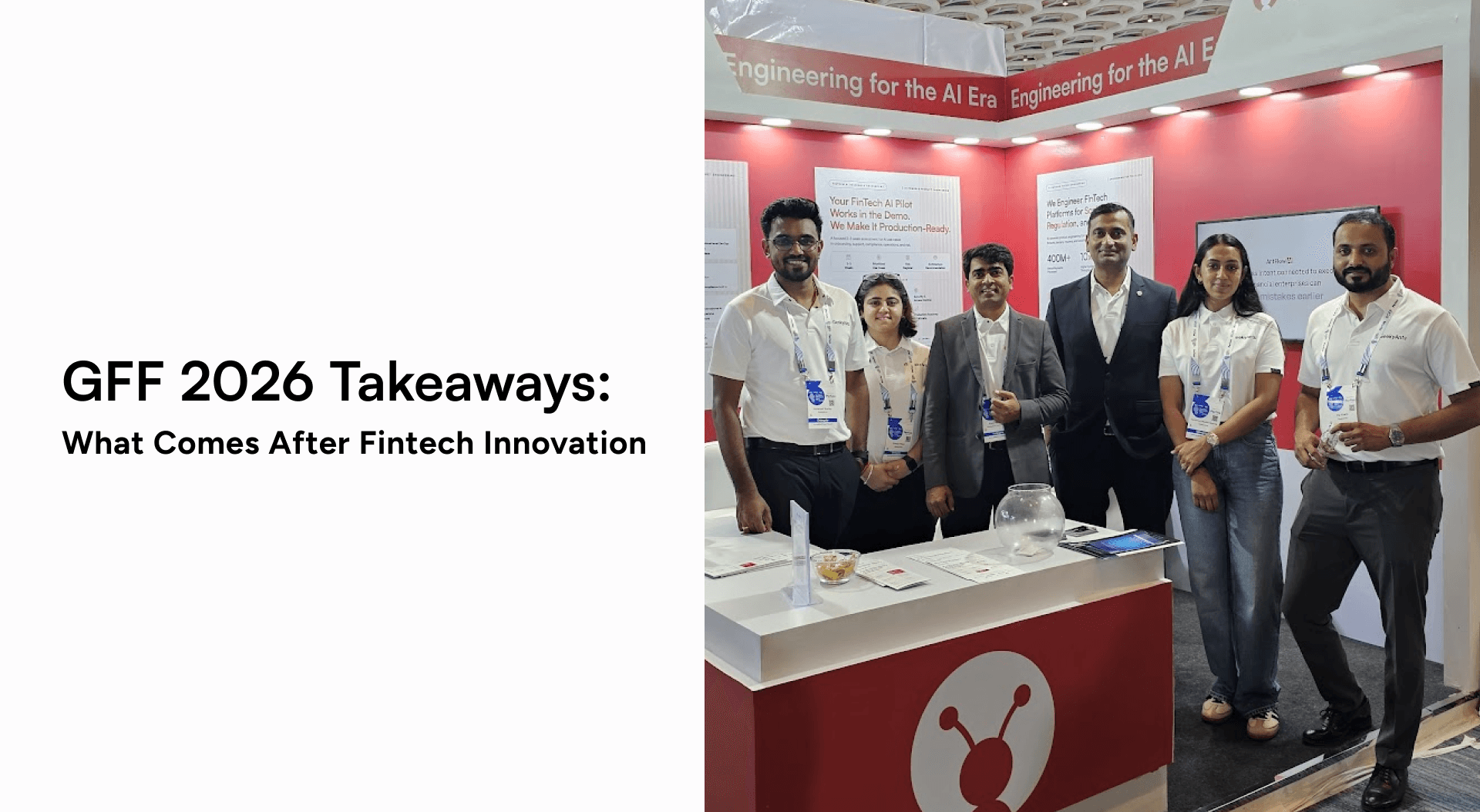

At Global Fintech Fest 2026 in Mumbai, the conversation centered on how financial systems become more intelligent without becoming less trustworthy. The industry has spent years building faster payments, digital financial products, and infrastructure that operates at enormous scale. GeekyAnts took part in that discussion from Booth JE16.
This article covers what the team brought to GFF 2026 and what it learned there: how intelligence is moving into payments and operations, where trust limits what AI can do, how programmability and regulation shape architecture, and what all of it means for the engineering work ahead.
What GeekyAnts Brought to GFF 2026
The seventh edition of GFF ran from September 8 to 11 at the Jio World Centre and Trident BKC in Mumbai. It brought together more than 100,000 attendees, 8,000 participating institutions, 5,000 startups, 1,200 speakers, 500 investors, and participants from more than 80 countries. Its theme, "Potential to Impact: Trusted, Connected, Global Systems for Inclusive Finance," ran across discussions on agentic AI, tokenization, quantum technologies, payments, lending, compliance, cybersecurity, and digital public infrastructure.
GeekyAnts attended as a Bronze Partner and exhibitor. The team used Booth JE16 to discuss fintech, AI, payments, digital banking, modernization, and the engineering questions that come with taking all of them into production. Saurabh Sahu, CTO at GeekyAnts, framed the question the company works through with clients: how to build systems where AI agents can take action while the organizations using them can still trust, verify, and take responsibility for those actions.
Intelligence Is Moving Into Payments and Operations
Kunal Kumar, CRO at GeekyAnts, identified the move from digitization toward intelligence as one of the key shifts at the event.
"India already has a very strong financial ecosystem, and the industry has been digitizing for a long time. What we are seeing now is a move toward a more intelligent operational ecosystem. As we scale, regulation and compliance will be as important as innovation."
Payments show that shift most directly. Fraud signals, identity, consent, risk scoring, credit decisions, and behavioral data increasingly work together while a transaction is happening, and the same opportunity extends into digital lending, insurance, wealth management, pensions, and cross-border finance.
Much of the consequential work sits behind the customer interface. Kunal put the transition in one line: "The fintech industry has moved from the chatbot to a different layer now." A fraud investigation may involve transaction analysis, policy checks, risk assessment, documentation, escalation, and communication, and agentic systems can coordinate more of those steps while keeping people involved where judgment or approval is required.
Where Does AI Stop and Human Judgment Begin?
Agentic AI raised a further question:
If agents understand intent and execute complex tasks, will customers prefer to interact with them instead of banking applications?
The answer depends on what customers ask the system to do. AI can take on more of the work in basic payments and onboarding flows, while a mortgage, a loan, or an investment decision still depends on trust and human judgment.
Giving an autonomous system authority over a major financial commitment requires confidence in the data it uses, how it reaches a decision, and when a human becomes involved. Explainability, consent management, data privacy, cybersecurity, and human oversight therefore belong to the product experience itself.
Conversations at the booth reflected this idea. Fintech leaders asked narrower questions than before, covering where AI improves operations, how it will work with the systems they already run, and what controls need to be in place before it reaches customers. Buyers want to know whether AI can shorten KYC, improve fraud detection, automate repetitive operations, or support better credit decisions.
What Does Tokenization Need to Work in Production?
Tokenization was another major theme, and the discussion is moving toward practical applications involving bonds, invoices, warehouse receipts, and other real-world assets. Programmability allows transactions and assets to carry rules governing when and under what conditions something happens.
Systems of that kind need legal clarity, reliable smart contracts, secure settlement, controls, and clear accountability when something does not happen as expected.
Kunal also pointed to regulation as one of the forces determining how quickly intelligent financial systems develop. Sessions covered AI governance, cybersecurity, digital identity, and consumer protection.
Quantum readiness was discussed as a long term question- where banks need visibility into their cryptographic dependencies and a plan for post-quantum security as standards evolve. These considerations influence architecture, data access, model behavior, approval mechanisms, observability, and customer experience from the beginning.
What This Means for How GeekyAnts Builds
GFF 2026 showed an industry moving into its next phase.
Payments remain foundational, and some of the largest opportunities are now based around what gets built on top of that infrastructure: intelligent lending, personalized banking, automated operations, programmable assets, inclusive financial products, and more connected cross-border systems.
For GeekyAnts, building these products requires AI, modern engineering, security, compliance, data, and human accountability to work together at scale.
Teams working through those decisions can see how GeekyAnts approaches fintech app development across digital banking, payments, lending, and legacy modernization.