

Key Takeaways
- Outsourcing has gone past cost-reduction. It is one of the ways the U.S. firms will find exclusive expertise essentials such as AI, cybersecurity, and blockchain, and accelerate deliveries in 2025-26.
- Hybrid models are a reality. Firms merge in-country management and nearshore flexibility and offshore cost effectiveness to trade off speed, expertise, and risk.
- Costs vary widely by region. Although the U.S. development rates could be up to $400 an hour, offshore markets such as India or Eastern Europe could provide the talent fraction of that price.
- It is a process and a partnership to success. Well-defined objectives, good contracts, and considering outsourced vendors as an extension of the team make outsourcing a long-term strategy value.
You are a company that desires to develop digital products, AI systems, and cloud solutions quickly. However, you do not have sufficient engineers to do so, like most businesses in 2025-26. The demand is increasing, there is a shortage of talent, and employment has become quite slow and costly. The outcome includes what are known as missed deadlines, stalled launches, and lost growth opportunities.
That’s why outsourcing software development has become a first-line action. By outsourcing, your business can scale teams when needed, tap into expertise you don’t have in-house, and bring products to market faster than traditional hiring allows.
The market illustrates the dramatic nature of this shift.
The outsourcing model has changed in the last decade. Previously, the quest to secure the cheapest price had resulted in time wastage and inadequate quality. Speed, scale, and innovation are fueling it today, helping the internal teams be strategy-focused and partners to take action.
What Is Software Outsourcing?
Outsourcing software development refers to entrusting a partner with your development project. You outsource when building in-house would require too much time, too much money, or skills that are not available locally. This strategy provides access to deep expertise, established processes, and proven infrastructure that enable quicker delivery cycles and lower overheads.
Rather than investing resources in recruitment and training, you gain a partner who takes charge of implementation while remaining aligned with business goals. The outcome is faster product launches, improved cost control, and the ability to compete in markets where speed and technical knowledge determine success.
Types of Software Outsourcing Services
Modern businesses rely on software outsourcing services to scale faster and close skill gaps. A software development company can deliver end-to-end solutions or specialized support, helping organizations access expertise while keeping teams focused on core goals.
1. Web Development
Companies outsource web projects to build custom applications and platforms without overloading internal teams.
2. Mobile App Development
Outsourcing partners can design and build iOS, Android or cross-platform apps, enabling businesses to reach wider markets.
3. Software Testing & Quality Assurance (QA)
Dedicated QA teams strengthen applications by ensuring they are secure, reliable, and launch-ready, reducing risks and costly errors.
4. Emerging Technology Consulting
Specialists in AI, ML, blockchain, and IoT help adopt advanced solutions that may be difficult to build with in-house resources.
The choice of outsourced services depends on the priorities. For example, AI and ML projects account for 27% of outsourcing, driven by challenges such as managing large datasets and delivering personalized user experiences.
What is Fueling Software Development Outsourcing in the U.S. (2025-26)?
Currently, the talent crunch and the increasing demand for specialized skills are considered the key motivations behind software development outsourcing. Over 65 percent of US-based companies in 2024 report difficulties in recruiting engineers with advanced expertise, and demand for cloud-native engineers is increasing by 40 percent per annum.
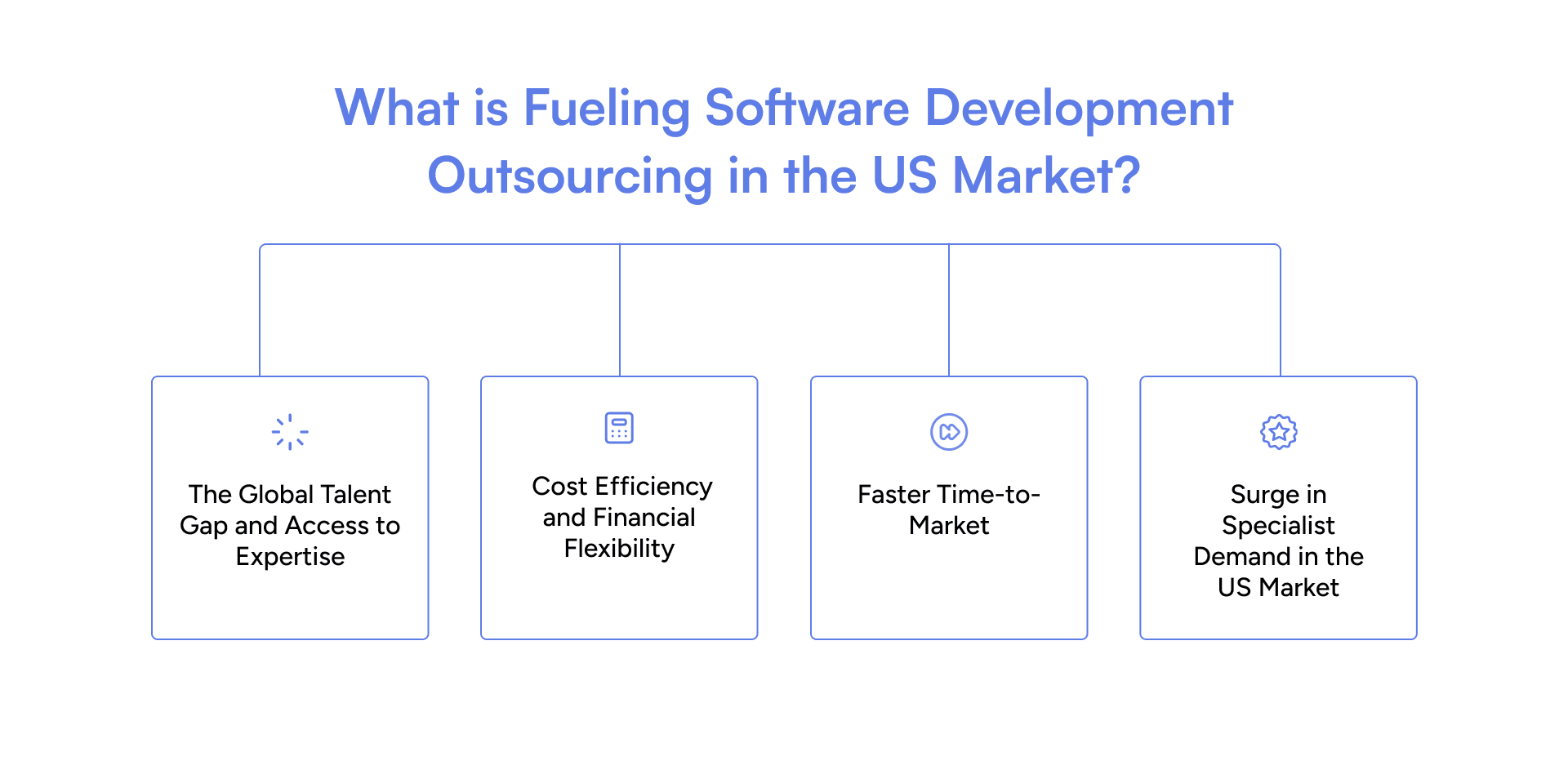
1. Global Talent Gap and Access to Expertise
Outsourcing leverages global experts in areas such as AI, cybersecurity, and blockchain—skills that are rare and expensive to source locally. With outsourcing, you can have access to the required skills while avoiding the tedious recruitment process.
A 2024 survey by Deloitte, shows that 72% of the companies outsource IT requirements, including software development, web development, and even maintenance for the same.
Outsourcing also helps you have access to more talent, across the globe, and in choosing the company that aligns with your business benefit, while also bringing innovative solutions on board.
2. Cost Efficiency and Financial Flexibility
Outsourcing can cut labor costs by up to 70% compared to building internal teams. It converts fixed overhead into variable expenses, freeing capital for core investments like research and marketing. The cost of outsourcing from India can help you save 60% in comparison to other countries.
While Financial flexibility refers to seamless scalability to meet your business requirements. Outsourcing companies generally have enough developers, which will help you in case of sudden scaling or adaptivity in terms of scope, features, timezone, etc.
3. Faster Time-to-Market
Hiring internally can delay timelines by months. Outsourced teams start within weeks, helping companies seize market moves more aggressively.
Hiring internally can take almost up to two months, that too depending on your requirement, alignment with the candidates, endless hours of reviewing resumes, but when you outsource, the same work can be started via an MVP, including the core, essential features to solve your problem, prove a product;s concept and real user feedback, all within in 10-12 weeks.
Also, you gain access to experienced, multidisciplinary talent, and integrating with AI and automated testing, which further accelerates development cycles and helps capture market shares more efficiently.
4. Surge in Specialist Demand in the US Market
US verticals like healthcare and fintech now drive outsourcing. With AI and ML accounting for 27% of initiatives, most of which are for Gen AI, AI-assistance in coding and testing, and Natural Language Processing.
The other skill that is in growing demand is cloud computing, growing 40% year-over-year; the most specific include AWS< GCP< Microsoft Azure, multi-cloud architecture, and cloud security.
Also, cybersecurity is a major specialist tech demand in the US market for software outsourcing. Several factors are driving this trend: a severe domestic talent shortage, rising cybercrime, and the increasing complexity of regulations. This has led many US companies to partner with specialized third-party providers, including those overseas, to manage their security needs.
In its essence, Outsourcing supports strategic, tech-first growth centered around getting a company that aligns with your business requirements and has an innovative solution approach, along with proven experience in the specific field.
Outsourcing is a strategic imperative for innovation velocity. In 2025, companies that view outsourcing purely through a financial lens are missing the bigger picture: access to specialized talent pools that simply don't exist domestically, and the ability to operate at a pace that internal hiring cycles can't match.
 Kunal KumarChief Revenue Officer
This perspective reveals a fundamental shift in how U.S. companies approach outsourcing in from tactical cost reduction to strategic capability acceleration. The primary value proposition has evolved beyond labor arbitrage to accessing niche expertise in areas like prompt engineering, zero-trust architecture, and Web3 development that would take 12-18 months to build internally.
Outsourcing eliminates the recruitment bottleneck, enabling companies to reach market 6+ months faster, often the difference between category leadership and irrelevance. Companies achieving the highest ROI (3.5x average returns per ISG data) treat outsourcing partners as strategic technology advisors involved early in product strategy and architecture decisions, not just execution resources.
Different Software Outsourcing Models and Their Costs
The decision-making process for choosing an outsourcing model depends on the project scope, budget, and the level of control you want to maintain. Each model has its merits, and success lies in selecting the one best suited to the nature of your engagement.
Location-Based Models
Onshore Outsourcing
Under this model, you partner with a software development company in your home country. It ensures simpler communication, clearer legal frameworks, and stronger cultural alignment. This approach works best for projects that demand high coordination and close collaboration.
Nearshore Outsourcing
You hire a partner in a nearby country. For US businesses, this often means teams in Latin America. It offers lower costs than onshore, time zone overlap within a few hours, and simpler travel for in-person meetings.
Offshore Outsourcing
This model involves working with a provider located in a distant country, such as India. It offers significant cost savings and access to a large talent pool. Offshore teams can also leverage time zone differences to provide around-the-clock development support.
Engagement-Based Models
Staff Augmentation
A business adds external developers to its in-house team. The vendor handles recruitment and vetting, while the company keeps full control of the work. It is useful for filling short-term skill gaps without hiring full-time staff.
Team Extension
A company extends the internal staff with a specialized department infrastructure of one of the outsourcing firms. The difference between this extended team model and the staff augmentation is that this one is more integrated with the culture and processes of the client. It is an abiding solution to increasing development capacity and staff unity.
Dedicated Team
A full team, including developers, QA, and a project manager, works only on the client’s project. The vendor handles administration, while the client sets direction. It works best for long-term projects with evolving requirements.
Project-Based Model
The client hands over an entire project with a fixed scope and timeline. The vendor owns delivery under an agreed budget and schedule. It suits MVPs and well-defined applications where predictability matters most.
Cost Comparison by Region
Region | Typical Hourly Rates (USD) | Average Annual Salary (USD) | Project Cost (Approximate) |
|---|---|---|---|
United States | $100 – $400+ | $60,000 – $150,000+ | $75,000 – $5M+ |
Latin America | $30 – $60 | $40,000 – $80,000 | $10,000 – $1M+ |
Eastern Europe | $20 – $70 | $35,000 – $75,000 | $10,000 – $1M+ |
Asia (India, Philippines) | $18 – $40 | $20,000 – $60,000 | $10,000 – $1M+ |
Typical Project Costs
- Small MVP or Prototype: $20,000 – $100,000
- Mid-Sized Custom Application: $100,000 – $500,000
- Enterprise Software Solution: $500,000 – $100M+
The outsourcing model selected defines how closely a project aligns with business objectives. Onshore, nearshore, and offshore models each come with advantages and trade-offs. The right choice depends on factors such as scope, budget, regulatory requirements, and the level of collaboration needed.
In-House or Software Development Outsourcing: Which one is the better choice for your requirements?
Choosing between an in-house team and outsourcing is one of the biggest strategic decisions for 2025. The choice shapes cost, speed, control, and access to talent. The right model depends on project scope, company culture, and long-term goals.
In-House vs Software Development Outsourcing: Key Differences
Feature | In-House Team | Outsourced Team |
|---|---|---|
Cost | High fixed costs: salaries, benefits, office space, infrastructure, training. | Lower variable costs with pay-as-you-go flexibility. |
Talent Access | Limited to local talent pools; long and costly hiring cycles. | Global access to specialized skills and ready-to-start teams. |
Control | Full managerial control with easy cultural alignment | Requires strong communication processes and balanced oversight. |
Scalability | Slow and difficult to adjust team size based on demand. | Flexible team scaling to match evolving project needs. |
Time-to-Market | Slower due to lengthy recruitment and onboarding. | Faster launches with pre-vetted teams starting within weeks. |
What to Choose?
Another use of outsourcing can be found in creating an MVP, filling a specific skill gap, or during a project with variable demands. It offers affordability and speed to pilot an idea and bring it to market without hiring full-time employees, which carry high overhead costs.
The hybrid model is the best for outsourcing as it combines in-house managers with distributed outsourcing partners. Continue to keep vision and strategy with the in-house team, while agile development is managed by a same-time-zone partner, and offshore staff handle low-cost QA, testing, and maintenance. This combination positively impacts a business by maximizing expertise, increasing speed and efficiency, and minimizing risks linked to location dependency.
Building Success Through Outsourcing: A Strategic Approach to Software Development
The success of outsourced software development depends on following a structured approach. A roadmap strategy ensures balance between the outsourcing plan and business goals, delivering measurable value.
Without a plan and the right documentation, the biggest mistake a business can make is entering a partnership blindly. Projects must begin with discovery, defining what you want to build, why you are building it, and who will benefit. This clarity transforms an outsourced company into an extension of your team rather than just a supplier.
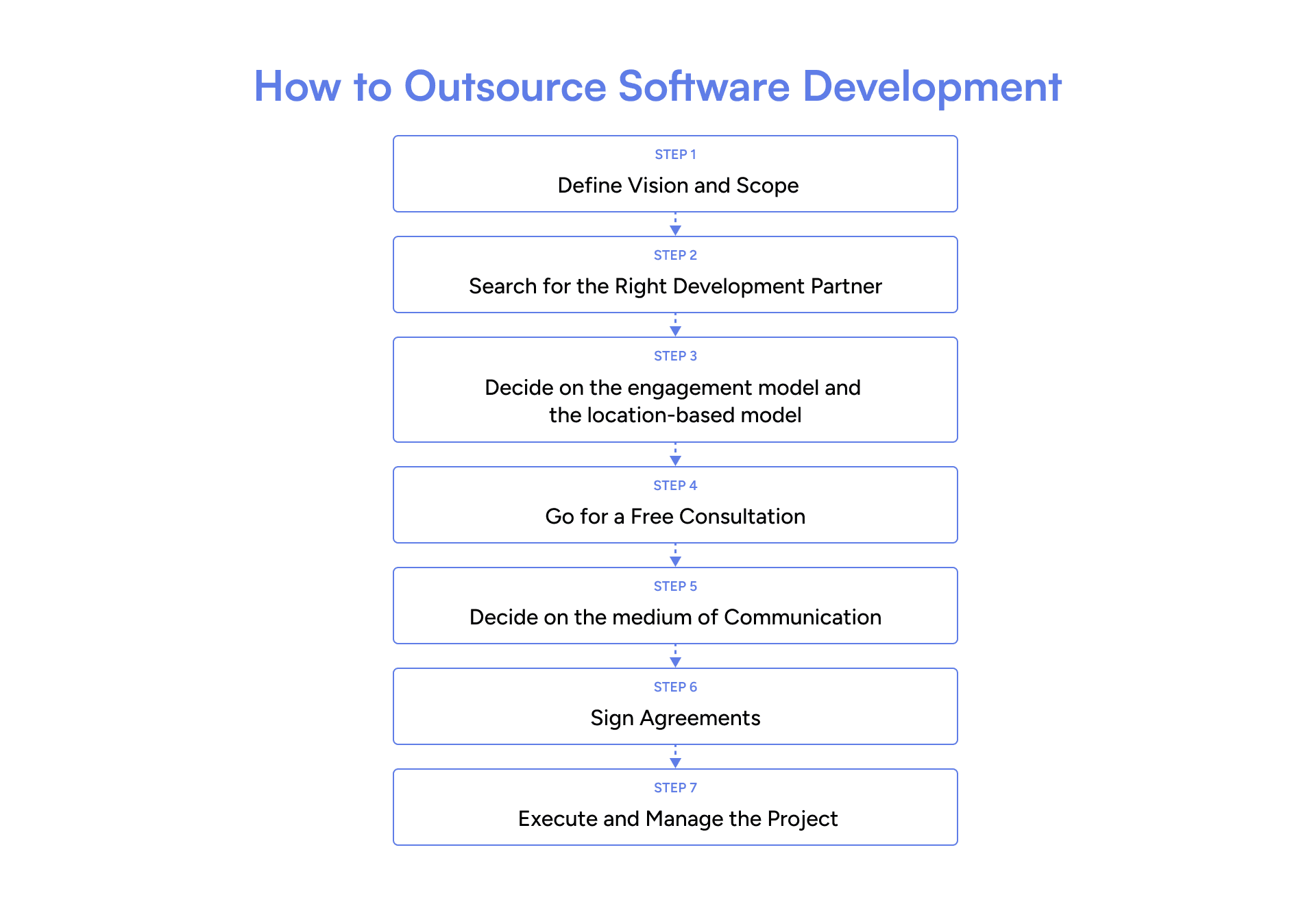
Step 1: Define Vision and Scope
Every outsourcing journey begins with clarity. It should define the problem to be solved, the target audience, and the expected outcomes. The scope document must outline objectives, deliverables, schedules, budgets, and stakeholders. This prevents scope creep and keeps both in-house and outsourced teams aligned.
Step 2: Search for the right Development Partner
Start with review sites such as Clutch or GoodFirms to reduce the number of possible vendors. Once you have narrowed it down to a few companies, go with the company that has both the technical expertise and the industry-specific knowledge. Look for the based projects that the company has worked on via Case Studies and testimonials.
Step 3: Decide on the engagement model and location-based models
As mentioned in the “Different Software Outsourcing Models and Their Costs” section, there are 3 types of location-based models: offshore, onshore, and nearshore. Between these, offshore has been considered superior by many businesses. It provides a significant cost saving while having access to specialized global talent, not only pertaining to tech but also industry-specific knowledge. It also provides scalability and 24/7 operations by leveraging different time zones.
Step 4: Go for a free Consultation
Most outsourcing companies provide free consultation. So, going for the free consultation allows you to evaluate the partner’s expertise, communication style, and cultural fit, without any financial risk. It is a critical step for defining project scope, assessing capability, and ensuring alignment with your business goals before committing to a contract.
Step 5: Decide on the medium of communication
Miscommunication has been identified as one of the most common failures in project implementation. So, choosing the means of communication is also important. Tools like Jira, Trello, Slack, Asana, Discord, etc, for clear communication, organizing tasks, and tracking progress, across time zones.
Using one consistent tool for communication for all the people of both parties involved in the project ensures objectives are aligned, mitigates misunderstandings, and builds the trust necessary to overcome the challenges of geographical distance, cultural differences, and varying work styles
Clear communication ensures that intended outcomes are provided, and difficulties are addressed promptly while also ensuring that the tasks are completed accurately and on time.
Step 6: Define Engagement and Agreements
The partnership should be formalized before development begins. Key documents include an NDA to protect information, a Master Services Agreement to govern the relationship, a Statement of Work that details deliverables, budgets, and schedules, and a Service Level Agreement to define the specific level of service that is provided, and metrics for quality measurement. These documents form the legal and operational foundation of an outsourcing partnership.
Step 7: Execute and Manage the Project
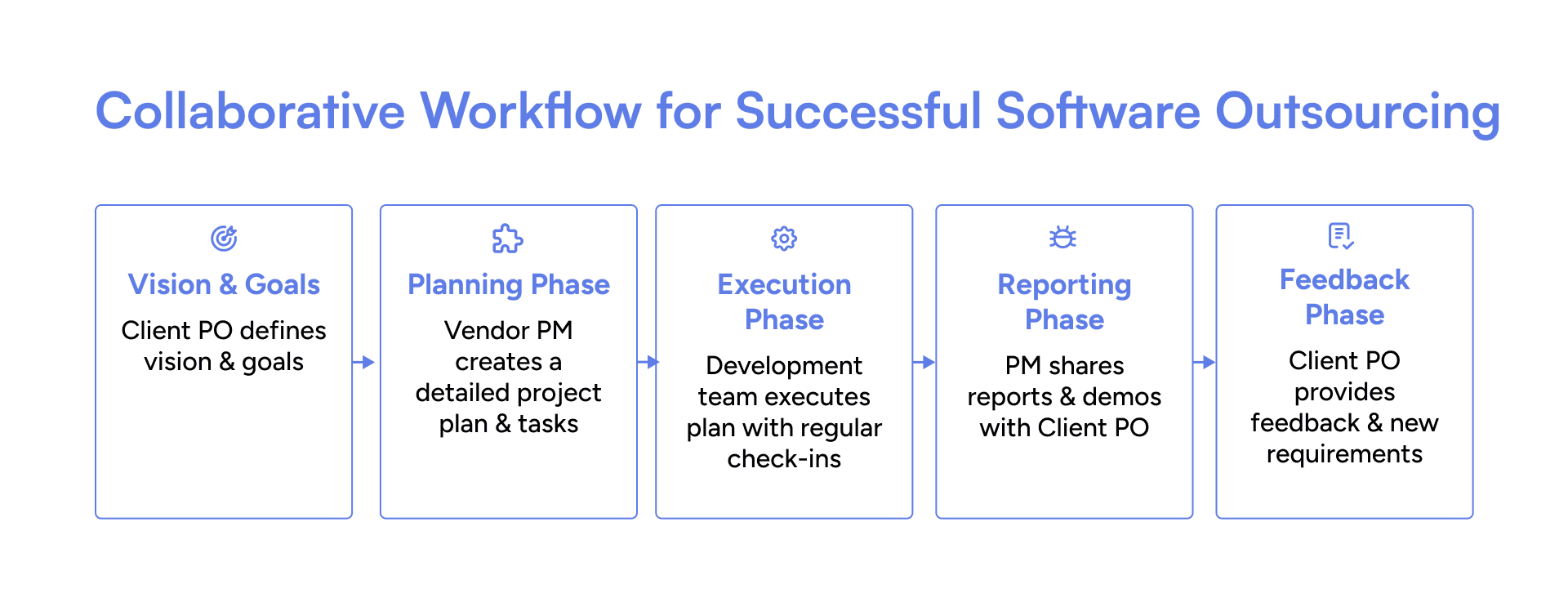
Execution requires close collaboration, and this is possible through agile practices such as Scrum or Kanban, which provide flexibility and transparency. The client assigns a Product Owner to maintain vision, while the outsourcing partner appoints a Project Manager to oversee operations. This clear division of roles ensures execution remains on track while strategy stays intact.
Collaboration is central to the success of an outsourced project. When a client treats the outsourcing team as an extension of their own, the best outcomes follow. Open communication, transparency, and accountability lead to products that meet long-term requirements.
Benefits of Software Outsourcing and the Risks That Can Undermine Them
Software outsourcing allows you to deliver faster, obtain hard-to-find skills, and increase capacity at a scale not possible through an in-house recruitment process. The possibilities are great, but they come with risks.
Advantages of Outsourcing Software Development
Outsourcing helps align delivery speed with market demands. Companies can reduce development expenses by 30–40 percent by avoiding duplicate iOS and Android teams, while also gaining access to specialized talent and scalable capacity through assembled teams.
1. Speed to Market
The team can be hired within weeks, enabling businesses to deliver on time without spending months on recruitment.
When you are competing in the market, time is the key, and when you’re in-house team is learning, some other people can take over that market. In order to continue having that competitive advantage, you can outsource your software development project and then be a step ahead of the competition. Here, your developers will be experienced, and the contracted third-party specialist will do the time-intensive work.
2. Access to Expertise
Outsourcing provides access to niche skills exactly when they are needed, whether it is a frontend specialist or a DevOps engineer. It provides a broader range of expertise on a global scale. When you stimulate your software development project, you have a chance to access one of the best software development companies in the world and its huge repository of specialists. All the developers are highly trained and come with experience. By introducing the relevant skills, they can significantly boost the performance of your business and make it skyrocket sales by influencing the necessary field of expertise.
3. Expand and Grow
The possibility of expanding and growing is high with the assistance of experts. There are engineers with years of experience who can guide you on the various aspects of your project. You can harness the outsourcing software development advantage and expand your business. It also brings about a number of advantages and places your business in a way you had not imagined. They are not only able to lead you down new paths, but also help with implementing those plans perfectly.
4. Complex Process made easy
Coordinating an offshore software project might sound daunting, but by clarifying a couple of processes at the beginning, the project can be easier to handle. The majority of companies will create meetings and appoint a team leader who will report on how the project is progressing through the different stages of the project. This makes you engaged in the process to an extent that when there is a road obstacle, you will be included in the process.
Simply put, outsourcing can enable organizations to build capacity internally in terms of strategy and customer understanding and leave execution-intensive tasks to trustworthy partners.
What Are the Software Outsourcing Risks and What Can You Do to Prevent Them?
The outsourcing issue has no insurance policy of peace. Too often, companies realize too late that cost savings have vanished due to project delays or declining quality. Common risks include:
1. Communication Gaps
Time-zone differences and unclear requirements often slow down projects.
How to avoid it: Establish structured overlap hours, shared tools, and weekly demos to keep visibility high.
2. Quality Variance
Not every partner enforces the same engineering standards.
How to avoid it: Set definitions of “done,” mandate code reviews, and track KPIs such as bug rates and coverage.
3. Scope Creep and Hidden Costs
Without clear contracts, projects expand silently.
How to avoid it: Implement change-control mechanisms and demand transparent rate cards to keep spending predictable.
4. IP and Security Concerns
Sensitive data or proprietary code can be at risk.
How to avoid it: Demand SOC 2 or ISO 27001 compliance, restrict access with least-privilege models, and retain ownership of repositories.
5. Vendor Lock-In
Relying too heavily on one provider can create dependency.
How to avoid it: Keep code, infrastructure, and documentation under client control to prevent entrapment.
Outsourcing is most effective when treated as a partnership. To achieve repeated success, governance must be built into the engagement itself. Well-defined SLAs, security, shared KPIs, and integrated capabilities with the functional management of the outsourcing organization that does not erode control.
Best Practices for Successful Software Outsourcing
Successful outsourcing goes beyond cutting costs. The best results come when vendors act as true partners, building “remote team extensions” that integrate seamlessly with client operations. With the right practices, outsourcing becomes a driver of speed, scale, and shared success.
- A Checklist for Success
Following proven best practices helps transform outsourcing from a transactional arrangement into a strategic, long-term partnership.
- Choose a Partner with Shared Values
The culture and working ethics of a partner are as important as technical skills. Collaborative culture promotes trust, a sense of ownership, and good work.
- Define and Document Everything
It is essential to provide a clear Statement of Work (SOW) that details expectations, project architecture, and scope to avoid confusion and maintain alignment.
- Stay in the Loop
A project cannot be treated as a “set and forget” affair. Maintain teamwork and regular contact. Encourage direct communication between the client’s team and individual developers to identify and resolve issues early.
- Adopt Agile Techniques
Agile methodology, with frequent updates, reviews, and feedback between stakeholders, enables outsourced teams to remain flexible and adapt quickly to changes in demand.
Case Spotlight
GeekyAnts partnered with one of North America’s largest full-service restaurant operators—managing 1,800+ restaurants and ranked among the 50 largest private employers in the U.S.—to build the mobile version of their food delivery app. The team developed a cross-platform solution using Agile principles such as accelerated sprints and daily scrums, while collaborating across time zones through MS Teams and Azure Boards. The effectiveness of this outsourcing engagement not only accelerated delivery but also resulted in a long-term relationship.
How to Select the Right Software Outsourcing Development Company for Your Business
Choosing the right software outsourcing development firm is the most crucial phase in the entire process. The careful due diligence process is necessary to locate a partner that can not only deliver technical excellence but also strategic value. The following checklist points out the essential considerations in the review of outsourcing software development firms.
1. Relevant Experience and Expertise
Find a provider who has been successful in your industry of interest and within the technology stack targeted by your project. This entails examining their portfolio and case studies to understand the depth and breadth of their work.
2. Methodology / Process Maturity
Ask them what methodology they use to develop (e.g., Agile, Scrum) and how they practice quality assurance (QA) and DevOps. A mature partner is expected to bring a quality product on time and at a lower cost.
3. Communication & Cultural Fit
Evaluate the quality of English and the approach to project management in the team. A partner with whom your company will fit well is bound to create a harmonious and productive working relationship.
4. Legal / Security Framework
Make sure that the partner is a strong data security practitioner and will sign a full-fledged NDA that clearly stipulates the extent of confidentiality and ownership of intellectual property. This is a way of protecting the most valuable resources of a company in case of risks.
5. Reviews & References
Get feedback from former clients. Request direct references and check independent review websites such as Clutch and G2 to get a clearer picture of how the partner performs and how reliable they are.
This list does not position the whole process of partner selection in the form of a mere decision but as a risk mitigation strategy. All the items in the list are directly associated with a possible risk, including poor quality or data breach. This due diligence is a key business operation that may make the difference between a successful and an unsuccessful engagement.
The future of software development outsourcing is built on trust. We have found that the most valuable partnerships are those where a client looks beyond hourly rates and focuses on a company's proven track record, its processes, and its ability to act as a true strategic ally. This is not about finding a vendor; it is about finding a leading and trusted partner.
Kunal KumarChief Revenue OfficerWhy GeekyAnts Is the Right Outsourcing Software Outsourcing Company for Your Project
GeekyAnts is a trusted software outsource development company with a proven record of delivering secure, scalable, and high-quality software outsourcing services and solutions to clients worldwide. With more than 800 projects completed and a 4.9/5 rating on Clutch, the company has built strong partnerships with U.S. startups and enterprises that seek speed, cost efficiency, and reliable innovation.
A Global Delivery Model with a U.S. Focus
The company established itself as a strong partner for U.S. startups and enterprises seeking rapid delivery, cost-effectiveness, and dependable innovation.
Secure, Scalable Solutions Specialization
GeekyAnts develops systems based on modular architecture that are scalable and reliable. It specializes in React Native, Flutter, Node.js, GraphQL, and full-stack development, ensuring seamless interaction between frontend and backend systems. Security and compliance are central, with solutions designed for resilience and tested on 100+ real devices to minimize release risks and build trust.
Case Study: North American Retail Giant
Problem
The company was one of the leading retailers in North America and had to update its online shopping system. The current platform was incapable of managing increased demand, featuring minimalistic CMS capabilities, as well as failing to deliver a powerful user experience to both customers and administrators. Fluid Shopify integration and enhanced business efficiency were also key demands.
Solution
Using Shopify APIs, a drag-and-drop content manager, and a design-first strategy in Adobe XD, GeekyAnts developed a cross-platform e-commerce web app and management system. The work started with a time and materials model but shifted to a fixed-cost model with extensive manual testing to maintain the reliability and performance.
Result
The client was provided with a platform that was scalable and easy to use, which facilitated operations, improved the customer experience, and resulted in a long-term collaboration with GeekyAnts.
Key Outsourcing Shifts Redefining the U.S. Market
The present-day outsourcing landscape is shifting to not being centered on costs, but push-pull strategic innovation, stronghold, and expansion. A number of trends are influencing this evolution.
1. AI-First Outsourcing
Generative AI has become a widespread business tool in the U.S., with 95% of companies implementing it in their operations. This surge has created a demand for external AI expertise to scale applications and convert experimental projects into ROI.
2. IT Outsourcing Repository and Development
In 2024, the American IT outsourcing market segment was projected to reach 245 billion dollars. The reason behind this growth is the need to have scalable models of delivery that are cost-efficient and of enterprise-level quality.
3. Security-First Partnerships
Security has been ranked as one of the most important needs, given the ever-increasing cybersecurity threats and regulations. Businesses are resorting to offshore partners that offer safe coding, periodic vulnerability testing, and compliance guarantees as part of long-term arrangements.
4. Right-Shoring; Hybrid Models
The new standard has now been right-shored, combining offshore, nearshore, and onshore teaching, balancing cost factor, time zone alignment, and cultural fit.
5. Outsourcing Sustainability
Sustainability is becoming a consideration. Clients are demanding partners who are environmentally sensitive. Techniques like minimization of energy consumption within the development environments and streamlining of codes are ways of outsourcing in line with the overall development CSR objectives.
Concluding Thoughts
An engine of resilience and innovation. The image of software outsourcing in 2025 is an engine of innovation and strength. This is important because it enables both startups and multinational firms to develop marketplaces due to its specialized skills in novel technologies. The process of success is based on the elements of effective communication, clear legal frameworks, and strong dedication to quality. There is a movement to fundamentally change outsourcing to hybrid solutions, which means in-house, near-shore, and offshore teams are combined, providing a more responsive service, with improved scaling and competitive ability in a rapidly expanding digital world.
FAQs about Software Development Outsourcing
1. How much does it cost to outsource software development in 2025?
The cost of outsourcing software development in 2025, for the MVP, can cost between 20,000 and 100,000 when outsourced to develop, and the enterprise solutions may go up to 500,000. The overall price does vary based on project scope, where one of your partners will be based, and what model of engagement you are going to use.
2. Which are the major outsourcing models of the startups and enterprises in the U.S.?
Major outsourcing models include onshore, nearshore, and offshore, as well as engagement models of staff augmentation, dedicated team, or project-based delivery. Most enterprises favor the hybrid models because they bring a balance to the startups that tend to go offshore as a sign of cost efficiency.
3. Under which circumstances should businesses outsource software development?
Outsourcing is useful in situations where deadlines are tight, costs are constrained, or specialized knowledge, such as AI or blockchain, is difficult to find locally. It assists in making businesses grow with haste and remain competitive.
4. How do you outsource software development successfully?
Success comes from a clear roadmap: define your goals, choose the right partner, set agreements early, and use Agile methods for collaboration. Treating the vendor as an extension of your team ensures the best results.
5. What are the challenges in software development outsourcing?
The common challenges include miscommunication, non-exceeded costs, and a gap in quality. These may be prevented through explicit agreements, good governance, and frequent interaction among the in-house and outsourced units.
6. What is an NDA in Software outsourcing?
An NDA offers security to information, code, and data about your business when engaging in a working relationship with an outsourcing company. It provides confidentiality and protection of intellectual property during the engagement.
7. Which region is the best for software outsourcing?
India, Eastern European region, Latin America, and Southeast Asia are the most recognized software outsourcing areas. Each of them has its benefits in terms of cost, talent, or time-zone fitability, with India standing at the highest level.