

Key Takeaways:
- Virtual fitting solutions for e-commerce solve the biggest pain point in fashion: poor fit. By showing users how clothes look and fit before checkout, they cut return rates by up to 30% and boost conversions up to 200%. This shows the benefits of AR in fashion in real business terms.
- Brands that build virtual try-on apps with custom features gain full control over UX, accuracy, and data. This eliminates vendor lock-in, supports scalability, and delivers unique shopping journeys tied to brand identity.
- Wondering how virtual fitting rooms work with your current tech? They now plug into platforms like Shopify, Magento, and headless systems via SDKs and APIs. This enables quick deployment without rebuilding your entire store.
- When you build a virtual fitting room with AI and AR, you unlock a full personalization engine. VFRs track shopper behavior, optimize size recommendations, and improve inventory planning through real-time data insights, core to the AI in the fashion industry.
Introduction: The Rise of AR & AI in Fashion Retail
We have all been there, shopping for clothes online, then playing the sizing lottery and hoping for the best. But what if you could see exactly how that outfit looks on you before hitting "buy"? Virtual Fitting Rooms powered by AR and AI are making this possible, and they are transforming fashion retail faster than anyone expected.
The Problem That is Costing Billions
Fashion retail has a little secret: one in three online clothing purchases gets returned, with poor fit driving 71% of these costly reversals. For consumers, it means frustration, wasted time, and sizing anxiety. For retailers, it means hemorrhaging profits and damaging brand trust. But here is where it gets interesting, Virtual Fitting Rooms (VFRs) powered by AR and AI are flipping this script entirely.
The Numbers Tell The Tale
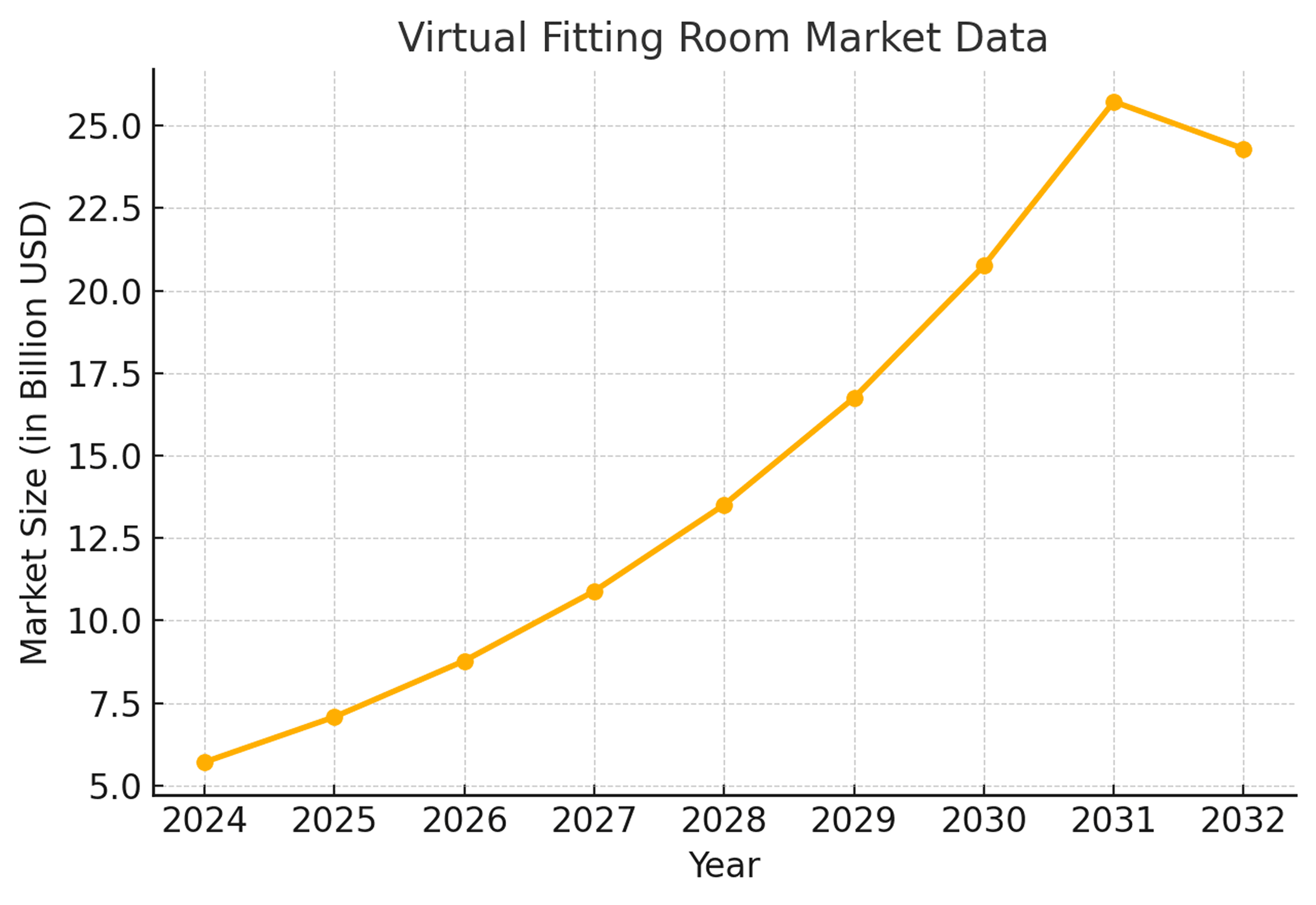
The virtual fitting room market is exploding. From $5.71 billion in 2024, it is racing toward $24.30 billion by 2032, a staggering 19.8% annual growth rate. More telling? 61% of shoppers now prefer retailers offering AR experiences, and 71% shop more frequently at stores that do. These trends underscore a broader transformation. Consumers now expect hyper-personalized, tech-driven retail experiences that blend convenience with interactivity. Virtual Fitting Rooms meet this demand, enabling fashion brands to drive conversions, reduce returns, and foster loyalty through immersive digital engagement.
What is Virtual Fitting Room Technology?
Virtual Fitting Room (VFR) technology enables users to virtually try on garments using Augmented Reality (AR) and Artificial Intelligence (AI), offering a lifelike view of how clothes fit, move, and style on their bodies or avatars. This reduces uncertainty, improves purchase confidence, and significantly lowers return rates. Beyond user experience, VFR solutions bring operational value by streamlining inventory decisions, enhancing personalization, and bridging offline and online journeys. As digital commerce grows, the ability to offer accurate, interactive try-on experiences has become a strategic differentiator for modern fashion and retail platforms.
How Virtual Fitting Room Technology Works
Virtual fitting room technology combines advanced 3D modeling, augmented reality, and AI to simulate the in-store try-on experience online. Scanning body measurements and matching them with product data enables shoppers to visualize fit, style, and size in real time, reducing returns and improving purchase confidence.
1. Intelligent Body Mapping & Input Collection
The process begins with user input or body scanning. Shoppers can either manually enter height, weight, and fit preferences or grant camera access (smartphone or web) to scan their body in real time. Advanced VFR solutions leverage LiDAR and depth-sensing technologies, commonly found in modern smartphones and AR glasses, to create precision 3D body models.
2. Dynamic Avatar Generation or AR Live Feed
Once data is collected, the system either:
- Generates a 3D digital twin (avatar) based on precise measurements and posture detection, or
- Overlays garments in real-time onto a live image or video feed of the shopper.
This allows shoppers to experience a high-fidelity representation of their physical self, vital for accurate size estimation, draping behavior, and visual styling.
3. Garment Rendering & Fit Simulation
Using machine learning algorithms, the system interprets garment metadata (fabric type, elasticity, stitching, size charts) to simulate realistic fits. Fabric physics engines replicate drape, stretch, layering, and even motion effects, enabling the user to see how a dress flows or a jacket flexes with body movement.
Some platforms go further, integrating brand-specific sizing deviations and behavioral data (purchase history, body type clusters) to recommend ideal styles and sizes.
4. AR Display & Omnichannel Integration
The final experience is rendered through AR on mobile/web platforms or in in-store digital mirrors. Users can:
- Rotate their model
- Mix and match outfits
- Capture or share looks
- Get AI-generated recommendations
In physical retail environments, RFID tags on garments can auto-trigger corresponding AR overlays when held near the mirror, connecting physical stock with a digital layer of context.
Types of Virtual Dressing Room Technology Solutions
Virtual dressing room solutions come in various formats, each leveraging unique technologies to enhance the online shopping experience.
1. Online Fitting Rooms (Web & Mobile-Based)
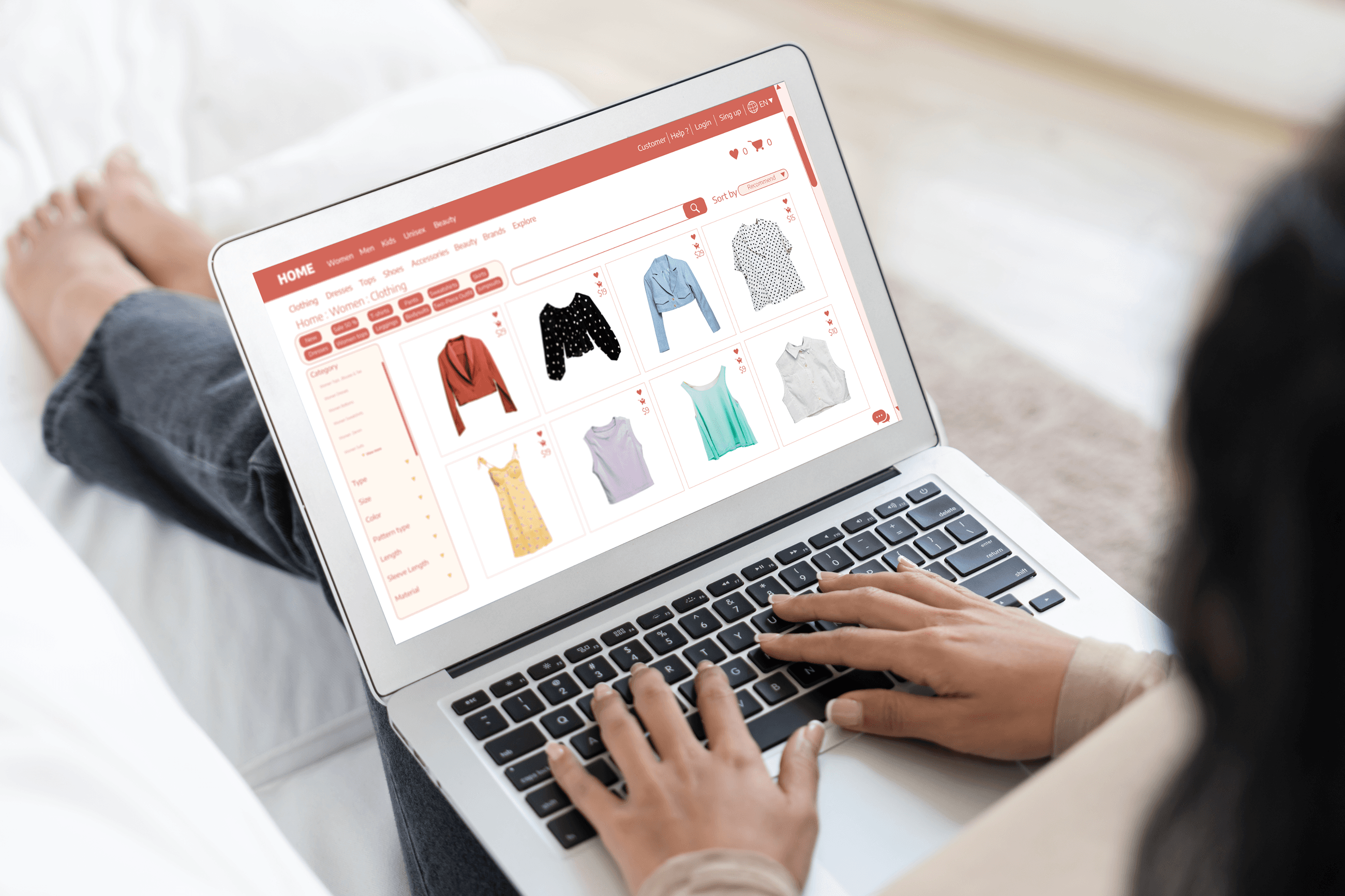
These are embedded within mobile apps or e-commerce websites and utilize smartphone cameras to overlay virtual clothing and accessories. Popular for accessories (eyewear, shoes, watches), they support rapid integration, broader market reach, and lower entry cost for scaling brands. Ideal for: D2C brands, eCommerce marketplaces, and emerging retailers testing digital try-on.
2. Avatar-Based 3D Fitting Rooms
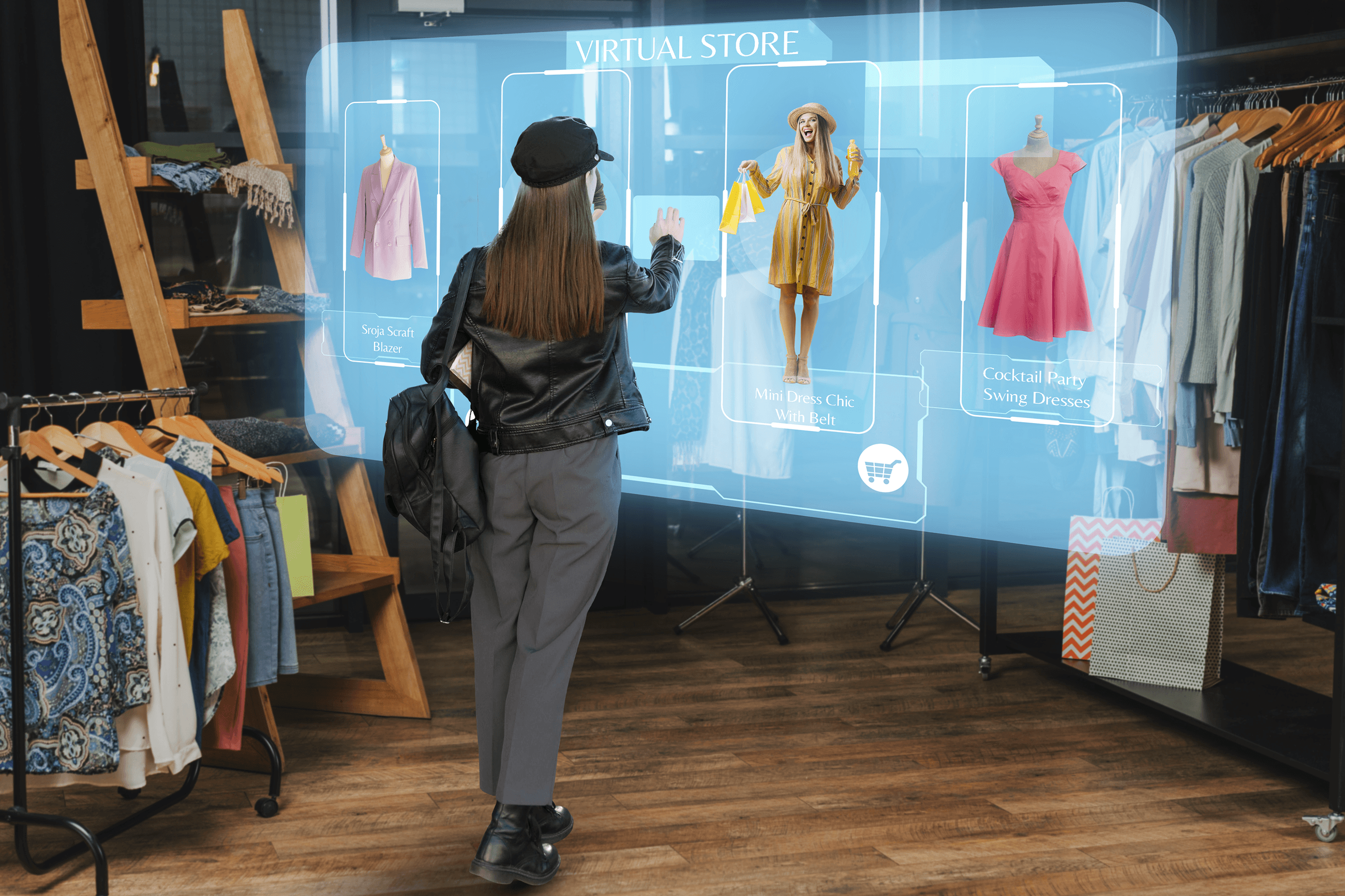
Users create avatars based on manual input or AI-generated body measurements. These models allow garments to be tried on virtually with greater fit accuracy. This controlled, repeatable model helps standardize fit experiences across collections, reduce cart abandonment, and gather actionable user data. Ideal for: Mid-market and enterprise fashion brands optimizing user retention and SKU recommendations.
3. In-Store Virtual Mirrors & Real-Time AR Try-Ons

In premium stores and showrooms, high-resolution smart mirrors and motion-enabled cameras render clothes on customers’ live reflections. These setups support real-time outfit switching, gesture-based UI, and deep RFID integrations bridging the gap between physical retail and immersive digital experiences. Ideal for: Luxury fashion brands, large retailers, omnichannel CX strategies.
Why This Technology Is Gaining Momentum
Virtual fitting rooms are solving longstanding challenges in fashion eCommerce, like high return rates and poor fit visibility, while creating new opportunities for engagement and brand loyalty. As retail technology advances, this capability enables platforms to deliver immersive, intelligent shopping experiences that scale with demand.
From enabling hyper-personalization to unlocking data-driven product insights, VFRs offer a strategic edge in a competitive digital landscape. Whether integrated into mobile-first channels or installed in physical showrooms, the right virtual try-on solution reduces cost, increases conversion, and elevates customer experience.
 Saurabh SahuChief Technology Officer (CTO)
What Is Driving the Rise of AR and AI in Fashion Retail?
Multiple factors are driving the rapid adoption of AR and AI in fashion retail, making these technologies a strategic priority for brands.
1. Reduce Returns with Better Fit Accuracy
Virtual Fitting Rooms solve the persistent challenge of sizing inconsistency in online fashion. By leveraging real-time body scans and intelligent garment mapping, these systems enable users to assess fit and appearance with precision. Retailers benefit from reduced product returns, lower logistics overhead, and improved net margins. The solution addresses a critical inefficiency in e-commerce operations.
2. Boost Sales by Increasing Engagement
Augmented product interactions lead to longer session durations and increased purchase confidence. Virtual try-ons convert passive interest into active intent by offering buyers a visual understanding of style, color, and fit. Platforms that embed AR into product journeys report double-digit increases in conversion rate and basket size. These improvements directly impact top-line revenue.
3. Build Loyalty Through Personalized Shopping
AI models analyze user preferences, purchase history, and browsing patterns to offer tailored recommendations. Personalization at this level builds stronger customer affinity and increases repeat transactions. Brands that deploy AI-driven shopping experiences consistently outperform those offering generic product catalogs.
4. Plan Smarter with Predictive Inventory
AI Predictive Analytics enables dynamic inventory planning and targeted fulfillment. Demand forecasting models evaluate behavioral signals and market data to guide stock replenishment and production cycles. Retailers reduce overproduction, minimize stockouts, and improve supply chain agility. This results in better working capital allocation and lower carrying costs.
5. Improve Designs Using Real-Time Feedback
Virtual Fitting Rooms collect detailed user interaction data, including engagement patterns and product rejections. Design teams can analyze this data to refine upcoming collections and eliminate underperforming styles. AI models further synthesize market trends, enabling predictive design decisions that align with emerging consumer preferences.
6. Cut Waste and Support Sustainability Goals
Virtual try-ons eliminate the need for physical samples during product development. Fewer samples reduce material waste, shipping emissions, and excess inventory. This operational shift aligns with sustainability benchmarks without compromising business performance. Brands that integrate AR into their product pipeline demonstrate measurable progress toward ESG goals.
7. Reach More Shoppers with Mobile AR
Smartphones with advanced cameras and processing capabilities now support most AR retail applications. Virtual try-ons scale across demographics without requiring proprietary hardware. This accessibility accelerates adoption and strengthens omnichannel experiences without increasing infrastructure cost.
8. Future-Proof with Support for Innovation Policies
National governments continue to invest in AR and AI innovation infrastructure. These initiatives reinforce long-term confidence in the technology’s viability and support enterprise adoption at scale. Retail organizations that invest early benefit from ecosystem incentives, regulatory readiness, and competitive differentiation.
Custom vs Ready-Made Virtual Fitting Room Apps
The decision to build a custom virtual fitting room (VFR) solution or implement a ready-made platform influences speed to market, control over data, differentiation, and long-term scalability. Both approaches have trade-offs, and understanding them in the context of your brand’s goals is critical.
- Custom-Built VFRs: Strategic Differentiation and Long-Term Control
Custom solutions provide full ownership, allowing teams to design a user experience tightly aligned with the brand’s identity, product logic, and customer segments. This approach enables granular control over features like AI-driven fit prediction, avatar accuracy, and 3D garment rendering. Custom builds are ideal for companies seeking proprietary tech, data privacy control, or deep integration with internal systems (e.g., PLM, ERP, inventory platforms). While development timelines are longer and initial investment higher, custom solutions offer long-term cost control by eliminating recurring vendor fees and reducing reliance on third-party roadmaps. They also prevent vendor lock-in and allow you to scale infrastructure on your terms.
- Ready-Made VFRs: Speed and Ease of Implementation
Off-the-shelf platforms offer rapid deployment and predictable setup costs, making them attractive for brands launching pilot programs or testing AR/AI capabilities quickly. These solutions typically include ongoing support, regular updates, and pre-integrated analytics dashboards. However, their feature sets are standardized, limiting flexibility in how garments are simulated, how body data is captured, or how deeply the system can be personalized. For brands with tight deadlines or limited technical bandwidth, ready-made solutions serve as a strong starting point. But over time, they may restrict optimization, differentiation, and customer-specific innovation, especially when adapting to evolving UX or compliance requirements.
The AI Impact
Recent advances in AI-assisted coding, automated testing, and low-code platforms have dramatically reduced the complexity and cost of building custom solutions. This has made bespoke development more accessible even for mid-sized players. As a result, the traditional barriers to building from scratch are eroding, making custom VFRs a viable, ROI-positive option for more brands.
To provide a clearer overview, the following table offers a comparative analysis:
Feature | Custom VFR Solution | Ready-Made VFR Solution |
Deployment Time | Longer – Full development lifecycle | Faster – Plug-and-play or API-based |
Personalization & Branding | Full control – Built around brand identity | Limited – Vendor templates with minimal tweaks |
Accuracy of Fit Prediction | High – Tuned to specific body types using custom AI models | Moderate – Standardized logic; less adaptable |
Immersive – Unique experience with tailored 3D/AR flows | Engaging – But less differentiated | |
Initial Cost | High – Custom dev, 3D modeling, QA, and infrastructure | Low – Monthly SaaS fee or licensing |
Long-Term Cost | Lower – One-time investment; no vendor lock-in | Higher – Ongoing subscriptions and per-seat licenses |
Return Rate Reduction | High – Enhanced sizing accuracy lowers returns | Medium – Depends on solution accuracy |
Data Privacy & Ownership | Full control – Compliant with in-house data governance | Shared – Governed by third-party terms |
Scalability & Integration | Fully scalable – Aligned to business roadmap | Scalable – Dependent on vendor infrastructure |
Maintenance & Support | In-house or outsourced partner required | Included – Managed by vendor |
Vendor Lock-in Risk | None – Full ownership of source and roadmap | High – Dependence on vendor’s roadmap and support |
Competitive Advantage | Strong – Proprietary solution builds long-term differentiation | Moderate – Others can replicate easily |
How to Build a Custom Virtual Fitting Room Platform? Step-by-Step Guide
Developing a custom AR Virtual Try-On platform is a complex undertaking that typically follows a structured software development lifecycle, encompassing planning, feature selection, UI/UX design, development, and rigorous testing.
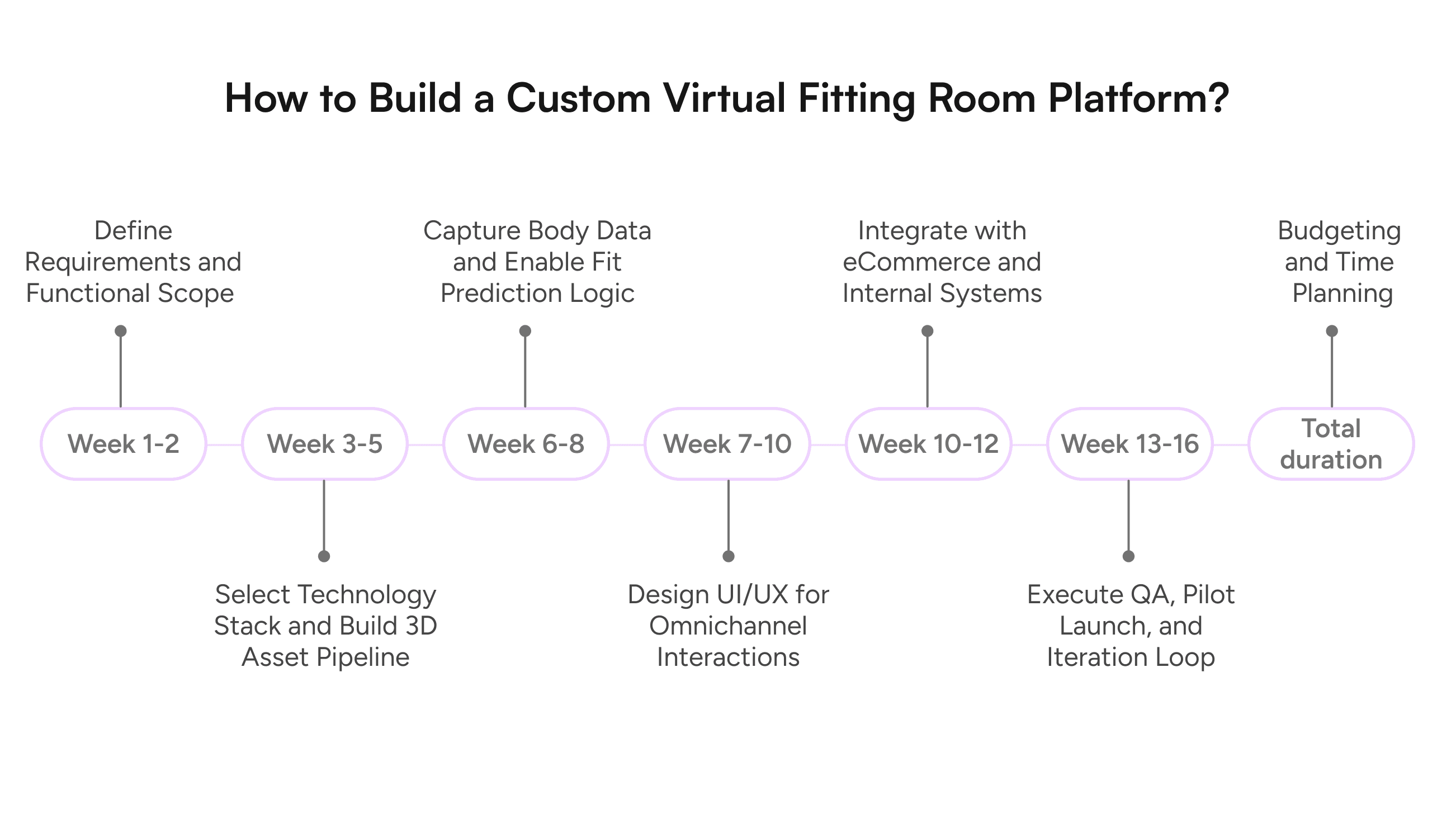
1. Define Requirements and Functional Scope
Timeline: Week 1–2 Begin with an intensive discovery workshop. Align all stakeholders on product goals, customer experience expectations, and technical constraints. Identify the product categories, sizing models, and try-on experiences the VFR must support. Translate these insights into a clear feature matrix and technical feasibility assessment. Establish KPIs for usability, fit accuracy, and integration success.
2. Select Technology Stack and Build 3D Asset Pipeline
Timeline: Week 3–5 Choose AR and AI tools that match the defined scope. Select SDKs for AR rendering, AI fit prediction, and backend infrastructure. Set up a 3D asset pipeline. For apparel, invest in photorealistic modeling and texture simulation. For accessories like watches and glasses, implement facial landmark mapping and object-specific modeling techniques. Build internal standards for consistency across SKUs.
3. Capture Body Data and Enable Fit Prediction Logic
Timeline: Week 6–8 Build a dual-mode input system. Allow users to enter measurements or use camera-based scanning. Integrate ML models that map body shapes to SKU fit characteristics using brand-specific size charts. Use synthetic data generation to train custom models where pre-trained alternatives do not exist. Apply feedback loops that refine predictions from past purchases and returns.
4. Design UI/UX for Omnichannel Interactions
Timeline: Week 7–10 Create responsive interfaces for mobile, web, and kiosk environments. Focus on product discoverability, intuitive garment switching, and dynamic view control. Integrate feedback mechanisms to flag issues in sizing accuracy or AR rendering. Ensure visual alignment with brand identity. Build out component libraries for long-term scalability across platforms.
5. Integrate with eCommerce and Internal Systems
Timeline: Week 10–12 Embed the VFR module into Shopify, Magento, or custom stacks using secure APIs. Map user sessions to cart behavior. Extend integrations to include customer accounts, product catalogs, checkout workflows, and analytics dashboards. Align SKU-level metadata across platforms for unified data operations. Prepare internal documentation for ongoing maintenance.
6. Execute QA, Pilot Launch, and Iteration Loop
Timeline: Week 13–16 Run internal QA using edge cases: varying lighting, camera angles, and body types. Deploy a limited-access pilot to collect behavioral data and qualitative feedback. Track drop-off points, conversion rates, and error patterns. Resolve model inaccuracies and interface friction. Deploy frequent iterations using agile sprints. Lock final build only after meeting accuracy and satisfaction thresholds.
7. Budgeting and Time Planning: Cost Centers and Development Load
- 3D Asset Development: $5,000–$15,000 for mid-size catalogs
- AI Fit Engine and ML Training: $3,000–$7,000, depending on accuracy needs
- UI/UX Design: 100–140 hours for cross-platform coverage
- eCommerce Integration: 60–100 hours for full-stack APIs
- Total Duration: 16 weeks (minimum) for MVP with pilot-tested accuracy
Strategic Perspective
Each phase requires direct alignment with business KPIs: conversion uplift, reduced return rate, and customer lifetime value. Avoid bundling features that do not directly support these outcomes. Prioritize flexibility in body data collection and consistency in visual output. Treat the VFR as a tech demo.
How to Integrate a Virtual Fitting Room into an eCommerce Website?
Integrating a Virtual Fitting Room (VFR) into an eCommerce platform requires a product strategy aligned with operational infrastructure, customer experience expectations, and platform growth goals.
1. Define the Integration Strategy
Begin with strategic alignment. Choose between:
- SaaS/API-Based Solutions: Offers prebuilt SDKs and APIs for rapid deployment. Best suited for brands optimizing for speed, lower upfront investment, and predefined functionality.
- Custom-Built Solutions: Enables complete control over user experience, fit accuracy, data handling, and scalability. Best for differentiated digital experience mandates and proprietary workflows.
Decision-makers should audit technical capacity, operational roadmap, and data ownership requirements before selecting a route.
2. Assess Technical Compatibility
Audit existing architecture. Confirm:
- Platform fit (Shopify, Magento, WooCommerce, custom stack)
- Backend compatibility with third-party APIs and SDKs
- Infrastructure readiness for real-time rendering and compute load
- Data routing for product SKUs, sizing charts, user metrics, and analytics sync
Avoid integration bottlenecks by ensuring architectural alignment from day one.
3. Prepare Product Data
Data accuracy defines try-on realism.
- For AR overlays: Use high-resolution, multi-angle product photography. Standardize lighting and backgrounds.
- For 3D models: Invest in detailed garment geometry, correct texture mapping, and accurate size mappings.
- For both: Maintain clean metadata with garment fit categories, material behavior, and sizing intentions.
Keep product data pipelines updated continuously to reflect catalog changes.
4. Design the User Interface
The VFR interface must match user expectations:
- Position entry points at product decision moments (e.g., near “Add to Cart”)
- Ensure fast response, gesture recognition, and device compatibility
- Integrate user onboarding with visual cues and minimal friction
- Enable view toggling, zooming, and size switching for garment comparison
This layer translates the tech backend into user confidence.
5. Execute the Integration
Developers implement code-level logic:
- Embed JavaScript or iframe-based launch triggers on PDPs
- Set up API calls for measurement inputs, size recommendations, and analytics logs
- Use SDKs where available for tighter customization
- Enforce HTTPS and GDPR-compliant data collection practices
Integration timelines vary—SaaS can go live in 2–3 weeks; custom builds may span 8–14 weeks.
6. Test, Launch, and Optimize
Conduct QA across devices and browsers. Validate garment rendering, cart functionality, and sizing logic. Deploy a pilot for user feedback. Track try-on session duration, conversion lift, and exit rates. Iterate based on performance insights. Define a continuous improvement loop that adapts the VFR as user behavior evolves and the product line expands. By following these steps, e-commerce brands can successfully integrate a virtual fitting room, transforming the online shopping experience and driving significant business value.
Challenges in Virtual Fitting Room Development and How to Solve Them
Virtual fitting rooms hold immense promise for apparel brands, but engineering a reliable, scalable VFR solution demands clarity on real-world technical challenges. For founders, tech leaders, and product owners, understanding where things break and how to fix them determines platform viability and user adoption.
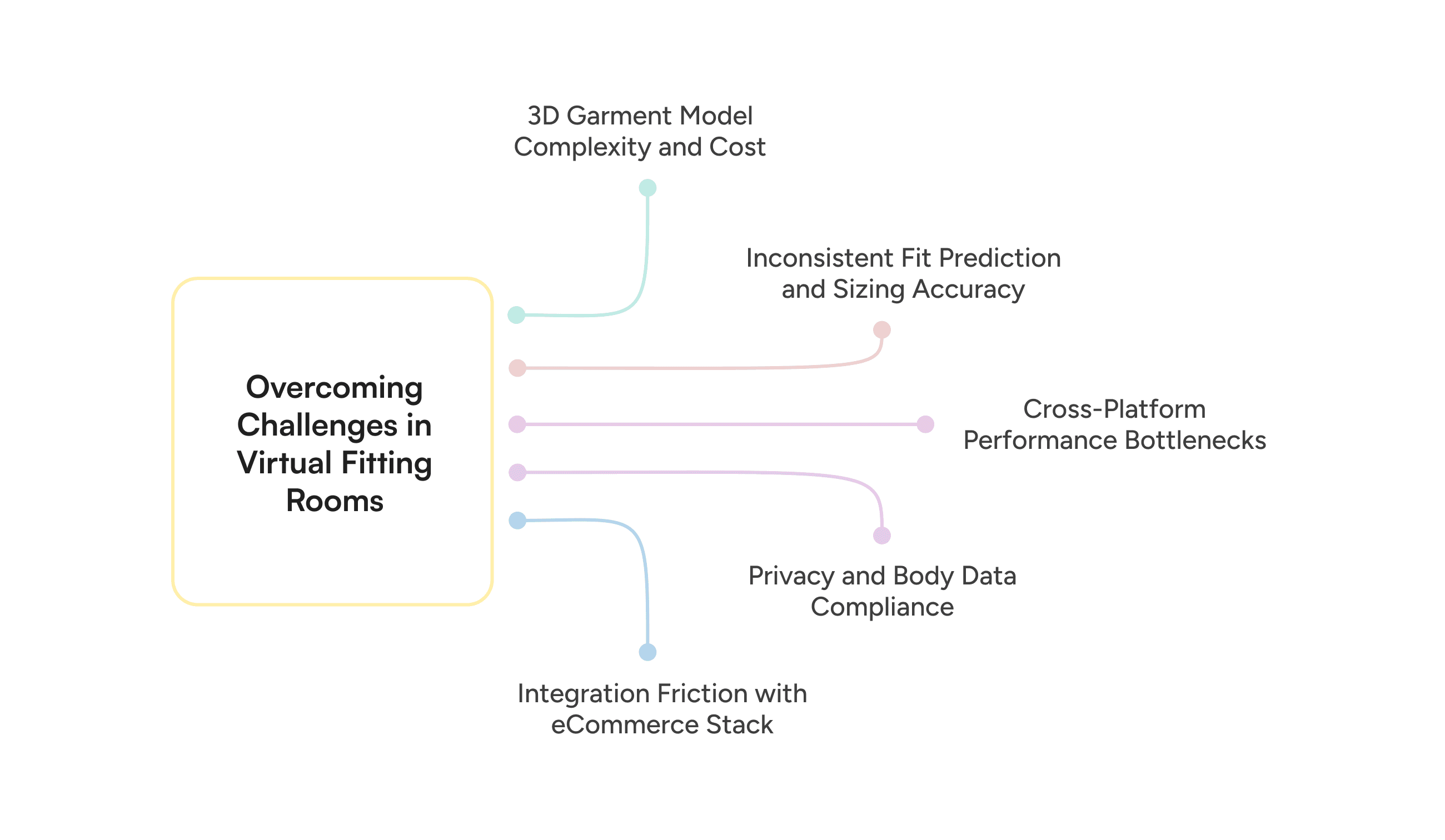
1. 3D Garment Model Complexity and Cost
The Challenge:
Each SKU requires a high-fidelity 3D asset to simulate fit and fabric behavior accurately. Fashion inventories often include thousands of items across multiple seasons, fabrics, and silhouettes. Manually creating 3D models at scale becomes time-consuming and expensive.
The Solution:
Adopt a hybrid strategy that combines AI-powered 3D generation tools with manual refinement. Use photogrammetry or deep learning algorithms to convert 2D product images into base 3D meshes. Prioritize manual optimization only for high-impact categories (bestsellers, campaign pieces, high-return segments). Integrate asset pipelines with Digital Product Passports (DPPs) and PLM systems to avoid duplication of effort across design and VFR teams.
2. Inconsistent Fit Prediction and Sizing Accuracy
The Challenge:
Body shapes vary significantly. Even when users input accurate measurements, VFRs struggle with garment-specific behavior like stretch, cling, or drape. Static size charts cannot accommodate real-world diversity in fit expectations.
The Solution:
Use AI/ML-based fit recommendation engines that learn from customer return patterns, rating feedback, and CRM profiles. Build hybrid models that blend parametric fitting (e.g., measurements, height, body shape) with behavioral inputs (style preferences, past purchases, regional trends). Integrate real-time fit scoring with configurable tolerances for each garment category.
3. Cross-Platform Performance Bottlenecks
The Challenge:
Real-time rendering of 3D try-ons or AR overlays requires high device compatibility. Lower-end phones struggle with framerate, while browsers handle WebGL rendering inconsistently. This leads to degraded UX and session drop-offs.
The Solution:
Leverage adaptive rendering techniques that auto-adjust based on user bandwidth, device GPU, and browser support. Implement lazy loading for heavy assets. Use a CDN-accelerated architecture and consider WebAssembly to run heavier client-side computations efficiently. Offer a fallback 2D visualization for constrained devices without blocking checkout flow.
4. Privacy and Body Data Compliance
The Challenge:
VFRs using camera feeds, photo uploads, or body scans collect sensitive personal data. Mismanagement of biometric data triggers regulatory risks under GDPR, CCPA, and emerging AI safety laws.
The Solution:
Design your system with privacy-first architecture. Avoid storing body data unless necessary. Use edge processing or one-time ephemeral rendering where possible. Ensure your VFR provider offers encryption at rest, explicit consent prompts, and clear data retention policies. Consult privacy legal advisors early in architecture decisions.
5. Integration Friction with eCommerce Stack
The Challenge:
Many VFR platforms function as siloed layers, disconnected from key ecommerce modules like PIMs, CRMs, checkout flows, or analytics dashboards. This fragmentation limits personalized recommendations, tracking, and marketing automation.
The Solution:
Use API-first, headless VFR platforms that support modular integration. Build middleware that bridges product metadata (e.g., material, cut, size availability) with the VFR engine. Sync fit preferences, try-on events, and avatar behavior to customer profiles in real time to enable personalized re-engagement.
Final Thought
Custom VFR development is a system problem. The stakes grow higher when scaling across geographies, fashion seasons, and omnichannel strategies. Solving these challenges requires more than feature checklists. It demands alignment between your technical architecture, data infrastructure, product vision, and customer psychology.
At GeekyAnts, our job is to ensure every try-on moment strengthens brand trust and drives conversion. Whether it’s building for mobile precision, AR realism, or scalable architecture, we architect VFRs as intelligent, immersive extensions of the retail journey.
Saurabh SahuChief Technology Officer (CTO)Why choose GeekyAnts for Virtual Fitting Room Development?
At GeekyAnts, we approach Virtual Fitting Room (VFR) development as an opportunity to modernize how fashion brands in the US and across the globe convert, engage, and retain customers. Our dedicated development team blends precision engineering with fashion-specific insight to deliver immersive AR/AI try-on experiences that reduce returns, improve sizing accuracy, and accelerate purchase confidence across platforms.
Our Strengths in Fashion-Tech and Virtual Try-On
We build tailored VFR solutions that align with brand identity, user behavior, and business growth:
- Specialized AR/AI Engineering — Our software development team works with real-time body tracking, facial landmarking, and garment simulation across SDKs like 8thWall, Banuba, and Ready Player Me. From camera-based overlays to full-body 3D try-ons, we adapt the tech stack to the product category.
- End-to-End Custom Delivery — We manage the full lifecycle—from strategy, architecture, and 3D asset pipelines to frontend integration, deployment, and QA. We ensure every component supports business KPIs: conversion, fit accuracy, and omnichannel parity.
- Speed, Scale, Accuracy — We design for performance. Every build supports real-time feedback, low-latency rendering, and accurate garment drape across mobile, web, and smart mirrors—without trade-offs on quality or UX.
- Composable Commerce Ready — Our VFR modules plug into Shopify, Magento, custom stacks, or headless architectures with clean APIs and storefront widgets. We ensure product try-ons, carts, size recommendations, and analytics operate as a seamless layer.
- Modular Build Models — We support rapid MVPs as well as scalable, production-grade systems. Whether you need SaaS-based VFR acceleration or a custom-fit engine built for multi-region infrastructure, we match delivery to growth stages.
- Privacy-First by Design — We respect user trust and compliance mandates. Our builds follow GDPR/CCPA protocols for body data, camera access, and consent workflows—ensuring responsible tech across all retail environments.
Continuous Product Evolution — Post-launch support, we monitor try-on analytics, optimize avatar realism, and improve AI sizing algorithms. We help teams evolve features based on real usage patterns, return behaviors, and feedback loops.
What Is the Future of Shopping with Virtual Fitting Rooms?
Virtual Fitting Rooms (VFRs) solve critical retail challenges by improving fit confidence, reducing returns, and increasing conversions by up to 200%. Backed by AI and AR, they power immersive, personalized experiences and generate high-value first-party data that informs smarter merchandising, inventory planning, and customer engagement. The VFR market is scaling fast, projected to reach $24.3B by 2032. Brands investing now gain a competitive advantage and future-proof their digital commerce strategy. To maximize ROI:
- Choose your build model strategically. Custom VFRs offer brand alignment and long-term scalability.
- Focus on fit realism. Prioritize precise 3D modeling and robust sizing engines.
- Iterate post-launch. Use customer feedback and analytics to fine-tune UX and performance.
- Think omnichannel. Ensure VFR works across web, mobile, and in-store touchpoints.
- Leverage insights. Treat VFR as a data asset to personalize at scale and drive decisions.
VFRs enhance both experience and operations. They turn browsers into confident buyers and position your brand as a digital leader.
FAQs on Virtual Fitting Room Technology for eCommerce Brands
1. How much does it cost to build a custom virtual fitting room for an online store?
The cost to build a custom virtual fitting room ranges from $20,000 to $100,000, depending on complexity, 3D asset volume, platform integrations, and AI precision. Factors include UI/UX design, 3D model creation, AI-based sizing logic, and omnichannel deployment. Custom solutions eliminate recurring vendor fees and offer long-term scalability.
2. What is the average development timeline for a virtual try-on solution?
Building a custom virtual try-on solution typically takes 12 to 16 weeks. This includes requirement analysis, 3D asset pipeline setup, AI model training, UI/UX design, eCommerce integration, and testing. Faster timelines are possible with modular MVP approaches using reusable SDKs or libraries.
3. Can virtual fitting rooms integrate with Shopify, Magento, or custom eCommerce platforms?
Yes. Virtual fitting rooms can integrate with Shopify, Magento, WooCommerce, and custom stacks using APIs, SDKs, or embedded widgets. Headless commerce platforms also support seamless VFR integration via API-first architecture for better control over UX and performance.
4. How accurate are virtual fitting rooms in measuring body and predicting fit?
Virtual fitting rooms using AI-driven body scanning and 3D modeling offer fit prediction accuracy between 85% to 95%. Advanced platforms simulate fabric drape, elasticity, and motion for realistic try-ons. Accuracy improves with integrated size charts, user feedback loops, and behavior-trained ML models.
5. Why are virtual fitting rooms important for fashion and retail brands in 2025?
Virtual fitting rooms reduce return rates, increase conversions, and enhance customer satisfaction. They support personalized shopping, real-time product visualization, and sustainability goals. In 2025, they are a strategic necessity for omnichannel retail and Gen Z engagement.
6. Who are the top technology providers for virtual fitting room software?
Popular virtual fitting room technology providers include Zyler, MemoMi, Fit Analytics, 3DLOOK, Vue.ai, Banuba, and GeekyAnts (custom builds). These providers vary in capability, pricing, and integration support—custom development offers full control, while SaaS platforms enable rapid deployment.
7. What hardware is required to use a virtual try-on feature on an e-commerce website?
Users only need a smartphone, tablet, or webcam-enabled device. Advanced VFR solutions support most modern iOS and Android smartphones with ARKit or ARCore. No additional hardware is required for browser-based or in-app AR try-ons, making them accessible at scale.
8. How is personal data protected in virtual fitting room applications?
Reputable VFR solutions follow GDPR, CCPA, and privacy-by-design principles. Data is encrypted during capture and transmission. Some providers process body scans locally on the device and do not store biometric data. Brands should choose vendors with transparent data handling, consent prompts, and minimal retention practices.