

Key takeaways
- Cloud kitchens are reshaping the U.S. food industry, driven by millennial demand for delivery-first experiences and operational efficiency at scale.
- Building a custom app is no longer optional—real-time order syncing, delivery logistics, and brand control require a tailored, full-stack solution.
- GeekyAnts brings deep engineering expertise, helping food brands launch scalable platforms with AI, IoT, POS integrations, and modular cloud-native architecture.
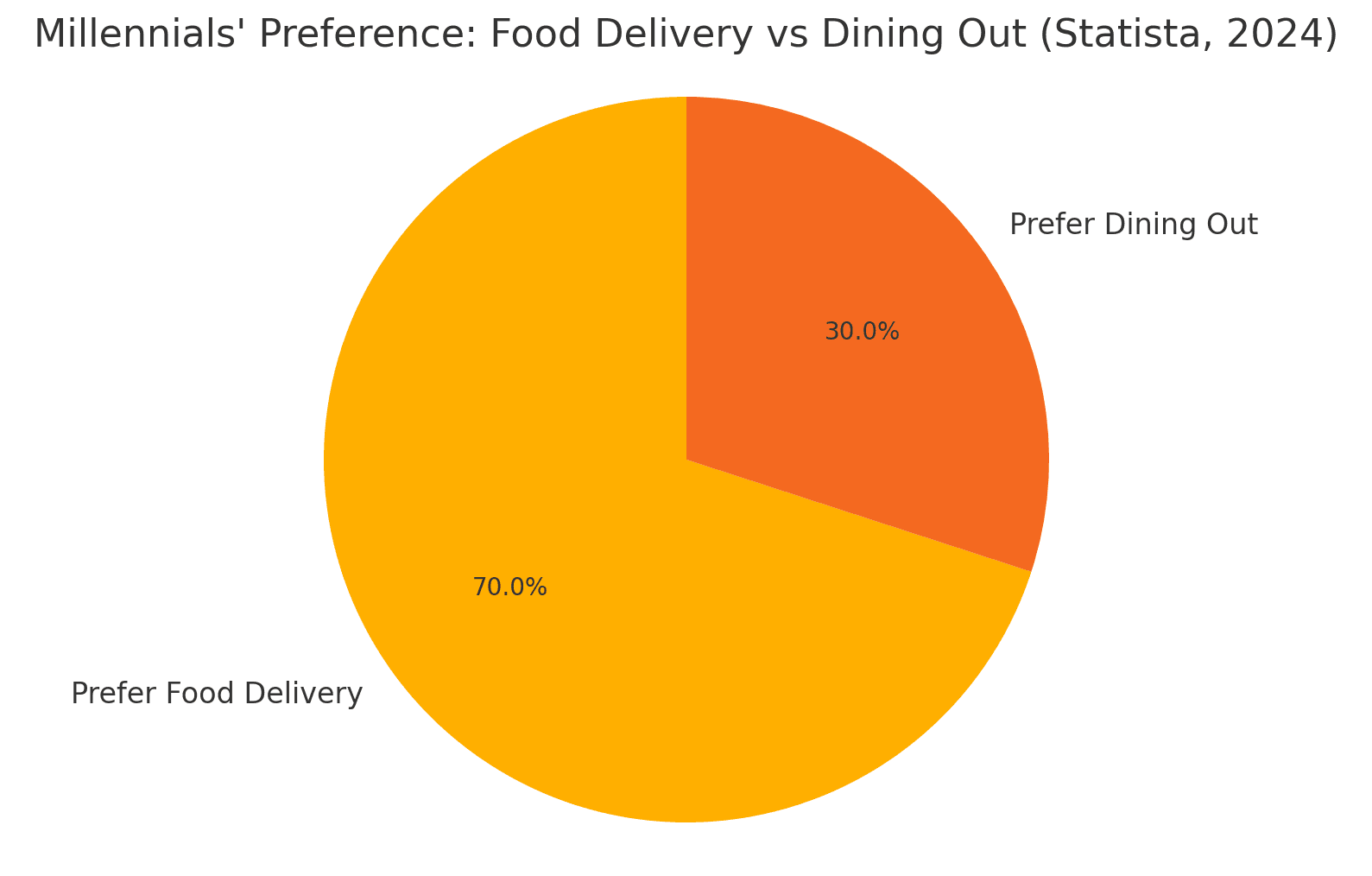
A kitchen that never opens its doors to diners can still outperform a hundred-seater restaurant—if its tech is built right. In the U.S., where 70% of millennials prefer food delivery over dining out (Statista, 2024), traditional restaurant models are straining under rising rent, labor shortages, and unpredictable footfall. Meanwhile, cloud kitchens—delivery-only kitchens powered by digital infrastructure—have grown into a $22 billion U.S. market, projected to hit $47 billion by 2030 (Emergen Research, 2024).
But tech is the make-or-break factor. Without real-time visibility into orders, fleet, and brands, even the best menu falls flat. In this blog, we will break down how to build a scalable, data-rich cloud kitchen app, designed for precision, control, and market speed.
The Cloud Kitchen Boom: U.S. and Global Market Dynamics
Cloud kitchens have evolved from niche concepts to mainstream operational models, reshaping the food delivery economy across regions. In both the United States and global markets, the momentum is being driven by rising consumer demand for convenience, the economics of low-overhead kitchens, and the maturity of digital ordering infrastructure.
U.S. Market Snapshot
In the United States, cloud kitchens are no longer experimental pilots—they are becoming central to modern restaurant strategies:
- The U.S. cloud kitchen market is valued at $8.6 billion (2023), with a projected CAGR of 12.8% through 2030.
- By 2025, more than 50% of all food delivery orders in the country are expected to originate from cloud kitchens.
- Key growth drivers include high real estate costs, labor shortages, and increasing consumer adoption of food delivery platforms.
U.S. operators are prioritizing operational control, real-time menu updates, and POS-integrated delivery workflows—solutions that allow kitchens to serve more customers with fewer physical constraints.
Global Market Outlook
The cloud kitchen ecosystem is scaling at an aggressive pace, particularly in high-growth markets across Asia, the Middle East, and Europe:
- The global market was valued at $56.7 billion in 2021 and is expected to reach $112.5 billion by 2027, expanding at a CAGR of 11.5%.
- Models like multi-brand cloud kitchens, franchise aggregators, and tech-enabled delivery kitchens are fueling expansion in countries like India, UAE, Singapore, and the UK.
Operators in these regions are leveraging AI for route optimization, dynamic pricing, and demand forecasting to maximize order throughput.
Strategic Takeaway
While the U.S. market focuses on operational efficiency, rapid fulfilment, and POS-integrated platforms, global markets are pushing for scale through multi-brand infrastructure, cross-border compliance, and hyperlocal delivery strategies. The competitive edge lies in building scalable digital platforms that can adapt to both local market nuances and global expansion demands.
Market Comparison
Region | 2023 Market Size | Projected CAGR | Key Growth Drivers |
United States | $8.6 B | 12.8% (2024–2030) | Real estate costs, delivery-first consumer behavior, tech-enabled kitchen management |
Global | $56.7 B | 11.5% (2021–2027) | Multi-brand expansion, AI for logistics, asset-light scalability |
Forecasted Growth | NA | $112.5B by 2027 | Operational efficiency, reduced capex, digital-first infrastructure |
What Is a Cloud Kitchen & How Does It Operate?
A cloud kitchen, also known as a virtual, dark, or ghost kitchen, is a delivery-only food service model designed for the digital economy. It eliminates physical dine-in spaces and replaces foot traffic with app traffic. Orders are received through digital platforms like Uber Eats, DoorDash, or proprietary restaurant apps, and meals are prepared in centralized commercial kitchens optimized for scale, speed, and multi-brand operations.
Unlike traditional restaurants, cloud kitchens operate with minimal overhead and are deeply integrated with technology, from automated order routing and kitchen display systems to real-time inventory sync and delivery partner APIs. The kitchen staff works in a production-line environment, often servicing multiple brands from a single kitchen, allowing better equipment utilization and faster go-to-market for new offerings.
The operating flow typically follows this chain:
- Order Intake: Received via aggregator platforms or branded apps.
- Smart Routing: Sent to the correct kitchen workstation based on cuisine, brand, or location.
- Automated Prep & Cook Queues: Powered by kitchen management software.
- Packaging & Dispatch: Integrated with delivery APIs for quick handoff.
Feedback & Retention: Looping back customer data for re-engagement and loyalty.
Types of Cloud Kitchen Models
Understanding the architecture of cloud kitchens is critical to choosing the right model. Here’s a breakdown of the most prominent types dominating the U.S. and global markets:
Cloud Kitchen Model | Description | Best For |
Single Brand, Single Kitchen | A centralized kitchen operates one restaurant brand exclusively, focusing on delivery. | Startups validating a new food concept. |
Multi-Brand Kitchen | A single kitchen operates multiple brands, often optimized by cuisine type and customer segmentation. | Maximizing ROI on space and staff. |
Aggregator-Owned Cloud Kitchens | Delivery platforms like Uber Eats or DoorDash operate their own kitchens and lease space to restaurant brands. | Expansion without CapEx; fast onboarding. |
Co-Working Kitchen Space | Third-party companies provide shared kitchen space, storage, and delivery logistics to multiple small food operators. | Early-stage operators or food entrepreneurs. |
Outsourced/Managed Cloud Kitchen | Entire operations—including cooking, packaging, and delivery—are outsourced to a kitchen operator. | D2C food brands looking to scale without ops. |
Hybrid Model | Combines dine-in services with a dedicated delivery-only kitchen in the same or nearby location. | Traditional restaurants are adding delivery arms. |
Why Build Your Own Cloud Kitchen App?
In a market where third-party delivery apps can charge 15–30% commission per order, owning the technology stack becomes a strategic advantage, not an option. Custom-built cloud kitchen apps provide end-to-end control over brand experience, customer data, operations, and profitability.
Whether you are a multi-brand kitchen operator or a single-brand scaling across geographies, your app puts you in the driver’s seat, with direct access to user behavior, loyalty triggers, order patterns, and delivery logistics.
Here is why building a custom cloud kitchen app matters:
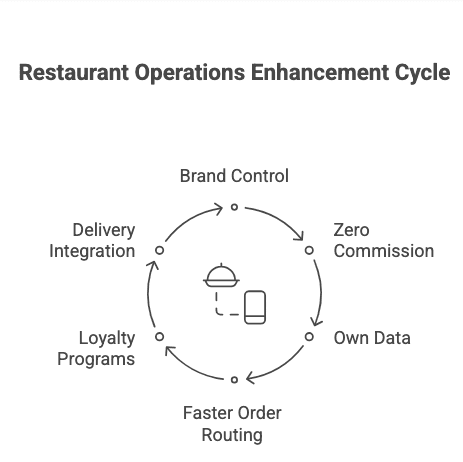
1. Brand Control, End to End
- Customize UI/UX to align with your brand story.
- Ensure a seamless experience from menu browse to final delivery.
- Avoid being lost among 100s of competitors on third-party aggregators.
2. Zero Commission on Orders
- No percentage cuts to platforms.
- Enables dynamic pricing, exclusive in-app discounts, and higher profit margins.
3. Own the Data
- Collect and analyze user behavior in real time.
- Enable personalized upsells, promotions, and AI-powered retention.
4. Faster Order Routing & Real-Time Kitchen Visibility
- Integrated with KDS (Kitchen Display Systems) and inventory.
- Reduce prep time and eliminate manual coordination across brands or stations.
5. Built-In Loyalty & CRM
- Launch loyalty programs, personalized reward journeys, and referral flows—all within the app.
- Increase repeat orders and customer lifetime value (CLV).
6. Full Integration with Delivery Partners
- Real-time rider tracking, dynamic ETA calculation, and automated dispatch.
- Option to integrate your fleet or 3rd-party logistics providers (e.g., DoorDash Drive, Uber Direct).
Owning the customer journey, from order to delivery, gave us the leverage to scale faster and build brand loyalty on our terms. With a unified app experience, we shifted traffic away from aggregators and turned first-time buyers into repeat customers.
 Kunal KumarChief Revenue Officer
Our Roadmap to Building a Successful Cloud Kitchen Platform — Expert Guide by GeekyAnts
At GeekyAnts, we have worked with food-tech innovators to architect cloud kitchen platforms that are not stitched together with off-the-shelf tools; they are purpose-built ecosystems designed for operational velocity and brand control. From order creation to last-mile tracking, every component is engineered for real-time performance, modularity, and scale.
Here’s how we approach it
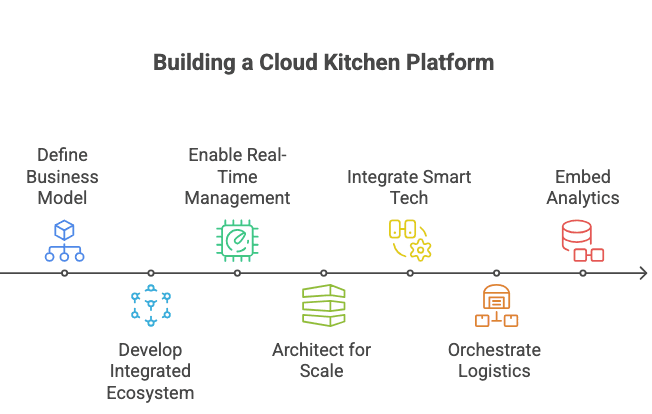
1. Define the Business Model and Ownership Architecture
Before writing a line of code, clarify the operating model. Will the platform support a single-brand kitchen, manage multiple virtual brands under one roof, or act as a franchise orchestration system across locations? For example, Kitopi's multi-brand cloud kitchens operate with centralized infrastructure and brand licensing, while Blue Apron functions as a single-brand delivery engine. Your model determines everything—from order routing logic to partner APIs and admin control layers.
2. Develop an Integrated Multi-App Ecosystem
The heart of a cloud kitchen lies in its digital interface. This includes:
- A consumer app for seamless ordering, loyalty, and real-time updates.
- A kitchen dashboard that syncs orders by SLA, prep time, and inventory levels.
- A delivery agent app for task assignments, optimized routing, and live tracking.
- A central admin console for menu management, location-wise brand control, performance insights, and integrations.
These components must operate as a tightly coupled system, ensuring no delays or data silos between consumer actions and kitchen outputs.
3. Enable Real-Time Order & SLA Management
Speed is the backbone of any cloud kitchen. The moment an order is placed, the platform should auto-prioritize it based on kitchen queue, inventory availability, and rider ETA. Real-time orchestration ensures that food is prepped just in time—never early, never late. Integrating WebSockets or event-driven Pub/Sub models is essential for maintaining millisecond-level sync across devices.
4. Architect for Scale with Cloud-Native Infrastructure
Cloud kitchens must be built for bursts. A Friday evening peak can see 10x order spikes within a 15-minute window. To ensure reliability:
- Use containerized microservices (Docker, Kubernetes) for better orchestration.
- Adopt serverless architectures (e.g., AWS Lambda or Firebase Cloud Functions) to auto-scale based on load.
- Implement CDNs and API caching to serve static assets and menus instantly.
Failures during peak hours do not lead to order cancellations—they damage brand trust and lifetime value.
5. Integrate Smart Kitchen Tech
Operational efficiency depends on how well the tech integrates with the kitchen floor. Modern cloud kitchens rely on:
- IoT-based food prep sensors to automate timers, temperature checks, and freshness monitoring.
- Barcode or RFID inventory tracking, tied directly to the backend.
- Real-time consumption data trigger auto-reordering systems.
This level of automation minimizes food waste and ensures prep timing aligns with order schedules.
6. Orchestrate Logistics & Last-Mile Delivery
Your delivery engine should be intelligent enough to adapt to:
- Real-time traffic conditions and reroute accordingly.
- Cluster orders in the same neighbourhood to reduce the cost per mile.
- Offer smart delivery window selections to consumers based on demand forecasts.
For platforms integrating third-party logistics (3PL), seamless API sync with Uber Eats, DoorDash, or Postmates is non-negotiable.
7. Embed Analytics, Loyalty, and Revenue Control
Once the operational pipes are flowing, the value lies in analytics. Your system should track:
- Ingredient-level usage patterns
- SLA deviations and kitchen bottlenecks
- Customer behavior and churn prediction
- ROI on offers, cross-sells, and loyalty campaigns
A well-structured dashboard helps both product managers and kitchen operators make data-backed decisions daily.
Must-Have Features for a Cloud Kitchen App in the U.S.
Cloud kitchens are strategic growth engines in the modern foodtech space.
Success goes beyond launching an app—it requires full-stack digital control.
Real-time visibility, operational precision, and smooth customer journeys are now essentials.
Here is what it takes to build a platform that truly delivers.
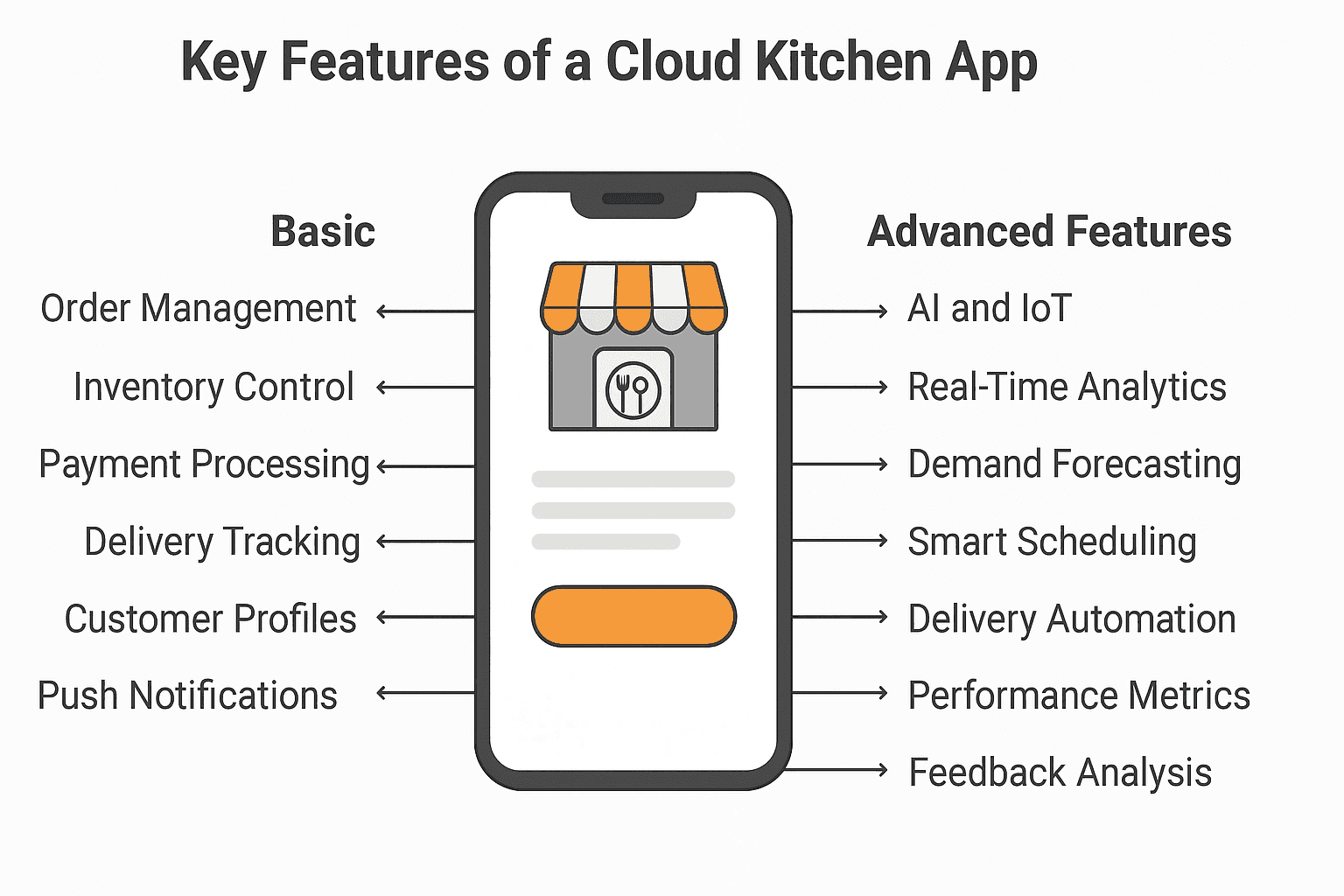
Core Features Required at Launch
1. Unified Order Lifecycle Management
A central nervous system to capture, assign, track, and fulfill orders across multiple sales channels (native apps, kiosks, delivery aggregators). This must include:
- Real-time sync between ordering apps, kitchen display systems (KDS), and delivery partners.
- Auto-prioritization of orders based on SLAs and kitchen load.
- End-to-end order visibility for staff and customers.
2. Dynamic Menu Management System
Menus should adapt based on:
- Real-time inventory availability
- Kitchen prep capacity
- Geo-targeted pricing and promotions
- A/B testing capabilities to compare item performance and tweak based on response.
This supports high-margin optimization and precise control over operations at scale.
3. Multi-Brand Kitchen Support
With many cloud kitchens running several virtual brands from a single facility, the platform must:
- Isolate workflows for each brand
- Offer brand-specific menus, pricing, and delivery logic
- Support shared kitchen resources without compromising brand experience
4. Integrated Kitchen Display System (KDS)
Forget paper tickets. A modern KDS enables:
- Visual tracking of every dish’s prep status
- Prioritization by cooking time and course order
- Alerts for delays, substitutions, or missing items
This streamlines the handoff between kitchen stations and reduces order errors.
5. Delivery Orchestration Engine
Beyond integrating with delivery aggregators, the platform should offer:
- Custom driver assignment logic
- Route optimization based on traffic and delivery time windows
- Real-time customer notifications via SMS, app, or email
- Support for curbside, in-store pickup, and scheduled delivery
6. Role-Based Access & Staff Ops Portal
Each persona—chef, floor manager, delivery lead, admin—needs:
- Tailored dashboards and permissions
- Checklists for shift handovers
- Task management workflows (e.g., restocking, hygiene protocols)
Advanced Features for Real-Time Efficiency
1. AI-Driven Demand Forecasting
Using historical order data, weather trends, local events, and traffic patterns to:
- Forecast daily peak hours
- Predict fast-selling items
- Adjust staffing and prep schedules dynamically
This helps minimize food waste, optimize workforce planning, and improve throughput.
2. IoT Sensor Integration
Smart sensors inside kitchen equipment enable:
- Live temperature monitoring of ovens, fridges, and prep counters
- Alerts for hygiene violations or maintenance requirements
- Compliance tracking with FDA and local health board standards
3. Smart Routing & Delivery Heatmaps
Using delivery data across zones to:
- Identify underperforming delivery areas
- Visualize prep-to-delivery lag by neighborhood
- Inform zone-specific promos or outlet expansion plans
4. Voice-Activated Kitchen Ops
Voice assistants triggered via kitchen devices for:
- Order status queries
- Hands-free task tracking
- Timer-based cooking automation
This reduces errors and allows multitasking during rush hours.
5. ML-Based Personalization Engine
On the customer side:
- Predicts dish preferences
- Bundles add-ons and upsells based on past orders
- Customizes delivery windows and promotions
This deepens customer loyalty and raises average order values.
6. Real-Time Feedback-to-Resolution System
Built-in feedback loops routed to the right team in real-time:
- Kitchen notified of order complaints
- Delivery issues flagged for route adjustments
- Auto-generated coupons or refunds based on severity
7. Multi-Location Admin & Franchise Dashboard
Especially relevant for U.S. chains and franchise models:
- Monitor outlet-wise revenue, prep time, delivery times
- Track compliance, hygiene scores, and customer satisfaction per unit
- Use gamified KPIs to incentivize high performance across locations
Cost Breakdown to Build a Cloud Kitchen App
Feature/Module | Description | Est. Effort (Hours) | Avg. Cost (USD) | U.S. Market |
Customer App (iOS/Android) | Menu browsing, real-time ordering, payments, loyalty | 300–350 | $15,000 | $22,500 |
Kitchen Dashboard | Order queue, meal prep status, ticketing system | 150–200 | $8,000 | $12,000 |
Delivery Partner App | Order pickups, route optimization, delivery confirmation | 200–250 | $10,000 | $15,000 |
Admin Panel | User management, analytics, pricing, role-based access | 180–220 | $9,000 | $13,500 |
Ingredient tracking, supply chain sync, spoilage alerts | 150–180 | $7,000 | $10,500 | |
Stripe, Razorpay, Apple Pay, PayPal | 80–100 | $4,000 | $6,000 | |
Analytics & Reporting Module | Real-time KPIs, order heatmaps, customer segmentation | 100–130 | $6,000 | $9,000 |
AI/ML for Demand Prediction | Predictive ordering, peak hours, staffing needs | 120–160 | $10,000 | $15,000 |
IoT Device Integration | Smart kitchen appliance connectivity, temp tracking | 100–140 | $9,000 | $13,500 |
Compliance & Security Layer | PCI DSS, GDPR/CCPA compliance, multi-tenant auth | 80–120 | $5,000 | $7,500 |
Testing & QA | Functional, performance, and device testing | 100–150 | $4,000 | $6,000 |
DevOps & Cloud Infra Setup | CI/CD, AWS/GCP configuration, and autoscaling setup | 80–100 | $5,000 | $7,500 |
Monetization Models for Cloud Kitchen Platforms
A successful cloud kitchen app is more than a logistics engine—it’s a revenue-generating platform. To build a sustainable business model, operators must leverage both core services and ancillary monetization opportunities.
Here is a breakdown of high-impact monetization models tailored for U.S.-focused cloud kitchen platforms:
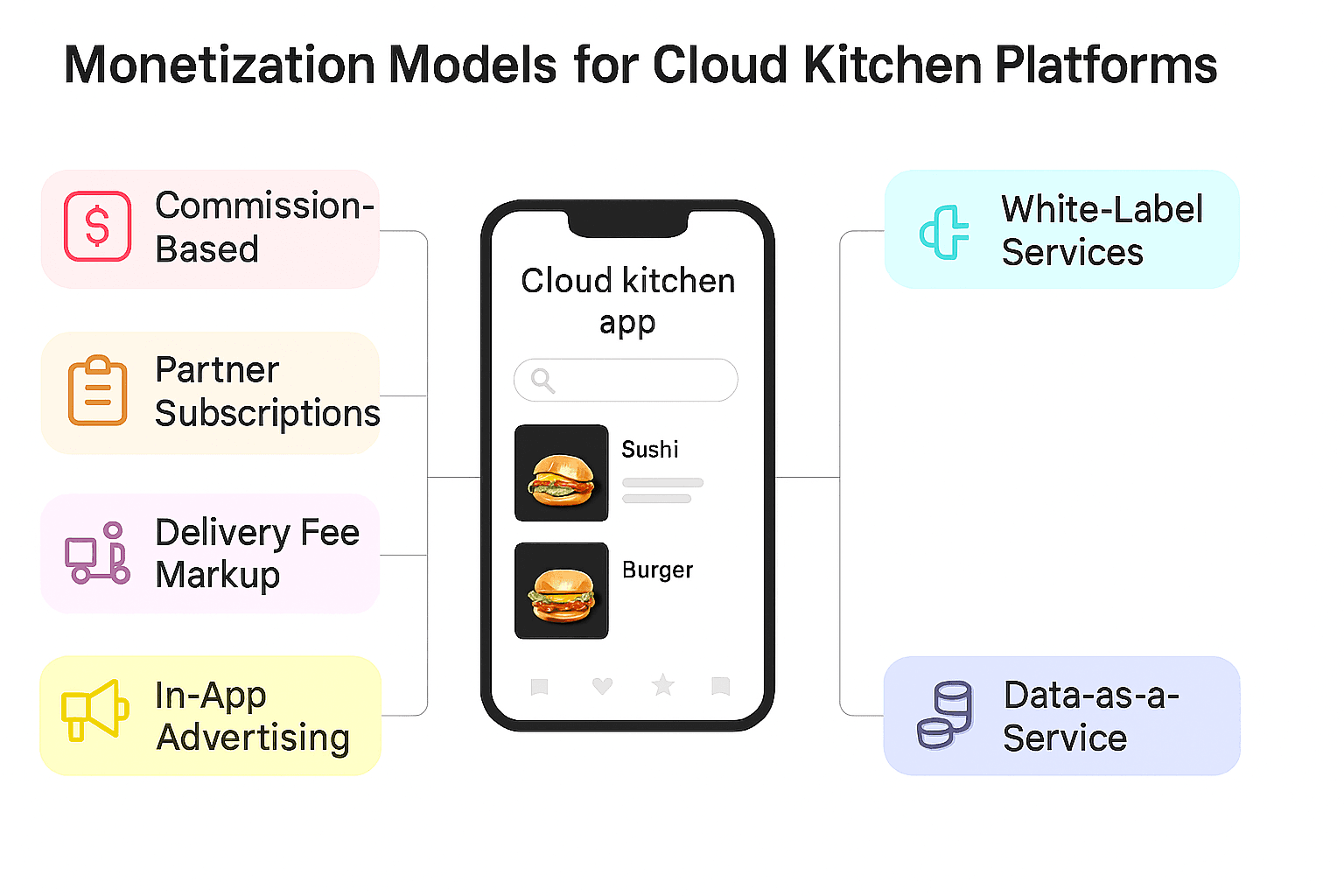
1. Commission-Based Model
Ideal for multi-brand or aggregator platforms, this model charges a percentage fee on each successful order placed through the platform.
- Who it's for: Marketplace-style platforms, virtual food courts
- Revenue stream: ~10–30% commission per order
- Example: DoorDash-style interfaces for cloud kitchen aggregators
2. Subscription Plans for Partner Brands
Offer tiered monthly plans to partner restaurants or kitchen brands for premium features like analytics dashboards, priority placement, or marketing automation.
- Tiers: Basic, Pro, and Enterprise
- Revenue stream: Predictable recurring revenue
- Includes: Real-time performance tracking, customer insights, and menu engineering tools
3. Delivery Fee Markup
Cloud kitchens can charge end-users a fixed or dynamic delivery fee, adjusted based on distance, order size, or time of day.
- Smart monetization: Use AI to optimize delivery pricing without reducing order volume
- Add-on: Surge pricing during peak hours
4. In-App Advertising & Promotions
Enable partner brands to run paid promotions inside the app—whether for banner placements, top-of-search listings, or seasonal offers.
- Revenue stream: CPM or CPC-based ads=
- Audience targeting: Based on user location, past orders, or time of day
5. White-Label Services
License your tech stack or offer it as a white-label solution to other operators or franchise brands.
- Ideal for: Scaling B2B SaaS monetization
- Bonus: Can include setup fee + monthly recurring revenue
6. Add-On Integrations (Pay-per-Use)
Offer optional modules like AI-powered menu optimization, IoT appliance management, or third-party CRM integrations as premium add-ons.
- Flexible pricing: Usage-based or feature-based tiers
- Upsell opportunity: Post-MVP deployments
7. Data-as-a-Service (DaaS)
Aggregate anonymized operational and consumer behavior data and offer insights to partner brands, suppliers, or marketing agencies.
- Data types: Heatmaps, churn patterns, item-level conversion
- Compliance: Fully GDPR/CCPA-compliant architecture
Why Choose GeekyAnts for Cloud Kitchen App Development
Built for Scale, Engineered for Results
At GeekyAnts, we don't deliver templates—we craft cloud-native platforms tailored to your kitchen workflows, regional compliance, and growth targets. Whether you're launching a virtual-first brand or managing multiple kitchen brands under one umbrella, our systems adapt to your operational DNA from day one.
End-to-End Engineering, Not Fragmented Fixes
From order aggregation and real-time kitchen routing to inventory sync and last-mile delivery integrations, we build cloud kitchen platforms that function as one cohesive unit, not disjointed tools stitched together. Our modular architecture ensures performance, uptime, and adaptability even during peak hours.
API-First Architecture, Zero Vendor Lock-In
Every layer of our tech stack—from frontend interfaces to backend orchestration—is designed for openness. You get full control over integrations, menu systems, delivery partners, and analytics pipelines. Whether you're syncing with DoorDash or building your fleet, our APIs give you the flexibility to evolve.
Expertise Across Domains That Power Cloud Kitchens
With 19+ years of experience across foodtech, logistics, and retail automation, we've helped digital brands move faster by:
- Reducing order errors via aggregator automation and POS integration
- Accelerating delivery with geo-optimized dispatch systems
- Streamlining inventory with IoT-connected appliances and dashboards
Let’s Engineer the Future of Your Kitchen
Cloud kitchens are evolving beyond basic ordering and delivery. With AI-driven demand forecasting, loyalty personalization, and operational analytics, tomorrow’s platforms need more than a dev team—they need a product engineering partner.
At GeekyAnts, we bring that vision to life—platforms that are modular, scalable, and built for growth.
Ready to Launch or Scale Your Cloud Kitchen?
Get in touch with our product experts and let’s build your competitive edge—custom tech, faster go-to-market, and a partner invested in your success.
Conclusion
Cloud kitchens represent more than a trend; they are a strategic shift toward precision-driven, scalable food operations. As the U.S. market matures, success will belong to platforms built with purpose: real-time intelligence, seamless integrations, and modular infrastructure. At GeekyAnts, we engineer these systems from the ground up—aligned with your brand’s workflow, growth plan, and delivery ecosystem. Let’s turn your operational vision into a market-ready platform that scales.
FAQs
1. How does a cloud kitchen work?
A cloud kitchen operates as a delivery-only restaurant with no dine-in facility. Orders come through digital platforms and are fulfilled from a centralized kitchen optimized for speed and efficiency.
Key operations include:
- Order intake via mobile apps, websites, or third-party aggregators
- Kitchen staff preparing food in centralized facilities
- Dispatch through integrated logistics/delivery partners
- Real-time tracking and updates for customers and operators
Cloud kitchens often serve multiple brands from the same facility, maximizing resource utilization.
2. How much does it cost to develop a cloud kitchen app in the US?
On average, developing a full-featured cloud kitchen app in the U.S. can cost between $80,000 and $250,000, depending on complexity, feature set, and integration depth.
Cost depends on:
- Number of user roles (admin, kitchen, customer, delivery)
- POS and aggregator integrations
- Real-time analytics and dashboards
- Custom UI/UX design and branding
- Compliance, hosting, and maintenance
You can refer to the cost breakdown section for a detailed table.
3. What features should a cloud kitchen app include?
A successful cloud kitchen app must support seamless ordering, kitchen management, and delivery—all within a secure and scalable system.
Essential features:
- Menu management and real-time inventory
- Multi-brand support and order queueing
- Customer tracking and delivery updates
- Integration with payment gateways and POS
- Analytics, loyalty programs, and promotions
Advanced features (for scale):
- AI-based demand forecasting
- IoT for kitchen appliances
- CRM and marketing automation
- API-first architecture for modularity
4. How long does it take to build a cloud kitchen platform?
The development timeline ranges from 12 to 20 weeks, depending on app complexity and business goals.
Typical phases:
- 2–3 weeks: Discovery, requirements, and architecture
- 4–6 weeks: UI/UX design and core module development
- 3–5 weeks: API integration and backend optimization
- 2–3 weeks: QA testing, deployment, and go-live
For enterprise-grade solutions with AI and third-party integrations, timelines may extend to 5–6 months.
5. What are the challenges & solutions while making a cloud kitchen app?
Building a cloud kitchen platform involves navigating technical, operational, and regulatory hurdles.
Common challenges:
- Managing high-volume, multi-brand orders in real time
- Syncing with POS, delivery, and aggregator platforms
- Ensuring data security and compliance (PCI DSS, CCPA)
- Maintaining kitchen efficiency across locations
GeekyAnts solutions:
- Custom microservice architecture for high concurrency
- Real-time integrations with POS, logistics, and payment systems
- Built-in compliance and audit-readiness
- Scalable, cloud-native infrastructure for multi-outlet growth
6. How to invest in cloud kitchens?
Investing in cloud kitchens can take multiple forms—owning brands, backing platforms, or licensing tech.
Ways to invest:
- Launch your virtual restaurant brand using cloud kitchen models
- Invest in cloud kitchen platforms or real estate infrastructure
- Partner with technology providers to license white-label solutions
- Explore franchise partnerships or aggregator-based delivery brands
Why it works:
Lower upfront costs, fast time to market, and high scalability make cloud kitchens an attractive investment, especially in urban, delivery-heavy regions.