
Your engineers are not slow. Your delivery model is. Why do we say this? Data and on-ground realities.
Most enterprises have already identified their AI use cases, with 82% of enterprises already running active PoCs. The gap is the execution. Relying on generalist teams and six-month hiring cycles costs you the first-mover advantage. By the time you hire, the market has moved. With inference and deployment now dominating AI compute over training, the priority has shifted from building models to operational scaling.
The AI POD model exists to close that gap by moving from chat-based tools to context-aware digital workers that coordinate across systems. The Blog breaks down what is required to make an AI POD work correctly across industries.
The problem is not a shortage of AI ideas
Every company we speak to has a list: automate customer support, build a recommendation engine, reduce manual review in compliance workflows. The use cases are there, but the pipeline is not.
What happens instead is that the AI initiative gets handed to the existing engineering team. Generalist developers — skilled at what they were hired to do — spend months learning LLM orchestration, vector databases, and RAG architecture on the job. The result is a prototype that works in a demo and breaks in production. The project stalls. The use case gets deprioritized.
This is the Capability-Delivery Gap: the distance between an identified AI use case and a deployed, production-stable AI system. It is where most AI ROI disappears.
Where the money leaks
The cost of the Capability-Delivery Gap is not theoretical. It shows up in four places on the Profit and Loss.
1. Slow-to-market cost
In AI, even a month of delay is a market position change. While your team is building the internal hiring case for an AI engineer, another company using a pre-assembled AI team has already shipped automated customer service or a live pricing model. First-mover advantage in AI compounds because each deployment generates proprietary training data that the next version learns from. Late entry means catching up against a moving target.
2. Recruitment and retention cost
A senior AI engineer costs $180,000 or more in base salary, before recruiter fees at 20% and the three to six months it takes to hire one. Build a team of three, and you are looking at $600,000 in annual cost before a line of production code ships. If one of those hires leaves for a larger offer mid-project — which happens because AI talent is in a global bidding war — the entire roadmap is at risk. A single point of failure in a three-person AI function is not a staffing problem. It is a business continuity problem.
3. Compute and token waste
Generalist developers building AI systems default to brute-force API calls: unstructured prompts, full-context retrieval, and no caching. The output works. The cloud bill does not. Poorly optimized AI architectures run at three to ten times the operational cost of a well-structured equivalent. A team without LLM-specific toolchain knowledge has no baseline to know when they are overspending or how to fix it.
4. The prototype trap
A working demo is not a production system. The gap between the two is observability: monitoring for hallucinations, tracking model drift, and detecting when outputs go out of bounds. Internal teams that built the prototype rarely have the toolchain to build the monitoring layer. The system ships, performs inconsistently, and erodes trust in AI as a category inside the company. Future AI initiatives face an internal credibility problem that the prototype created.
The four leak points: a summary
- Slow-to-market: competitor advantage accrues while internal hiring cycles run.
- Recruitment cost: $180k+ per senior AI hire, 20% recruiter fee, 3–6 months to close.
- Compute waste: unoptimized AI builds run at 3×10x the necessary operational cost.
- Prototype trap: demos that can’t be monitored erode internal confidence in AI investment.
What the AI POD model actually is
An AI POD is a self-contained delivery unit with the specific disciplines that your AI systems require. Each role within a POD exists because AI delivery fails at specific seams when any one of them is missing.
The POD model also changes the budget structure. Instead of an open-ended R&D spend, the client gets a fixed-output engagement: defined deliverables, defined cost, and a predictable timeline to production.
How it works in practice
The sequence matters. Most AI pitches start at the model layer. That is the wrong starting point.
1. Start with the data foundation
An AI system is only as accurate as the data it ingests. Before any model is selected, the POD maps the data landscape: where the silos are, what the ingestion architecture needs to look like, and how to structure modular data engines that can be updated independently as the system evolves. Skipping this step produces AI that gives confident, wrong answers.
2. Use domain-driven design to define boundaries
The AI does not need access to everything. Domain-Driven Design defines the service boundaries: which data the AI touches for orders, which for fulfilment, which for compliance. Tight boundaries reduce the attack surface, reduce hallucination risk, and make the system easier to audit when something goes wrong.
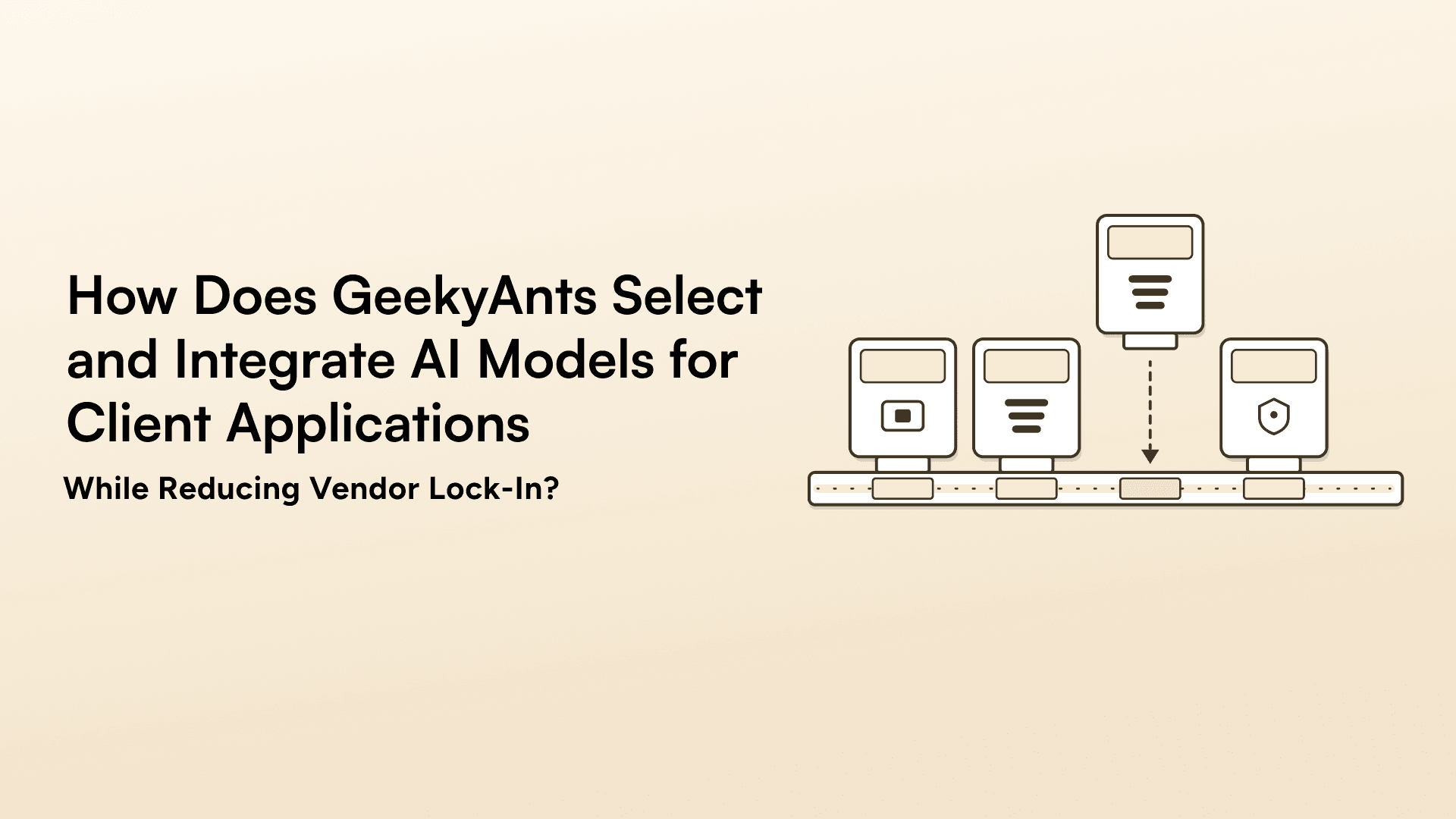
3. Build for model-agnosticism from day one
The LLM landscape changes every quarter. A system built tightly around a single model is a liability the moment a better or cheaper model ships. PODs built on open frameworks — LangChain, LlamaIndex — allow the underlying model to be swapped without rebuilding the integration layer. The client retains flexibility. The vendor does not gain lock-in.
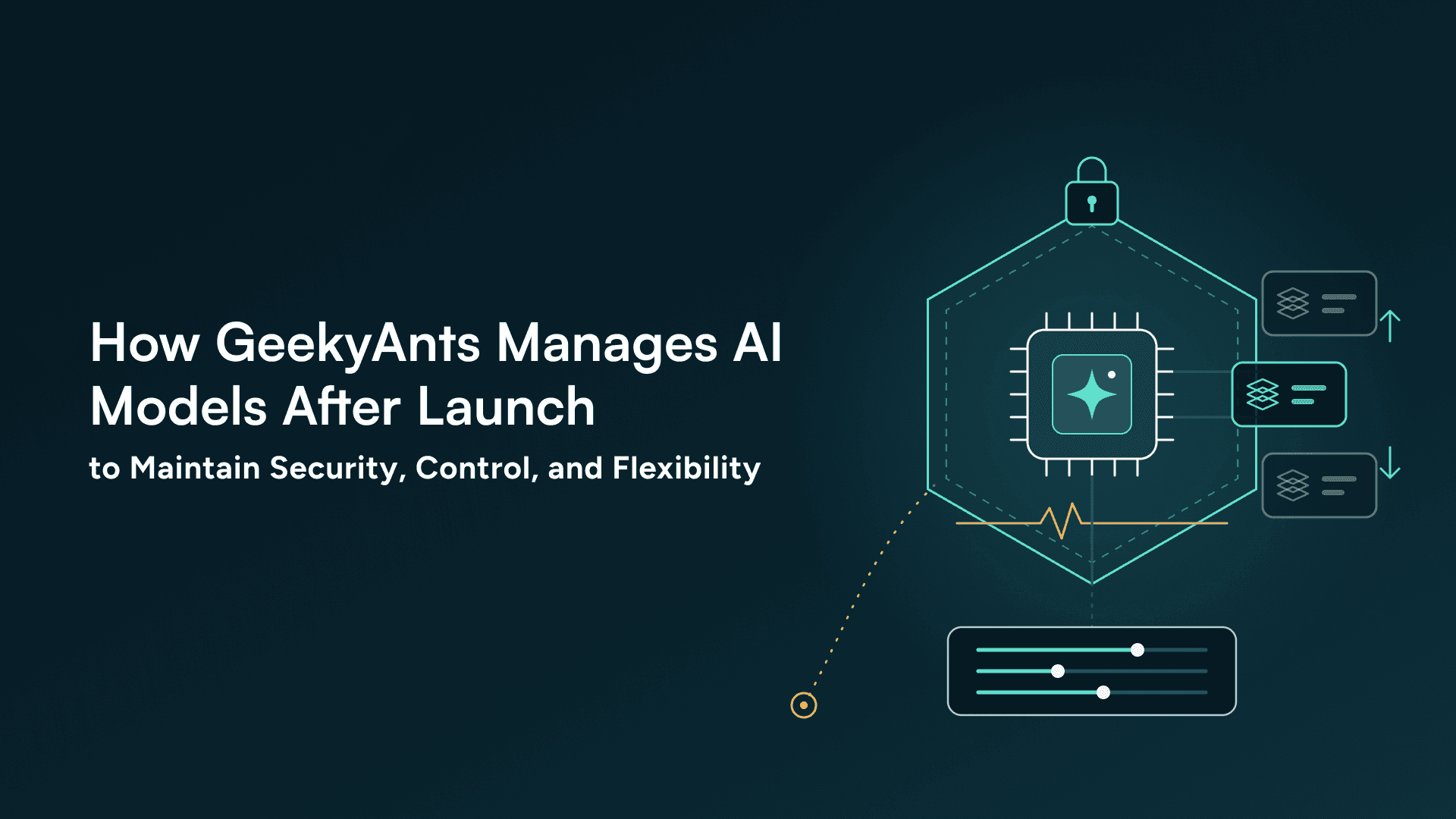
4. Ship the observability stack, not just the model
Production AI requires monitoring that generalist engineers are not trained to build. The observability stack covers hallucination detection, drift monitoring, token cost tracking, and human-in-the-loop checkpoints for decisions that carry legal or financial weight. In 2026, “the AI made the decision” is not an acceptable answer in a compliance audit. The audit trail is part of the deliverable.
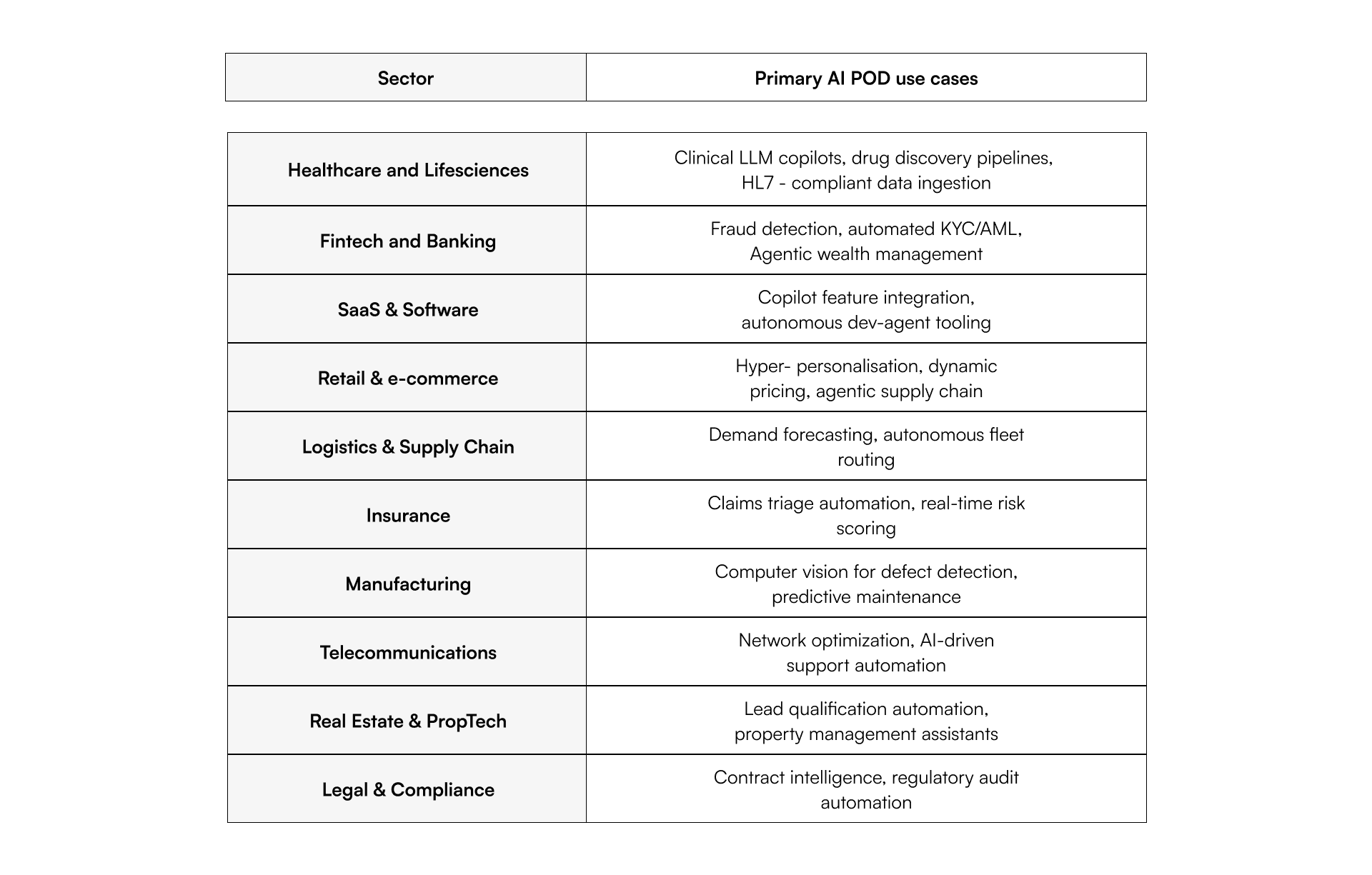
Where AI PODs are being deployed
The sectors with the highest AI POD spend share two characteristics: large data volumes and complex regulatory requirements.
Both increase the cost of building AI internally and increase the value of getting it right the first time.
Why the Current AI Engagement Model is Broken
Most AI partnerships fail because they sell the capability layer without the accountability layer. To move from a pilot to a profit center, an AI POD must solve for the four hidden friction points that derail enterprise execution.
1. Token Cost & Infrastructure Opacity
Most providers sell capacity—hours, team size, and sprint velocity. They rarely account for the "run" cost. An agentic workflow shipped without token guardrails can generate a $50,000 monthly API bill overnight.
- GeekyAnts POD Standard: We treat token optimization and budget guardrails as core deliverables. Every deployment must answer the primary question: "What does this cost to run at scale?"
2. Data Ingestion Over Model Hype
Pitches often lead with the model, but a model is only as good as its inputs. Building a sophisticated chatbot on top of siloed, uncleaned data results in high-quality hallucinations, not business intelligence.
- GeekyAnts POD Standard: We build the ingestion and orchestration layers first, ensuring the foundation is liquid and accessible before the first prompt is ever written.
3. Lack of Audit Trails
In regulated industries—finance, healthcare, or legal—an AI output without a why is a liability. If a system approves a loan or triages a patient, there must be a forensic trail for every decision made.
- GeekyAnts POD Standard: Human-in-the-loop (HITL) checkpoints and automated decision logs are mandatory. We sell the action plus the accountability, ensuring every autonomous decision meets legal and compliance benchmarks.
4. Strategic Vendor Lock-in
Many providers build on proprietary black boxes. When the engagement ends, you are left with a system you can’t maintain or migrate because the vendor owns the infrastructure.
- GeekyAnts POD Standard: We believe in IP Ownership and Model-Agnostic Architecture. Our goal is to hand over a system your team can actually run in-house.
What a responsible AI POD engagement looks like
There are gaps in how most vendors scope and deliver engagements. A well-structured POD engagement covers all of the following before the first sprint.
- Data foundation audit before model selection: identify silos, define ingestion architecture, and build modular data engines.
- Domain-driven service boundaries: the AI accesses what it needs for specific tasks, not the full data estate.
- Token budget guardrails: defined cost ceilings per workflow, with monitoring against them from day one.
- Model-agnostic architecture: built on open frameworks (LangChain, LlamaIndex) so the model can be swapped without rebuilding the integration layer.
- Observability stack: hallucination monitoring, drift detection, and human-in-the-loop checkpoints for high-stakes decisions.
- Full IP transfer: every model, configuration, and codebase transferred to the client on engagement close.
- Audit trail by default: automated decision logs for any output that carries legal or financial weight.
The capability already exists in your organization
The engineers on your team are not the problem. They were hired to build software systems, and they are good at it. AI systems require a different discipline stack — one that took years to develop inside research labs and AI-native companies. The AI POD model transfers that stack into your delivery pipeline without the hiring cycle, the single-point-of-failure risk, or the compute waste that comes from learning it under production conditions.
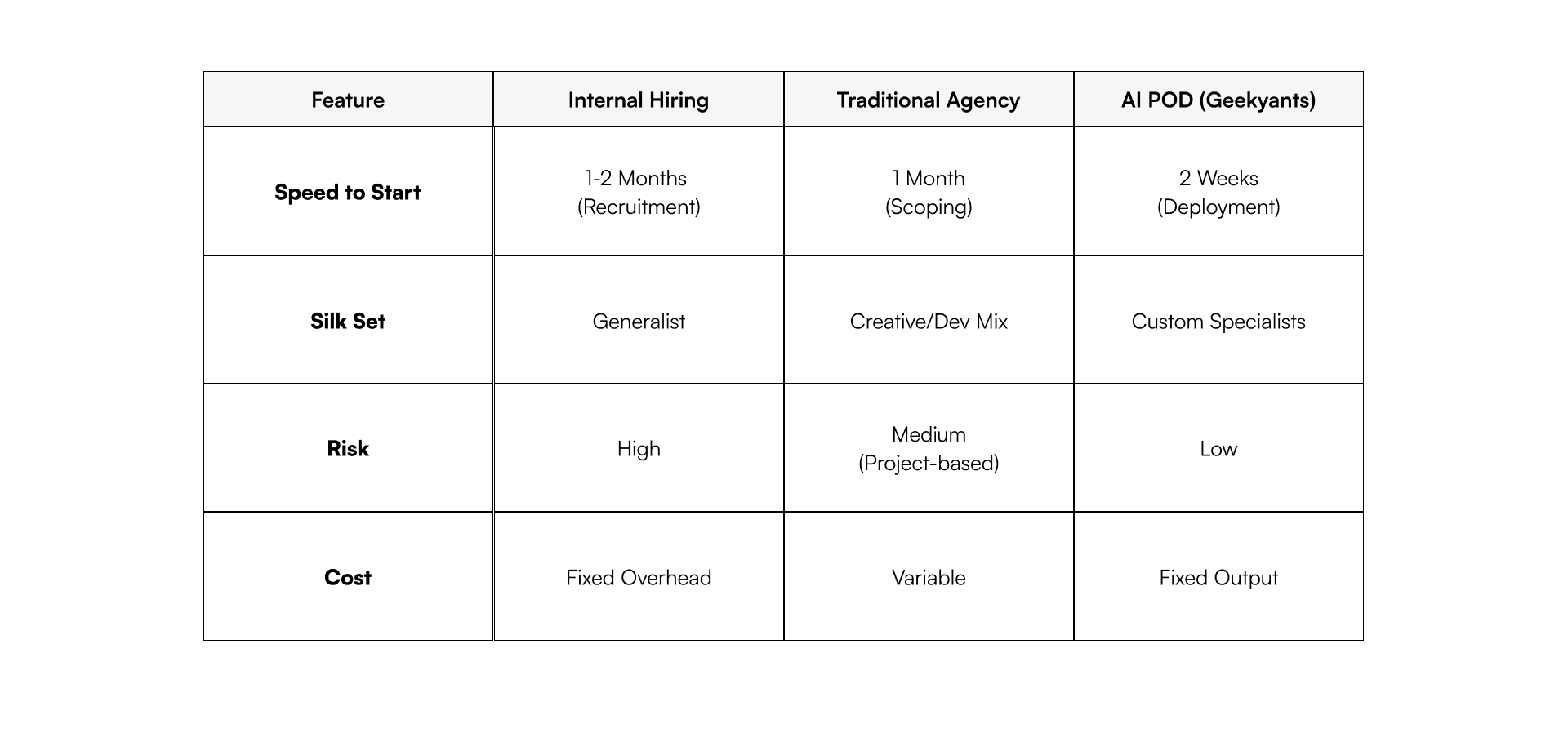
But how long can you afford to have the wrong delivery model in place while you figure it out?
We deploy AI PODs across industries with active production systems in fintech, healthcare, SaaS, and logistics. Each engagement covers the full scope described here: data foundation, model architecture, observability, and IP transfer.
If you are working through a specific use case — an AI feature that stalled in prototype, a cloud bill that grew faster than the capability, or a system that lacks the monitoring layer — the approach is available to discuss. Talk to our AI consultants today.