

Editor’s Note: This article was originally written by Amrit Saluja and published in December 2025. It was revised and updated by Harrini in July 2026 to refresh industry statistics, AI adoption trends, implementation guidance, ROI insights, and best practices for AI demand forecasting in restaurants. The technical content was reviewed by S Lakshmi, Head of Project Management Office, and Kunal Kumar, Chief Revenue Officer (CRO).
Key Takeaways
- Food waste is a major profit leak for U.S. restaurants. The U.S. wastes nearly 60 million tons (120 billion pounds) of food each year, valued at an estimated $218 billion. Poor demand forecasting contributes to excess inventory and food waste in restaurants.
- AI-powered demand forecasting can help restaurants cut food waste by 30–40%. It also optimises labour scheduling and improves inventory planning. This leads to a measurable return on investment within the first 3-6 months of use.
- Restaurants using AI forecasting gain a competitive edge. They maintain stable margins and consistent availability. In contrast, those relying on manual estimates face higher waste, more stockouts, and weaker operational resilience.
U.S. restaurants waste nearly 60 million tons (120 billion pounds) of food every year, worth an estimated $218 billion.
Traditional forecasting methods rely on gut instinct and last year's numbers. They fail when customer demand becomes unpredictable—when foot traffic and menu orders shift based on weather, local events, or seasonal changes. The National Restaurant Association estimates that total operating expenses for the average U.S. restaurant increased 36% between 2019 and 2026, which has put significant pressure on already-thin profit margins.
Yet the restaurant industry is rapidly adopting AI. As per a Deloitte survey report, 82% of restaurant executives are increasing their AI investments. In addition, the global AI in inventory management market has witnessed a growth from $9.54 billion in 2025 to $12.36 billion in 2026, representing a 29.6% annual growth rate. Those leading the charge use AI demand forecasting to predict customer orders with precision, turning waste into savings and volatility into competitive advantage.
In this guide, we will show you how AI forecasting works, why it delivers measurable ROI, and how to implement it in your restaurant. Whether you are a single-location operator or a multi-unit chain, the path forward is the same: data-driven decisions that protect margins and cut waste.
Why Traditional Forecasting Is Failing in U.S. Restaurants
Margins in the restaurant industry have always been thin, but what is different today is how quickly the old ways of predicting demand fall apart. For decades, operators leaned on intuition, paper logs, and spreadsheets that looked at last year’s averages. What once worked in a stable environment now collapses under the volatility of today’s restaurant market.
Consumer traffic is influenced by dozens of variables — weather shifts, local events, holidays, and even social media trends. A Tuesday this year looks nothing like a Tuesday last year. When forecasts can’t adjust to these dynamics, restaurants face a double hit: unsold inventory piling up in the back and customers turned away when bestsellers run out.
The real cost of broken forecasting goes beyond wasted food. It means wasted labor hours prepping meals no one orders, cash locked up in stock that spoils, and service quality slipping as managers scramble to cover shortages. The result is an unstable business model where profitability is left to chance.
Forecasting today means reading demand as it changes, not after the fact. AI gives restaurants the power to see those shifts in real time, align resources with precision, and protect margins in an industry where every percentage point matters.
 Kunal KumarChief Revenue Officer
Traditional forecasting has reached its limits. What matters now is understanding how AI forecasting works — and why it is transforming restaurant operations.
The Game Changer: How AI Demand Forecasting Works for Restaurants
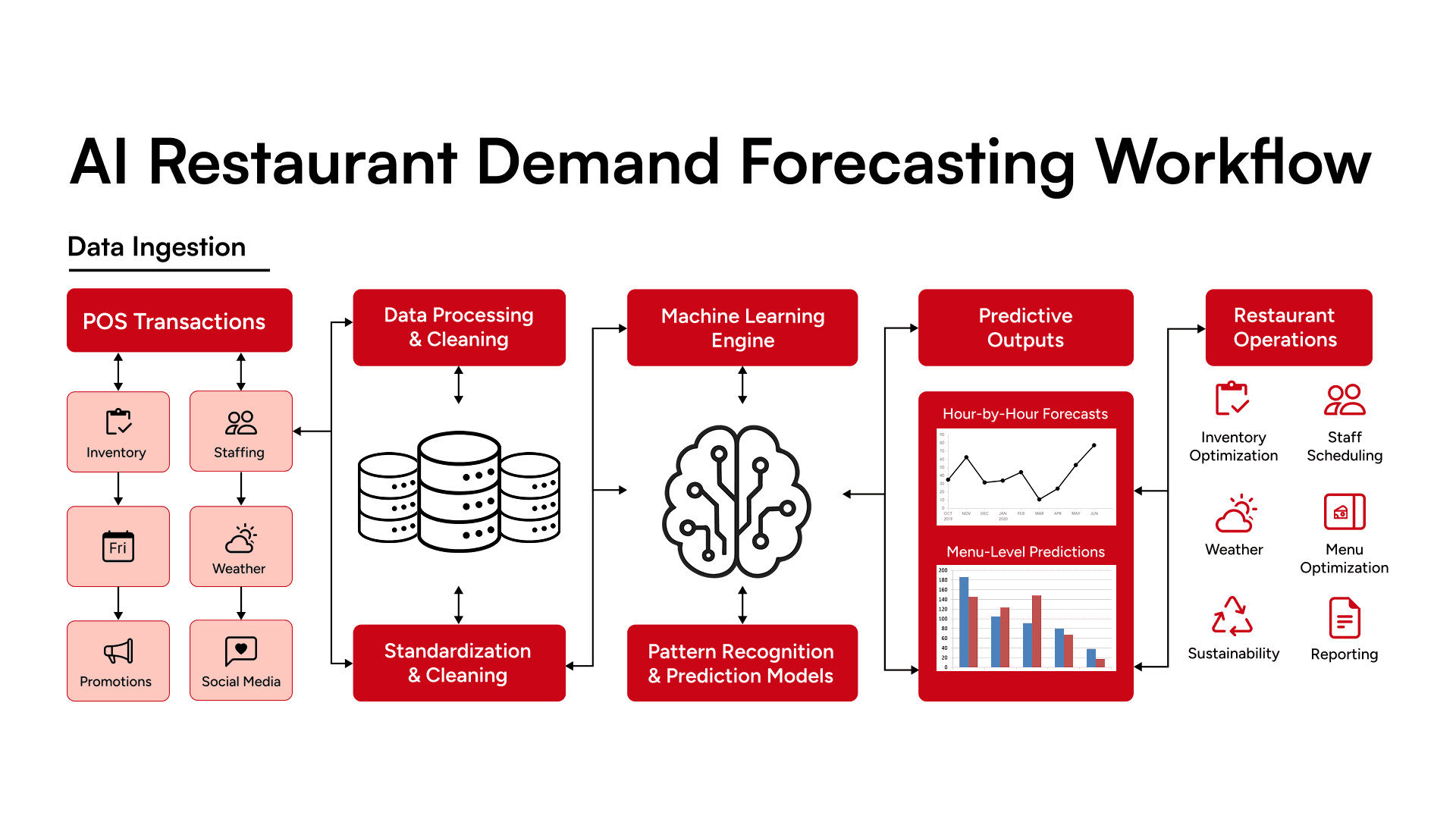
AI forecasting is not about replacing human instinct; it is about enhancing it with precision. Where spreadsheets and historical averages stop, AI brings together hundreds of real-time signals — weather, local events, seasonality, promotions, and even social media trends — to predict demand within 2-5% accuracy.
At its core, the system works in three stages:
- Data Ingestion of POS transactions, inventory levels, staffing schedules, and external factors like weather forecasts and community events feed into the model.
- Pattern Recognition: Machine learning analyzes these inputs, uncovering correlations invisible to the human eye. For example, a 10% drop in temperature on a Friday evening might consistently shift sales from salads to hot entrées.
- Predictive Output: The system generates hour-by-hour demand predictions for each menu item, giving managers the clarity to order the right quantities, prep with confidence, and schedule staff efficiently.
Implementation Guide & ROI: Making AI Forecasting Work for Your Restaurant
Large restaurant chains are already demonstrating the impact. Chipotle has reduced food waste by nearly 30% while maintaining menu availability at 99.8%. Domino's uses predictive ordering to optimize kitchen output during peak hours. Starbucks applies its DeepBrew AI platform to align inventory with customer preferences across thousands of locations.
This practical tool integrates directly with existing POS systems. Cloud computing has lowered implementation costs, and pre-trained models built for restaurants make deployment accessible.
The result is operational resilience. Operators move from reacting to yesterday's numbers to anticipating tomorrow's demand with precision that protects margins and customer satisfaction.
And yet, the financial case becomes even clearer when we break down what food waste actually costs U.S. restaurants.
AI demand forecasting sounds powerful in theory — but how does it move from buzzword to bottom-line results in your restaurant? The reality is that successful adoption is not about flipping a switch. It is a structured process that turns messy data into measurable ROI. Here’s how leading U.S. restaurants are implementing it step by step:
Step-by-Step AI Forecasting Program for U.S. Restaurants
1. Discovery & Benchmarking
Every journey starts with a baseline. Restaurants begin by auditing their current forecasting methods, waste levels, and labor costs. This provides a benchmark — a “before picture” — against which the impact of AI can be measured. For a typical 50-seat restaurant, baseline waste may range from $3,000–$4,000 per month.
2. Pilot Implementation
Instead of rolling out across all locations, smart operators start small. A single high-volume location is chosen to run AI forecasts in parallel with traditional methods. This reduces risk while allowing the team to compare results in real time. Within the first 30–45 days, most pilots show 15–20% improvements in forecast accuracy.
3. Integration & Scaling
After the pilot shows results, the system gets connected to the restaurant’s POS and inventory setup. Most providers run on cloud platforms now, so the rollout doesn’t drag on for months — in many cases, it is done within a couple of weeks, though larger or more complex operations can take closer to two months.
4. KPI Tracking
Operators do not “trust the AI” — they track results against clear KPIs:
- Forecast accuracy rate
- Food waste percentage
- Labor efficiency per shift
- Customer satisfaction scores
These KPIs create transparency, showing managers how AI impacts both daily operations and long-term profitability.
5. Continuous Improvement
AI models improve with feedback. Over time, the system learns from new data: seasonal changes, customer patterns, and even local events. This creates a self-optimizing loop where forecasts get sharper each month. Operators who continuously refine their models often achieve 30–40% waste reduction within the first year.
Calculating ROI
Adoption decisions ultimately come down to the numbers. Here’s a realistic ROI snapshot for a mid-size U.S. restaurant:
Category | Cost / Savings | Details |
|---|---|---|
Setup & Training (Year 1) | $25,000 – $50,000 | One-time investment for deployment & staff training |
Monthly Subscription | $500 – $2,000 per location | Ongoing software cost |
Savings – Food Waste Reduction (30%) | ~$2,400/month | Based on the typical waste cut in a 50-seat restaurant |
Savings – Labor Efficiency (15%) | ~$1,800/month | Reduced overstaffing & overtime |
Savings – Inventory Carrying (25%) | ~$600/month | Less stock held, lower spoilage & storage costs |
Total Monthly Savings | ~$57,600 | Combined efficiency impact |
Annual Savings | ~$57,600 | Across one year of operation |
ROI Timeline | 3–6 months | Payback period depending on size & complexity |
Annual ROI | 120% – 280% | Typical range reported by adopters |
The value of AI forecasting extends past immediate cost savings. It reinforces customer trust, enhances brand reputation, and creates operational stability — benefits that compound over time. For operators pursuing long-term competitiveness, the next step is strengthening the digital backbone.
How POS Systems Enable AI Forecasting
AI forecasting works best when built into systems designed for it. Our guide shows how a modern POS system integrates with AI demand forecasting to deliver sustained performance gains.
Explore the POS System Guide →
Practical AI Use Cases That Cut Waste and Strengthen Margins
AI demand forecasting applies across the entire restaurant value chain — from procurement to kitchen operations. These applications create measurable impact, turning inefficiencies into profitability.
1. Waste Tracking & Analytics
AI systems monitor waste at the ingredient and plate level, producing daily insights into where losses occur. Domino’s uses predictive dashboards to identify over-prep and adjust processes, recovering thousands of dollars per location annually.
2. Smarter Inventory Management
Predictive models align purchasing with real demand. Starbucks applies AI through its DeepBrew platform to match store-level inventory with local consumption patterns, reducing spoilage by up to 30% while ensuring consistent availability.
3. Menu and Portion Optimization
AI evaluates item-level sales performance to flag low-margin or low-demand dishes. A U.S. farm-to-table chain removed underperforming menu items and adjusted portion sizes, achieving an 18% reduction in food waste without impacting customer satisfaction.
4. Dynamic Pricing and Promotions
Excess inventory is redirected into revenue through targeted offers. Starbucks’ AI inventory system aimed to reduce overstock by 30 percent and stockouts by 25 percent across U.S. stores, according to a later summary of the program.
5. Food Donation Management
AI platforms detect surplus stock in advance and connect restaurants with donation networks. This reduces disposal costs, supports ESG commitments, and builds measurable community goodwill.
6. Supply Chain Forecasting for Quick-Service
In quick-service formats, predictive analytics stabilizes procurement. McDonald’s applies AI to synchronize supply orders across regions, cutting logistics costs while maintaining product consistency across thousands of outlets.
7. Predictive Analytics for Labor Efficiency
Labor represents 25–35% of operating costs. AI demand forecasts translate into staffing schedules that match real demand. U.S. operators report 10–15% reductions in labor costs through fewer idle hours and lower overtime.
8. Global Supply Chain Optimization
Multi-location brands use AI to consolidate shipments and reduce transportation waste. A global coffee chain applied predictive supply chain models to align imports with regional demand, improving margins by millions annually.
These applications show AI’s direct financial and operational impact: less waste, lower costs, stronger margins, and improved customer trust.
AI in the Kitchen: From Prep to Service
Forecasting shapes front-of-house decisions, but the kitchen is where efficiency is executed. AI-powered kitchen display systems translate demand predictions into real-time prep workflows, reducing waste and bottlenecks.
Learn how AI improves kitchen efficiency →
Restaurant Challenges AI Helps Overcome: Measurable Impact in Operations
Restaurant waste takes many forms—unsold food, overstocked inventory, misaligned staff schedules. These challenges quietly drain margins every day. AI applications turn data into concrete action, addressing each challenge directly.
1. Waste Tracking & Visibility
The first win: complete visibility. AI systems track what gets discarded, ingredient by ingredient, showing managers exactly where losses occur and why. This shifts decisions from guesswork to targeted problem-solving.
2. Smarter Inventory Management
Demand forecasts connect directly to purchasing decisions. Restaurants stock shelves without overfilling them. Starbucks has used this approach to cut spoilage significantly while maintaining product availability.
3. Menu & Portion Optimization
AI identifies underperforming dishes and flags portions larger than actual demand. These adjustments reduce waste while keeping customers satisfied. Predictive pricing accelerates the sale of perishable items through targeted offers, converting potential losses into revenue.
4. Labor Scheduling Efficiency
Quick-service chains use predictive scheduling to align staff shifts with customer flow, cutting idle hours and overtime. Larger operators extend this into supply chain optimization, consolidating shipments and reducing logistics costs across regions.
Choosing the Right AI Forecasting Partner: What to Look For and Why It Matters
The biggest risk with AI forecasting is not the technology—it is selecting the wrong partner. A system that does not integrate with your POS or inventory software, or one your staff won't trust, creates more confusion than value. The right partner, however, becomes an operational asset that pays for itself within months.
Key Criteria for Evaluating AI Forecasting Solutions
1. System Integration: The platform must connect seamlessly with your existing POS and inventory management tools. Poor integration slows adoption and creates data silos. Verify integration timelines and compatibility before committing.
2. Forecast Accuracy: Ask for documented evidence of accuracy rates. The best systems achieve 85–95% accuracy within the first few months. This directly impacts your ROI and operational confidence.
3. Scalability: Your solution should support a single location today and scale to dozens tomorrow without requiring a complete rebuild. Verify how the system handles growth.
4. Industry Expertise: AI forecasting for retail or logistics differs significantly from foodservice operations. Partner with providers who have proven restaurant experience and understand your operational nuances.
5. Training & Support: Even advanced systems fail if staff can't use them or don't trust the output. Ensure your provider offers comprehensive training, documentation, and ongoing support for your team.
When Restaurants Are Ready for AI
Most operators recognize readiness when problems become too costly to ignore: food waste exceeding thousands monthly, recurring stockouts, inefficient scheduling, or complexity from multi-location management. At that point, the cost of inaction outweighs the adoption investment.
Why Choose GeekyAnts as Your AI Forecasting Partner
GeekyAnts, an AI-Powered Digital Product Engineering and Consulting Company, with 800+ successful digital projects delivered across industries, including deep work in restaurant operations, POS modernization, kitchen management, and real-time inventory systems. Because we have built the foundational tools restaurants rely on, we understand exactly how data flows across the kitchen floor and into the business office — and how to convert that data into forecasting intelligence that improves accuracy day after day.
Our approach is simple but rigorous.
- We audit your existing systems — POS, prep logs, vendor data, and inventory tools.
- We design a forecasting layer tuned specifically to your menu patterns, traffic cycles, and location behavior.
- We integrate the models directly into the tools your team already uses, so adoption feels natural, not disruptive.
- We train staff, monitor accuracy, and refine the models continuously, ensuring the system becomes a reliable part of daily operations.
As our Chief Revenue Officer (CRO), Kunal Kumar, puts it:
“AI forecasting isn’t about adding a feature. It’s about giving operators a capability they can rely on every day, built into the tools they already use."
This philosophy allows us to help restaurants reduce waste, stabilize margins, and scale forecasting across locations without operational friction. If you’re facing unpredictable demand, rising costs, or recurring stock inefficiencies, the next step is clear:
Book a direct consultation with our restaurant AI specialists to see exactly how forecasting can transform your operations.
Conclusion
Food waste is a profit leak that weakens even the best-run restaurants. AI forecasting turns that loss into measurable savings, aligns labor with demand, and protects margins in a volatile market. Operators using it are not experimenting — they are running stronger, more predictable businesses. Those still relying on guesswork face higher costs and greater risk with each passing month. The choice is simple: adopt AI forecasting to secure competitiveness, or watch margins erode while others move ahead.