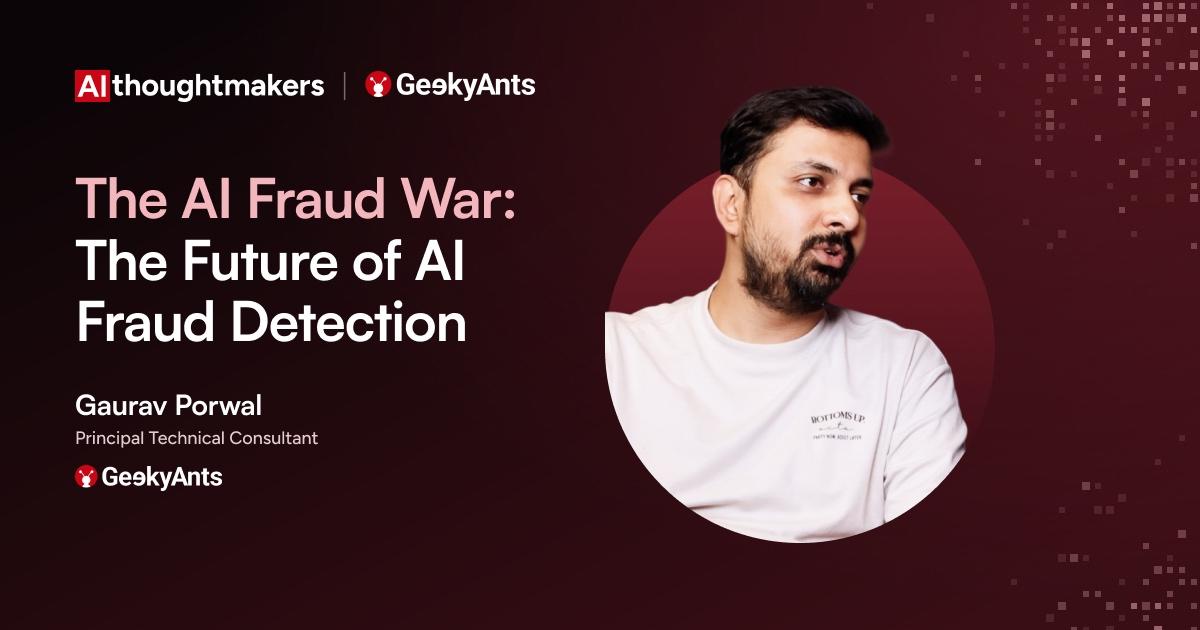


Editor's Note: This blog is adapted from episode 8 of the AI ThoughtMakers podcast featuring Gaurav Porwal, Principal Technical Consultant at GeekyAnts, in conversation with host Prem Prakash Goswami.
In 2024, an employee at engineering firm Arup's Hong Kong office transferred approximately $25.6 million after a video call with people believed to be senior executives. Their faces and voices had been recreated using deepfake technology. The employee was following instructions from people who appeared authorized to give them.
The case raises a question that extends beyond corporate payments. If a video or voice can be convincingly fabricated, what should banks rely on when confirming a customer's identity?
The concern is already visible in financial services. In November 2024, the US Financial Crimes Enforcement Network (FinCEN) warned of increased suspicious activity reporting involving suspected deepfake media, including fraudulent documents used to evade identity checks.
In episode 8 of AI ThoughtMakers, GeekyAnts' Gaurav Porwal discusses how these attacks work and why AI detection needs to operate alongside human verification.
Want to hear the discussion firsthand? Catch the full podcast episode.
How AI Is Changing Financial Fraud
Generative AI has been able to make Deepfake creations easier and less expensive to produce, opening a channel of access to impersonation techniques.
There are three main methods to achieve this:
- Face swapping: Replacing a person's face in an image or video with someone else's identity.
- Facial reenactment: Making an existing photograph or recording appear to respond to prompts, including head movements during identity checks.
- Voice cloning: Generating speech that resembles a real person using samples of their recorded voice.
These techniques pose threats at various stages of customer engagement. A doctored video may be used when opening an account. A synthetic voice can make a fraudster’s instructions sound credible. The use of a credible video call can make an employee believe the speaker before verifying the instructions through other means.
The business problem is the same across these situations: familiar identity cues have become easier to imitate, while the consequences of a wrong decision remain substantial.
Why Video KYC Needs More Evidence
Video Know Your Customer (KYC) checks compare a face with an identity document and ask the applicant to demonstrate that they are present whereas, traditional liveness checks may involve simple blinking or turning the head on command.
While those movements served as good enough checks earlier, synthetic media is currently capable of reproducing all of them.
Gaurav discusses remote photoplethysmography (rPPG), which analyzes tiny changes in skin color associated with blood flow. Researchers have explored these signals for deepfake detection. They provide supplementary evidence rather than a guarantee, as lighting, recording quality, and evolving generation techniques can affect performance.
Another view is that of the device level. The organization can check to see if the video stream is coming from the appropriate camera environment or whether there are indications that the camera is virtual.
NIST's digital identity guidance specifically addresses forged media and video injection attacks in remote identity verification.
With seemingly multiple signals available to strengthen identity verification, the next question that naturally arises is, how much of the fraud detection process AI can actually handle on its own.
Can AI Detect Fraud Without Human Verification?
Imagine an account-opening request where the submitted document appears genuine and the face matches, but device checks raise concerns about the video feed.
That result warrants investigation because a suspicious signal alone does not establish fraud.
This is where the verification process of an institution becomes important. The system must have guidelines about whether to proceed further, seek more verification, or refer the matter to an experienced reviewer. There also needs to be tracking of which signals were used for the above decision-making process.
The AI can check the patterns of images and signals that cannot be assessed by human eyes. However, human reviewers are needed to deal with uncertain situations where a mistaken signal might lead to blocking a genuine customer from establishing their account.
Therefore, a good fraud detection program must track much more than the number of suspicious requests. They must focus on confirmed fraud, false positives, review costs, and what happened to the customers in the referred cases.
A better fraud detection process has no significant value if it causes avoidable delays for genuine customers.
Can Financial Institutions Keep Up With AI-Enabled Fraud?
The interview describes an ongoing contest: attackers adapt their techniques, while institutions learn from attempted fraud and update their controls.
Banks may have substantial verification and transaction data, but that advantage depends on lawful data use, accurate labeling, and regular evaluation.
It also requires governance. Organizations need to know which model or rule produced an alert, how decisions are reviewed, and whether an updated detection method performs better against both fraudulent and legitimate cases.
Compliance requirements vary by market, so security controls should be designed around the obligations relevant to the institution.
Digital identity is changing alongside these defenses. Biometrics and passkeys may reduce reliance on passwords, while digital identity wallets may provide new ways to present credentials.
None removes the need for account recovery, additional checks on sensitive transactions, or safeguards against impersonation.
Conclusion
The future of fraud detection will depend on how institutions make verification decisions when faces, voices, and documents can be manipulated.
AI can examine evidence at a scale and level of detail that people cannot reliably match, but institutions still need to decide when evidence is sufficient and when a person should investigate.
The aim is to make fraudulent access harder while keeping legitimate financial services usable.
Businesses developing secure onboarding and transaction experiences can explore GeekyAnts' Fintech App Development Services.