

Key Takeaways
- Weigh the choice on what it costs to reach a working production system, rather than on salaries versus contract rates.
- Read speed two ways, since a pod assembles skills quickly while an established internal team already knows your product and data.
- Staff for the full range of production work, because AI delivery needs far more than model engineers to succeed.
- Keep AI in-house when it is core to your product and your team can hold the capability long term.
- Choose a pod when the deadline is tight, specialists are missing, and you need several disciplines working at once.
- Consider a hybrid model that keeps strategy and governance internal while external capacity handles the build.
Introduction
After a funding round, the priorities of the engineering organization change. Before the raise, the goal was to prove the idea could work. After it, the same idea has to become a product that runs reliably every day, protects customer data, and contributes to revenue. Meeting that expectation usually depends on having enough of the right engineering talent, which is where the question of an AI team in-house vs outsourced first comes up, and where most funded companies find their main constraint.
Leaders often treat the response as a choice between hiring internally or outsourcing the work. A more useful question is which operating model can deliver the funded AI roadmap and keep it running there. It focuses attention on the capability being bought, which is a working and dependable product, rather than on where the people building it are employed.
Three operating models are available.
- An in-house AI team gives the company full control over priorities and keeps the knowledge inside the business over the long term.
- A dedicated product engineering pod is an established external team that takes ownership of delivery and works directly against the roadmap.
- A hybrid model keeps strategy, data, and key decisions in-house while the pod provides the capacity to build and ship.
Each model balances speed, control, and risk differently, so the right choice depends on the roadmap and on the strength of the existing team.
Current data explains why the decision matters. Stanford's 2026 AI Index reports that 88% of organizations had adopted AI by 2025, while McKinsey finds only about 7% have scaled it across the enterprise. Most companies now use AI, but few operate it reliably in production, and closing that gap is what a funded roadmap has to achieve. GeekyAnts assesses the decision on the cost of reaching a reliable production outcome rather than the price of a hire or a contract.
After a raise, the pressure is to show the board that something is moving, so companies hire quickly or sign a vendor quickly. The more useful question is what the roadmap actually needs to reach production, because that answer decides the shape of the team. Get that order right and the cost decision usually settles itself.
 Kunal KumarChief Revenue Officer
How Should You Staff an AI Product Development Team After Funding?
After funding, AI stops being a set of experiments a company is testing and becomes a product the business has to run and support every day. That change raises what the engineering team is expected to deliver, and it changes how the team should be staffed.
The Roadmap Moves from Validation to Execution
Before funding, AI use cases are usually experiments that show an idea has potential. After funding, the same use cases have to reach production and stay reliable, and the pressure to get there comes from several directions:
- Leadership and the board want evidence that the investment is producing results.
- Investors expect steady progress against the plan they backed.
- Product teams and customers need releases that ship on schedule and work in daily use.
Reaching production also takes more engineering than a prototype did. A live system includes data pipelines, integrations, testing, monitoring, and security, so the work grows well beyond the model itself.
When the internal team cannot cover all of it quickly enough, engineering capacity becomes the limit on how fast the roadmap can move.
Hiring Becomes a Strategic Decision
Because the work has grown, the staffing plan has to grow with it. A funded AI roadmap needs more than machine learning engineers, and relying on one strong hire usually leaves the product missing what production requires. A dependable build draws on several disciplines at the same time:
- Product leadership to turn priorities into a delivery plan
- Data engineering and MLOps to keep pipelines and deployment reliable
- Cloud infrastructure to run the product at scale
- Security and governance to keep the system safe and compliant
- QA and evaluation to confirm the product behaves as intended
Covering all of these disciplines is what makes the decision strategic rather than routine.
The real choice is whether to build this capability inside the company as an in-house AI team, or bring it in as a ready-made dedicated product engineering pod, which the sections that follow compare in full.
Dedicated Product Engineering Pod vs. In-House AI Team: Which Model Fits Your Funded Roadmap?
This is a crucial decision for most organizations. Most teams settle it by comparing one salary against one hourly rate, which measures the smallest part of what each model provides.
The comparison that holds up is a dedicated product engineering pod vs in-house AI team on equal terms: scope, seniority, and delivery timeline on both sides, then looks at what each option gives you across the factors that decide whether a funded roadmap actually reaches production.
The Comparison Matrix
The table below sets both models against the factors that decide whether a funded roadmap reaches production. Read each row as a trade-off rather than a score, since the weighting depends on your situation.
Factor | In-House AI Team | Dedicated Product Engineering Pod |
Time To A Working Team | Weeks to months of recruiting for each role | Days to weeks when the provider has people available |
Access To Scarce Skills | You compete for every specialist separately | Multiple disciplines arrive together as one unit |
Product And Customer Context | Deepens the longer employees stay | Built deliberately through embedded work and stable membership |
Cost Shape | Fixed and recurring across salary, benefits, tooling, and retention | Contracted and adjustable, with higher senior rates per hour |
Scaling Up Or Down | Scaling up needs hiring, scaling down is difficult | Capacity flexes by phase within the agreement |
IP And Source Control | Owned by default | Owned only when the contract and repository setup make it explicit |
Institutional Knowledge | Stays as long as people stay | Retained only when transfer is designed into delivery |
MLOps And Operations | Worth owning when AI runs continuously | The faster fix when deployment and reliability are the immediate gap |
Long-Term Capability | Compounds internally with strong retention | Builds internal skill only through pairing and handover |
Management Load | You hire, manage, and retain every role | The provider runs delivery while you keep product and architecture control |
Team Continuity | Exposed to attrition and backfill gaps | Depends on the provider holding the same members in place |
Best Economic Fit | Steady, heavy use across a multi-year roadmap | Uneven or phase-based demand, or when waiting to hire is costly |
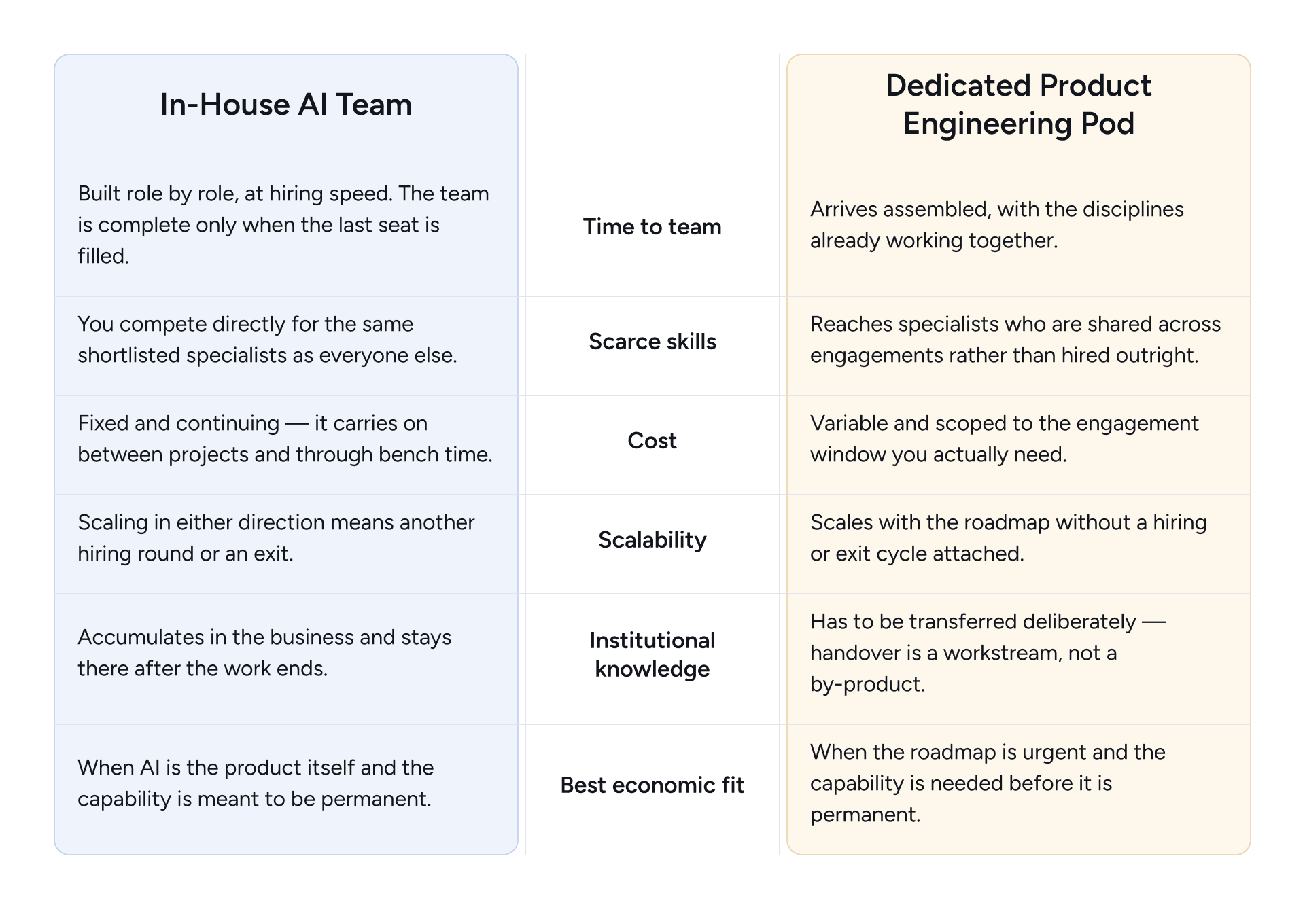
How To Read This Comparison
The matrix does not name a winner, and the pointers below explain why the right answer changes by company.
- Compare like with like- Set the same scope, seniority, and timeline against both options before comparing cost, or the numbers will mislead you.
- Weigh two kinds of speed- Time to assemble a team and time to a stable production release are different, and only one of them may be your real constraint.
- Treat ownership as a design choice- Source code, IP, and knowledge stay with you only if the contract and setup are written that way, whichever model you pick.
- Let workload duration lead- Steady, multi-year demand rewards an in-house team, while demand that rises and falls by phase rewards a pod.
- Keep governance on your side either way- Cloud, model, and data responsibilities remain the company's, so neither model removes them from your plate.
Read together, the matrix and the pointers give a conditional answer.
An in-house AI team fits when AI is central to the product and the workload stays steady enough to keep a permanent team busy.
A dedicated AI product engineering pod fits when the roadmap is moving faster than you can hire and you need several disciplines contributing from the first week.
Most teams frame this as hire versus outsource, which skips the real question. What matters is what the roadmap needs to reach production and who owns it once it is live. Settle that first, and the cost comparison usually answers itself. A pod earns its place when you need several skills working from week one and cannot hire that fast, and an in-house team earns its place when the capability has to stay and compound inside the product.
Kunal KumarChief Revenue OfficerWhat Does a Dedicated AI Product Engineering Pod Actually Include?
A pod is easy to mistake for a group of outsourced developers you rent by the month, and that assumption sets the wrong expectations. This section defines what a real pod is, who sits in it, and what it owns, so you can tell a genuine delivery unit from extra hands.
It Is a Cross-Functional Unit, Not a Pool of Developers
The word "pod" gets used loosely. A dedicated AI product engineering pod is a cross-functional team, embedded in your workflow, that owns a defined part of the product rather than working ticket by ticket.
Outsourced developers will await instructions and return the code. A pod turns the company's business goal into a working product capability and stays accountable for how that capability performs in production. In case of the bid that is only machine learning engineers, responsibility for integration, data, testing, and operations will remain yours.
Who Sits in a Production Pod?
The model is a small part of a system that has to run reliably, so a production build needs several disciplines working together. The roles below cover most enterprise AI work, and few engagements need all of them at full weight at once.
Role | What They Own in Production |
AI / Product Lead | Turns priorities into a plan, sets acceptance criteria, keeps delivery aligned to the outcome |
AI / ML Engineer | Model choice, orchestration, retrieval, agent logic, and AI-specific evaluation |
Full-Stack / Product Engineer | Customer workflows, APIs, integration, and dependable product behavior |
Data Engineer | Pipelines, data quality, lineage, and permissions |
MLOps / Cloud Engineer | Deployment, environments, versioning, monitoring, rollback, and cost control |
QA / AI Evaluation Engineer | Test sets, regression checks, failure analysis, and release criteria |
UX / Product Designer (where required) | Human review, escalation, feedback capture, and task completion flows |
What Does the Pod Take Responsibility For?
What separates a pod from a demo team is the scope it owns end to end. A capable one treats the model as one component inside a system it is accountable for, from design to a running, maintained product.
- AI architecture that holds up as models and requirements change
- Product engineering that turns the model into usable features
- Data pipelines that keep inputs clean, current, and permissioned
- Model and API integration wired into your existing systems
- Testing and evaluation that confirm quality before and after release
- Deployment and monitoring that keep the product live and observable
- Optimization of cost, latency, and reliability in production
Ownership after launch is where thin engagements fall short. Connecting an API can produce a working demo, but keeping that system accurate, safe, and affordable as data and usage change is the work that protects the investment.
Companies ask us for AI engineers, but that is rarely what makes a product succeed in production. The model is a fraction of the work. What decides the outcome is the data pipeline feeding it, the evaluation that catches drift, the monitoring that flags problems before customers do, and someone owning all of it after go-live. A pod that cannot cover that is a demo team, not a delivery team.
Kunal KumarChief Revenue Officer
What Does an AI Product Development Team Really Cost After Funding?
The cost is the deciding factor that decides whether this choice will be made or not, and where it is normally wrong. In this section, we will discuss the total cost incurred to hire internally with the productive engineering capacity AI development partner vs in-house team comparison actually delivers.
US wage levels can be pulled from the Bureau of Labor Statistics Occupational Employment and Wage Statistics for each role, and the benefit share can be applied from the BLS Employer Costs for Employee Compensation series, after which recruiting and first-year tooling push the figure higher.
Why Does the Salary Figure Underestimate the Cost?
A salary looks like the price of a hire, but it is only the visible part. The real figure is the fully loaded cost of keeping a person productive, which is what you should set against any pod quote.
The internal costs that sit on top of salary include the following:
- Recruiting to source and close each specialist in a competitive market
- Benefits added to every base salary
- Onboarding time before a new hire is productive
- Infrastructure for compute, tooling, and environments
- MLOps to keep models deployed and running
- Security to protect data and meet internal standards
- Management time to lead, coordinate, and review the team
- Retention to keep specialists once the market bids for them
An AI product engineering pod carries its own costs, and a fair comparison names them too:
- Engineering capacity billed against agreed scope
- Specialist expertise across several disciplines
- Team management handled by the provider
- Onboarding into your stack and context
- Governance alignment to your controls and standards
- Transition planning for a clean handover later
Compare Capacity, Not Headcount
When both sides are fully costed, what really matters is not which is cheaper but rather how much capacity for productive work you get out of each of them. Headcount counts people paid for by salary, while capacity counts productive work produced.
- Usable capacity of an internal team goes down while filling positions, onboarding new people, and managers spending their time coordinating rather than producing.
- A pod turns spend into capacity faster since it comes with a ready-made team, but with higher rates for senior specialists and learning period for the provider anyway.
Time is part of the cost. SHRM's 2026 recruiting benchmark reports a median of 39 calendar days to fill a single nonexecutive role, and engineering roles run longer than most.
What it really boils down to is equal scope, seniority, and duration of efforts for both, then compare which side will get the funded roadmap to production out of spend.
It is not always cheaper to use a pod.
It usually makes more sense to go internal in case the team works productively year after year and knows something valuable for your product. Going for a pod usually works better in case of variable demand for your product, multiple skills required at once, or cost of hiring exceeds the higher hourly rate.
Leaders compare a salary to an invoice and think they have compared cost, but they have compared two different things. The salary hides recruiting, benefits, management, and the months before anyone ships. The real measure is how much work reaches production for the total you spend, and how soon. That is the number worth arguing over.
Kunal KumarChief Revenue OfficerWhen Should You Build the AI Team In-House?
Building internally is the right move under specific conditions, not as a default. This section lays out those conditions so you can check your own situation against them before committing to permanent headcount.
An in-house AI team is the stronger option when several of the following hold together. Any one of them can point inward, but the case gets firmer as more of them apply at once.
- AI is core intellectual property, central to what makes your product different rather than a supporting feature.
- The roadmap is long-term, with enough sustained work to keep a permanent team fully occupied for years.
- Proprietary knowledge matters, because your data, domain, or workflows shape model quality in ways an outside team cannot easily learn.
- You can hire and retain specialists, which is a real constraint given that AI and engineering roles remain among the slowest to fill.
- Internal governance is mature, with the security, data, and compliance controls already in place to run AI responsibly.
- Long-term ownership outweighs early speed, so keeping the capability inside the company is worth a slower start.
This case grows stronger after product-market fit, when AI architecture and operating knowledge start shaping repeated product decisions. At that stage, the value of holding the capability inside the company usually outweighs the delay of building it.
Quick Check: Is In-House the Right Call?
This section is not an argument for hiring by default. It is a test of whether permanent AI capability will compound inside the business or stall once the initial build is done.
Use the short checklist below to test the fit before you decide. If most boxes are ticked, an in-house AI team is likely the sound choice.
In-House Readiness Check |
When Does a Dedicated Product Engineering Pod Make More Sense?
An AI product engineering pod suits a different set of conditions from an in-house team, and they surface most clearly right after funding. The checklist below shows when external capacity closes the gap faster than hiring can.
A dedicated product engineering pod tends to be the stronger option when several of these apply:
Pod Readiness Check |
That last point is where a pod earns its place after funding. It lets you reach production and see the real cost of running the system before you take on the fixed expense of a permanent team, which is a lower-risk way to move quickly.
Can a Hybrid AI Model Keep Ownership In-House While a Product Engineering Pod Extends Capacity?
For many funded and enterprise teams, the workable answer combines both models rather than choosing one outright.
This section shows how a hybrid AI model keeps the decisions that must stay internal while a dedicated product engineering pod supplies the capacity that is hard to hire quickly.
A hybrid model works by drawing a clear line between what the company owns and what the pod delivers. The company keeps strategy, context, and control, and the pod adds execution capacity against the roadmap. That line holds only when both sides are defined up front and run on the same processes.
What Should Stay Under In-House Ownership
Some responsibilities lose value or create risk once they sit outside the company, so they belong with your own team. These are the areas where context compounds over time and where control has to be unambiguous.
- Product strategy, including priorities and the outcomes the roadmap is meant to reach
- Customer knowledge, since understanding users shapes what gets built and why
- Data ownership, keeping control of the data that feeds and differentiates the product
- Governance and security, holding authority over controls, access, and compliance
- Architecture direction, setting the technical foundations the product is built on
- Business prioritization, deciding what gets worked on and in what order
What Should Product Engineering Pods Deliver
With ownership settled internally, the pod supplies the disciplines and throughput to build and ship. This is where external engineering capacity moves the roadmap without taking the company's decisions away from it.
- AI and product engineering to turn the plan into working features
- MLOps and integrations to deploy reliably and connect to existing systems
- Evaluation and productionization to confirm quality and get the system live
- Flexible capacity to scale effort up or down as the roadmap demands
A hybrid setup succeeds when the internal team and the pod operate together rather than in parallel. The connection between them is what keeps ownership internal while the work moves at pod speed.
How Do You Choose Between an In-House AI Team and a Dedicated Product Engineering Pod?
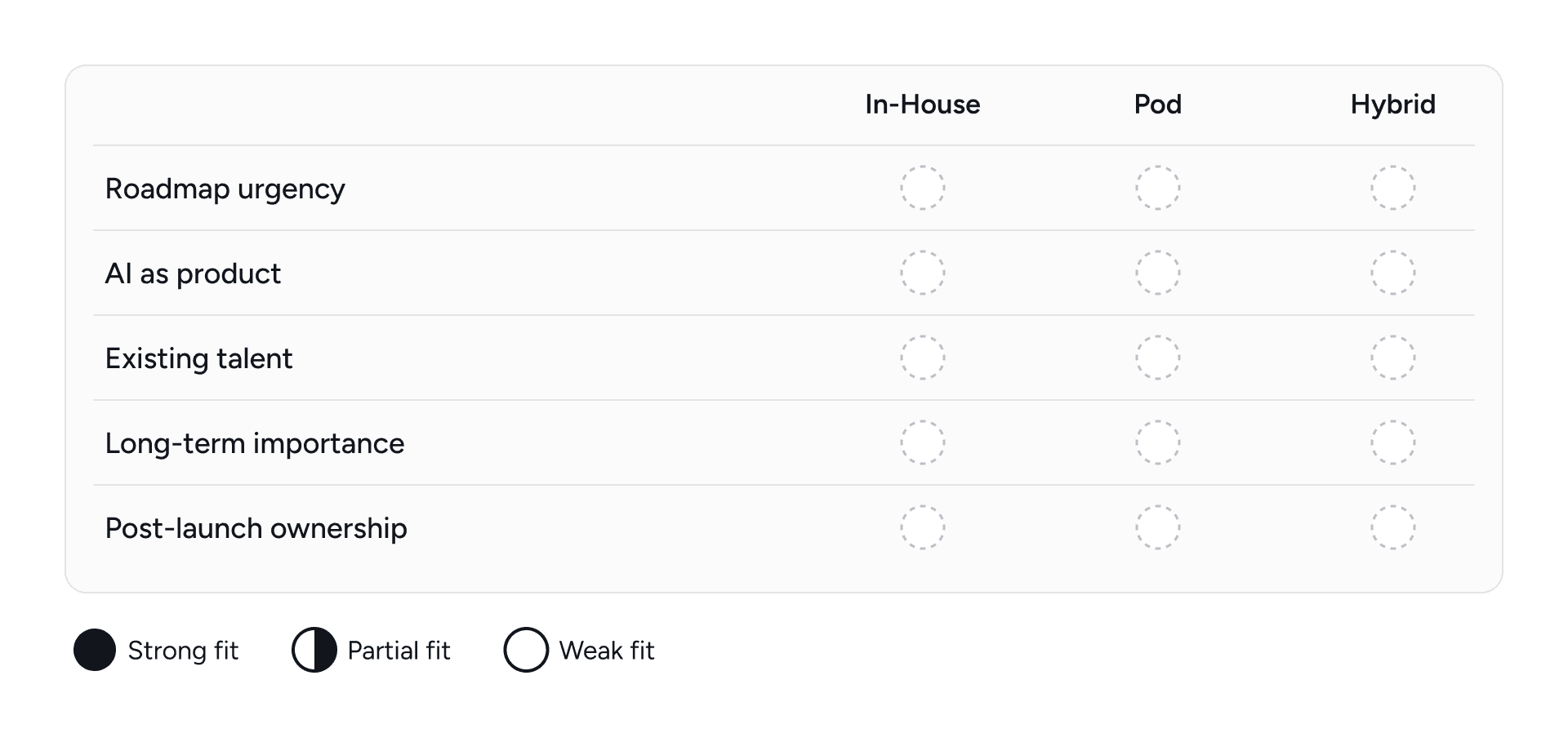
This is the decision the whole article has been building toward, reduced to five questions you can answer in a single sitting. Work through them in order, and the pattern of your answers will point clearly toward in-house, a pod, or a hybrid.
Q1. When does the funded roadmap actually have to be live and earning?
Set that date against a realistic hiring timeline of several months per specialist. If production has to arrive first, a pod or a hybrid gets you there while you recruit. If the date has real slack, an in-house build can meet it without outside help.
Q2. Is AI the thing customers pay for, or the thing that makes it work better?
When AI is the product itself, the capability is worth owning outright and keeping in-house. When AI improves a product that sells on other strengths, external delivery carries far less strategic risk and frees your team for the parts that differentiate you.
Q3. Which of the disciplines a production build needs do you already employ?
List product, data, ML, MLOps, evaluation, and security against your current team. One or two gaps you can hire into over time. Three or more missing at once is a signal to bring in a pod that arrives with all of them rather than recruiting each in sequence.
Q4. Will this capability still be central to the business in three years?
If the answer is a confident yes and the workload stays heavy, internal investment pays back. If the need is one intense phase followed by lighter maintenance, buy capacity you can scale down instead of headcount you have to keep paying.
Q5. After launch, whose responsibility is it to run and improve the system?
If the answer is your own team, then ownership, pairing, and knowledge transfer have to be written into the engagement from day one, whoever builds it. If a provider will keep running it long-term, weigh how easily you could take it back before you commit.
A lean toward in-house on most questions favors building the team internally, a lean toward external favors a dedicated product engineering pod, and a genuine split across the five points is the clearest signal that a hybrid model fits your situation.
How do you Structure a Product Engineering Pod Without Creating Vendor Dependency?
The risk buyers worry about is handing control to a provider they cannot replace. That risk stays manageable when ownership and knowledge transfer are built into the engagement from the start rather than negotiated at the exit.
Structure the engagement so control stays with the company. Require stable named team members, keep repositories, cloud and model accounts, secrets, and production credentials under client control, and schedule knowledge transfer as a milestone rather than a final-week task.
Use the checklist below when scoping the engagement.
Vendor-dependency controls |
How Does a Funded Roadmap Move From Plan to AI in Production? A Three-Stage Operating Model
The choice between a dedicated product engineering pod and in-house AI team is not fixed for the life of the roadmap. This section lays out a three-stage model that changes the balance as the work matures, so external capacity is heaviest when you need it and internal ownership grows as the system becomes core.
Across all three stages, internal leadership stays in charge of direction while the pod's involvement rises and falls with the work in front of it. The stages run in order, and each one has a clear exit before the next begins.
Stage 1: Validate the Approach Before Scaling Spend
The first stage exists to remove uncertainty cheaply, before larger investment is committed. Internal leadership and the pod work together to prove the idea is sound on the terms that matter to the business.
They agree on:
- The architecture
- The evaluation criteria
- The business metrics
- The data it can use
- The constraints production will impose.
The output is a tested baseline the team can measure everything else against, which matters because Gartner expects more than 40% of agentic AI projects to be canceled by the end of 2027 on unclear value and weak controls. A validated baseline is how you avoid becoming one of them.
Stage 2: Productionize With Capacity, Controls, and Monitoring
Once the approach holds up, the work shifts to making it dependable at scale. This is the heaviest stage for the pod, because integration and reliability absorb the most effort.
The team adds deployment automation, security, monitoring, evaluation gates, incident procedures, and governance.
Capacity expands here so the roadmap keeps moving while these layers go in, and the internal team stays close to every decision that will later be theirs to run.
Stage 3: Institutionalize Ownership Inside the Company
As the system proves its value, ownership moves inward. Capabilities that turn out to be strategically important belong with employees who will maintain and extend them for the long term.
External specialists stay only where demand is occasional or highly specialized, so you keep flexible access without carrying a permanent cost for work that appears in bursts.
Why Should You Consider GeekyAnts for a Dedicated AI Product Engineering Pod?
The most useful way to read any provider, GeekyAnts included, is against the standard this article has already set.
GeekyAnts works as an AI-Powered Digital Product Engineering and Consulting company, with more than 20 years of product engineering behind it. Its reported track record includes over 1,000 products shipped, more than 200 of them AI products since 2020, and over 550 client engagements.
Delivering inside client environments has pushed GeekyAnts engineers to work more like consultants, watching how a team actually operates, questioning assumptions early, tying technical choices to business outcomes, and staying close enough to production to learn from what happens after launch.
Its pods are built on that basis, embedding senior engineers, technical leads, and QA into the client's stack and processes. GeekyAnts runs dedicated product engineering pods that combine product strategy, AI engineering, full-stack development, MLOps, QA, and security under one delivery owner, so a funded team moves from roadmap to production while control stays in-house.
None of that makes GeekyAnts the automatic answer. Apply the same test recommended throughout this article: inspect the people proposed, ask for production evidence near your use case, set measurable acceptance criteria, keep ownership internal, and put knowledge transfer and exit into the contract.
A provider comfortable with that scrutiny is worth shortlisting.
We stopped calling ourselves an engineering vendor years ago, because the projects that succeed need something different. Our engineers sit close to the customer's work, challenge the brief when it needs it, and stay accountable after go-live. Twenty years of shipping products taught us the model is the easy part. Owning the outcome in production is the job.
 Kumar PratikFounder & CEO
So Which Model Should You Choose After Funding?
The choice isn’t black and white.
- See what works with your roadmap and the team you have built.
- Create your own internal team for artificial intelligence if AI is fundamental to your product.
- Hire a dedicated product engineering pod if your roadmap is evolving faster than you can hire people.
- Operate a hybrid if the above is true, with strategy, data and governance managed internally, while the pod provides the capacity to develop and deploy the product.
Ultimately, choose based on what it will cost to get to a production-ready outcome.