

Key Takeaways
- AI investment platforms combine market predictions, behavioral personalization, and advisor decision-support to improve investor retention and reduce operating costs.
- Real-time portfolio strategies that adapt to investor behavior and market conditions replace fixed portfolio models.
- Regulatory readiness and transparent AI decision-making must be built into the platform from the first version, not added after launch.
- Building an AI investment platform requires a structured process spanning data infrastructure, model development, compliance integration, and continuous improvement.
The global robo-advisory market was valued at USD 6.61 billion in 2023 and is projected to reach USD 41.83 billion by 2030, growing at a 30.5% compound annual rate, according to Grand View Research. IMARC Group places the 2025 figure at USD 14.7 billion, with projections reaching USD 95.6 billion by 2034. The trajectory is not a forecast anymore. It is an active shift in how wealth management firms compete, retain clients, and build digital infrastructure.
The shift is underway at major financial institutions. Fintech firms are building AI-powered advisor tools, personalization features, and decision-support systems while keeping human advisors central to the client relationship. A 2025 McKinsey report found that AI tools could improve advisor productivity by 25% to 40% over time. Close to 80% of affluent households still prefer a human relationship for financial advice. That means the AI investment platforms firms build must support advisors, not attempt to replace them.
This guide is written for VPs of Engineering, Heads of Digital Transformation, and product leaders at wealth management firms, banks, and fintech companies. The sections ahead cover how to plan, build, and scale an AI financial advisor platform, from data infrastructure and compliance to predictive analytics, personalization, and development costs.
Wealth management firms come to us at two different points. Some come early, with a clear product vision and a team ready to build. Others come after a failed attempt, carrying technical debt, compliance gaps, and a board asking why the platform is not live yet. The ones who come early ship in months. The others spend that same time undoing decisions they made in a hurry.
 Kunal KumarChief Revenue Officer
Across 50+ fintech engagements, the pattern is consistent: firms that treat compliance and AI as design inputs ship faster, retain investors longer, and spend less fixing what they rushed past. GeekyAnts has seen this directly, from building real-time trading platforms to digital wealth apps with personalized portfolio tools and risk analysis. The infrastructure decisions made in the first sprint determine how much the platform costs to maintain, scale, and keep compliant two years after launch.
Why Are Traditional Robo-Advisors Falling Short of What Modern AI Investment Platforms Can Deliver?
A traditional robo-advisor collects investor preferences, assigns a standard portfolio, and rebalances on a fixed schedule. That process has not changed materially since these platforms first entered the market. The problem is that the expectations of investors, advisors, and business leaders have changed.
Investors want an experience built around their individual goals, not a pre-built portfolio structure that treats every user the same. Advisors want clear, useful information inside the platform rather than being forced to work across disconnected systems. Product and engineering leaders want a platform that scales without requiring proportional growth in team size.
AI investment platforms are designed to meet those expectations. They study investor behavior, monitor market conditions in real time, and adjust portfolios based on current data. They bring advisors into the product experience with suggested actions, risk summaries, and investor-specific context. Compliance is built in from the first version, not layered on post-launch.
Comparison Table:
Aspect | Traditional Robo-Advisor | AI Investment Platform |
|---|---|---|
Learning ability | Runs on fixed rules and does not improve after launch. | Studies investor actions and market results to improve over time. |
Investor experience | Every investor receives the same portfolio structure and journey. | Each investor receives a different experience based on goals, behavior, and preferences. |
Role of the advisor | Advisors have limited visibility into what the platform is doing for each investor. | Advisors see investor-specific summaries, risk updates, and suggested next steps. |
Business growth | Serving more investors requires a matching increase in manual work. | The platform supports more investors without the same increase in team size. |
Compliance | Compliance reviews happen after the product is built, causing delays. | Compliance rules are part of the platform from the first version. |
Advisor workflow | Advisors work outside the system or with limited platform intelligence. | Advisor copilots surface investor-specific summaries, risk signals, and suggested next actions. |
What Business Outcomes Should an AI Investment Platform Deliver?
Before selecting a technology approach or AI development partner, business leaders need to define what the platform must achieve for the organization. Capabilities matter, but they are only useful when they connect to measurable outcomes. For firms investing in AI portfolio management, these outcomes are what separate a useful product feature from a defensible platform investment.
Faster investor onboarding is among the first. A platform that uses AI to pre-fill profiles, assess risk tolerance, and suggest starting portfolios can cut the setup process from days to minutes. For digital platform leaders, that is a direct measure of product performance at its first interaction with an investor.
Higher digital engagement follows. When the platform delivers personalized insights, timely alerts, and relevant updates, investors return at a higher rate. That frequency signals that the product delivers ongoing value rather than acting as a one-time setup tool.
Investor retention depends on the platform demonstrating that it understands individual goals and adjusts to changing circumstances. AI portfolio management tools that learn from behavior build trust that static platforms cannot match. That trust is what keeps investors from moving to a competitor.
Improved advisor productivity results from the platform handling data gathering, portfolio tracking, and routine reviews. Those hours shift toward high-value conversations with clients rather than administrative work.
Lower cost to serve each investor is the business model outcome. The AI financial advisor platform automates tasks that would otherwise require manual effort, which means growth does not require proportional growth in team size. For engineering and product leaders, this is the metric that makes platform investment defensible at the board level.
ICP Alignment Table:
Role | Primary Outcome to Prioritize |
|---|---|
VP of Engineering | A platform that scales with demand, is maintainable, and allows the team to ship improvements at pace. |
VP of Digital Platforms | A modern product foundation that supports new features without rework as investor volume grows. |
Head of Digital Transformation | A clear path from current operations to a digital model that drives adoption across the business. |
How Do You Build an AI Investment Platform? A Step-by-Step Development Process
The biggest mistake firms make is focusing on the AI model before defining the investment workflow it is supposed to support. Many teams jump into recommendation engines, LLM copilots, or signal generation before deciding who the user is, what decisions the AI should influence, how much autonomy it should have, and how those decisions fit inside a regulated advisory process.
 Jani Hardik SanjayProduct Owner I
Building an AI investment software platform is not a single-phase project. It is a multi-stage process spanning research, design, engineering, compliance, and continuous improvement. The steps below outline the path from initial planning to post-launch operations.
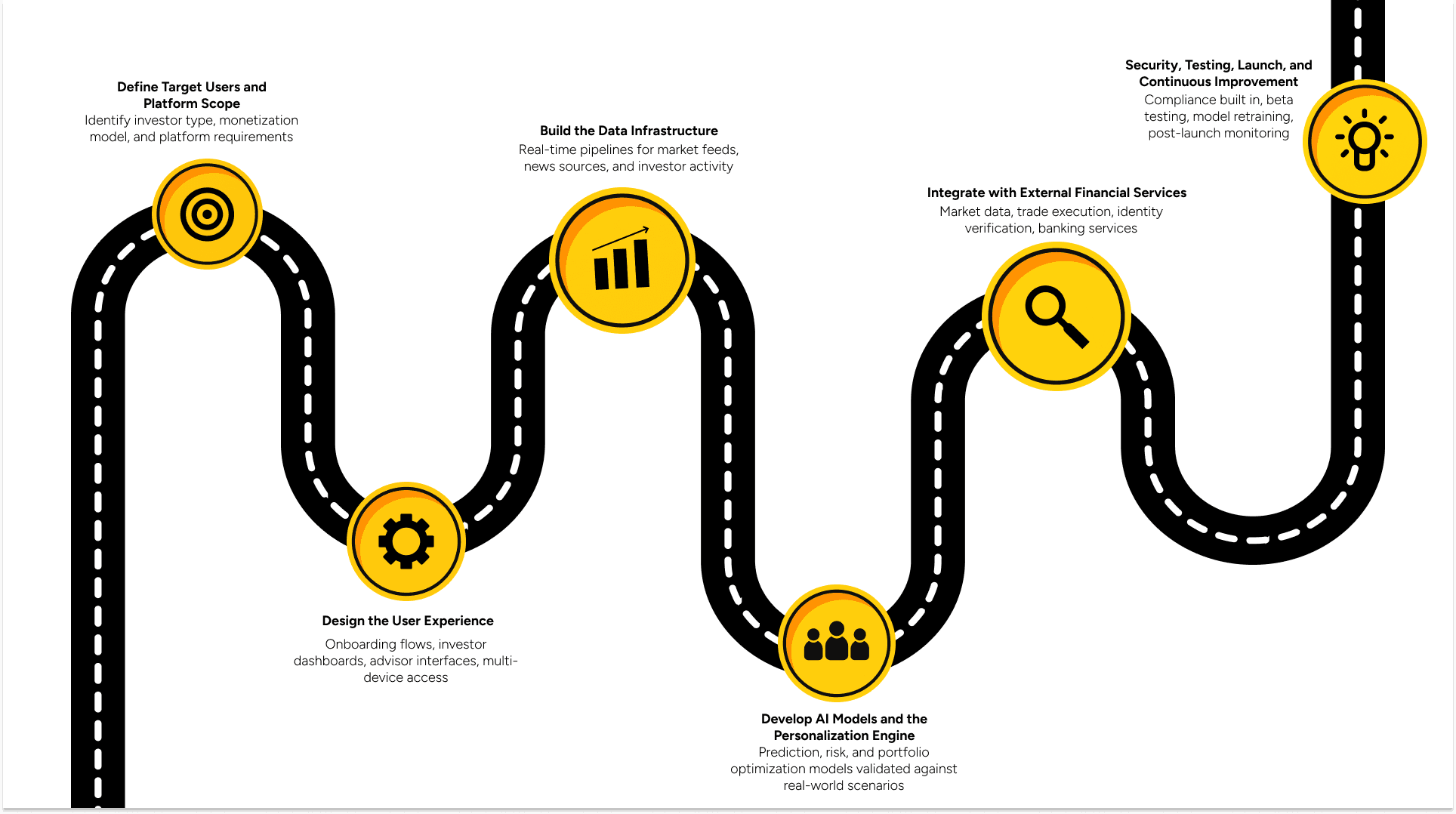
Step 1: Define Target Users and Platform Scope
The first step is identifying who the platform serves: retail investors, high-net-worth individuals, or institutional clients. Each category carries different expectations for personalization, reporting, compliance requirements, and advisor involvement. This stage includes market research, competitive analysis, and defining the monetization model. The output is a requirements document that guides every decision that follows.
Step 2: Design the User Experience
The platform must feel trustworthy and clear for both investors and advisors. This stage covers onboarding flows, investor dashboards, advisor interfaces, portfolio views, and alert systems. Design decisions at this stage must account for multi-device access and role-specific views. Complex financial information needs to be readable and actionable for every user type defined in Step 1.
Step 3: Build the Data Infrastructure
The platform's intelligence depends on the quality and speed of its data. This stage involves building pipelines that collect, clean, and organize data from market feeds, news sources, investor activity, and economic reports. Real-time processing is required so the platform can respond to market changes as they happen, not at the end of the day.
Step 4: Develop AI Models and the Personalization Engine
This stage covers the development and training of prediction models, risk models, and portfolio optimization models using historical and current data. Each model is validated against real-world scenarios before connecting to the platform. In parallel, the personalization engine is built to connect investor data, behavioral history, and model outputs into investor-specific experiences. This is the layer that separates an AI investment platform from a standard rule-based system.
Step 5: Integrate with External Financial Services
The platform must connect with external services to function. The table below maps the core integration categories to their role in the platform.
Integration Category | Provider Examples | Role in the Platform |
|---|---|---|
Market Data | Alpha Vantage, IEX Cloud, Bloomberg API | Provides real-time and historical market prices, indices, and commodity data. |
Trade Execution | Interactive Brokers API, Alpaca API | Enables automated buying and selling of assets through brokerage connections. |
Identity Verification | Trulioo, Onfido, Jumio | Supports KYC and AML compliance through identity verification at onboarding. |
Banking Services | Plaid, Yodlee, Open Banking APIs | Facilitates secure access to banking accounts, account information, and fund transfers. |
Step 6: Security, Testing, Launch, and Continuous Improvement
The regulatory requirements outlined in the compliance section are built into the platform during development, not added as a final checkpoint. Functional testing, performance testing, security audits, and compliance validation run before launch. A closed beta with a representative group of investors and advisors provides usability feedback. After launch, the platform requires ongoing monitoring of model accuracy, investor engagement, and regulatory updates. AI models are retrained on a scheduled basis to prevent performance degradation. New features and updated compliance measures are added based on real usage data and advisor input.
A production-grade AI investment platform typically takes eight to fourteen months to move from architecture to launch. The longest delays usually come from governance validation, advisor workflow testing, compliance reviews, and controlled production rollouts rather than model development itself.
Platforms that require major rework after launch often lack operational discipline in the early stages. Common issues include hardcoded business rules, weak audit trails, delayed observability planning, and governance layers added after development instead of during architecture design.
What Are the Core Components of an AI Investment Platform?
An AI investment platform is built on five connected layers. Each layer handles a distinct part of the investor and advisor experience.
The Data Layer
This layer collects and organizes the information the platform needs to function. It pulls in market prices for stocks, funds, and digital assets, alongside non-traditional sources such as news coverage, public sentiment, and environmental and social responsibility ratings. Data must be received and processed in real time.
The Prediction and Analysis Layer
This layer turns collected data into patterns and signals the platform can act on, including projected market movement, portfolio risk levels, and optimal investment distribution for a given investor's goals. This is what distinguishes an AI investment platform from a standard robo-advisor.
The Personalization Layer
This layer ensures no two investors receive the same experience. It evaluates risk tolerance, tracks behavioral patterns, and adjusts recommendations based on those inputs. The result is a portfolio that reflects the individual investor, not a template.
The Execution Layer
This layer connects the platform to the financial systems where transactions happen. It handles buying and selling of assets, connects with brokerage services, and manages the timing and logic behind portfolio adjustments.
The Investor Experience Layer
This is the part of the platform that investors and advisors interact with. It includes dashboards showing portfolio performance, alerts flagging material changes, and clear explanations for why the platform took a specific action. Investor trust in AI portfolio management depends on the quality of this layer.
How Do AI Investment Platforms Turn Predictions Into Personalized Portfolio Insights?
According to Grand View Research, the predictive analytics market was valued at USD 18.89 billion in 2024 and is projected to reach USD 82.35 billion by 2030. In wealth management, 91% of asset managers are using or planning to use AI in their investment strategy and research, according to IntellectAI. Predictive analytics in finance is no longer an experimental capability. It is a baseline requirement for firms building production-grade AI investment platforms.
The value of predictive analytics lies in moving the platform from analyzing what happened to anticipating what is about to happen. The platform reads pricing data, news coverage, economic reports, and public sentiment signals together to identify the direction markets are moving. Risk forecasting assigns probability-weighted loss estimates to portfolio positions, surfacing that information to advisors before damage occurs. Scenario modeling projects how a portfolio would perform under different conditions, allowing investors and advisors to compare outcomes and select the path that fits stated goals.
A prediction has no business value unless it leads to a decision. The platform converts each prediction into a defined next step, whether that means redistributing assets, reducing exposure in a declining category, or restructuring a portfolio around updated goals. This conversion from signal to action is where predictive analytics in finance delivers its highest return.
The gap between a prediction and a personalized investor response is where most platforms fall short. That gap is closed by the intelligence loop, a six-stage cycle that connects every layer of the platform.
The Intelligence Loop: How It Works
The cycle begins with data collection, where the platform gathers market prices, investor activity, news feeds, and economic reports. It moves into pattern recognition, identifying shifts in market direction, changes in investor behavior, or growing risk in a specific sector.
The third stage is insight generation. The platform converts patterns into investor-specific findings. Two investors holding the same position may receive different findings based on their individual goals and risk tolerance. The same market signal produces two different outputs for two different investors.
That finding moves into the action stage. One investor may receive a recommendation to redistribute across stronger categories. Another may receive confirmation that their current position remains aligned with their goals. Advisors receive the context needed to guide the conversation in either case.
After the action is taken, the platform enters the feedback stage, recording whether the portfolio performed as projected, whether the investor accepted the recommendation, and whether the advisor modified it before acting. The final stage is refinement: the platform feeds the recorded result back into the cycle so future recommendations for that investor are sharper.
Adaptive Learning Over Time
The intelligence loop does not produce the same output quality on day one as it does after thousands of completed cycles. Each cycle builds a more detailed profile of each investor's preferences, decision patterns, and responses to different recommendation types. The platform learns which investors accept changes during periods of instability and which prefer to hold. Over time, the longer an investor stays on the platform, the more precisely tailored their experience becomes.
For business leaders, this has a direct impact on two outcomes from the previous section: investor retention and cost to serve. A platform that improves with every interaction gives investors a reason to stay and reduces the manual effort required to serve each one.
What AI Models Power a Modern AI Investment Platform?
An AI investment platform uses four categories of models, each responsible for a specific function.
Machine learning models (regression, clustering) analyze historical market data and investor behavior to find patterns. Regression models project how investments may perform based on past trends. Clustering models group investors with similar profiles so the platform can tailor recommendations to each group.
Deep learning models (LSTM, transformers) analyze data that changes over time, such as stock prices and interest rates. LSTM models study the order and timing of past events to project what is ahead. Transformer models process large data volumes and identify connections across multiple time periods.
Reinforcement learning models test different portfolio structures, evaluate multiple distribution options, and select the configuration that produces the best projected outcome for the investor's stated goals. The model improves with each completed cycle.
NLP models for sentiment analysis read and interpret text from news articles, financial reports, and social media. They assess whether the tone of that information is positive, negative, or neutral for a given company or sector, allowing the platform to factor public sentiment into its recommendations.
For engineering leaders evaluating model priorities, the decision depends on the platform's primary function. A production-ready AI investment platform will use all four categories in coordination.
How Should AI Investment Platforms Handle Regulatory Compliance, Security, and AI Governance?
In AI investment platforms, compliance, security, and governance are not release-stage activities. They are product architecture decisions. Firms that delay governance until the end usually slow themselves down later through rework, approval bottlenecks, and loss of investor trust.
Jani Hardik SanjayProduct Owner IFor any firm building an AI investment platform, compliance, security, explainability, and governance are design principles, not post-launch additions. Firms that treat them as a final checklist face rework, regulatory scrutiny, and loss of investor confidence.
The SEC's 2026 Examination Priorities, published in November 2025, made AI a primary focus area for investment advisors and broker-dealers. Examiners are reviewing how firms evaluate AI tools before deployment, how they monitor AI-generated outputs, and whether they document human oversight over AI-driven decisions. FINRA's 2026 Annual Regulatory Oversight Report requires firms to move from experimentation to formal governance, with documented approval for each AI use case and human validation for any investor-facing output.
KYC, AML, and Investor Identity Verification
Every AI investment platform must run Know Your Customer (KYC) and Anti-Money Laundering (AML) checks before granting platform access. AI strengthens both processes by cross-referencing multiple databases at the point of verification, detecting inconsistencies faster than manual review, and monitoring accounts continuously for unusual transaction patterns. These workflows must be built into the onboarding flow from the first release.
SEC Compliance Requirements
The SEC expects any firm using AI in portfolio management, trading, or investor communications to maintain written policies describing how the AI is used, how it is monitored, and how decisions are disclosed. The 2026 priorities confirm that examiners will test whether firms can explain how their AI reached a specific decision. Firms with assets under management below USD 1.5 billion must comply with updated Regulation S-P requirements by June 3, 2026, covering vendor review, breach notification, and recordkeeping for any AI vendor handling investor data.
FINRA Guidelines
FINRA Rule 3110 requires firms to establish supervisory procedures covering AI tools the same way they cover any other part of the business. The 2026 report specifies that firms must maintain logs of AI inputs and outputs, track version changes, control access for both human and automated accounts, and define human checkpoints before any AI-generated action is executed. Platforms that use AI to generate investor-facing communications must treat those communications as regulated content subject to the same review standards as any investor correspondence.
Data Privacy, Encryption, and Security
Platforms serving investors across multiple regions must account for overlapping data privacy laws. The California Consumer Privacy Act (CCPA) gives investors the right to know what personal data is collected, request its deletion, and opt out of its sale. GDPR applies to any platform handling data from European investors, even if the platform operates from the US. Both laws require clear consent before data collection and investor access to their own information on request.
At the infrastructure level, all data must be encrypted in transit and at rest. Role-based access controls must limit who can view investor information, and detailed logs of every access event must be maintained. The SEC and FINRA expect firms to demonstrate that security measures cover AI-specific risks, including unauthorized access to models and the data they process.
Explainability and AI Governance
When the platform recommends a portfolio change or flags a risk, both the investor and the advisor must be able to understand why. Regulators expect the same. The SEC's 2026 priorities state that examiners will ask firms to explain the logic behind AI-driven decisions affecting retail investors. Explainability must be designed into the system so that every recommendation traces back to the data and logic that produced it.
AI governance is the framework that ties compliance, security, and explainability together. It defines who owns each AI use case, how new use cases are approved, how models are tested, and how human oversight is maintained. FINRA's 2026 report recommends formal AI governance programs with clear ownership across business, compliance, technology, and risk teams. For platform builders, governance is a product requirement that shapes how the platform is designed, built, and operated.
Across wealth management and fintech, trust remains the deciding factor for AI adoption. Advisors and investors may be interested in AI-powered recommendations, but production adoption only happens when firms can explain how decisions are generated, monitored, and reviewed through human oversight.
What Features Should a Modern AI Investment Platform Include?
- Automated portfolio management: Handles portfolio adjustments without requiring manual input from the advisor or investor.
- Goal-based investing: Lets investors set targets such as retirement or home ownership, with portfolios aligned to each goal.
- Tax optimization: Identifies opportunities to offset gains by selling underperforming positions.
- Risk alerts: Continuously monitors conditions and notifies investors and advisors about shifts that could affect portfolio performance.
- AI-powered insights: Generates investor-specific findings based on market data and behavioral patterns through investor and advisor dashboards.
- Multi-device access: Delivers a consistent experience across desktop, mobile, and tablet.
What Technology Stack Powers an AI Investment Platform?
The technology behind an AI investment platform spans four core layers.
Layer | Technology Options | Role in the Platform |
|---|---|---|
Frontend | React, Angular, Vue.js, Flutter | Builds investor dashboards, advisor interfaces, and cross-platform mobile applications. |
Backend | Handles server-side logic, data processing, and integration with external financial services. | |
AI and Machine Learning | TensorFlow, PyTorch, Scikit-Learn | Builds and trains the prediction, personalization, and risk models powering the platform. |
Database | PostgreSQL, MongoDB, MySQL | PostgreSQL and MySQL handle structured financial data. MongoDB handles unstructured investor data. |
Data Streaming and Storage | Kafka, Snowflake | Kafka handles real-time data streaming. Snowflake stores and organizes large volumes of historical and current data. |
AWS, Microsoft Azure, Google Cloud Platform (GCP) | Provides scalable compute, storage, networking, deployment pipelines, and disaster recovery support. | |
Security | OAuth 2.0, JWT, Auth0, Okta, AES-256 Encryption | Secures authentication, authorization, investor data protection, and compliance requirements. |
Third-Party APIs | Plaid, Alpaca, Stripe, Bloomberg API, Yahoo Finance API | Enables integrations for banking, trading, payments, and real-time market data access. |
The choice of tech stack depends on platform scale, team capabilities, and the compliance requirements outlined in the regulatory section. The right stack reduces development time and keeps the platform maintainable as investor volume and features expand.
How Much Does It Cost to Build an AI Investment Platform?
The cost depends on several factors: the sourcing model (in-house versus outsourced), platform type (web, mobile, or both), scope of AI capabilities, number of user roles, performance targets, number of integrations, third-party service fees, and the level of compliance and security required.
Development Stage | Estimated Cost Range | What It Covers |
|---|---|---|
Research and planning | USD 15,000-40,000 | Market research, competitive analysis, investor persona definition, and requirements documentation. |
USD 20,000-60,000 | Design of investor dashboards, advisor interfaces, onboarding flows, and mobile screens. | |
Frontend development | USD 40,000-120,000 | Development of web and mobile interfaces for investors and advisors. |
Backend development | USD 60,000-180,000 | Server-side logic, database setup, API development, and integration with financial data services. |
USD 80,000-180,000 | Building and training prediction, personalization, and risk models. | |
Security and compliance | USD 30,000-100,000 | Encryption, access controls, KYC/AML workflows, and SEC/FINRA compliance implementation. |
USD 20,000-70,000 | Functional, performance, security, and regulatory compliance validation. | |
USD 5,000-40,000 annually | Ongoing infrastructure costs based on platform scale and data volume. |
Most cost overruns in AI investment platform development come from production infrastructure rather than model creation. Data engineering, governance workflows, observability, compliance operations, market data licensing, and integration layers often become the largest long-term expenses.
The total cost varies by platform complexity:
- Basic platform: USD 150,000-300,000
- Mid-range platform: USD 400,000-900,000
- Enterprise-grade platform: USD 1M-3M+
Generative AI features introduce additional operational costs through prompt governance, hallucination testing, retrieval tuning, and continuous evaluation. In practice, firms are not only funding AI development; they are funding a regulated digital product ecosystem with ongoing operational responsibilities.
What Are the Biggest Challenges in Building an AI Investment Platform?
Data quality is the first. AI models produce outputs based on the data they are trained on. Incomplete, outdated, or biased data produces flawed recommendations. Maintaining clean, current data requires validation and update processes that run throughout the life of the platform.
Model drift is a persistent risk. AI models lose accuracy over time as market conditions and investor behavior change. Without a scheduled process to evaluate and retrain models, platform recommendations fall out of alignment with current conditions.
Regulatory risk grows with each annual examination cycle. The SEC and FINRA expand their expectations every year. Firms must track new priorities and update their platforms accordingly to avoid penalties or delayed launches.
Trust and transparency affect adoption rates. When the platform operates as a black box where recommendations appear without explanation, investors and advisors pull back. Building visible, traceable decision-making at every level is a product requirement, not an optional design choice.
Advisor adoption determines whether the platform delivers its full business value. Advisors need training, workflow integration, and confidence in platform output before they incorporate it into their daily practice. A platform that feels disconnected from how advisors already work faces resistance regardless of how capable the underlying models are.
Why Choose GeekyAnts as Your AI Investment Platform Development Partner?
We have spent nearly two decades watching firms treat the gap between prototype and production as a minor engineering problem. In wealth management, that gap is where platforms fail, where compliance breaks down, and where investor trust is lost before it is ever built. What we bring to AI investment platform development is not just engineering capability. It is the discipline to build systems that hold up after launch, not just before it.
 Kumar PratikFounder & CEO
GeekyAnts has delivered 50+ fintech projects across trading platforms, digital wealth apps, and payments infrastructure handling 400 million transactions annually. Across those engagements, the firms that scaled fastest were not the ones with the most features at launch. They were the ones whose data infrastructure, compliance workflows, and AI models were built to production standards from the first sprint.
GeekyAnts was founded in 2006 and has completed 550+ client engagements across 50+ industries, with teams in India, the UK, and the USA. The company has been ranked in the Top 15 for AI and software development by TopDevelopers.co and has maintained partnerships with multiple clients for more than five years.
For firms building an AI investment platform, GeekyAnts maps its core capabilities directly to the challenges covered in this guide.
Challenge from This Guide | GeekyAnts Capability | Proven Result |
|---|---|---|
Building AI models for prediction, risk, and personalization at production scale | 99% reduction in manual effort and 85%+ accuracy in AI-driven processing. | |
Moving from prototype to production-grade platform within a defined timeline | 6-8 week sprint covering architecture, AI integration, testing, and launch. | |
Modernizing legacy systems that cannot support real-time data processing | 50% cloud cost reduction and zero unplanned downtime during migration. | |
Building interfaces that make AI decisions transparent and trustworthy | Transparency-first design practice for AI-driven dashboards and workflows. | |
Handling high-volume data pipelines, API integrations, and security at scale | Architectures supporting 5M+ daily users with 60% lower infrastructure costs. |
Conclusion
The firms that treat AI as a design principle across prediction, personalization, compliance, and advisor support will be the ones that retain investors, reduce operating costs, and scale their platforms. The steps, components, and strategies in this guide provide a clear path for product and engineering leaders ready to build.
Sources & Citations:
- https://www.grandviewresearch.com/industry-analysis/robo-advisory-market-report
- https://www.researchandmarkets.com/reports/5766552/robo-advisory-market-report
- https://www.mckinsey.com/industries/financial-services/our-insights/how-ai-could-reshape-the-economics-of-the-asset-management-industry
- https://www.mckinsey.com/industries/financial-services/our-insights/the-signal-in-the-sell-off-wealth-managements-value-in-the-ai-era
- https://www.grandviewresearch.com/industry-analysis/predictive-analytics-market
- https://www.mercer.com/insights/investments/portfolio-strategies/ai-in-investment-management-survey/
- https://www.sec.gov/about/reports-publications/2026-examination-priorities
- https://www.troutmanfinancialservices.com/2025/12/key-takeaways-from-finras-2026-annual-regulatory-oversight-report/