

Key Takeaways-
- Traditional methods make lending slow and still overlook risks. The real shift will come when banks treat AI, automation, and risk intelligence as core infrastructure rather than add-on tools.
- Automation clears routine checks in minutes, while AI runs stress tests and monitors borrowers in real time. This allows lenders to move approvals faster while keeping regulatory safeguards intact.
- Banks that adopt AI sooner gain smarter models, cleaner data, and stronger portfolios—building an advantage that slower adopters will find hard to match.
In the United States, corporate loan underwriting is a paradox: businesses seeking capital urgently face approval cycles that can stretch 30 to 60 days, while banks grapple with rising defaults and mounting compliance costs. With corporate loan volumes exceeding $2.7 trillion in 2023, the stakes have never been higher. Traditional systems, designed for stability, now act as bottlenecks in a market that demands speed, transparency, and precision. This blog explores why incremental fixes are no longer enough — and how AI, automation, and risk intelligence are reshaping underwriting for decision-makers who want efficiency, compliance, and better loan outcomes.
The real bottleneck in U.S. lending is not capital—it is outdated underwriting. Until banks treat AI and automation as core infrastructure, loan approvals will remain slow while risks slip through the cracks.
 Saurabh SahuChief Technology Officer (CTO)
The Broken State of Corporate Loan Underwriting in the U.S.
Corporate loan underwriting was designed to be a banking safety check. It is supposed to help lenders decide whether a company deserves the capital to grow, while keeping risk under control. On paper, the system looks solid. In practice, it feels stuck in another era.
Most teams are still buried in paperwork, flipping through balance sheets and outdated scoring models. The process drags, and every extra week makes lenders uneasy while borrowers watch opportunities disappear. What should build confidence often ends up creating frustration on both sides.
And then comes regulation. From Basel III to OCC oversight, the paperwork never ends. Some banks spend close to 10% of their operating budgets just to stay compliant. Even with all that effort, defaults keep climbing in certain sectors, which shows the system isn’t catching risks the way it should.
Meanwhile, fintech challengers are proving how different things could be. It relies on automation and fresh data sources to approve loans in days or hours. Traditional banks, tied down by legacy systems, can’t keep up. What was once a safeguard is now a bottleneck, and that reality has left lenders with a choice: keep patching a broken model, or rebuild it with AI, automation, and risk intelligence at the core.
AI as the Missing Piece in Corporate Loan Underwriting
Artificial intelligence is beginning to close the gaps that have long undermined corporate loan underwriting. For years, lenders have leaned on balance sheets, tax records, and a few financial ratios to make their calls. That worked in a slower economy, but today it leaves too much hidden. A business can look steady on paper yet show signs of stress in places the old models never check.
This is where AI makes a difference. Instead of stopping at the numbers on a balance sheet, AI systems can dig into the everyday signals a business leaves behind—its payment habits, activity with suppliers, or even the tone of news coverage around it. Put together, these details give lenders a far clearer view of a company’s health than a static spreadsheet ever could.
The real value lies in prediction. AI systems learn from thousands of past outcomes, spotting warning signs before it is visible to an underwriter. A sudden change in transaction patterns or a drop in market sentiment can serve as an early alarm. These signals allow lenders to act before problems turn into defaults.
For decision-makers, the impact is direct. Approvals move faster, portfolios hold up stronger, and risk teams spend less time reacting and more time planning. AI doesn’t eliminate uncertainty, but it gives banks the ability to stay ahead of it—and in today’s market, that’s the edge every lender needs.
Turning Data into Decisions: AI’s Workflow in Loan Underwriting.
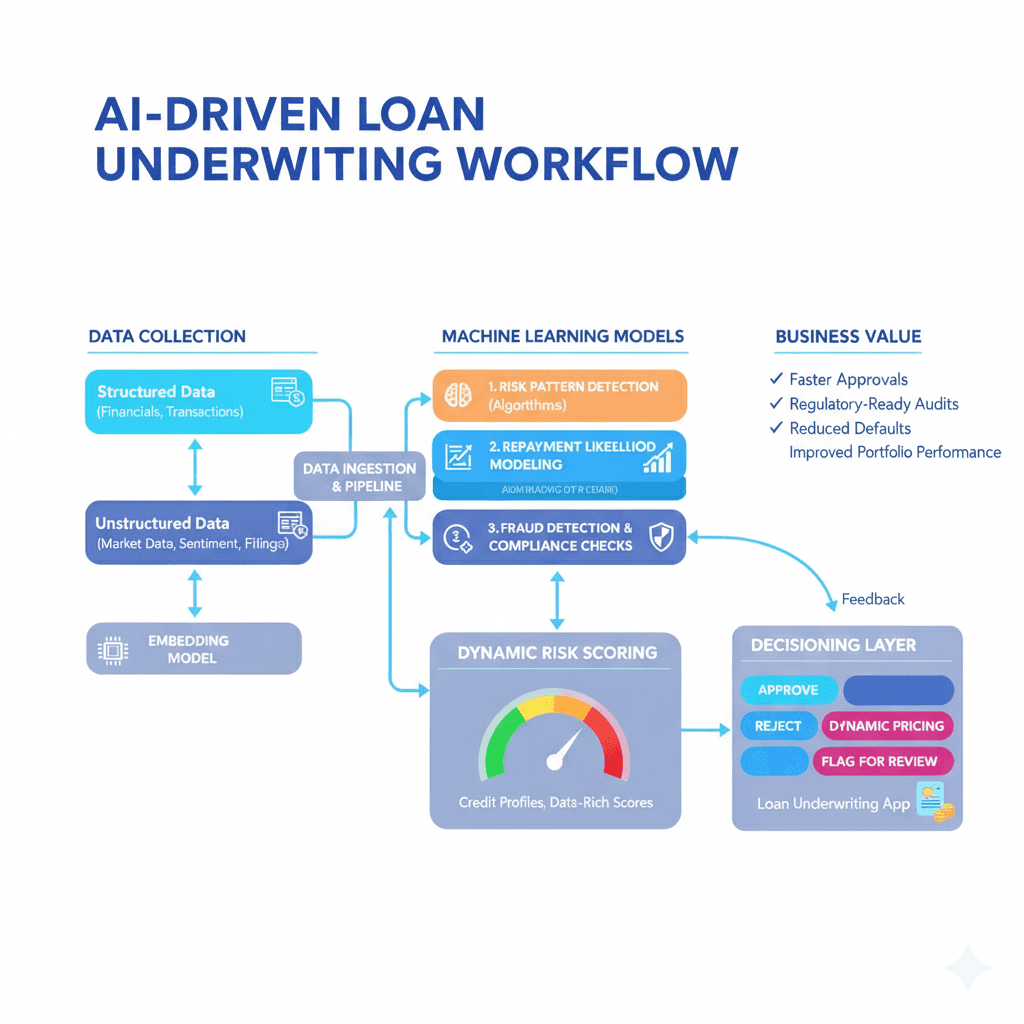
But how does this actually play out inside a bank? The process isn’t magic—it’s a series of steps that turn messy, raw data into lending decisions that executives can act on.
It begins with data collection. Traditional underwriting often stops at financial statements and tax returns. AI goes further. AI pulls from two kinds of information. On one side are the structured records—repayment history, account transactions, and other financial data. On the other are less formal but equally valuable sources: market reports, news coverage, and supply chain activity. Looking at both sets together gives lenders a view of the company as it stands today, not a picture frozen in last quarter’s files.
This information is funnelled through a data ingestion pipeline, where embedding models clean it up, standardize formats, and make it usable. Without this step, the variety of inputs would overwhelm any system. Once the data is organized, the real intelligence kicks in.
Machine learning models examine the patterns buried inside. Some are built to spot the early tremors of financial stress, others to project repayment capacity, and still others to run fraud and compliance checks. What a human analyst might miss in months of review, these models can surface in seconds.
The output flows into dynamic risk scoring. Unlike credit scores that freeze at a point in time, these scores move with the market. It reflects how a borrower looks today, not months ago.
Finally comes the decisioning layer. At this point, a loan can be greenlit, declined, priced more precisely, or flagged for extra scrutiny. And it happens in minutes, not weeks.
For banks, the benefits show up quickly. Banks notice the change in very practical ways. Approvals that once dragged now move quickly. Audits, while still necessary, don’t consume the same amount of effort. Defaults ease off, and portfolios begin to show more stability. What makes the system even stronger is its memory—each decision feeds the next, so the models keep improving over time.
Automation as a Driver of Modern Underwriting
Manual underwriting drains time and delays decisions, but automation shifts the focus. Banks can respond when clients need funds most, while keeping risk and compliance firmly in check
 Pushkar KumarPrincipal Technical Consultant.
The challenge with underwriting isn’t diligence—it’s speed. By the time the paperwork clears, the borrower’s circumstances may already look different,” explained a senior risk officer at a U.S. commercial bank. The mentioned fact is common in numerous lenders and explains the reason why the process of automation is being embraced at a rapid rate.
Routine checks, document verification, as well as compliance reviews and fraud screening are the main causes of delays in most banks. These measures must be made, and when attempted by hand, take weeks to accomplish. Each KYC/AML requirement adds another layer of friction. With automated document handling, the same checks finish in minutes. Staff are freed from chasing paper and can focus on judgment calls that actually need human expertise.
Automation also makes compliance stronger. KYC/AML systems match identities against global watchlists instantly, closing gaps that slip through manual reviews. Fraud detection tools catch irregular patterns as they happen, giving lenders a chance to intervene early. U.S. regulatory environment, banks are under pressure to be both fast and thorough—automation is one of the few ways to meet that standard.
Scalability is another clear advantage. Traditionally, more loan applications meant hiring more people. Automation breaks that link. With automation, banks can handle more loan files without stretching their teams thin. It also gives them room to test new lending products and to serve customer groups that were previously ignored because of cost. The effect is noticeable: the cost of each loan goes down, margins improve, and established banks have a better shot at standing up to fintechs that thrive on speed.
The Strategic Value of Risk Intelligence in Underwriting
Traditional credit scores record past repayment behavior but fail to warn about what may happen next. Risk intelligence fills that gap. Banks combine balance sheet data with signals from markets, supplier stability, sentiment shifts, and ESG reports. This mix gives lenders a live and realistic picture of a borrower’s resilience.
Banks conduct stress tests to avoid being caught off guard. Risk teams model the effect of higher interest rates, inflation, or sector slowdowns. These simulations expose weak spots in loan books before defaults spread, giving managers time to adjust terms and set aside capital.
Risk tools also trigger early alerts at the borrower level. A missed supplier payment or a surge of negative coverage can raise a flag before a loan turns risky. At the portfolio level, systems highlight industries—such as retail, logistics, or manufacturing—that face heavier exposure. Managers use those signals to rebalance in time.
Clearer visibility alters lending economics. Banks that make loans more transparent promote the pricing of loans more accurately, minimize bad performing assets and boost returns. The regulators also react in a good way, as the institutions are now able to show the real-time monitoring and future planning rather than using the dead records.
When banks connect AI, automation, and risk intelligence, the parts reinforce one another:
- AI collects and interprets signals.
- Automation executes reviews at scale and speed.
- Risk intelligence converts those results into a forward-looking strategy.
Together, the trio creates an underwriting process that works faster, manages risk earlier, and keeps portfolios steady under market pressure.
Comparison: Traditional vs AI-Powered Underwriting
This table shows how traditional underwriting methods lag behind AI-powered approaches across key underwriting dimensions.
Dimension | Traditional Methods | AI-Powered Methods |
|---|---|---|
Speed | Weeks to approve; paperwork delays | Instant or same-day decisions with automated workflows |
Accuracy | Reliance on past data; slower detection of risk | Real-time signals from varied sources catch risk early |
Compliance | Manual checks; prone to human error and oversight | Automated compliance with built-in checks reduces infractions |
Risk Management | Reacts after defaults appear | Predicts potential defaults; stress-tests portfolios beforehand |
Scalability | An increase in loan volume requires more staff | Scales without proportional hiring; handles volume with ease |
Cost Efficiency | High operational costs; inefficiencies persist | Lower cost per loan; fewer wasted resources |
Where AI and Automation Create Value in Underwriting
Lenders across banks, fintechs, and NBFCs now use AI and automation as everyday tools. The focus is on cutting delays, keeping checks accurate, and reducing compliance effort.
1. Automated Credit Scoring
Lenders mix financial records with live data streams to score borrowers. Banks push large loans through faster. Fintechs rely on it to handle high volumes of SME and retail credit.
2. Real-Time Document and Compliance Verification
Systems check KYC, AML, and documents on the spot. This cuts down errors and removes long manual reviews. Banks and NBFCs are relying on it to give loans fast and prevent compliance slip-ups.
3. Predictive Fraud Detection
AI Models scan payments and records for unusual behavior. Early warnings give lenders time to act before problems spread. Fintechs benefit when processing small loans in bulk, while banks apply it to stop large fraud cases.
4. Dynamic Risk Pricing
Loan terms shift in line with borrower risk. Banks use it to protect margins. Fintechs use it to compete with flexible pricing offers.
5. Loan Portfolio Monitoring & Optimization
Tools track loan books around the clock. Risk managers move away from weak sectors before defaults pile up, keeping portfolios balanced.
Barriers to Adopting AI and Automation in Loan Underwriting
U.S. banks face strict oversight. Regulators expect lenders to prove that automated decisions meet laws such as CCPA and GLBA. Supervisors also ask banks to show how models work and to explain why a loan was approved or declined.
AI bias is another concern. If models learn from flawed data, they can repeat those flaws. That creates the risk of unfair lending decisions. Banks reduce that risk only when they audit models and test outputs regularly.
Data privacy rules add weight. Every day, underwriting systems process sensitive borrower records. One violation will result in substantial fines, lawsuits and loss of trust particularly in states that have stringent privacy regulations.
Legacy systems slow adoption as well. Many banks still run on old cores. Adding AI to those setups means costly integration, retraining staff, and managing disruption. The gap between old and new systems makes full rollout harder.
These issues do not erase the value of new technology. They remind lenders to move with balance—pushing for speed while keeping governance and controls in place.
Data Governance and Implementation Best Practices
Banks handle borrowers' financial details, credit histories, and business records daily. Written procedures covering data gathering, storage limits, and usage boundaries must exist before anything else. Without these frameworks, lenders encounter regulatory violations and damaged reputations. Ongoing validation and external reviews ensure models remain transparent and follow requirements like CCPA and GLBA.
Success requires collaboration across departments. Risk teams understand loan exposure patterns, compliance staff maintain regulatory boundaries, and IT groups support operational systems. When these units work separately, problems emerge. Coordinated efforts make underwriting tools more dependable and easier to justify during examinations.
Outdated technology creates additional obstacles. Numerous American banks operate on systems from previous decades, and these platforms resist modification. Moving to internet-based solutions with connection protocols lets lenders add new capabilities rapidly, control expenses effectively, and respond to regulatory changes.
After deployment, models require continuous supervision. Economic conditions change, information patterns shift, and unfair treatment can develop. Refreshing algorithms, stress testing, and performance tracking maintain precision. Documented decision paths also help banks demonstrate to clients and authorities how conclusions are reached.
Moving ahead, building adaptable systems matters as much as solving current problems. Rate fluctuations, stricter regulations, and borrower pattern changes will persist. Institutions creating flexible frameworks now prevent expensive overhauls tomorrow and remain competitive against digital lenders already operating with greater speed.
The Road Ahead for Corporate Lending with AI
The next phase of corporate lending in the U.S. won't be defined by faster workflows alone—it will be shaped by lenders who treat AI as core infrastructure rather than a bolt-on tool. Predictive analytics will give banks portfolio-wide foresight, stress-testing industries against rate shifts or supply chain shocks before risk materializes. Advanced systems will expand beyond basic document handling to produce full regulatory filings and compliance documentation, tasks that now require substantial manual effort from specialized teams. Connected platforms will merge risk evaluation, regulatory verification, and operational workflows into unified processes, removing the departmental divisions that cause bottlenecks and extended approval times.
The competitive edge lies in timing. Institutions that start now will own cleaner data, smarter models, and underwriting systems that improve with every loan cycle. Those who wait to play catch-up in a market where speed, precision, and regulatory transparency are no longer optional is not shaping the future of underwriting—it is becoming the operating system of credit itself.
How GeekyAnts is Reshaping the Corporate Loan Underwriting
Banks across America need better underwriting systems, and GeekyAnts delivers them. We've spent nearly twenty years building financial software, and we know what works.
Our approach is straightforward: we create custom platforms that make loan decisions faster and more accurate. While other companies sell generic tools, we build solutions that fit your specific needs. Whether you're a regional bank or a national lender, we design systems that work with your existing processes.
Here's what we do differently:
We do not just automate paperwork. We build complete underwriting platforms that analyze risk, verify documents, and ensure compliance—all in one system. Our clients typically cut their approval times from weeks to days while reducing operational costs by 40-60%.
We understand banking regulations inside and out. Every system we build meets federal compliance requirements from day one. No shortcuts, no gaps, no regulatory headaches later.
We work with your team, not around them. Our engineers collaborate with your risk managers and compliance officers to create solutions that actually get used. No complicated installations that sit on the shelf.
Major banks trust us because we deliver results. Our platforms process millions of loan applications, and our clients consistently report better portfolio performance and lower default rates.
The lending industry is changing fast. Fintechs are winning business with speed, and regulators are demanding better oversight. You need technology partners who understand both sides of that challenge.
Ready to modernize your underwriting? Talk to our experts and see how we can build a system that gives you the competitive edge you need.
Conclusion
Corporate underwriting won’t fix itself. Manual reviews, legacy cores, and paperwork-heavy compliance slow lending and still miss risk. That gap costs revenue and invites surprises. The path forward is clear: build underwriting as a system—AI for signals and prediction, automation for clean execution, and risk intelligence for early warnings and portfolio control. Done well, lenders cut cycle time, price with precision, explain every decision, and spot trouble before it hits the P&L. Yes, hurdles remain: bias, privacy rules, legacy integration.
Banks beat them with tight data governance, joint ownership across risk–compliance–tech, cloud and APIs, and continuous testing with audit trails. Speed without control is a risk; control without speed is lost business. You need both. Early movers gain a compounding edge. Models learn each quarter, data quality hardens, and portfolios get sturdier. AI is not shaping the future of underwriting—it is the operating system of credit. The window is open; the build starts now.
FAQs
1. How is AI transforming corporate loan underwriting in the U.S.?
AI lets banks look past balance sheets. It uses live signals—payments, supplier activity, and market news—to create risk insights. Decisions move faster, and lenders catch warning signs that older models overlook.
2. How does automation help to save time and cost of underwriting?
A majority of the delays are paperwork and compliance checks. Automation removes such a backlog within minutes rather than weeks. Banks reduced the approval process and were spending less money on manual review teams.
3. What are the benefits of AI-informed corporate lending decisions?
Risk applications execute stress tests and monitor sectors in real time. In case of any change in the conditions, banks will be able to change the prices, to rebalance the exposure, and to take action before the accumulation of the defaults.
4. What are the compliance concerns that the U.S. lenders must take into consideration in adopting AI underwriting?
The lenders are required to comply with privacy regulations such as CCPA and GLBA, demonstrate fairness of models, and be able to explain the decision. Older legacy systems create complexity, and therefore integration must be thought over.
5. Why should financial institutions partner with technology companies for AI-powered underwriting solutions?
Specialist firms know how to design and integrate these platforms. They deliver systems that match regulations, scale with loan volumes, and improve results without forcing banks to rebuild from scratch.