

Editor’s Note: This article was originally written by Amrit Saluja and published in September 2025. It was revised and updated by Harrini in September, 2026 to reflect the latest advancements in AI-powered predictive monitoring, application maintenance strategies, observability tools, security best practices, U.S. compliance considerations, and industry trends. The technical content was reviewed by Saurabh Sahu, Chief Technology Officer (CTO), and Takasi Venkata Sandeep, Tech Lead II.
Key Takeaways
- Predictive monitoring shifts app support from reactive fixes to proactive foresight, cutting MTTR by 60% and preventing up to 90% of outages.
- AI-driven maintenance creates measurable business value by improving compliance, optimizing resources, and driving customer retention.
- Enterprises that adopt predictive monitoring unlock resilience and ROI, with case studies showing tenfold returns across industries like fintech, healthcare, and manufacturing.
- Adoption challenges can be overcome through clean data pipelines, incremental integration, and targeted upskilling, enabling enterprises to scale predictive monitoring without disruption.
Application downtime in the U.S. market costs more than lost revenue. It breaks SLAs, triggers compliance risks, and erodes customer trust. A missed trade, a failed telehealth session, or an e-commerce crash can damage both reputation and growth.
Reactive support models cannot meet these stakes. Enterprises need AI-powered insights that detect hidden patterns, predict failures before they occur, and keep systems reliable, audits clean, and uptime promises intact.
Predictive monitoring delivers that foresight. By anticipating failures before they surface, it positions application support as a driver of resilience, compliance, and business value.
What is Predictive Monitoring in App Support?
Predictive monitoring in app support is the use of AI to foresee failures before they occur. It draws signals from live system metrics, user activity, and historical performance logs, then interprets them to highlight early signs of trouble. Instead of waiting for an error to disrupt customers, teams receive a clear forecast of when and where the risk may arise.
The difference lies in foresight. Reactive support responds after a breakdown. Preventive support follows a schedule that often replaces healthy components too early or misses irregular issues entirely. Predictive monitoring changes the equation. It empowers teams to resolve problems at the right moment, conserve resources, and ensure critical uptime for platforms that drive financial, healthcare, or retail operations.
For U.S. enterprises, it is a guarantee that SLA promises are met, compliance frameworks remain intact, and the business runs without interruption. In a market where digital trust defines competitiveness, predictive monitoring has become the foundation of resilient app support.
Enterprises cannot afford to treat downtime as an afterthought. Predictive monitoring is the difference between maintaining digital trust and losing it in an instant.
 Saurabh SahuChief Technology Officer (CTO)
This perspective underscores how predictive monitoring redefines application support for U.S. enterprises. By shifting from reactive fixes to AI-driven foresight, organizations not only safeguard uptime but also strengthen compliance, optimize resource use, and protect customer confidence. In industries where seconds of disruption can cost millions, predictive monitoring positions app support as a strategic business enabler rather than a cost center.
The Future of App Support with Predictive Maintenance
Application support can not rely on reacting to failures anymore. Every outage risks SLA penalties, compliance violations, and customer churn. Predictive monitoring changes the model by preventing issues before they surface.
The biggest impact is shown in Mean Time to Resolution (MTTR). AI anomaly detection cuts troubleshooting time, speeds root cause analysis, and reduces MTTR by up to 60%.
Uptime and availability also improve. Predictive systems anticipate demand, adjust resources in real time, and reduce unexpected downtime by as much as 90%. For enterprises, this means uninterrupted trading, continuous healthcare sessions, and stable e-commerce performance. The effect reaches customer retention and app store ratings. Poor experiences drive negative reviews and churn. Predictive monitoring lowers latency, reduces errors, and sustains user confidence, keeping apps rated higher and customers loyal.
By shifting focus from fixing problems to preventing them, predictive monitoring positions app support as a driver of stability and growth.
Type | Approach | Advantages | Disadvantages | KPI Impact | Best Use Case |
Reactive | Fix after failure | Low upfront cost | High downtime, SLA breaches, costly recovery | MTTR high, uptime inconsistent | Non-critical apps |
Preventive | Scheduled checks | Planned effort reduces some risks | Over-maintenance, missed hidden issues | MTTR moderate, uptime uneven | Routine systems |
Predictive | Continuous AI-driven monitoring | Reduced MTTR, fewer outages, stronger retention | Higher setup cost, skilled talent needed | MTTR ↓60%, downtime ↓90%, churn ↓15% | Mission-critical apps |
Reactive vs Preventive vs Predictive Maintenance: A Complete Comparison
Reactive Maintenance
Reactive maintenance, often called “breakdown maintenance,” fixes issues only after they occur. It is simple and requires minimal upfront investment, which makes it attractive for non-critical systems. However, this approach creates frequent downtime, SLA breaches, and unplanned repair costs. In regulated industries such as banking or healthcare, a reactive model also risks compliance violations because outages disrupt required service levels. While viable for low-priority assets, it falls short for applications where uptime and user trust are essential.
Preventive Maintenance
Preventive maintenance relies on fixed schedules based on time or usage intervals. Teams replace or service components whether or not they show signs of failure. This approach reduces unexpected breakdowns but introduces inefficiencies. Over-maintenance leads to premature part replacement and unnecessary costs, while rigid schedules miss subtle performance issues. For enterprises running SaaS platforms, preventive maintenance offers more reliability than reactive models but still struggles to guarantee uptime for critical apps with strict SLA targets.
Predictive Maintenance
Predictive maintenance applies AI and real-time monitoring to forecast failures before they happen. It continuously analyzes telemetry, performance logs, and usage patterns to identify risks and trigger proactive action. This approach reduces Mean Time to Resolution (MTTR) by up to 60%, cuts downtime by as much as 90%, and improves resource utilization. More importantly, predictive maintenance safeguards customer experience, keeps compliance intact, and ensures that SLA commitments are consistently met. For mission-critical applications in finance, healthcare, and e-commerce, predictive monitoring is not an enhancement — it is a necessity.
How Predictive Monitoring Works in Modern Apps
Modern applications demand more than after-the-fact monitoring. Enterprises must prove uptime commitments, meet compliance standards, and deliver seamless user experiences without interruption. Predictive monitoring addresses this by creating a closed loop of data, intelligence, and action. The process is not abstract; it follows a structured path that turns raw telemetry into early warnings and faster recovery.
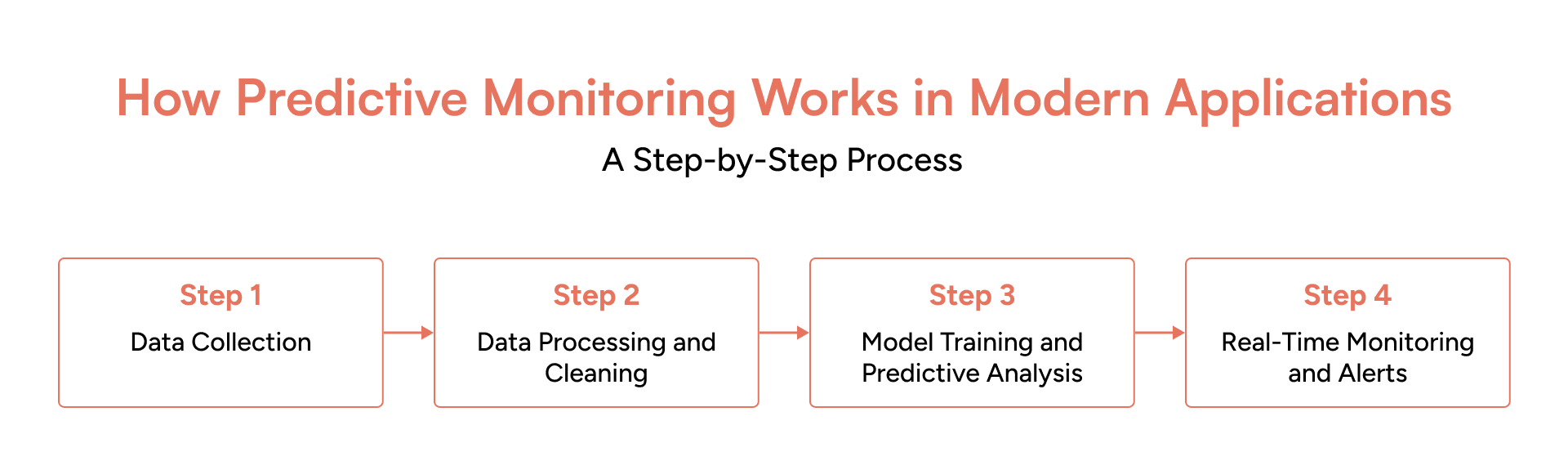
Step 1: Data Collection
Timeline: 1–2 weeks for instrumentation and pipeline setup.
Instrumentation begins at the client level with SDKs and OpenTelemetry embedded in iOS, Android, and web apps. These capture response times, error logs, crashes, and user actions. On the backend, event pipelines such as Kafka or Kinesis ingest logs from servers, APIs, and cloud services. Observability platforms like Datadog, New Relic, or Grafana unify this data into dashboards. This architecture connects front-end behavior to backend performance and creates a complete baseline for analysis.
Step 2: Data Processing and Cleaning
Timeline: 1–2 weeks to build cleansing pipelines and validation checks.
Raw data carries noise, gaps, and duplication. Teams apply normalization and filtering inside data lakes or warehouses before creating a curated feature store. Techniques such as outlier detection, enrichment, and schema validation ensure models receive clean inputs. Strong governance at this stage prevents false alerts later.
Step 3: Model Training and Predictive Analysis
Timeline: 2–4 weeks for initial training and validation.
Machine learning algorithms such as XGBoost, TensorFlow, or cloud AI services like AWS SageMaker and GCP Vertex AI train on historical incidents and usage patterns. Models learn to spot signals that precede latency spikes, error surges, or churn. With MLOps tools such as MLflow or Kubeflow, models are validated, tuned, and deployed. Continuous retraining keeps predictions aligned with evolving usage.
Step 4: Real-Time Monitoring and Alerts
Timeline: 1–2 weeks to integrate alerts into ITSM and incident workflows.
Once deployed, models monitor live telemetry streams in real time. Anomalies — rising error rates, abnormal response times, or traffic surges — trigger alerts in ITSM tools like ServiceNow or Jira. On-call platforms such as PagerDuty or Opsgenie route notifications instantly, while automated playbooks execute fixes where possible. This closes the loop between detection and resolution.
This step-by-step framework makes predictive monitoring actionable. It begins with instrumentation, matures through clean data and trained models, and delivers real-time alerts that reduce MTTR, increase uptime, and protect compliance.
Why Choose AI-Powered Predictive App Maintenance
Predictive monitoring in application support goes beyond efficiency — it creates measurable business outcomes that reactive and preventive models cannot deliver.
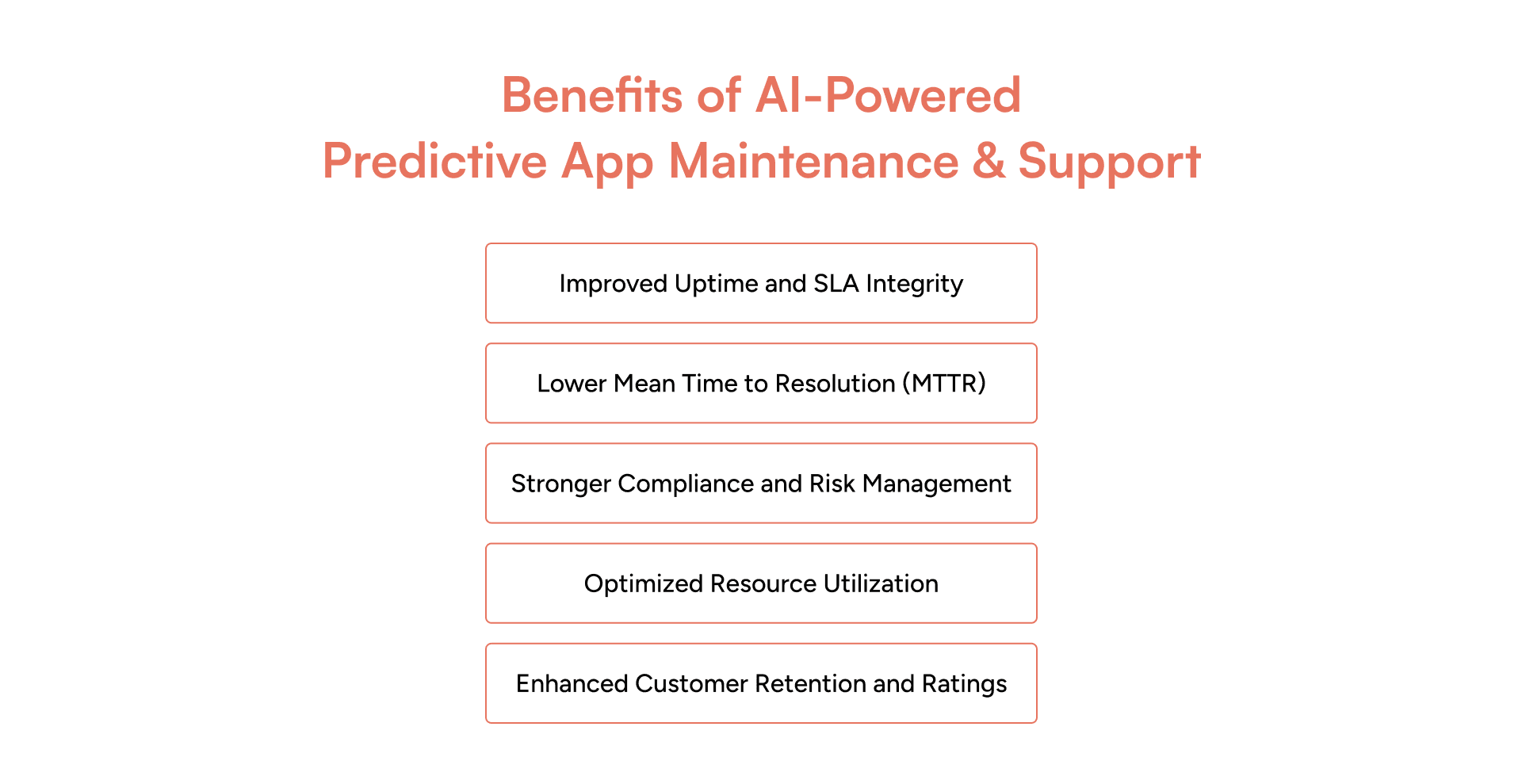
1. Improved Uptime and SLA Integrity
AI-driven foresight reduces unplanned outages by up to 90%, ensuring that mission-critical systems in finance, healthcare, and retail remain online without disruption.
2. Lower Mean Time to Resolution (MTTR)
Machine learning models accelerate root cause analysis, cutting MTTR by as much as 60%. Faster recovery translates into uninterrupted trading sessions, seamless patient consultations, and smoother digital transactions.
3. Stronger Compliance and Risk Management
By preventing failures before they occur, predictive monitoring minimizes the risk of SLA penalties, compliance violations, and regulatory scrutiny, especially under frameworks like HIPAA and CCPA.
4. Optimized Resource Utilization
Instead of premature maintenance or emergency fixes, predictive insights enable precise interventions. Enterprises conserve engineering resources and reduce infrastructure overhead.
5. Enhanced Customer Retention and Ratings
Users experience fewer errors, lower latency, and more reliable performance. This stability builds digital trust, improves app store ratings, and reduces churn by up to 15%.
Essential Tech Stack for Predictive Monitoring
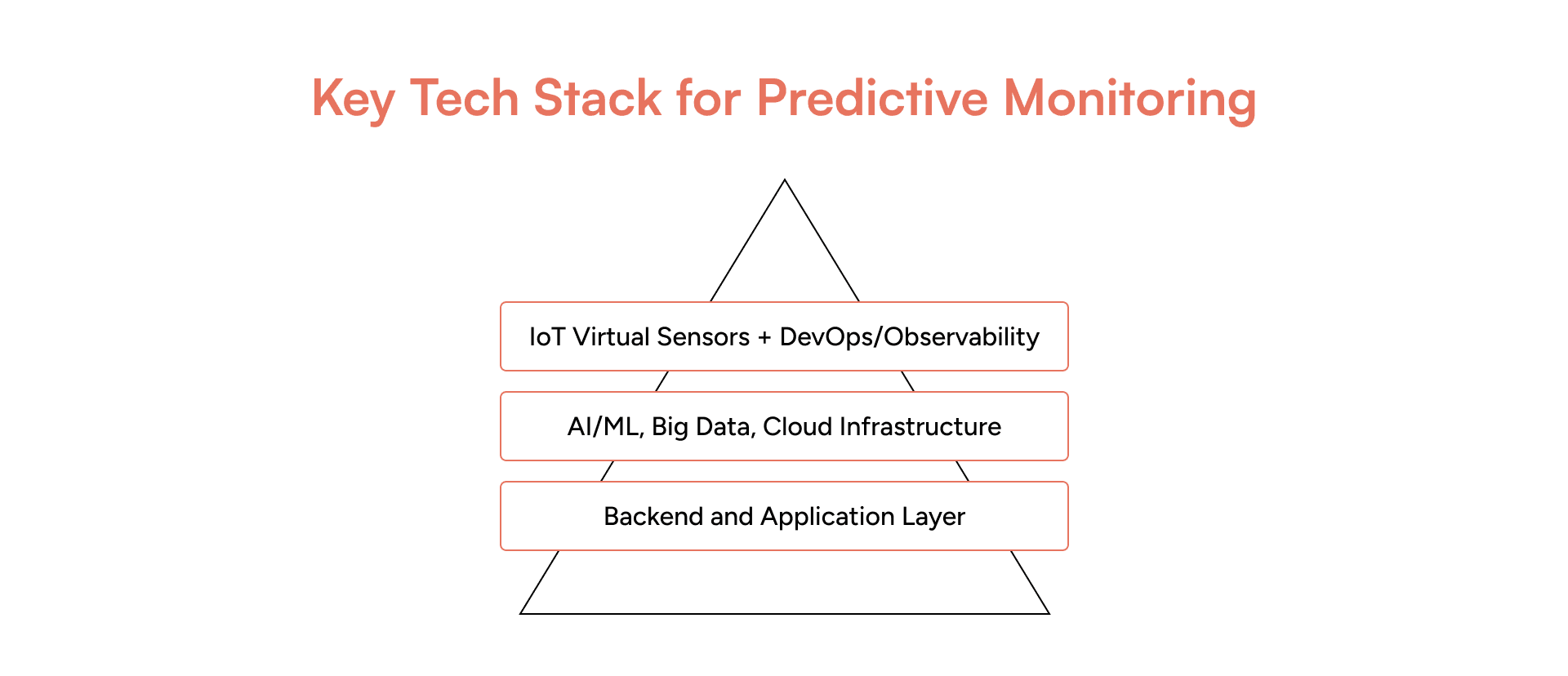
Predictive monitoring thrives only when technology layers work in unison. Modern enterprises cannot rely on algorithms alone; they need a full-stack approach that connects backend systems, cloud infrastructure, data pipelines, AI engines, and DevOps workflows. This integrated stack turns raw telemetry into reliable foresight.
1. Backend and Application Layer
The foundation sits in the backend. Microservices, APIs, and containerized services power modern applications, generating the operational signals that predictive monitoring consumes. Frameworks like Node.js, Python, and Java build the logic, while container technologies such as Docker and Kubernetes provide scalability. Properly instrumented, these services supply the heartbeat data, such as latency, request failures, and throughput, that monitoring models depend on.
2. AI and Machine Learning
Machine learning is the decision engine of predictive monitoring. Supervised models recognize patterns that led to past failures, while unsupervised models uncover anomalies never before documented. Reinforcement learning adapts decisions over time, refining maintenance actions as environments change. Models range from Random Forests and Neural Networks to Time Series predictors and NLP classifiers that parse logs or user feedback. With MLOps platforms like MLflow or Kubeflow, these models remain accurate, scalable, and continuously updated.
3. Big Data and Analytics
Applications generate volumes of logs, metrics, and user interactions measured in terabytes. Platforms such as Apache Spark and Hadoop process this flow, while data warehouses and feature stores structure it for analysis. Predictive algorithms then convert the stream into trend forecasts and early warnings. The ability to work with both structured telemetry and unstructured text makes big data analytics essential for predictive monitoring at enterprise scale.
4. Cloud Infrastructure
Predictive monitoring gains resilience from cloud-native services. AWS CloudWatch, Azure Monitor, and Google Operations Suite deliver deep visibility, while cloud AI platforms like SageMaker and Vertex AI accelerate model training. Elastic scaling ensures that monitoring keeps pace with unpredictable demand. Multi-region deployments safeguard uptime and align with U.S. enterprises’ SLA commitments.
5. IoT-Inspired Virtual Sensors
In physical industries, IoT sensors track temperature or vibration. In applications, the equivalent lies in “virtual sensors”—response times, API throughput, database latency, CPU and memory utilization, and user click paths. These signals provide a 24/7 feed of system health. By treating every log line and interaction as a sensor, enterprises create a live map of performance that models can interpret in real time.
6. DevOps and Observability
DevOps practices close the loop between detection and response. CI/CD pipelines push monitoring hooks with every release. Observability stacks—Prometheus, Grafana, Datadog, ELK—visualize live conditions. Alerting systems like PagerDuty and Opsgenie route incidents instantly. Integration with ITSM platforms such as ServiceNow ensures no anomaly is left unresolved. This layer ensures predictive monitoring does not stop at insight but drives immediate action.
How Does Predictive Monitoring Support U.S. Security and Compliance Requirements?
Predictive monitoring delivers little value if it ignores compliance. The U.S. privacy landscape is fragmented, from California’s CCPA/CPRA to HIPAA in healthcare, and every framework raises the stakes for how data is collected and processed. Enterprises must disclose what they track, give users clear opt-outs, and protect sensitive records under strict audit scrutiny.
This makes security certifications more than a box to tick. ISO 27001 and SOC 2 validate that systems safeguard data at scale. The NIST Cybersecurity Framework provides a structured lens for risk management. HIPAA brings the sharpest edge of accountability, where a single misstep in handling health data can result in severe penalties.
For application leaders, predictive monitoring aligned with these standards does more than prevent downtime. It preserves trust, ensures SLA integrity, and keeps enterprises on the right side of regulators. In a market where resilience and compliance carry equal weight, predictive monitoring must operate as both watchdog and guardian.
Key Challenges in Adopting Predictive Monitoring in the U.S.
Adopting AI-powered predictive monitoring in U.S. enterprises promises fewer outages and stronger customer trust. Yet the path is not straightforward. The hurdles involve data, integration, skills, culture, and costs. Success lies in tackling each challenge with targeted solutions.
1. Data Quality and Availability
Challenge: Enterprises generate massive datasets, but much of it is messy, inconsistent, or incomplete. Poor-quality data leads to false alerts and unreliable predictions.
Solution: Establish strong data governance from day one. Build cleaning pipelines, enforce validation checks, and deploy anomaly detection to ensure only reliable data powers AI models.
2. Integration with Legacy Systems
Challenge: Many U.S. enterprises still rely on decades-old IT systems that cannot easily interact with modern AI platforms. This slows projects and increases risk.
Solution: Take an incremental approach. Start small with APIs and middleware, bridge systems step by step, and use cloud-based AI to process workloads without overloading legacy infrastructure.
3. Scalability at Enterprise Scale
Challenge: Monitoring millions of real-time signals across apps pushes infrastructure and algorithms to the limit. Costs rise quickly when systems are not designed to scale.
Solution: Adopt cloud-native infrastructure. Use containerization with Docker, orchestration with Kubernetes, and optimized algorithms to ensure elasticity without cost spirals.
4. AI Skills Gap
Challenge: Over 60% of U.S. predictive monitoring pilots stall because organizations lack skilled data scientists, ML engineers, or domain experts.
Solution: Invest in structured upskilling programs. Partner with AI consultants for a head start, while building internal teams for long-term sustainability.
5. Cultural Resistance
Challenge: Employees often distrust AI or resist workflows that disrupt established habits. This leads to poor adoption despite technical success.
Solution: Drive transparency from leadership. Position AI as an enabler. Involve teams early in pilots, encourage feedback, and frame predictive monitoring as a shared achievement.
For U.S. enterprises, predictive monitoring is less about deploying algorithms and more about addressing human, financial, and infrastructure realities. Those who succeed start with clean data, modernize integrations step by step, invest in people, and plan costs with precision. AI delivers the most value not when it predicts failure, but when it reshapes trust in digital reliability.
Industry Use Cases for AI-Powered Predictive Monitoring
To illustrate the real-world impact of AI-powered predictive monitoring in app support, here are three studies showcasing challenges, solutions, and outcomes across industries.
1. Secure Storage Monitoring System
(Focus: IT infrastructure, data compliance, and secure storage environments)
Challenge: A storage solutions provider struggled to safeguard data centers against risks like temperature surges, humidity changes, and unauthorized access. Existing systems only triggered alarms after an incident occurred.
Solution: GeekyAnts developed an IoT-enabled monitoring system with AI-driven predictive alerts. By analyzing environmental patterns and access logs, the platform forecasted risks such as overheating or intrusion attempts before they escalated.
Outcome: The client minimized data loss risks and improved compliance readiness. Predictive insights helped operations teams act early, cutting emergency interventions by 40% and strengthening overall system resilience.
2. IoT Healthcare Solution for Athletes & Amputees
(Focus: Digital health, sports medicine, wearable IoT, patient care).
Challenge: Sports scientists and medical experts needed a reliable way to monitor hydration, exertion, and recovery patterns for amputees and athletes. Conventional methods only flagged problems after they became visible symptoms.
Solution: GeekyAnts built an IoT-powered healthcare platform that continuously tracked biometric data. Predictive models analyzed hydration levels and performance indicators to forecast potential fatigue, dehydration, or stress injuries.
Outcome: Athletes and patients received real-time alerts before conditions worsened. The system enabled predictive care, reducing the risk of injury while improving performance outcomes. For clinicians, the proactive insights supported more accurate treatment and rehabilitation planning.
3. Manufacturing Asset Management Dashboard
(Focus: Predictive monitoring, factory assets, equipment efficiency)
Challenge: A manufacturing client needed to oversee critical assets across multiple sites. Existing maintenance was reactive, with breakdowns leading to costly downtime and irregular servicing.
Solution: GeekyAnts designed a centralized asset management dashboard that captured IoT sensor data from equipment. AI models detected anomalies in vibration and temperature patterns, predicting failures before they occurred.
Outcome: The client reduced unplanned downtime by 30% and optimized spare-part usage. Predictive monitoring allowed maintenance teams to schedule interventions precisely when needed, boosting productivity and extending asset lifespans.
ROI and Cost Implications of AI-Powered Maintenance
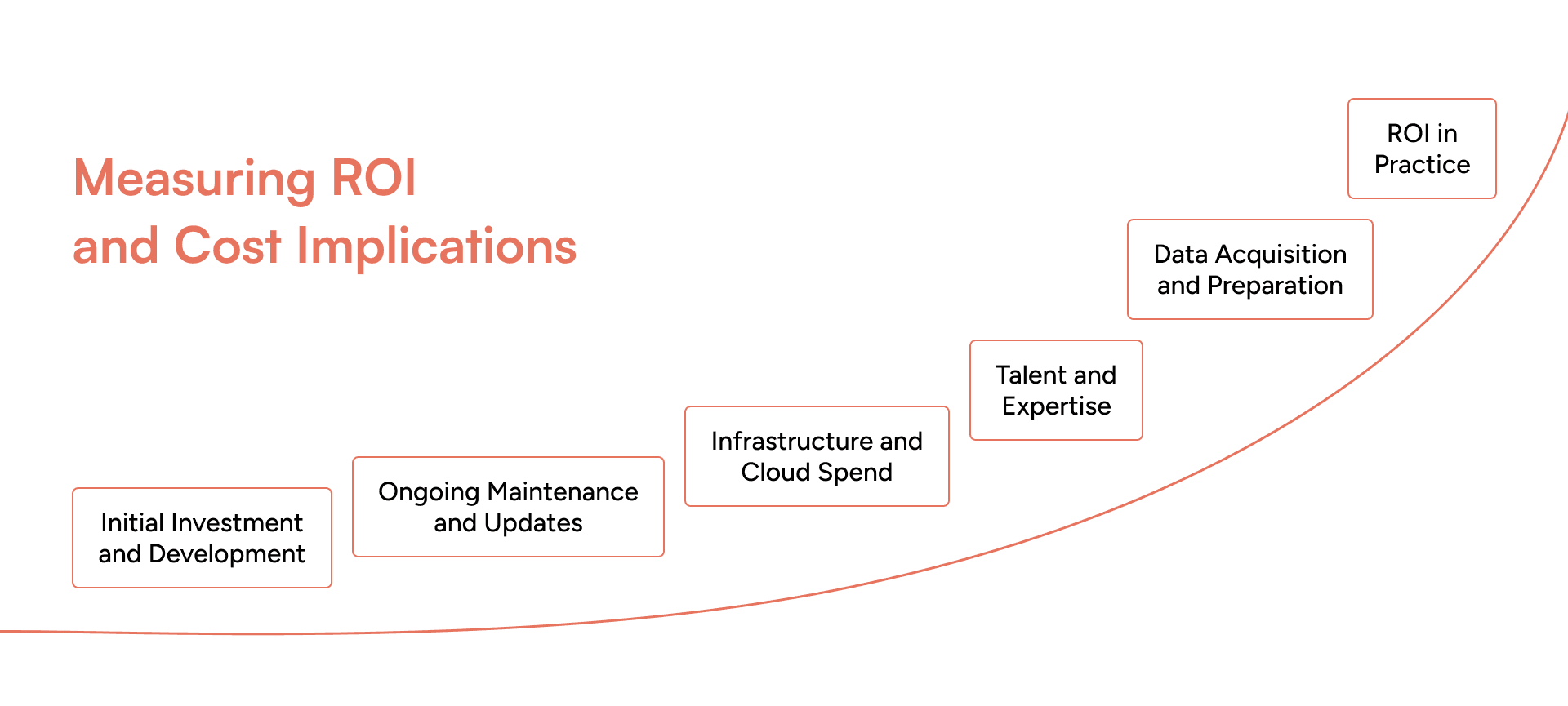
Adopting AI-powered predictive monitoring is as much a financial decision as it is a technical one. Leaders often focus on the upfront build, but true clarity comes when both cost layers and return are measured together.
1. Initial Investment and Development
Building predictive systems requires upfront spend on intelligent data pipelines, AI frameworks, and app development. Depending on scope, this can range from $40,000 for a streamlined model to $300,000 or more for enterprise-grade deployments. Native builds often fall between $20,000 and $150,000 per platform, while cross-platform projects land closer to $30,000 to $250,000. Adding deep AI or machine learning models pushes costs higher, often by $50,000 to $300,000.
2. Ongoing Maintenance and Updates
Models improve only when retrained on new data. That requires continuous tuning and platform updates, which usually cost 15–25% of the original build each year. Without this budget, predictive accuracy weakens, and business outcomes suffer.
3. Infrastructure and Cloud Spend
AI workloads demand GPU-rich compute, fast storage, and scalable network capacity. Whether hosted on Google Cloud, AWS, or on-premises, these costs scale with data volume. Leaders must weigh short-term cloud elasticity against long-term hardware investments.
4. Talent and Expertise
Building a predictive monitoring system is not possible without strong teams of data scientists, engineers, and domain experts. Recruiting, retaining, and training talent adds a recurring cost that is often underestimated but critical for sustained ROI.
5. Data Acquisition and Preparation
High-quality data is the fuel. Collecting, cleansing, and labeling large volumes of logs, metrics, and feedback is both labor-intensive and costly. Yet without this step, even the most advanced models will fail.
6. ROI in Practice
The return is measured in reduced downtime, fewer emergency interventions, and stronger customer trust. A mid-size manufacturer that invested $200,000 in predictive monitoring avoided nearly $2 million in unplanned losses within the first year, achieving a tenfold return. Similar multipliers have been observed across healthcare, fintech, and SaaS.
Why GeekyAnts for Predictive App Support?
Enterprises often face a common question: Why GeekyAnts? The answer lies in the depth of expertise and the ability to combine engineering precision with predictive intelligence.
Predictive maintenance is about engineering reliability at scale. At GeekyAnts, we not only monitor applications, but we also anticipate their needs. Our teams design systems that grow smarter with every interaction, ensuring our clients remain a step ahead.
Saurabh SahuChief Technology Officer (CTO)GeekyAnts has delivered predictive monitoring solutions across industries, from IoT-enabled healthcare platforms to AI-powered asset management dashboards. Each engagement reflects domain expertise, a strong focus on resilience, and measurable outcomes for clients.
GeekyAnts, one of the leading app maintenance and support companies in the USA, builds predictive systems that enhance reliability, optimize costs, and safeguard long-term application performance.
Conclusion: The Future of AI-Powered App Maintenance
The future of app maintenance is predictive. AI-powered monitoring is shifting the paradigm from reactive firefighting to anticipatory resilience. Applications of tomorrow will not only self-diagnose but also self-heal, reducing downtime while improving user trust.
Industries as diverse as fintech, healthcare, manufacturing, and SaaS are already reaping the benefits of predictive insights. The next phase lies in automation, where predictive signals trigger autonomous responses, further reducing human intervention while increasing precision.
For businesses, the strategic imperative is clear: invest in predictive monitoring now to build systems that stand the test of scale, complexity, and rising customer expectations. GeekyAnts remains committed to shaping this future, ensuring enterprises unlock reliability, efficiency, and growth from their applications.