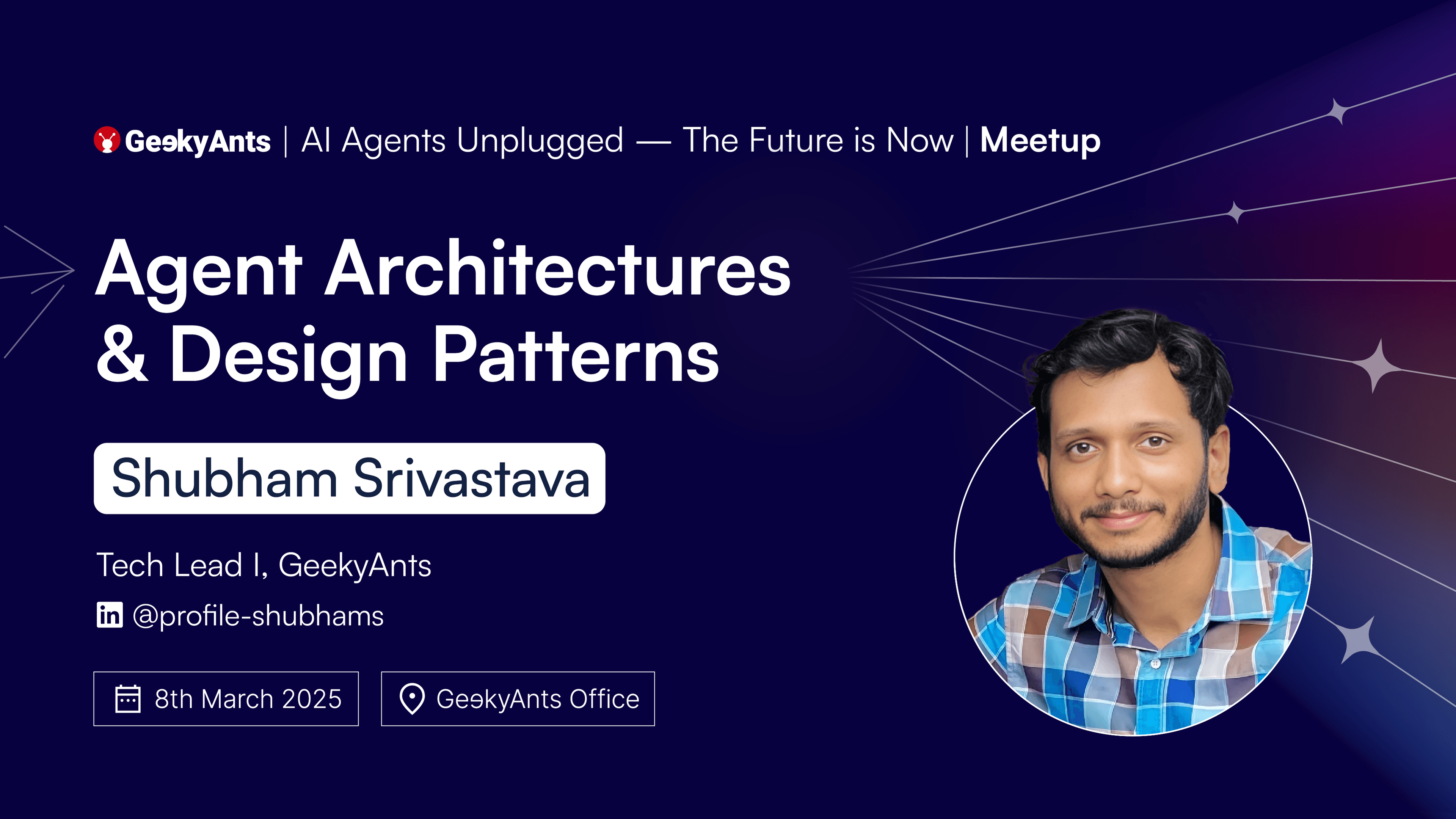

Editor’s Note: This blog is an adapted narrative based on insights shared by Shubham Shrivastava, Tech Lead at GeekyAnts, during an internal knowledge session. While refined for clarity, it reflects his deep dive into AI agents and their real-world applications.
AI systems have long been praised for their efficiency, but most remain confined to static, rule-based operations. They follow predefined logic, execute repetitive tasks, and struggle with complex, real-world decision-making. In high-stakes environments, adaptability, context-awareness, and independent reasoning are key. Traditional AI often falls short in these areas. These limitations create inefficiencies, slow down automation, and demand constant human intervention.
AI agents are changing this equation. Designed to think, analyze, and act autonomously, they integrate Large Language Models (LLMs), memory retention, and tool execution to handle dynamic workflows with precision. More than assistants, these agents are decision-makers capable of optimizing processes, learning from interactions, and automating tasks at an unprecedented scale. This blog explores their architecture, design patterns, and how they are reshaping industries.
AI Agents: Beyond Traditional AI Models
What Are AI Agents?
AI agents are intelligent software systems designed to think, decide, and act autonomously. Unlike traditional AI models that operate within predefined rules, AI agents leverage Large Language Models (LLMs), memory retention, and function execution to process information dynamically and take real-time actions.
As Shubham Shrivastava, Tech Lead at GeekyAnts, highlighted in his speech, AI agents are more than conversational interfaces. They are decision-making systems capable of analyzing data, executing tasks, and refining outputs without human intervention. Their ability to learn from interactions, optimize workflows, and drive automation positions them as a transformative force in modern business intelligence.
How Do AI Agents Differ from Traditional AI?
Feature | Traditional AI Models | AI Agents |
Decision-making | Static, rule-based | Adaptive, real-time |
Context retention | Limited | Persistent memory |
Task execution | Predefined logic | Dynamic function calls |
User Interaction | Passive (responds to input) | Proactive (takes action) |
For instance, a traditional AI-based chatbot answers customer queries based on predefined scripts. In contrast, an AI agent-powered assistant can analyze previous interactions, fetch user data, and suggest solutions dynamically—mimicking human decision-making.
The Four Pillars of AI Agent Architecture
AI agents function autonomously by integrating four core components, each essential for intelligent decision-making, contextual understanding, and task execution.
Large Language Model (LLM) – The Brain
An LLM serves as the cognitive core of an AI agent, enabling it to process inputs, generate responses, and reason through complex scenarios. Beyond simple text generation, LLMs analyze patterns, infer insights, and execute decisions based on real-time data. Whether answering queries or generating reports, this component ensures that AI agents respond intelligently and adaptively.
Memory – Context Retention
Unlike traditional AI models that forget past interactions, AI agents use persistent memory to maintain context, ensuring continuity and personalized decision-making. For example, an AI-powered financial assistant learns from spending habits, identifies patterns, and provides smarter financial recommendations, enhancing user experience over time.
Tools – Function Execution
AI agents extend beyond data processing by integrating with external tools, APIs, and databases to automate real-world tasks. A calendar management AI, for instance, does not just suggest time slots—it analyzes schedules, detects conflicts, and autonomously organizes meetings, eliminating manual intervention.
Prompt – Defining the Agent’s Persona
Every AI agent operates based on a predefined persona, determined through structured prompts that shape behavior, tone, and response patterns. This ensures that AI agents align with specific business needs—whether as a research assistant, customer support agent, or operations manager—maintaining consistency and reliability in execution.
By integrating these components, AI agents do not just automate workflows; they mimic human decision-making, optimize processes, and drive intelligent business operations.
AI Agent Design Patterns: The Blueprint for Autonomous Decision-Making
AI agents follow structured design patterns that enhance their decision-making, optimize automation, and enable them to handle complex workflows with precision. These patterns define how AI agents interact, learn, and execute tasks independently.
Reflection – AI Learns From Itself
AI agents can self-improve by using multiple LLMs to refine outputs iteratively. One LLM writes code, while another reviews and enhances it, ensuring higher accuracy and efficiency without human intervention. This process significantly reduces errors (by 30-50%) and accelerates software development, making AI-driven coding tools indispensable for engineering teams.
Tool Calling – Smarter Task Automation
Beyond passive data processing, AI agents actively execute tasks by integrating with external tools, APIs, and databases. For example, an AI-powered legal assistant can retrieve case laws, draft contracts, and summarize legal documents autonomously. This same approach enhances customer service, where AI agents dynamically pull records, analyze queries, and generate precise responses—reducing response times and improving customer experience.
Planning – AI as a Task Manager
AI agents don’t just complete tasks—they plan and structure them into smaller, executable steps. A supply chain AI, for instance, can analyze procurement needs, optimize inventory, and automate logistics, ensuring seamless operations. Hugging Face’s research demonstrates how AI can generate text, images, and audio in structured workflows, proving that AI agents can orchestrate complex, multi-step tasks efficiently.
Multi-Agent Collaboration – AI Teams at Work
Instead of a single AI handling everything, specialized AI agents collaborate like a well-coordinated team. In content creation, one AI researches topics, another writes drafts, and a third proofreads and refines. This multi-agent collaboration model is also transforming R&D, where AI teams accelerate product innovation by breaking down challenges, iterating solutions, and streamlining execution—reducing time-to-market for new developments.
By leveraging these design patterns, AI agents move beyond simple automation to become adaptive, decision-making systems that optimize workflows, enhance productivity, and drive innovation across industries.
AI Agents in Business: Real-World Applications
AI agents are transforming industries by automating complex workflows:
- Finance: Algorithmic trading, fraud detection, investment advisory.
- Healthcare: Diagnostic AI agents assisting in medical imaging and patient triage.
- Operations: HR automation, IT support, and workflow management.
According to industry reports, businesses using AI agents report 20-40% higher operational efficiency.
The Future of AI Agents: What’s Next?
AI agents are evolving from automation tools to intelligent decision-makers, capable of adapting to fast-changing business environments. Advances in real-time reasoning will allow them to process live data, anticipate challenges, and optimize responses instantly. However, in high-stakes fields like finance, healthcare, and security, human-in-the-loop (HITL) AI will remain essential, ensuring oversight and accountability in decision-making. As enterprises scale AI adoption, industry forecasts suggest AI-driven automation will contribute over $15 trillion to the global economy by 2027, solidifying AI agents as critical enablers of innovation and operational efficiency.
Conclusion
AI agents are more than automation tools—they are intelligent decision-makers transforming business operations. By integrating real-time reasoning, contextual memory, and dynamic execution, they overcome the limitations of traditional AI, driving efficiency, scalability, and innovation. From self-learning models to multi-agent collaboration, AI is redefining workflows, accelerating productivity, and enabling businesses to operate with unparalleled autonomy. As industries evolve, companies that leverage AI-driven automation will lead the next phase of digital transformation.
Looking to integrate AI agents into your business? Partner with GeekyAnts to stay ahead.