
Enterprise generative AI spending has broken all historical records. Yet, recent data from MIT’s Project NANDA reveals that 95 percent of generative AI pilots deliver zero measurable profit and loss impact.
Additional research from IDC shows that only four out of every 33 artificial intelligence proofs of concept ever reach production. This massive gap between investment and value is a failure of operational design.
Many corporate executive boards approved early AI budgets on pure faith. Now, the bill has come due, and Chief Financial Officers are rightfully demanding structural proof of value.
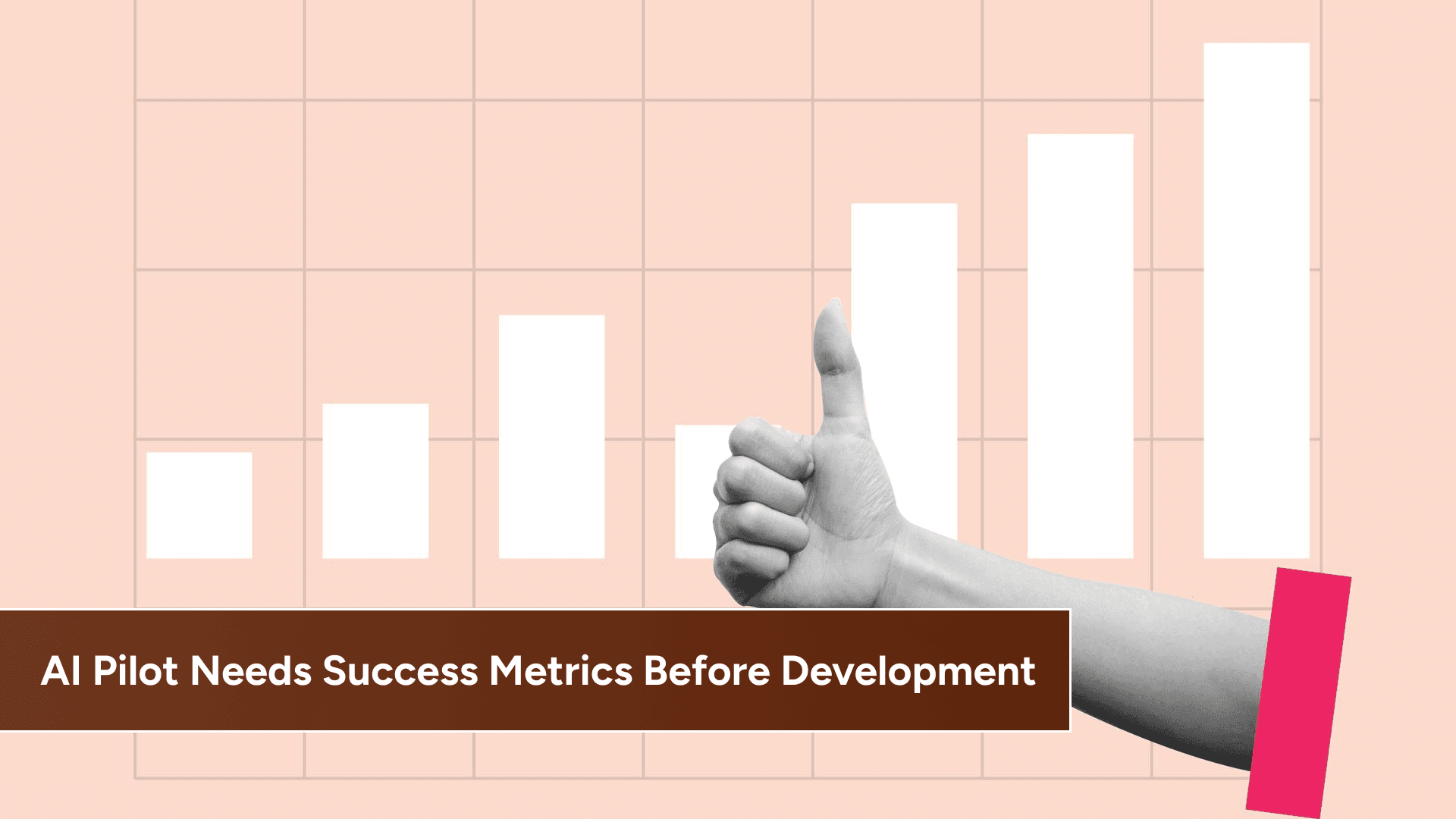
To bridge this gap, your leadership team must understand a fundamental truth. An AI pilot will inevitably fail to scale if your organization does not establish concrete success metrics before a single line of code is written.
The Trap of the Tech-First Mindset
Most failed AI projects start with an aspirational goal focused entirely on what the technology can do. Technology teams often select a trendy tool first and then search for a corporate problem to solve with it. This approach creates impressive software demonstrations but generates zero actual business value.
A pilot designed purely to show that AI is capable of a task will always succeed in an isolated test environment. However, isolated test environments bypass your legacy enterprise resource planning systems and your data governance policies. When that ungrounded pilot finally moves toward production, it hits the reality of your data infrastructure and quickly collapses. The RAND Corporation reports that over 80 percent of AI initiatives fail to deliver their intended value, which is double the failure rate of traditional corporate technology projects.
You cannot fix this issue by purchasing a more advanced machine learning model. You fix this issue by establishing rigorous operational constraints before your development lifecycle begins.
Defining Value Before Development
True production readiness means defining your economic destination at the very beginning of the journey. A mandate to "use AI to improve customer service" is a strategy that has already failed.
Conversely, a mandate to "reduce average customer ticket resolution time from 47 minutes to under 25 minutes for tier-one issues" gives your engineering team a fighting chance. Pre-defined metrics serve as an architectural forcing function for your data teams.
When you establish clear targets early, you force your developers to build the necessary data pipelines and integration layers immediately. Gartner predicts that by the end of this year, organizations will abandon 60 percent of AI projects due to a lack of AI-ready data infrastructure.
When you set your Key Performance Indicators first, your teams are forced to clean and connect the relevant databases before running the pilot. This operational discipline ensures that you are running your tests on real, production-grade information rather than perfectly curated sample data. Furthermore, clear metrics allow you to accurately calculate the total cost of ownership at scale.
Production-level AI environments routinely run three to five times higher than initial pilot budget projections due to intense computing demands. If you do not know the exact financial value of the process efficiency you are gaining, you cannot calculate whether the production computing costs will destroy your profit margins.
The Four Levels of Executive Measurement
To ensure your next AI investment graduates into a scalable enterprise capability, you must avoid tracking legacy metrics that do not reflect modern automated workflows.
A highly effective performance framework requires balancing your tracking across four distinct operational levels.
Measurement Level | Core Focus Area | Representative Executive Metric |
|---|---|---|
Level 1: Capability | Workforce readiness and tool trust | Employee adoption rates and weekly problems solved |
Level 2: Process | Operational velocity and systemic quality | Workflow cycle times and automated defect rates |
Level 3: Experience | External and internal stakeholder impact | Net Promoter Scores and immediate response times |
Level 4: Financial | Absolute bottom-line business returns | Direct cost reductions and net margin improvements |
If your executive dashboard contains only Level 4 financial metrics, you are looking backward at lagging indicators rather than managing current drivers.
You must focus heavily on Level 2 process metrics because those are the precise operational levers that your leadership team can directly influence.
Shifting From Experimentation to Execution
The era of funding AI experiments for the sake of corporate novelty is officially over.
Organizations that successfully cross the pilot-to-production gap treat AI as a core business transformation, not as a standalone IT project. They build cross-functional ownership by involving business unit leaders, legal compliance officers, and end-users on day one.
They also realize that technology only accounts for a small portion of the total value, while the remaining majority relies entirely on process redesign and workforce training. If your team cannot clearly articulate how a pilot's success will alter your profit and loss statement, you should pause the project.
Spending capital to optimize a business process that does not drive meaningful corporate outcomes is a waste of scarce resources. Anchor your very first AI pilot to a major cost center, an active revenue driver, or a critical customer satisfaction metric.
By enforcing rigorous, pre-development measurement, you protect your capital, maintain organizational momentum, and position your company within the profitable minority of enterprise AI leaders.