

A prospect evaluating a software development partner may want to speak with a company that has worked with the team before. A reference call can help answer practical questions about delivery, communication, technical capability, and the working relationship.
GeekyAnts handles client-reference requests on a case-by-case basis. There is no standing list of clients available for reference calls. Sales and Account Management assess each request against the prospect’s project, the existing client relationship, contractual terms, and client consent.
This process gives qualified prospects access to useful project evidence while protecting client time, confidential information, and contractual commitments.
Which GeekyAnts Clients Can Provide a Reference?
The strongest reference comes from a client whose engagement has a clear connection to the prospect’s requirements.
Consider a company planning a financial platform with a dedicated engineering team. A client with experience in a related domain, delivery model, project scale, or technology can provide context that matches the planned engagement. Brand recognition carries less value when the projects have little in common.
GeekyAnts considers factors such as:
- Industry and business domain
- Technology used in the project
- Engagement model
- Project size and scope
- Geography
- Relationship health
- Project outcomes
- Client interest and availability
Reference participation remains voluntary. GeekyAnts seeks client consent for each proposed introduction.
The sales stage shapes the value of the call. A prospect gains the most from a reference after reviewing GeekyAnts’ capabilities, proposal, relevant case studies, and commercial fit. At that stage, the conversation can focus on specific questions that remain before a decision.
This protects clients from reference requests during early discovery and gives the prospect a clearer reason for the conversation.
How Does the GeekyAnts Client-Reference Process Work?
The process begins with a qualified opportunity and a clear purpose for the reference request.
Sales and the Account Manager identify an engagement that matches the prospect’s needs. They consider project relevance, relationship health, client willingness, and the terms that govern the engagement.
A reference request can follow this path:
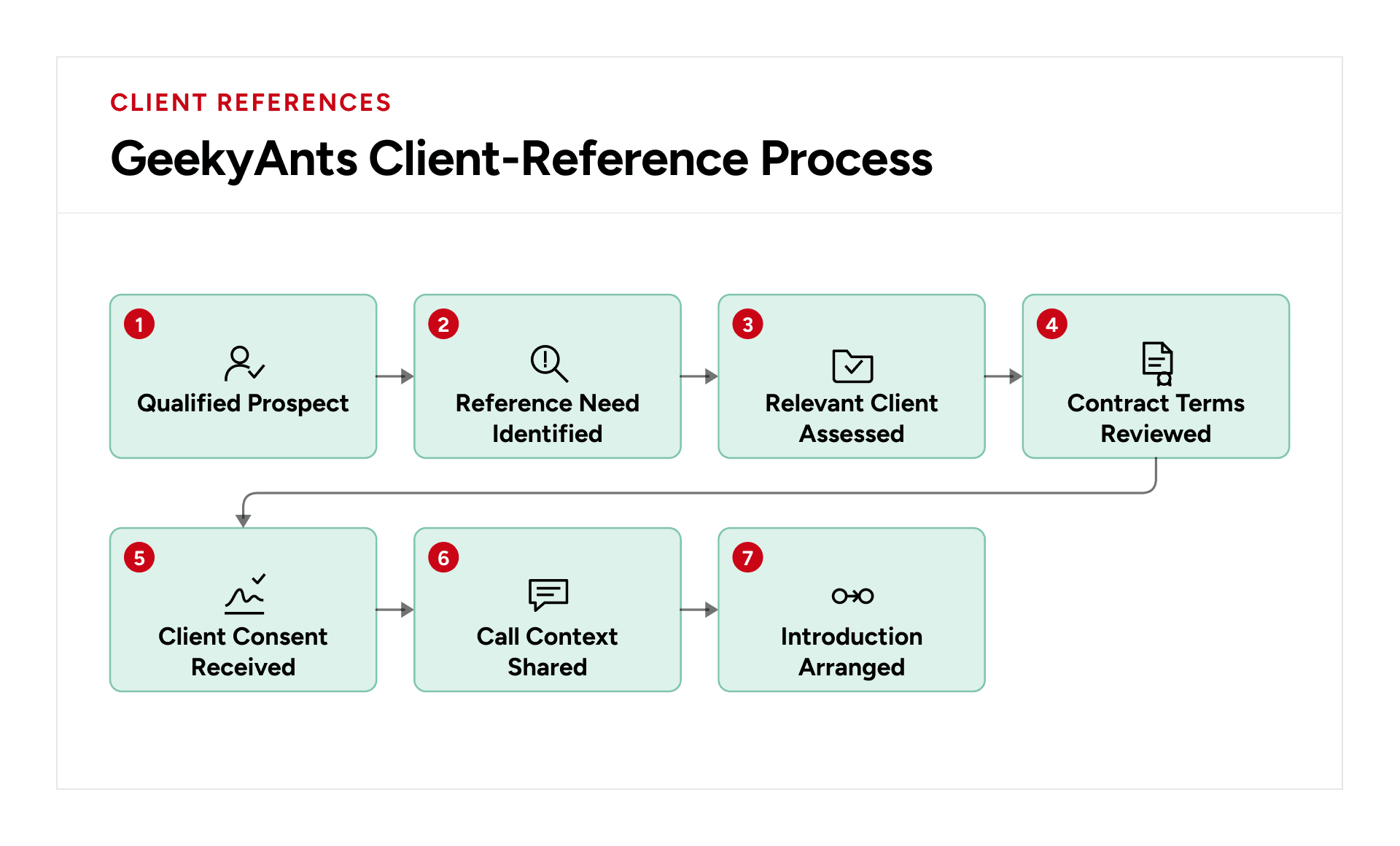
The client receives context about the prospect, the purpose of the conversation, the expected duration, and the broad subjects that may come up.
This step creates a defined scope for both sides. The prospect knows what the conversation is meant to cover, and the existing client knows what has been requested.
The introduction includes only the information needed to set up the conversation, without unnecessary commercial or confidential details from the prospect or the existing client.
The reference call forms one part of the evaluation process. Proposals, technical discussions, case studies, solution walkthroughs, and commercial reviews answer other questions. A reference has the most value when the prospect wants evidence about delivery experience or the working relationship.
How Do NDAs and Client Permissions Shape Reference Calls?
Every reference request must follow the agreements that govern the client engagement.
These can include a Non-Disclosure Agreement (NDA), Master Services Agreement (MSA), Statement of Work (SOW), and project-specific confidentiality terms. These agreements define what GeekyAnts can share and what must remain protected.
Restricted information may include:
- Business or product metrics
- System architecture
- Product roadmaps
- Intellectual property
- Internal processes
- Sensitive project information
Public use of a client name does not authorize a reference conversation. GeekyAnts seeks appropriate consent before arranging the introduction.
Some engagements need stricter controls. These can include BFSI and FinTech projects, healthcare products, government and public-sector work, internal enterprise platforms, white-labeled products, and projects involving sensitive data or intellectual property.
Certain confidentiality terms can restrict disclosure of the engagement itself. In such cases, the reference process has to stay within those boundaries.
The purpose is simple. Prospects should receive evidence they can use for evaluation, while existing clients retain control over information connected with their engagement.
What Can a Prospect Review if a Client Reference Is Unavailable?
When a direct client-reference call is unavailable, prospects can assess GeekyAnts' experience through published case studies, verified client reviews, and technical demonstrations.
GeekyAnts has worked with clients across FinTech, healthcare, e-commerce, education, manufacturing, travel and hospitality, and other industries. Our case studies cover projects across these sectors, including the business challenges, engineering approaches, and outcomes that clients have approved for publication.
Our Clutch reviews provide another source of client feedback. These verified reviews serve as client-reference evidence, giving prospects insight into GeekyAnts' delivery quality, communication, project management, and client relationships through feedback from past clients. They offer firsthand accounts of working with GeekyAnts without requiring a direct introduction.
For engagements with confidentiality restrictions, GeekyAnts can share anonymized project examples, relevant case studies, or capability demonstrations within the permitted scope. A prospect evaluating technical expertise can review a solution walkthrough, while one assessing delivery experience can refer to client reviews and project outcomes.
These resources help prospects evaluate GeekyAnts' experience while respecting existing client agreements and confidentiality commitments.
This approach keeps the evaluation focused on the information needed for the buying decision.
How GeekyAnts Handles Client References
GeekyAnts treats client references as part of a qualified sales process. The choice of reference depends on project relevance, relationship health, contractual permissions, client consent, and availability.
Sales and Account Management can coordinate an introduction when a suitable client agrees to take part. If confidentiality terms or client preference prevent a call, case studies, verified reviews, anonymized project examples, and solution walkthroughs can support the evaluation.
For companies considering GeekyAnts for a software development engagement, the process starts with the evidence needed to make the decision. The team can then identify the reference format that fits the project and the stage of evaluation.