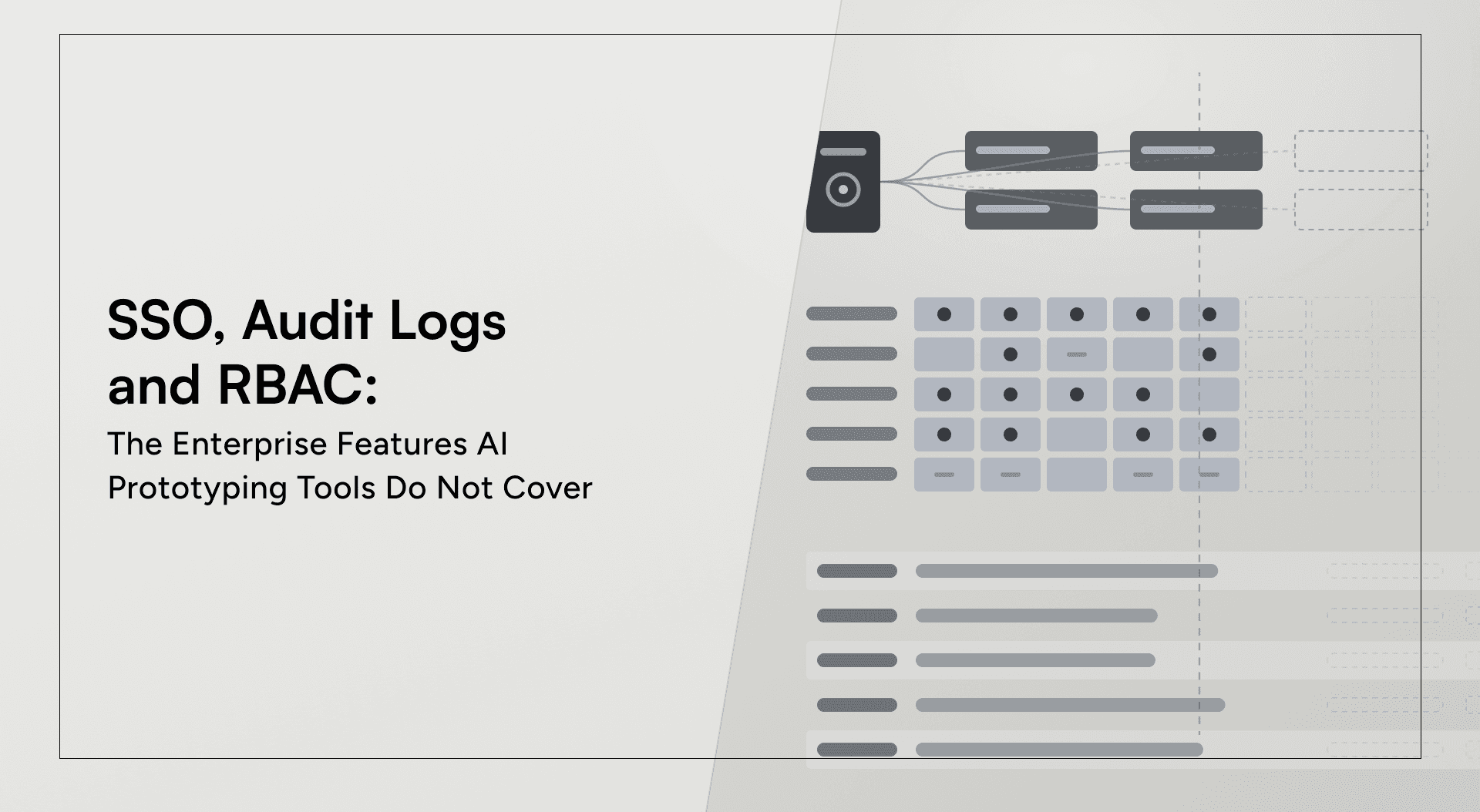

AI prototyping tools build a working application in minutes. They do not build the features an enterprise buyer checks before signing: single sign-on, audit logs, and role-based access control.
The gap shows up late, usually after the demo has already won the room. In this episode of the AI Thoughtmakers podcast, host Prem speaks with Sarika, V P Engineering at GeekyAnts, about why these three features stay out of reach for AI tools and what it costs teams who ship without them.
Watch the full episode here:
The write-up below covers the same ground if you would rather read it.
Why do AI Tools Stop Short of Enterprise Features?
Two reasons: complexity and security.
These features describe how an organization works. Every company defines its own roles, its own access levels, and its own rules about who sees what. That information lives inside the organization, and an AI tool has no access to it.
So the output matches the input. Give a tool a simple instruction and you get a generic module back. The context that makes the implementation correct: role structure, access levels, employee strength - never reaches it.
Why is SSO so Difficult to Generate?
One Login, Many Access Levels
Single sign-on lets a person log in once and carry that session into services that are otherwise unrelated. However, logging in is simple.
The complexity starts after it, because different services can grant different access levels to the same login. Mapping that correctly requires knowing what each service does and who in the company should reach it.
SSO and RBAC are the Same Problem
Single sign-on carries the identity. Role-based access control decides what the identity can do. A person authorized for multiple roles inherits overlapping access, and the overlap has to resolve predictably.
In a company with significant employee strength, the number of roles and access levels grows with the structure. What looks like a login screen is an architecture decision.
Why are Audit Logs always an Afterthought?
Audit logs are the most ignored feature on the list.
Why Teams cut Them
Budget or go-to-market pressure. An owner looking at the feature list decides logging can wait, because nothing visibly breaks without it. It carries no demo value, so it loses to whatever does.
What you Lose Without Them
The issue becomes hard to trace. You go by whatever the reporter tells you, and no evidence exists to say definitively what caused it.
CCTV works as the comparison here. Cameras do not stop anything on their own, and they give you the record you need once something has happened. Audit logs do the same job for a product: they let you get back to the instance that triggered the issue.
Nobody asks for audit logs until something goes wrong. Teams do not realize the need before that.
What is Role Explosion?
How Access Actually Works
No individual gets access one-to-one. A role is defined first, that role carries access to a set of services, and people are assigned to the role.
The person in the role can change while the role stays the same, and someone moving to a new role picks up a different set of accesses.
Where the Numbers Get out of Hand
Take twenty distinct accesses in an organization. The number of roles you can build from the combinations of them runs far past what any team tracks by hand, and employees holding multiple roles add overlaps on top.
That is role explosion. Managing permissions turns into a product of its own.
How do Mature Companies Handle this?
The conventional approach puts a very experienced person on the design and runs it through multiple levels of review.
AI changes the first half. The base work gets generated quickly and saves real effort. The review does not go away- an expert still has to look at the output and refine it. For anything security-critical, that expert review stays mandatory. AI works as an assistant here, not an authority.
When does a Prototype Become a Liability?
Speed is the whole attraction. A prototype appears in minutes, presents well, and makes a strong pitch.
Production asks for different things: security, scalability, and the access features above. When none of them are checked, the prototype cannot go into production no matter how complete it looks.
Are these tools creating fake products? Yes and no. They produce applications that are aesthetically very presentable, which is exactly what you want for a quick pitch or for showing someone an idea. Assuming the same artifact reaches production in a short time is the mistake.
Investors have adjusted. The mistake was common early on. Enough failed cases have been visible since that buyers and investors now run their own due diligence before believing a demo.
Are we Heading for an AI Technical Debt Crisis?
In the conventional model, an unscalable system announced itself. Adding a feature meant heavy rework, the rework consumed developer time, and the effort was visible to everyone approving it.
An AI-generated system hides that signal. The tool absorbs the same rework at speed, often by regenerating the system completely, and what you see is burned tokens rather than a slipped schedule. Speed works as an advantage and a risk at the same time.
Who is Accountable?
The product owner, as the final decision maker. Skipping audit logs or postponing a real access model is a business decision with a known cost. Making it without assessing the risk is where teams get hurt.
Where do AI Dev Tools go From Here?
The direction looks bright, and capability is building fast.
Some time back, an AI model could look at an orange and identify it from shape and color, and the standard objection was that it could not smell one. There is now a field working on sensing chemical molecules and predicting smell from them. Capabilities that look fixed do not stay fixed, and these tools will keep moving toward autonomy.
The Rapid-Fire Round
The episode closes with a rapid-fire round, and the six answers compress the whole conversation into single lines.
- Slack's real strength? It is enterprise ready
- Okta in one word? Trust
- Most ignored feature? Audit logs
- Biggest AI myth? That it is always production ready
- SSO or passwords? SSO
Future of AI dev tools: bright, and moving toward autonomous systems
Two of those answers describe the same problem from opposite ends. Teams skip audit logs because nothing breaks without them, then assume the generated system is production ready. The bill for both arrives at the same time, usually during a security review.
What this Means for your Next Build
Slack did not win on features. It won because enterprises could trust it in their environment, and it addressed what enterprise readiness actually requires. Okta scaled on the same basis. Trust goes a long way, and it is the part AI still cannot generate for you.
Use AI prototyping tools for what they do well: build the pitch fast and test the idea early. Before that work moves toward production, bring in the access model, the logging, and the expert review.
Build fast if you can. Build right if you want to last.
That second part is where most teams need help. Getting the prototype to production means designing the access model, adding the audit trail, and putting an expert review in front of anything security-critical. It is engineering work, and it does not start after the demo- it starts when you decide the idea is worth building.
That is what our AI-Powered Product Engineering practice is built for: taking an idea from validation to a system that holds up in an enterprise security review. If your prototype is doing well in the room and you are not sure what it takes to ship it, talk to us.